
Guide
Does Jupi work? Ginger and turmeric at a fraction of the trial doses, plus electrolytes and vitamins
Quick answer
Does Jupi work? No trial has tested the powder. A scoop lists 250 mg of ginger root and 500 mg of turmeric root, below the 480 mg of ginger extract that improved symptom scores in an 80-person dyspepsia trial and the 750 mg to 2 g of turmeric used in trials of 78 to 206 people, and those trials measured dyspepsia, not bloating alone. A scoop also carries 400 mg of sodium and vitamin D at 250% of the Daily Value. Amazon shows 4.1 from 1,568 ratings, on a listing whose ingredient line is shorter than the brand’s current panel.
Jupi is a blood orange powder stirred into 8 to 12 ounces of water once a day. The page calls it Debloat & Hydration, the jar says Wellness & Hydration, and it combines a ginger-and-turmeric mix with electrolytes and vitamins C and D.
What Jupi is, and what it is not
One scoop is 6.3 g, and the jar is labeled about 30 servings. The panel lists, per scoop: organic turmeric root 500 mg, kiwi fruit 300 mg, organic ginger root 250 mg, baobab fruit 200 mg, papaya fruit 150 mg, organic apple cider vinegar 125 mg, coconut water powder 100 mg, lemon balm 4:1 extract 100 mg, organic lemon fruit 25 mg, organic cayenne pepper 10 mg and BioPerine black pepper extract 5 mg. The vitamins and minerals are vitamin C 100 mg (from acerola), vitamin D 50 mcg (the page says 2,000 IU), magnesium 100 mg as glycinate, zinc 2 mg, sodium 400 mg, chloride 610 mg and potassium 150 mg. It is sweetened with stevia leaf extract.
There is no proprietary blend, and the eleven botanical and fruit lines add up to 1,765 mg of the 6.3 g. The turmeric and ginger are listed as root, not as extracts, and no curcuminoid or gingerol content is printed. There are no live organisms and no enzyme activity printed. Jupi is an herbal-and-electrolyte drink mix, not a probiotic, a fiber or a digestive enzyme.
The trial of the product itself
We could find none. PubMed and ClinicalTrials.gov searches returned nothing about it. The only outcome figure is the brand’s own: its FAQ says 87% of customers reported reduced discomfort within 7 days in internal surveys, with no number of respondents given. The product page also describes “6 Clinically-Studied Ingredients” (turmeric, lemon, ginger, cayenne, black pepper and pink salt); that is a brand claim about ingredients, not a trial of the powder.
The evidence for the ingredients
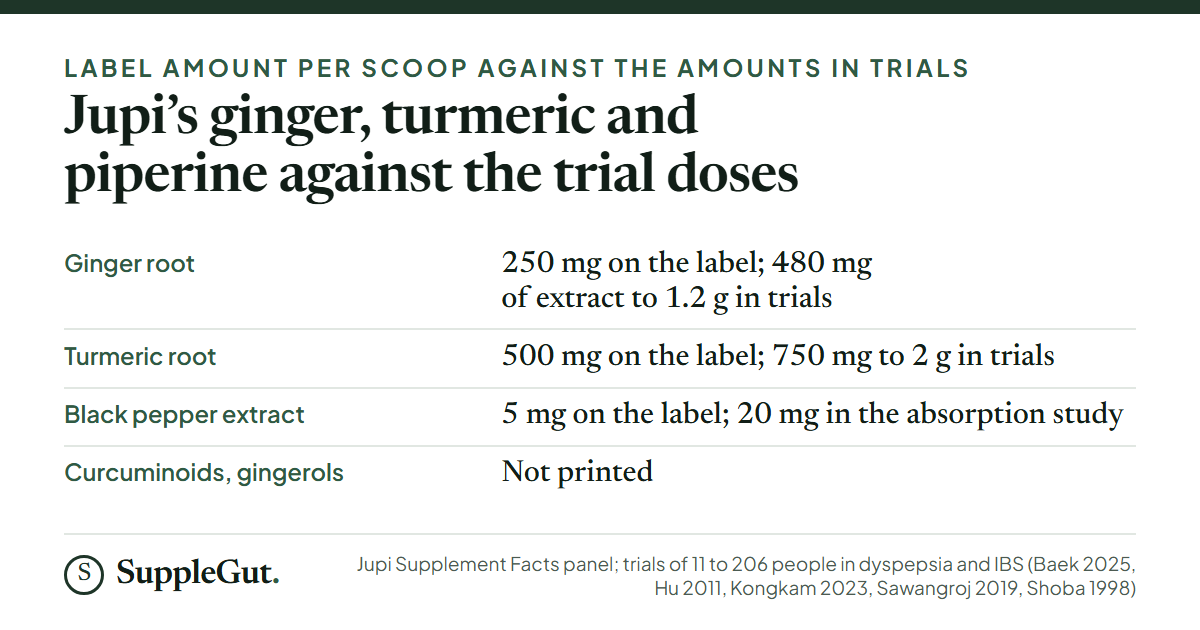
The ginger and turmeric trials were done in functional dyspepsia (upper abdominal pain and fullness), not bloating alone, and their doses sit above the label amounts. The chart on this page sets them side by side.
Ginger, 250 mg of root powder per scoop. In 80 adults with mild to moderate functional dyspepsia, 480 mg a day of a steamed ginger extract for 12 weeks improved symptom scores against placebo (Baek et al., Food & Function, 2025). A single 1.2 g dose in 11 patients shortened the time for the stomach to half-empty, 12.3 minutes against 16.1 on placebo, but gastrointestinal symptoms did not differ (Hu et al., World Journal of Gastroenterology, 2011). In 45 people with irritable bowel syndrome, 1 g and 2 g of ginger a day for 28 days did not beat placebo (57.1% responders on placebo, 46.7% on 1 g, 33.3% on 2 g) (van Tilburg et al., Complementary Therapies in Medicine, 2014). In an open-label study of 1,080 mg a day in 47 completers, mild adverse effects included bloating in 14.9% and heartburn in 12.8% (Aregawi and Zoltan, Current Therapeutic Research, 2025). We found no trial of 250 mg of ginger root powder for bloating.
Turmeric, 500 mg of root powder per scoop. In 206 people with functional dyspepsia, curcumin at 2 g a day (250 mg capsules, two four times a day) for 28 days was comparable to omeprazole (Kongkam et al., BMJ Evidence-Based Medicine, 2023). In 78 people with postprandial distress syndrome, Curcuma longa at 750 or 1,500 mg a day gave symptom scores similar to simethicone, with higher recurrence on turmeric (42.9% and 45.5%) than on simethicone (13.6%) (Sawangroj et al., F1000Research, 2019). A 2023 Cochrane review concluded that Curcuma longa probably gives a moderate improvement in global dyspepsia symptoms at four weeks, from two studies in 110 participants (Báez et al., Cochrane Database of Systematic Reviews, 2023). A 2024 systematic review of 26 turmeric studies in digestive disorders judged most to be at high risk of bias and the effects inconsistent outside inflammatory bowel disease and IBS (Thavorn et al., Phytotherapy Research, 2024). Against that, 500 mg of root powder with no curcuminoid figure is below the 750 to 1,500 mg preparations and a quarter of the 2 g curcumin dose.
The black pepper line is the one place the label points at an absorption study. In the widely cited human study, 20 mg of piperine with 2 g of curcumin raised curcumin availability by 2,000% in healthy volunteers, where 2 g alone gave very low or undetectable levels (Shoba et al., Planta Medica, 1998). Jupi has 5 mg of BioPerine with 500 mg of turmeric root powder: a lower piperine amount, a root powder rather than a curcumin extract, so the pairing in the study does not carry over directly. No trial of BioPerine for bloating was found.
We found no human trial in bloating for lemon balm, lemon or apple cider vinegar. The cayenne (10 mg) is small next to the 2.5 g a day of red pepper powder tested in a 30-patient dyspepsia trial, and the electrolytes and vitamins have no bloating evidence on the pages we read; they are there for the hydration and immune claims.
How to take Jupi
The directions are one scoop in 8 to 12 ounces of water, stirred or frothed until dissolved, daily. The brand advises people with a sensitive stomach to start with half a scoop.
Side effects and who should not take it
The panel image shows no warning text, and we found no allergen statement beyond Amazon’s vegan and gluten-free title. The brand’s FAQ says anyone with a sensitive stomach, a medical condition, medication, or a pregnancy or nursing should talk with a healthcare provider first; that advice is on the site, not a printed pack warning. Two label amounts are worth checking against your own situation: one scoop has 400 mg of sodium (17% of the Daily Value) and 150 mg of potassium, and vitamin D is 50 mcg, 250% of the Daily Value, in a single scoop.
What the reviews say
Amazon shows 4.1 out of 5 from 1,568 ratings. We could not read the star split or the review text, so the recurring praise and complaints from independent buyers are not recorded here. The Amazon listing’s ingredient line is shorter than the brand’s current panel (turmeric root, ginger root, vitamin C and pink salt) and its flavor reads Orange, where the panel lists 20 ingredients in Blood Orange, so the 4.1 may include an earlier formula.
The brand’s own site prints “4.8” and “4.8/5 based on 1,024 reviews”. That is typed page text: no review widget renders on the page, so the individual reviews cannot be seen. There is no Trustpilot profile for the domain.
The subscription and refund terms
The brand site shows no subscription plan; the bundles are one-time purchases. Amazon offers Subscribe & Save at $31.49. The brand’s statements on returns differ by page: the refund policy and the FAQ give a 60-day return window, with returns to a Florida address and no returns on sale items; the FAQ also describes a 30-day “Feel It or It’s Free” guarantee by email, and the cart banner says 30-day money back. Amazon marks the item non-returnable. We found no billing complaints.
Two smaller facts. The panel net weight is 189 g (30 scoops of 6.3 g) while the jar graphic reads 4.63 oz (132 g); the two do not agree. And the brand names no manufacturer, laboratory or certification and states no third-party testing.
Who Jupi is for
- A daily electrolyte-and-vitamin drink with some ginger and turmeric in it.
- A reader who wants every amount printed, with no blend to decode.
- Someone comfortable with 400 mg of sodium and 250% of the vitamin D Daily Value in a scoop.
If the aim is to reach the ginger or turmeric amounts used in trials, a single-ingredient product states them directly; Nature’s Way ginger root capsules are one example in the catalog. OLLY Beat the Bloat and Lemme Debloat Gummies are other bloating products; the Lemme Debloat guide covers the gummy. The bloating guide starts from the cause instead of the product, and the quiz narrows by symptom.
Cost
| Route | Price | Per day, one scoop |
|---|---|---|
| Brand site, one jar | $47.99 | $1.60 |
| Brand site, 3 jars | $95.98 | $1.07 |
| Brand site, 5 jars | $143.96 | $0.96 |
| Amazon, one time | $41.99 | $1.40 |
| Amazon, Subscribe & Save | $31.49 | $1.05 |
The brand words its bundles as buy 2 get 1 free and buy 3 get 2 free, with free shipping on those; its own comparison graphic says about $1.17 a serving, which matches none of the prices above.
The products in this catalog
Common questions
Does Jupi work for bloating?
No trial of Jupi was found. Its 250 mg of ginger root and 500 mg of turmeric root per scoop are below the doses in dyspepsia trials (480 mg of ginger extract to 1.2 g of ginger; 750 mg to 2 g of turmeric), and those trials measured dyspepsia symptoms rather than bloating alone. The brand’s survey claim of 87% reporting less discomfort in 7 days gives no number of respondents.
What is in a scoop of Jupi?
One 6.3 g scoop lists turmeric root 500 mg, kiwi 300 mg, ginger root 250 mg, baobab 200 mg, papaya 150 mg, apple cider vinegar 125 mg, coconut water powder 100 mg, lemon balm extract 100 mg, lemon 25 mg, cayenne 10 mg and BioPerine 5 mg, plus vitamin C 100 mg, vitamin D 50 mcg, magnesium 100 mg, zinc 2 mg, sodium 400 mg, chloride 610 mg and potassium 150 mg. It is sweetened with stevia leaf extract, and there is no proprietary blend.
Is Jupi safe, and what are the side effects?
The panel image shows no warning, but the brand’s FAQ says to talk with a healthcare provider if pregnant, nursing, taking medication or living with a medical condition, and to start with half a scoop if the stomach is sensitive. In an open-label study of 1,080 mg of ginger a day, 14.9% reported mild bloating and 12.8% heartburn. One scoop has 400 mg of sodium and vitamin D at 250% of the Daily Value.
How much does Jupi cost, and is there a subscription?
A jar of about 30 servings is $47.99 on the brand site ($1.60 a day) and $41.99 on Amazon ($1.40 a day, or $31.49 on Subscribe & Save). Brand bundles are $95.98 for 3 jars and $143.96 for 5. The brand site shows no recurring plan. Its refund page and FAQ give a 60-day return window, the FAQ also describes a 30-day guarantee, and Amazon marks the item non-returnable.
Why are there two different ratings for Jupi?
Amazon shows 4.1 from 1,568 ratings. The brand site prints 4.8 from 1,024 reviews as typed page text, with no review app rendering the individual reviews. The Amazon listing also names a shorter ingredient line and an Orange flavor, where the brand’s current panel lists 20 ingredients in Blood Orange, so the Amazon figure may include an earlier formula.
Jupi or a plain ginger or turmeric supplement: what is different?
Jupi puts ginger, turmeric, electrolytes and vitamins in one powder, with root weights rather than extract strengths. A single-ingredient product can state a ginger or turmeric dose near the trial amounts, as Nature’s Way ginger root capsules do for ginger. No trial compares the two.
Sources
- Baek HI, Ha NR, Kim C, et al. "Efficacy and safety of steamed ginger extract for gastric health: a randomized, double-blind, placebo-controlled multi-center clinical trial." Food & Function, 2025;16(18):7316–7329. PMID 40878144
- Hu ML, Rayner CK, Wu KL, et al. "Effect of ginger on gastric motility and symptoms of functional dyspepsia." World Journal of Gastroenterology, 2011;17(1):105–110. PMID 21218090
- van Tilburg MA, Palsson OS, Ringel Y, et al. "Is ginger effective for the treatment of irritable bowel syndrome? A double blind randomized controlled pilot trial." Complementary Therapies in Medicine, 2014;22(1):17–20. PMID 24559811
- Aregawi LG, Zoltan C. "Evaluation of Adverse Effects and Tolerability of Dietary Ginger Supplementation in Patients With Functional Dyspepsia." Current Therapeutic Research, 2025;102:100792. doi.org/10.1016/j.curtheres.2025.100792
- Kongkam P, Khongkha W, Lopimpisuth C, et al. "Curcumin and proton pump inhibitors for functional dyspepsia: a randomised, double blind controlled trial." BMJ Evidence-Based Medicine, 2023;28(6):399–406. doi.org/10.1136/bmjebm-2022-112231
- Sawangroj N, Budkaew J, Chumworathayi B. "Efficacy of Curcuma longa in treatment of postprandial distress syndrome: An open-label randomized-controlled trial." F1000Research, 2019;8:1827. doi.org/10.12688/f1000research.20662.1
- Báez G, Vargas C, Arancibia M, et al. "Non-Chinese herbal medicines for functional dyspepsia." Cochrane Database of Systematic Reviews, 2023;6:CD013323. doi.org/10.1002/14651858.CD013323.pub2
- Thavorn K, Wolfe D, Faust L, et al. "A systematic review of the efficacy and safety of turmeric in the treatment of digestive disorders." Phytotherapy Research, 2024;38(6):2687–2706. doi.org/10.1002/ptr.8189
- Shoba G, Joy D, Joseph T, et al. "Influence of piperine on the pharmacokinetics of curcumin in animals and human volunteers." Planta Medica, 1998;64(4):353–356. PMID 9619120
- Brand pages: Supplement Facts panel, directions, FAQ, refund policy and prices. drinkjupi.com/products/jupi; Amazon listing: price, rating and ingredient line. amazon.com/dp/B0DS1C3P6X
Not sure which product fits your situation?
This guide covers the mechanics. The quiz takes your specific symptoms, routine and preferences and matches you to one product from the catalog.
Take the quiz →