
Stool form and regularity
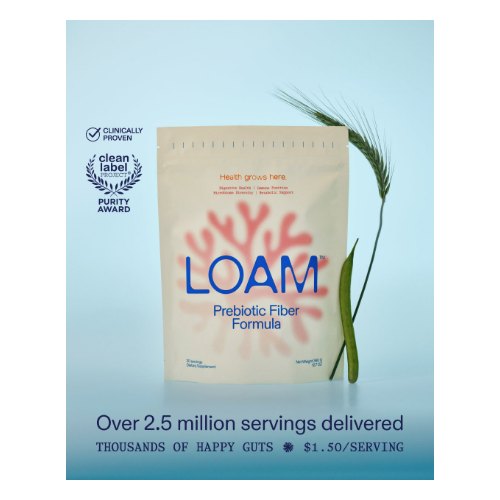
LOAM Prebiotic Fiber Formula
An unflavored powder with 10 g of fiber from six prebiotics, one scoop a day stirred into water.
- Format
- Powder, once a day
- Type
- Fiber and prebiotic
- Cost
- $1.67 a day
- Customer rating
- 4.4 out of 5 from 21 ratings from Amazon
What the accounts we could find say
- No taste, dissolving into plain water
- A gentle change in regularity
- Customer service replacing or sorting out problem orders
There is not enough independent feedback here to call those themes reliable. Low review confidence — the 4.4 from 21 Amazon ratings is independent but small, the brand’s own 4.7 from 333 ratings sits on its site, and the Trustpilot profile has 14 reviews (3.3), mostly from UK customers about shipping.
Why it might work
The six soluble fibers (guar gum, xylooligosaccharides, carrot fiber, wheat dextrin, corn fiber and tapioca fiber) are not digested in the small intestine and are fermented by bacteria in the colon at different speeds, which the brand says gives steadier short-chain fatty acid production and less gas at once. Fermentation can raise bifidobacteria counts and, in some people, soften stool, but readily fermented fibers add little stool bulk compared with a gel-forming fiber such as psyllium. Gas and bloating are the usual dose-related effects, which is why the brand advises starting with half a scoop. The label does not show how many grams of each fiber a scoop has, and the brand’s figure for gas (21 percent less than inulin) comes from a laboratory fermentation model, not people.
What the research supports
The evidence here is mostly for the ingredient class, not this formula. A 2022 meta-analysis of 16 trials found fiber helped chronic constipation mainly above 10 g a day, and this label gives 10 g of dietary fiber, at that threshold, from six fibers whose individual amounts are not printed. The brand reports a 47-person, 30-day placebo-controlled trial that measured gut bacteria composition, but it names no journal and gives no stool or symptom result, and the registered record lists a 90-person study not yet started at its last update. For one component, a 12-week trial of 6 g a day of partially hydrolyzed guar gum in 108 IBS patients improved bloating scores against placebo.
What the label discloses
The panel lists the six fibers in a single 11.75 g blend with no per-ingredient amounts, and 10 g of it is counted as dietary fiber. The label says “Contains: Wheat” and also “Gluten Free”, because the wheat fiber is processed to test below 20 ppm gluten, and a separate wheat-free version exists. The brand states third-party testing of every batch and publishes per-serving heavy-metal figures, but names no laboratory, and a Clean Label Project badge on the label was not verified.
Who this tends to suit
We match this product to people reporting irregular bowel habits and bloating. It fits someone whose priority is a steady daily routine, regularity or day-to-day comfort. Whether it is the best fit for you depends on the rest of your answers — what you have already tried, what format you will take, and anything that has to be ruled out.
Where it may not fit
The label supports gluten-free, no added sweeteners, dairy-free and vegan. We flag this product for anyone pregnant or breastfeeding or taking prescription medication, and the quiz removes it rather than recommending it in those cases. That is a caution about who should be deciding, not a claim about the product. A powder only works if you will take it once a day, every day.
Side effects and what to be aware of
Reviewers’ complaints center on shipping cost and delivery time to the UK, subscription reorders that were mishandled, mild gas and bloating in the first week, and a powdery aftertaste for one person. The standard formula contains wheat, and the brand points people with a wheat allergy to its wheat-free version. The brand’s FAQ says to consult a healthcare provider if pregnant, nursing or on medication.
Common questions
Does LOAM prebiotic fiber work?
The brand reports a 47-person, 30-day placebo-controlled trial that found a different gut bacteria composition on LOAM, but it has not named a journal and shows no stool or symptom result. A 2022 meta-analysis found fiber helped chronic constipation mainly above 10 g a day, and one scoop has 10 g of dietary fiber, with the six fibers’ individual amounts not printed. About 6 g a day of one of the fibers, partially hydrolyzed guar gum, improved bloating in a 12-week trial of 108 IBS patients.
What is in LOAM, and does it contain wheat?
One 12 g scoop has 25 calories, 10 g of dietary fiber and an 11.75 g blend of partially hydrolyzed guar gum, tapioca fiber, soluble wheat fiber, soluble corn fiber, xylooligosaccharides and soluble carrot fiber, with nothing else listed. The label says Contains: Wheat and also Gluten Free, because the wheat fiber is processed to test below 20 ppm gluten. LOAM also sells a wheat-free version with five fibers.
Does LOAM cause gas or bloating?
The brand says to start with half a scoop for three to four days, then move to a full scoop, and describes the blend as low-FODMAP-friendly without naming a certifier. A few Trustpilot reviewers mention mild gas or bloating in the first week that eased. In the brand’s laboratory fermentation model LOAM produced 21 percent less gas than inulin, a result not yet tested in people; a registered trial of that comparison (NCT07525180) has no results posted.
How much does LOAM cost?
The brand charges $50 for a 30-serving pouch one time ($1.67 a day, plus $5 shipping under $100), $45 on a monthly subscription ($1.50 a day) or $127.50 for three months ($1.42 a day). Amazon lists it at $49.99, or $44.99 with Subscribe & Save. The 30-day money-back guarantee covers a first order bought on the brand’s site only.
LOAM vs Metamucil, or another prebiotic fiber powder?
No head-to-head trial in people was found. Psyllium, the fiber in Metamucil, was one of the fibers with significant effects in a 2022 constipation meta-analysis, while LOAM is a blend of fermentable fibers with a 10 g total and no per-fiber amounts. LOAM costs about $1.67 a day one time.
Before you take this. Speak to a doctor or pharmacist first if you are pregnant or breastfeeding, or taking prescription medication. Nothing on this page is medical advice, and no supplement diagnoses, treats, cures or prevents disease.
Is this the right one for you?
The quiz works out which of the products we have researched fits your symptoms, your routine and what you have already tried — and tells you plainly if none of them do.
Take the quiz →Free. Private. Nothing to sign up for.
Others we researched for the same job
These sit in the same role as LOAM Prebiotic Fiber Formula — stool form and regularity — so they are the sensible things to weigh it against.
See all the products we have researched →
Related reading
Background on how this type of product works, read from the trial evidence.