
Guide
Does LOAM work? Six fibers, ten grams, and a trial the brand has not published
Quick answer
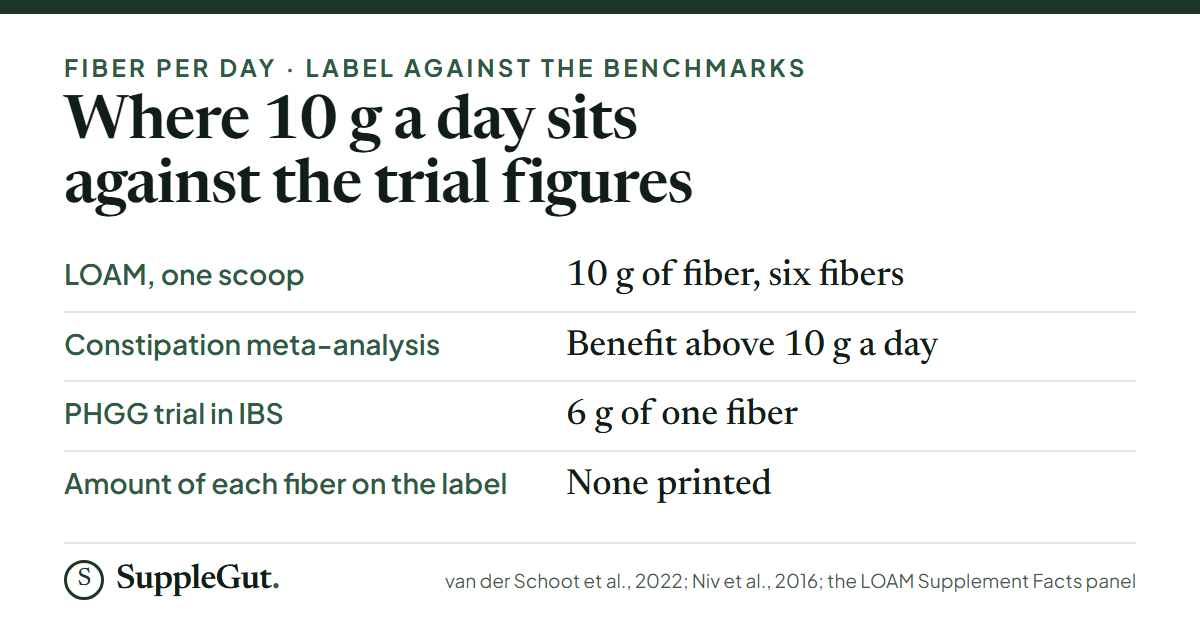
Does LOAM Prebiotic Fiber work? No published trial of this powder was found. The brand reports a 47-person, 30-day placebo-controlled trial (GRASP) that measured gut bacteria, but it names no journal and shows no stool or symptom result, and two registered trials have no results posted. One scoop has 10 g of dietary fiber from six fibers, exactly at the 10 g line where a 2022 constipation meta-analysis found benefit only above it, and the label prints no amount for any single fiber. Ratings run 4.4 from 21 on Amazon, 4.7 from 333 on the brand’s own site and 3.3 from 14 on Trustpilot.
LOAM Prebiotic Fiber Formula is an unflavored powder that puts 10 g of dietary fiber in a 12 g scoop from six different fibers. What sets it apart from the fiber on the next shelf is the blend, since most powders use one. The label prints a single total for all six, which shapes everything below: how much of any one fiber is in the scoop is not stated, so no trial dose for a single fiber can be matched against it.
What LOAM is, and what it is not
One scoop (12 g) is listed at 25 calories, 11 g of carbohydrate and 10 g of dietary fiber, 36% of the daily value. The fiber comes from one proprietary blend of 11.75 g: partially hydrolyzed guar gum (PHGG), tapioca fiber, soluble wheat fiber, soluble corn fiber, xylooligosaccharides (XOS) and soluble carrot fiber. The panel names three ingredient brands (Fibalance, PreticX and Benicaros) but gives no grams for any single fiber. The blend is 98% of the scoop and 10 g of it counts as dietary fiber; the label does not say what the other 1.75 g is, and the brand’s product page describes the scoop as “12 g total prebiotics”, a different figure from the printed 11.75 g. There are no other ingredients, no sweeteners or flavors, and no probiotic.
The panel reads “Contains: Wheat”, and the same label image carries a “Gluten Free” mark. The brand explains that the soluble wheat fiber is processed to remove gluten protein, so the finished powder tests under the 20 parts per million gluten limit, and it advises anyone with a wheat allergy to choose its separate wheat-free version, a five-fiber formula sold at the same price. Gluten-free and wheat-free are different statements, and this label makes the first and not the second. The brand also states vegan, dairy-free, soy-free and “low-FODMAP-friendly”; no certifying body for the last one is named on the pages we read.
The label reads “Distributed by GutWise Inc., Newport Beach, CA”, and the brand is LOAM Science. It presents its founder, Dr. Karan Rajan, as a practicing surgeon who tried more than 60 fiber supplements after a blood test, and he appears in its ads and pages under labels such as “doctor-founded”. That is the brand’s description of him, and the product’s evidence is set out below.
The trial of the product itself
The label and product page print “clinically shown”, footnoted to the GRASP trial: 47 people, double-blind, placebo-controlled, 30 days. That is the brand’s description. Its write-up reports that gut bacteria on LOAM differed from placebo, with the genus Roseburia the most enriched, and that microbial richness held steady on LOAM while it dipped slightly on placebo. The write-up gives no effect sizes or p-values, names no journal or authors, and reports no stool frequency, bloating or other symptom result. We found no paper under the name in PubMed.
The registry entry for GRASP (NCT07514741, sponsored by LOAM Science) lists healthy adults, an estimated 90 participants, a start date still ahead when it was posted, and a primary outcome of gastrointestinal adverse events and discontinuations; the digestive-comfort score is a secondary outcome, and no results are posted. The planned enrollment (90) and the trial the brand describes (47) differ, and we cannot reconcile them from the public record.
A second registered trial, NCT07525180, run by an outside company, compares 12 g a day of LOAM with 12 g of inulin and a cellulose placebo for four weeks in healthy adults who eat little fiber, with daily gas measured by a wearable device as the main outcome. It lists 125 participants and no results. The brand also reports a laboratory colonic-fermentation study in which the blend produced 21% less gas than inulin. That was done with donated stool samples in a lab model, not in people, so it is not a human result; the registered trial is the human test of the same question.
We found no trial of the finished product in constipation, irritable bowel syndrome or bloating in people with symptoms. The brand also runs pages aimed at GLP-1 users and at perimenopause; the trials above do not address those groups.
The evidence for the fiber
The closest benchmark is a 2022 meta-analysis of 16 trials in 1,251 adults with chronic constipation. Fiber helped more people than control (66% responding against 41%; relative risk 1.48), but the benefit appeared only at doses above 10 g a day, and the fibers with significant effects were psyllium and pectin, with flatulence higher on fiber (van der Schoot et al., American Journal of Clinical Nutrition, 2022). LOAM’s 10 g sits exactly at that line, not above it, and none of its six fibers is psyllium or pectin. A 2021 systematic review of over-the-counter constipation products graded psyllium as moderate evidence and gave polydextrose, inulin and fructo-oligosaccharide an insufficient grade; it did not grade LOAM’s fibers as such (Rao and Brenner, American Journal of Gastroenterology, 2021, supported by Bayer US).
The strongest evidence for any single component is PHGG. In 121 people with irritable bowel syndrome (108 analyzed), 6 g a day for 12 weeks improved the bloating score by 4.1 points against 1.2 on placebo (p = 0.03), with no effect on other symptoms (Niv et al., Nutrition & Metabolism, 2016). The PHGG amount in a LOAM scoop is not printed, so that dose cannot be compared with the label. A trial in long-term-care residents with constipation, using 5 g a day for four weeks, found no change in bowel frequency or stool form but less laxative use in the last two weeks (PMID 35297467).
For the others: XOS at 3, 5 or 10 g a day in functional constipation improved symptoms over one month, according to the authors (PMID 38370040). Carrot fiber trials used 0.3 to 1.5 g a day, were funded by the ingredient’s maker and measured immune response and gut bacteria, not stool outcomes (PMID 38593705). Soluble corn fiber at 20 g a day, about twice the whole label dose, produced a mild laxative effect with more flatulence in 36 healthy adults (Timm et al., Journal of Nutrition, 2013). One review argues that readily fermented fibers add little stool bulk compared with a gel-forming fiber such as psyllium (McRorie, Digestive Diseases and Sciences, 2016), a counterpoint to a formula built on fermentation.
All of this is evidence for the ingredients, at doses that are mostly not LOAM’s. Because the label does not split the 11.75 g among six fibers, a reader cannot tell which trial dose, if any, a scoop reaches.
How to take LOAM
The brand’s directions: one scoop a day stirred into 10 to 12 fl oz of water or any liquid and left for 60 seconds, at whatever time is easiest to keep up. It advises starting with half a scoop for three to four days, then moving to a full scoop, so the gut can adjust. A fair test is longer than a few days: the GRASP trial the brand describes ran 30 days, and the trial benchmarks above ran four to 12 weeks.
Side effects and who should not take it
The panel image shows no warning statements beyond the wheat allergen line. The brand’s FAQ says to consult a healthcare provider first if pregnant, nursing or on medication. Gas and bloating are the usual dose-related effects of fermentable fiber, which is why the brand’s own directions start at half a scoop; a few Trustpilot reviewers report mild gas or bloating in the first week, easing afterward, and one describes a powdery aftertaste. Anyone with a wheat allergy is the group the brand itself directs to the wheat-free version. The brand states third-party testing of every batch and publishes per-serving heavy-metal figures (lead 0.08 micrograms, arsenic 0.08, mercury 0.04, cadmium 0.02) but names no laboratory; we found no certificate of analysis, and we found no announcement from the Clean Label Project, whose purity badge appears on the label image, naming this product.
What the reviews say
The three scores come from three kinds of source. Amazon shows 4.4 from 21 ratings (72% five-star, 6% one-star) on a listing sold by LOAM Science. The brand’s own page shows 4.7 from 333 ratings through a review widget on its own site. Trustpilot, which is independent, shows 3.3 from 14 reviews, six of them one-star. The Trustpilot reviewers are mostly in the United Kingdom, and their low scores are largely about the cost and time of shipping from the United States, not the powder; one recent reviewer says a UK warehouse has since opened. We found no Better Business Bureau profile.
The recurring praise is a powder with “no taste” that blends into plain water, a gentle change in regularity, and customer service that replaced or fixed problem orders. The recurring complaints are shipping cost and delivery time to the UK, subscription reorders that were sent wrongly or not stopped when a reviewer asked, and mild gas in the first week. With 14 Trustpilot reviews and 21 on Amazon, none of these patterns rests on many people.
The refund and subscription terms
The brand’s published terms give a 30-day money-back guarantee on a first purchase made directly on loamscience.com, whether a one-time order or a first subscription order, requested by email within 30 days of delivery. Later orders are not eligible, original shipping and taxes are not refunded, and orders from marketplaces such as Amazon follow the retailer’s policy; the Amazon listing is marked non-returnable for food-safety reasons. Subscriptions can be paused or canceled at any time, and the monthly and quarterly discounts carry onto renewals. Single pouches can be bought one time on the brand site or on Amazon, and the brand’s FAQ recommends its own site.
Who LOAM is for
- Someone who wants a multi-fiber blend that dissolves in water with no taste, in a single daily scoop.
- Someone adding fiber to a daily routine, willing to start at half a scoop and build up.
- Someone avoiding added sugar, sweeteners and sugar alcohols, who is comfortable with a 10 g total and no per-fiber amounts.
- Someone with a wheat allergy, who would use the wheat-free version rather than the standard one described here.
If you want one fiber at a dose a trial used, California Gold Nutrition Sunfiber PHGG is plain guar fiber, and NOW Foods Psyllium Husk Powder is the psyllium option. Supergut is another unflavored multi-fiber blend with a smaller total, covered in the Supergut guide, and NOW Foods Inulin is a single-fiber powder of the kind the registered trial uses as its comparator. The probiotic or fiber guide, the bloating and gas guide and the quiz start from the symptom instead of the product.
Cost
On the brand site the 30-serving pouch is $50.00 one time, or $1.67 a day, plus $5 shipping on orders under $100. A monthly subscription is $45.00 ($1.50 a day) and a quarterly subscription is $127.50 for 90 servings ($1.42 a day), both with free shipping. Amazon lists the same pouch at $49.99 ($1.67 a day) or $44.99 with Subscribe & Save ($1.50 a day). Single-serve sachets are $60.00 for 30 ($2.00 each), and a 14-count stick pack is $32.00 ($2.29 each). The wheat-free version is priced the same as the standard pouch.
The products in this catalog
Common questions
Does LOAM Prebiotic Fiber work?
No published trial of the powder was found. The brand reports a 47-person, 30-day placebo-controlled trial that found a different mix of gut bacteria on LOAM, but it names no journal and shows no stool or symptom result. A 2022 meta-analysis found fiber helped chronic constipation only above 10 g a day, and one scoop has exactly 10 g from six fibers, with no per-fiber amounts printed. About 6 g a day of one of them, PHGG, improved bloating in a 12-week trial of 108 people with IBS.
What is in LOAM, and does it contain wheat?
One 12 g scoop has 25 calories, 10 g of dietary fiber and an 11.75 g blend of partially hydrolyzed guar gum, tapioca fiber, soluble wheat fiber, soluble corn fiber, xylooligosaccharides and soluble carrot fiber, with nothing else listed. The label says “Contains: Wheat” and also “Gluten Free”, because the brand processes the wheat fiber to test under 20 parts per million of gluten. A separate wheat-free version has five fibers and the same price.
Does LOAM cause gas or bloating, and how do you start?
The brand says to start with half a scoop for three to four days, then move to a full scoop, and calls the blend low-FODMAP-friendly without naming a certifier. A few Trustpilot reviewers report mild gas or bloating in the first week that eased. In the brand’s laboratory fermentation model LOAM produced 21% less gas than inulin, which is not a result in people; a registered trial of that comparison (NCT07525180) has no results posted.
Is LOAM “clinically shown”, as the label says?
The label and product page print “clinically shown”, footnoted to the GRASP trial (47 people, double-blind, placebo-controlled, 30 days). The brand’s write-up reports gut bacteria results only, with no numbers, no journal and no stool or symptom outcome, and the registry entry for GRASP (NCT07514741) lists 90 planned participants and no results. We found no paper under the trial’s name in PubMed.
How much does LOAM cost?
On the brand site the 30-serving pouch is $50.00 one time ($1.67 a day, plus $5 shipping under $100), $45.00 on a monthly subscription ($1.50 a day) or $127.50 for three months ($1.42 a day). Amazon lists it at $49.99, or $44.99 with Subscribe & Save. Sachets cost $2.00 a serving and a 14-count stick pack $2.29.
What do the reviews say, and what are the refund terms?
Amazon shows 4.4 from 21 ratings, the brand’s own site 4.7 from 333 and Trustpilot 3.3 from 14, with the low Trustpilot scores mostly about UK shipping and subscription reorders. The 30-day money-back guarantee covers a first order bought on loamscience.com only; Amazon orders follow Amazon’s policy and the listing is marked non-returnable.
LOAM vs psyllium, Supergut or inulin?
No head-to-head trial in people was found. Psyllium was one of the fibers with significant effects in the 2022 constipation meta-analysis, while LOAM is a blend of fermentable fibers with no per-fiber amounts. See the Supergut guide for another multi-fiber blend; the registered trial NCT07525180 compares LOAM with inulin on gas.
Sources
- van der Schoot A, Drysdale C, Whelan K, Dimidi E. Fiber supplementation in adults with chronic constipation: updated systematic review and meta-analysis of 16 randomized trials. American Journal of Clinical Nutrition, 2022 (PMID 35816465). pubmed.ncbi.nlm.nih.gov/35816465
- Rao SSC, Brenner DM. Over-the-counter therapies for chronic constipation: systematic review of 41 randomized trials. American Journal of Gastroenterology, 2021 (PMID 33767108). pubmed.ncbi.nlm.nih.gov/33767108
- Niv E, Halak A, Tiommny E, et al. "Randomized clinical study: Partially hydrolyzed guar gum (PHGG) versus placebo in the treatment of patients with irritable bowel syndrome." Nutrition & Metabolism, 2016;13:10. doi.org/10.1186/s12986-016-0070-5
- Partially hydrolyzed guar gum in long-term-care residents with chronic constipation, 5 g a day for 4 weeks. Journal of Nutrition, Health and Aging, 2022 (PMID 35297467). pubmed.ncbi.nlm.nih.gov/35297467
- Xylooligosaccharides at 3, 5 or 10 g a day compared with fructooligosaccharides in functional constipation. Food Science & Nutrition, 2024 (PMID 38370040). pubmed.ncbi.nlm.nih.gov/38370040
- Carrot-derived rhamnogalacturonan-I and gut bacteria in 146 healthy adults. Biomedicine & Pharmacotherapy, 2024 (PMID 38593705). pubmed.ncbi.nlm.nih.gov/38593705
- Timm DA, et al. Polydextrose and soluble corn fiber at 20 g a day in healthy adults. Journal of Nutrition, 2013 (PMID 23427334). pubmed.ncbi.nlm.nih.gov/23427334
- McRorie JW. Review of fermentable fibers and laxation. Digestive Diseases and Sciences, 2016 (PMID 27680987). pubmed.ncbi.nlm.nih.gov/27680987
- ClinicalTrials.gov registry entries NCT07514741 and NCT07525180. clinicaltrials.gov/study/NCT07514741
- Brand pages: product label, directions, price, GRASP and laboratory-study write-ups, FAQ and shipping and returns terms. loamscience.com
- Amazon listing: ratings and price. amazon.com
- Trustpilot profile for loamscience.com. trustpilot.com
Not sure which product fits your situation?
This guide covers the mechanics. The quiz takes your specific symptoms, routine and preferences and matches you to one product from the catalog.
Take the quiz →