Daily gut routine
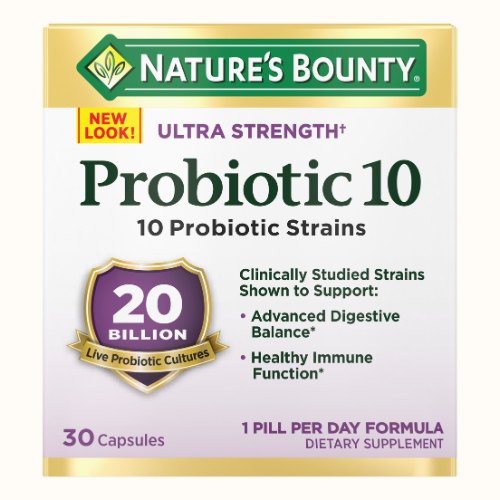
Nature's Bounty Probiotic 10, Ultra Strength
A 10-strain, 20-billion-CFU blend leaning on several branded, individually studied strains rather than one dominant organism.
The label names all ten strains and a 20 billion CFU total but gives no per-strain split, so there is no way to tell whether any one strain is present at the amount its own research used, and no trial has tested this ten-strain combination. The strain with the most research behind it, L. plantarum 299v, has mixed results: early small trials were positive on abdominal pain, and a longer eight-week trial found no difference from placebo. The strain evidence and the label follow below.
- Format
- Capsule, once a day
- Type
- Probiotic
- Cost
- See the price on Amazon
- Customer rating
- 4.3 out of 5 from 262 ratings from naturesbounty.com
Not sure it suits your symptoms? The quiz matches one product to you in one to three minutes.
What customers consistently report
- Better digestion and gut comfort
- A once-a-day capsule with no aftertaste
- Good value for the price
Those are the themes that recur across the reviews. Low review confidence — 4.3 from 262 reviews on the brand’s own store (naturesbounty.com).
The mechanism, as the brand describes it
This capsule's logic is breadth: ten named strains may interact with the gut in different ways, rather than asking one organism to do all the work. A 20-billion-CFU total gives the blend a substantial overall count, and naming every strain is more useful than a generic species list because probiotic effects can differ even between strains of the same species. The difficult part is that the label gives no CFU allocation to each strain. It is therefore impossible to tell whether any one branded strain is present at an amount comparable with its research, and the finished ten-strain combination has not been tested. The capsule is convenient and the ingredients are unusually identifiable, but a large total is not a substitute for knowing the working dose of each component. Identifiable ingredients and a large total remain insufficient to demonstrate that any component is present at an effective dose.
What has actually been tested
The evidence for this product’s individual branded strains is mixed, which supports a skeptical read rather than the brand’s marketing framing. For L. plantarum 299v, early small trials were strongly positive on abdominal pain, but a more recent, longer eight-week trial found no significant difference from placebo and attributed the earlier apparent benefit partly to a substantial placebo effect, and a further trial also found no significant efficacy. A 2021 meta-analysis of 42 trials still lists this strain among six with a significant IBS abdominal-pain benefit overall, but the contradicting individual trials above show the effect is not consistent across all studies. No trial tested this product’s full 10-strain combination.
What the panel prints, and what it leaves out
The label discloses all 10 strains by name, including branded strains with their own trademark symbols, and the total CFU, but not individual per-strain splits. No third-party testing certificate is named; the brand instead cites years of research as a general claim rather than finished-product certification.
When it makes sense
We match this product to people reporting bloating, gas and general abdominal discomfort. It fits someone whose priority is day-to-day comfort or a steady daily routine. Which product the quiz lands on also turns on what you have already tried, the format you prefer, and any exclusions that apply to you.
Where it falls short of the brief
The dietary claims the label makes are gluten-free. One group does not see Probiotic 10, Ultra Strength in their results: people pregnant or breastfeeding or taking prescription medication. The product is not the problem; the person who should decide is. It is a capsule taken once a day, every day, and the quiz asks whether that is a routine you will keep.
Side effects and what to be aware of
Live organisms: the usual caution for anyone immune-suppressed. The label gives the total count but not the amount of each of the ten strains.
Questions people ask
Does Nature’s Bounty Probiotic 10 work?
No trial has tested this ten-strain combination, so the honest answer rests on the individual strains, and that evidence is mixed. For L. plantarum 299v, early small trials were strongly positive on abdominal pain, but a longer eight-week trial found no significant difference from placebo, and a 2021 meta-analysis of 42 trials still lists it among six strains with an IBS pain benefit overall. The label gives no per-strain CFU, so there is no way to tell whether any strain is present at the amount its research used.
How many CFU and how many strains are in Probiotic 10?
Ten named strains, including branded strains with their own trademark symbols, and 20 billion CFU in total. The label does not split that total between the strains. A large total is not a substitute for knowing the working dose of each component.
Is Nature’s Bounty Probiotic 10 third-party tested?
No third-party testing certificate is named. The brand cites years of research as a general claim rather than a finished-product certification.
One check first. Nature's Bounty sells a supplement, not a treatment, and if you are pregnant or breastfeeding, or taking prescription medication the decision belongs with a doctor or pharmacist, not with this page.
Would the quiz pick this for you?
Tell the quiz your symptoms, what you have tried and any medicines you take; it ranks Probiotic 10, Ultra Strength against the rest and shows its reasons.
Take the quiz →Free. Private. Nothing to sign up for.
Its peers in the catalog
Daily gut routine: that is the job Nature's Bounty Probiotic 10, Ultra Strength does, and these are the other entries doing it.
See all the products we have researched →
Further reading
The guides behind the category, written from the trials rather than the labels.