Daily gut routine
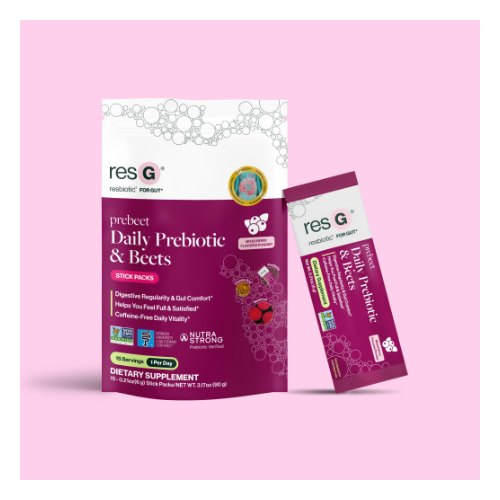
ResBiotic resG prebeet Daily Prebiotic & Beets
A once-a-day drink-mix stick pack of resistant potato starch and beetroot powder for an everyday gut routine.
- Format
- Powder, once a day
- Type
- Prebiotic and fiber
- Cost
- See the price on Amazon
- Customer rating
- See the reviews on Amazon
Not sure it suits your symptoms? The quiz matches one product to you in one to three minutes.
How it is meant to work
Resistant potato starch is a fiber that passes undigested to the colon, where gut bacteria ferment it; the brand says this feeds Bifidobacterium and Akkermansia and produces short-chain fatty acids. Beetroot juice powder adds nitrate and color, and the B12 is a vitamin dose with no known role in stool or gas. Fermentation of any fiber can itself produce gas, and the Monash low-FODMAP certification refers to one serving. The brand links the Akkermansia rise to natural GLP-1 production, but that claim rests on cell studies, and the label does not let a reader check what the product does in a person on a GLP-1 medicine.
On the label
Both active amounts are printed (3.5 g resistant potato starch, 2 g beetroot juice powder), plus 1,000 mcg of vitamin B12. The label carries Non-GMO Project Verified, Monash low-FODMAP and Nutrastrong prebiotic badges, but no certificate of analysis or testing laboratory was found. The free-from statement covers gluten, dairy, soy and tree nuts only, with no statement on egg, fish, shellfish or sesame.
The evidence, such as it is
No trial of resG itself was found. The nearest evidence is a 2023 randomized, placebo-controlled trial of the same 3.5 g dose of Solnul resistant potato starch in 72 healthy adults for four weeks, which raised Bifidobacterium and Akkermansia and reduced liquid and hard stools compared with placebo. It was funded by the starch’s maker, excluded people with gut complaints, and a follow-up analysis of the same trial found no significant effect on bloating or gas scores. No trial in people taking semaglutide or tirzepatide was found, and the brand’s GLP-1 figure comes from cell studies.
Who it fits
The quiz pairs it with answers that mention bloating, gas, constipation and irregular bowel habits. The goal it serves is regularity or day-to-day comfort. That is the symptom side. The quiz also asks what has already failed for you, which format you will take and what has to be excluded before it names resG prebeet Daily Prebiotic & Beets.
When something else fits better
On diet, the label backs gluten-free, dairy-free and vegan. Keeping to a powder once a day, every day is part of whether resG prebeet Daily Prebiotic & Beets works for anyone.
Side effects, and who should check first
Reviewers on the brand’s own site mostly describe less bloating, a mild taste and easy packs, with occasional notes that the powder does not mix well or settles in the cup. The label prints no warnings beyond the standard statement; the brand suggests asking a primary care doctor if unsure. Subscription discounts apply to the first order only, and returns must be unopened with a $6 restocking fee.
Common questions
Does resG prebeet work for bloating and constipation?
No trial of resG itself was found. A four-week placebo-controlled trial of the same 3.5 g of resistant potato starch in healthy adults found fewer liquid and hard stools than placebo, but it was funded by the starch’s maker and a secondary analysis of it found no significant effect on bloating or gas scores. Brand-site reviewers often report less bloating; no study of it in people on GLP-1 medicines was found.
Is resG prebeet safe, and what are the side effects?
The label prints no warning other than the standard statement, and the trial of the starch reported no serious events, with gastrointestinal events of similar frequency in the placebo group. Resistant starch and other fibers are fermented in the colon, which can cause gas in some people. It also contains 1,000 mcg of vitamin B12 and 2 g of beetroot powder.
Does resG prebeet help with Ozempic or Mounjaro side effects?
The brand markets it for gut discomfort on GLP-1 medicines and says it reduces bloating, gas and constipation. The only supporting human trial used healthy adults not taking those drugs, and the 400% GLP-1 figure comes from cell studies. Guidance for managing constipation on these drugs advises water, activity and dietary fiber and does not name resistant starch products.
How much does resG prebeet cost?
A 30-stick box is $45.99 on the brand site, about $1.53 a day at one stick; the 30-serving pouch is $39.99 ($1.33 a day). Subscribing saves 20% on the first order on the brand site, and the subscription is the option selected when the page loads. H-E-B lists 15 sticks at $24.96 in a search snippet.
resG prebeet vs resM: which is for gut symptoms?
resG is the gut-symptom product (bloating, gas, occasional constipation). resM is a capsule marketed for cravings and weight; its published eight-week trial of 80 adults is a preprint and measured weight, not gut symptoms. The brand was founded by a University of Alabama at Birmingham pediatrician.
Check it against your own symptoms
If you are weighing resG prebeet Daily Prebiotic & Beets against alternatives, the quiz does that weighing for your symptoms and shows the ledger.
Take the quiz →Three minutes, no account.
Others we researched for the same job
These sit in the same role as ResBiotic resG prebeet Daily Prebiotic & Beets — daily gut routine — so they are the sensible things to weigh it against.
See all the products we have researched →
Related reading
Longer reads on the mechanism and the evidence for products like this one.