
Guide
Does resG prebeet work? The starch trial, the GLP-1 claim and the subscription terms
Quick answer
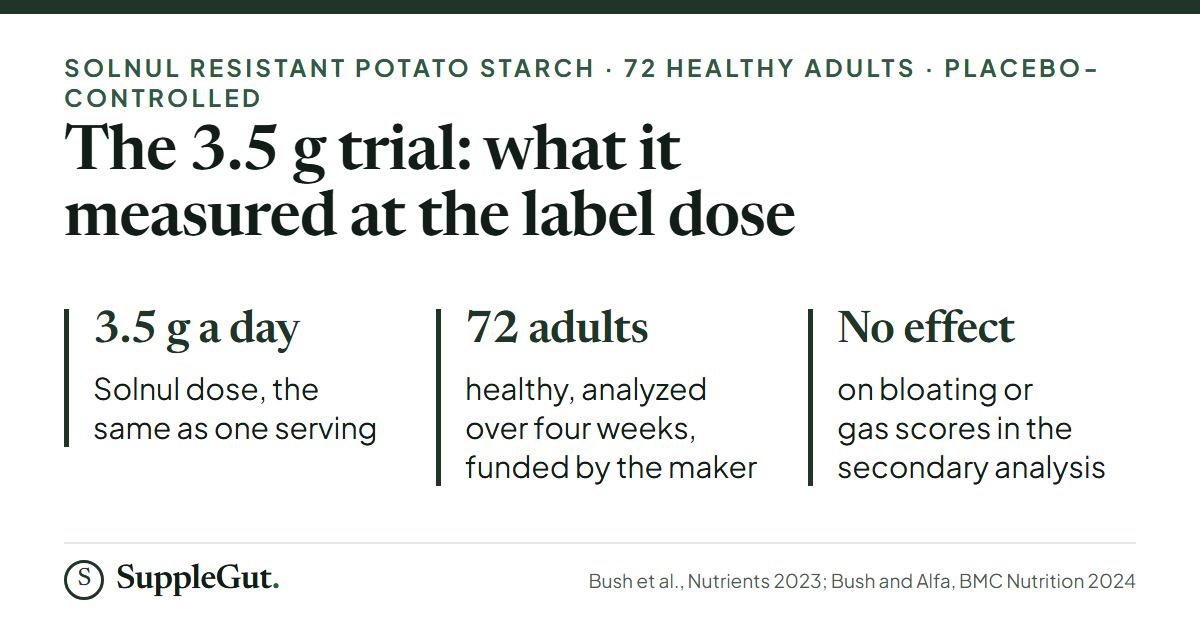
Does resG prebeet work? No trial of resG prebeet itself exists. The nearest evidence is a four-week, placebo-controlled trial of the same 3.5 g of Solnul resistant potato starch in 72 healthy adults, funded by the starch’s maker: it raised Bifidobacterium and Akkermansia and cut liquid and hard stools, but a secondary analysis found no significant effect on bloating or gas scores. The GLP-1 claim rests on cell studies, and no trial in people on semaglutide or tirzepatide was found.
resG prebeet is a drink-mix powder from Resbiotic Nutrition, Inc. in Dallas, sold as single-serve stick packs or a pouch with a scoop. Each serving holds 3.5 g of a branded resistant potato starch (Solnul) and 2 g of beetroot juice powder, and the brand markets it for bloating, gas and occasional constipation, especially on GLP-1 medicines. The finished product has no trial. This page sets out what the one nearby trial measured, what it did not, and how the claims, reviews and subscription terms line up.
What resG prebeet is, and what it is not
The Supplement Facts panel names a “prebeet blend” but prints both amounts: 3.5 g Solnul resistant potato starch and 2 g beetroot juice powder. A serving is 5.9 g, with 20 calories, 5 g of carbohydrate and 2 g of dietary fiber; the panel does not explain why 3.5 g of resistant starch shows as 2 g of fiber. It also carries 1,000 mcg of vitamin B12 as methylcobalamin. Other ingredients are natural flavors, silica and rebaudioside M, a stevia extract. The label prints Non-GMO Project Verified, Monash University low FODMAP certification for one serving, and a “Nutrastrong Prebiotic Verified” badge. We found no certificate of analysis and no named testing laboratory.
It is a fiber, not a probiotic: nothing in it is alive. The free-from list covers gluten, dairy, soy and tree nuts; we found no statement on egg, fish, shellfish or sesame, and no facility statement.
The trial behind the starch, and what it did not measure
There is no trial of resG prebeet. The brand’s own footnotes say so: the “250% Akkermansia” and “200% Bifidobacterium” figures come from a placebo-controlled trial of 3.5 g a day of Solnul, the same dose as one serving, and the “400% increase in GLP-1” comes from preclinical human cell studies of the finished formula.
The Solnul trial randomized 75 healthy adults aged 18 to 69 in Guelph, Ontario, to 3.5 g, 7 g or a corn-starch placebo for four weeks; 72 were analyzed, 24 per arm (Bush et al., 2023). The 3.5 g group had a larger rise than placebo in Bifidobacterium (p = 0.038) and Akkermansia (p = 0.014), and reported no liquid stools (Bristol type 7), with fewer type 7 and fewer hard or lumpy stools than placebo. The 7 g group did not reach significance (p = 0.14 and 0.056).
The limits: the maker of Solnul, MSP Starch Products, funded the trial and its first author works for that company; the Bifidobacterium and Akkermansia results were calculated after removing outliers (3 and 4 people for Bifidobacterium, 1 and 6 for Akkermansia); people with gut complaints including IBS were excluded; diet was not controlled; and the authors name the short duration as a limit. The trial measured gut bacteria and stool form in healthy adults, not bloating or gas in people on GLP-1 medicines. We did not extract the mean changes behind the brand’s percentage figures.
A secondary analysis of 70 of the same participants looked at bloating, gas, belching, constipation, diarrhea and abdominal pain, all reported at low levels at baseline. Neither the starch nor placebo had a significant effect on the mean symptom scores (Bush and Alfa, 2024). A meta-analysis of resistant-starch trials in healthy adults found stool weight rose by 35.5 g a day but stool frequency did not change significantly (Shen et al., 2017); the doses in such trials are higher than 3.5 g. We found no trial of beetroot powder for bloating, gas or constipation.
The GLP-1 claim
The brand’s page opens with “especially while using GLP-1 treatments” and says the starch feeds Akkermansia, which it links to natural GLP-1 production. That figure rests on cell studies. We found no trial of resistant potato starch in people taking semaglutide or tirzepatide. Those drugs raise the risk of constipation (relative risk 2.10 for semaglutide and 3.36 for tirzepatide against placebo) and nausea (2.95 and 2.90) in adults with overweight or obesity (Ismaiel et al., 2025). The expert consensus on managing these effects advises more movement, water and fiber and considering stool softeners (Gorgojo-Martínez et al., 2022), and a joint advisory names gastrointestinal effects as a main challenge of the therapy (Mozaffarian et al., 2025). Neither document names resistant potato starch or this product.
How to take it
Mix one stick pack or scoop into 8 to 12 oz of cold water and shake. The directions allow one to two servings a day; the pouch says one a day. Settling at the bottom of the cup is normal, according to the brand’s FAQ. The Solnul trial ran four weeks, and in it the 7 g dose did less well than 3.5 g on the bacteria measures.
Side effects and who should not take it
The label prints no warning beyond the standard FDA statement; the brand’s FAQ suggests speaking with a primary care physician if unsure. In the Solnul trial there were 56 treatment-emergent events in 33 of 72 people, similar across arms and mostly gastrointestinal; none were serious and none led to stopping. Fermentation of any fiber can produce gas in the colon, and the low FODMAP certification applies to one serving. The B12 dose is far above the daily value; we found no gut trial of it.
What the reviews say
The score depends on where it is read. The brand’s own page shows 4.99 from 1,381 reviews (1,368 five-star, 13 four-star) through a review widget it hosts. After loading 104 of them we counted 3 labeled verified buyers, and the sentence “I was skeptical, but enough people mentioned digestion and bloating” appeared twice. Amazon shows 4.0 from 45 ratings for the 30 stick packs (52% five-star, 15% one-star; sold by a third-party seller) and 3.6 from 78 for the tub sold by Resbiotic (42% five-star, 14% one-star, 9% two-star). The text on Amazon sits behind a sign-in. Trustpilot has one review in the past year, about a different product.
Brand-site reviewers praise less bloating and gas, a mild taste and portable sticks. The complaint we could read is that it mixes poorly. We found no billing or refund complaint, but Amazon, Walmart and Reddit text could not be read, so that is an absence of data.
The subscription and refund terms
The product page loads with “Subscribe, Save 20%” selected, and a buyer picks “One-time purchase” to avoid it. The Terms of Service say subscription discounts apply to the first order only, and that trial or sample campaigns commit the buyer to at least one month of a subscription, charged 30 days after the order. The brand sells an $11.99 sample stick pack; we did not test whether it starts a subscription. The refund policy offers a 30-day money-back guarantee on a first purchase: the order must be returned unopened, in resellable condition, at the buyer’s cost, less a $6 restocking fee. The refund policy and the Terms print different customer-service phone numbers.
resM is a different product
The same brand sells resM, a capsule marketed for cravings and weight, not gut symptoms. Its sponsor-run trial has been posted as a preprint, not peer reviewed: 80 adults with overweight or obesity for eight weeks, body weight −2.6 kg on resM against +0.5 kg on placebo. It measured weight and cravings, so it says nothing about bloating, gas or constipation, and it tested resM, not resG.
Who resG prebeet is for
- Someone who wants a small daily dose of resistant starch in a low-FODMAP-certified powder and accepts that the trial of it measured gut bacteria and stool form in healthy adults.
- A person who prefers single-serve sticks and a mild flavor.
- A buyer comfortable choosing the one-time option on the brand page, or buying on Amazon.
Supergut uses the same starch inside a blend with no printed amounts, covered in does Supergut work. For constipation, the options with strong guideline backing are in constipation treatments with strong evidence, and NOW Psyllium Husk Powder is the fiber with the longest trial record.
Cost
At one serving a day, a 30-stick box is $45.99 ($1.53 a day) and the 30-serving pouch is $39.99 ($1.33). The 90-serving pouch is $109.99 ($1.22) and the 15-stick box is $25.99 ($1.73). The canister of 25 servings is $35.99 ($1.44). Subscribing takes 20% off the first order. Shipping is free from $49, in the U.S. only. At the two servings a day the directions allow, each figure doubles.
The products in this catalog
Common questions
Does resG prebeet work for bloating and constipation?
No trial of resG itself exists. A four-week placebo-controlled trial of the same 3.5 g of resistant potato starch in 72 healthy adults found fewer liquid and hard stools than placebo, but the starch’s maker funded it, and a secondary analysis found no significant effect on bloating or gas scores. Brand-site reviewers often report less bloating.
Is resG prebeet safe, and what are the side effects?
The label prints no warning beyond the FDA statement. In the trial of the starch there were no serious events, and gastrointestinal events were of similar frequency on placebo. Resistant starch is fermented in the colon, which can cause gas in some people. It also contains 1,000 mcg of vitamin B12 and 2 g of beetroot powder.
resG prebeet with Ozempic or Mounjaro: does it help?
The brand markets it for gut discomfort on GLP-1 medicines. The only supporting human trial used healthy adults not taking those drugs, and the 400% GLP-1 figure comes from cell studies. Guidance for constipation on these drugs advises water, activity and fiber without naming this product; see the constipation treatments guide.
What is in resG prebeet?
One 5.9 g serving contains 3.5 g of Solnul resistant potato starch, 2 g of beetroot juice powder and 1,000 mcg of vitamin B12 as methylcobalamin, with natural flavors, silica and rebaudioside M. The panel shows 2 g of dietary fiber and 20 calories. It is certified low FODMAP at one serving.
How much does resG prebeet cost, and is a subscription the default?
A 30-stick box is $45.99, about $1.53 a day at one stick, and the 30-serving pouch is $39.99 ($1.33). Subscribing saves 20% on the first order, and the subscription is the option selected when the brand page loads. Amazon lists the 30 sticks at $45.99.
resG prebeet vs resM: which is for gut symptoms?
resG is the gut-symptom product, marketed for bloating, gas and occasional constipation. resM is a capsule marketed for cravings and weight. Its eight-week trial of 80 adults is a preprint and measured weight, not gut symptoms.
What is the Resbiotic refund policy?
The brand offers a 30-day money-back guarantee on a first purchase. The order must be returned unopened and resellable, at the buyer’s cost, less a $6 restocking fee, and trial packs are not eligible for return. Subscriptions can be managed online, by email, chat or phone.
Sources
- Bush JR, Baisley J, Harding SV, et al. "Consumption of Solnul™ Resistant Potato Starch Produces a Prebiotic Effect in a Randomized, Placebo-Controlled Clinical Trial." Nutrients, 2023;15(7):1582. doi.org/10.3390/nu15071582
- Bush JR, Alfa MJ. "Consumption of resistant potato starch produces changes in gut microbiota that correlate with improvements in abnormal bowel symptoms: a secondary analysis of a clinical trial." BMC Nutrition, 2024;10(1):152. doi.org/10.1186/s40795-024-00962-7
- Shen D, Bai H, Li Z, et al. "Positive effects of resistant starch supplementation on bowel function in healthy adults: a systematic review and meta-analysis of randomized controlled trials." International Journal of Food Sciences and Nutrition, 2017;68(2):149–157. doi.org/10.1080/09637486.2016.1226275
- Ismaiel A, Scarlata GGM, Boitos I, et al. "Gastrointestinal adverse events associated with GLP-1 RA in non-diabetic patients with overweight or obesity: a systematic review and network meta-analysis." International Journal of Obesity, 2025;49(10):1946–1957. doi.org/10.1038/s41366-025-01859-6
- Gorgojo-Martínez JJ, Mezquita-Raya P, Carretero-Gómez J, et al. "Clinical Recommendations to Manage Gastrointestinal Adverse Events in Patients Treated with Glp-1 Receptor Agonists: A Multidisciplinary Expert Consensus." Journal of Clinical Medicine, 2022;12(1):145. doi.org/10.3390/jcm12010145
- Mozaffarian D, Agarwal M, Aggarwal M, et al. "Nutritional priorities to support GLP-1 therapy for obesity: a joint Advisory from the American College of Lifestyle Medicine, the American Society for Nutrition, the Obesity Medicine Association, and The Obesity Society." American Journal of Clinical Nutrition, 2025;122(1):344–367. doi.org/10.1016/j.ajcnut.2025.04.023
- resM eight-week trial in 80 adults with overweight or obesity (NCT06911073), medRxiv preprint, 2026. doi 10.64898/2026.07.23.26358809
- Brand page: label, directions, claims, price, refund policy and terms of service (resbiotic.com/products/prebeet); Amazon listings: price, ratings and star split (B0DPLKR1PP, B0CKZJLK5Y)
Not sure which product fits your situation?
This guide covers the mechanics. The quiz takes your specific symptoms, routine and preferences and matches you to one product from the catalog.
Take the quiz →