
Guide
Does 1MD Complete Probiotics Platinum work? Eleven organisms, one coded strain, and what the trials cover
Quick answer
Does 1MD Complete Probiotics Platinum work? We could find no trial of the capsule itself. One of its 11 organisms, Bacillus coagulans MTCC 5856, has placebo-controlled trials at 2 billion spores a day, including a 70-adult trial in which gas and bloating scores fell from 8.91 to 3.06 against 9.42 to 8.43 on placebo, but the label gives one 51 billion CFU total and does not say how much of it is that strain. The other ten organisms are named by species only, and the FOS prebiotic is 50 mg against 2.5 to 10 g in the trials. On Amazon, 72% of 5,504 ratings are five-star.
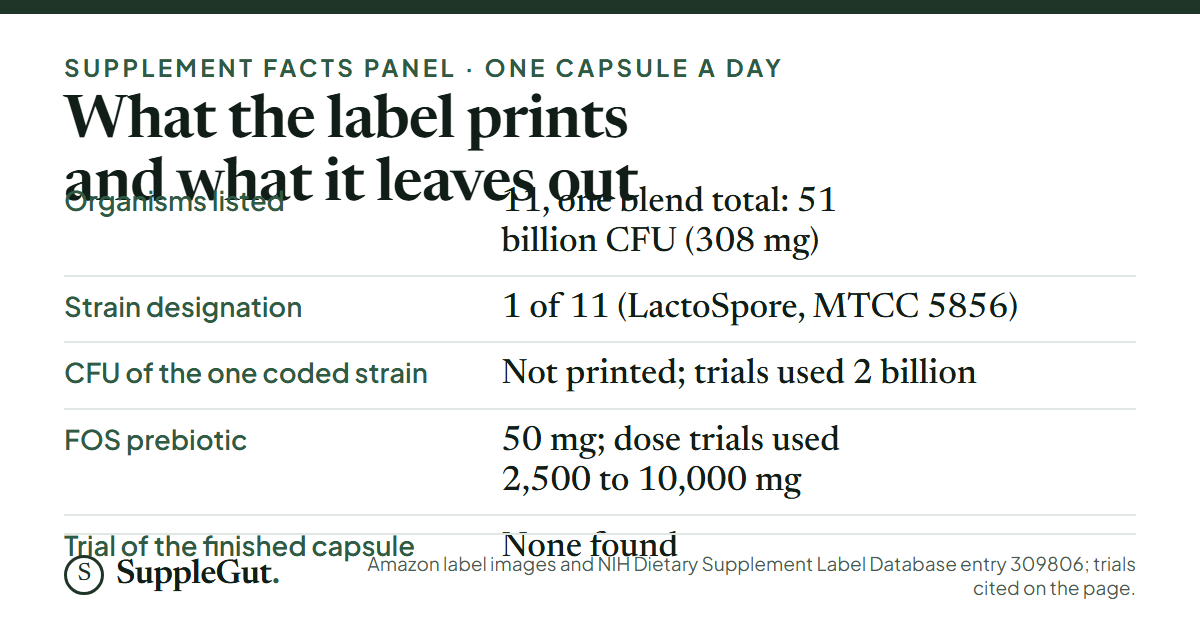
1MD Complete Probiotics Platinum is a once-a-day delayed-release capsule from 1MD Nutrition that lists eleven organisms, a single total of 51 billion CFU and a small amount of fructo-oligosaccharide (FOS) prebiotic. What separates it from the shelf next to it is the number of names on the panel; what limits what can be said about it is how few of those names are tied to a strain. This page sets out what the label prints, which trials exist for which part, how the review pools differ and what the brand’s billing and return terms say.
What Complete Probiotics Platinum is, and what it is not
The Supplement Facts panel lists one serving of one capsule, with 30 servings in a bottle. The panel shows a single line, Complete Probiotic Blend, 51 billion CFU (308 mg), with eleven organisms named beneath it: Lactobacillus acidophilus, Bifidobacterium lactis, B. longum, B. bifidum, L. plantarum, L. bulgaricus, L. casei, L. salivarius, LactoSpore (Bacillus coagulans MTCC 5856), L. gasseri and L. rhamnosus. Below the blend is 50 mg of NutraFlora FOS. The other ingredients are the delayed-release vegetable cellulose capsule, rice flour and silica. The bottle carries dairy-free, non-GMO, shellfish-free, peanut-free and wheat-free badges, and no “contains” statement.
The panel gives one CFU figure for the whole blend, not a count for each organism. Of the eleven, only LactoSpore carries a strain designation (MTCC 5856, a trademark of Sabinsa). The other ten are printed as species names alone. A species name does not identify a strain, and probiotic trials are tied to strains, so those ten cannot be matched to any published result from the label. Nor does the label say how much of the 51 billion CFU is the B. coagulans strain.
The label has changed. NIH’s Dietary Supplement Label Database holds three earlier entries for this product name. The 2021 entry lists the FOS at 100 mg and prints a code after each species (for example L61A after L. acidophilus and B42L after B. lactis); a 2022 entry carries the same codes. The 2024 entry, which matches the current bottle, lists 50 mg of FOS and no codes. We could not identify the codes in PubMed and could not tell whether they were strain designations or supplier catalog codes, so we make no claim about what changed in the capsule.
The trial of the product itself
There is none. We searched PubMed and ClinicalTrials.gov under “1MD Nutrition” and “Complete Probiotics Platinum” and found no record in either. The brand’s product page cites percentages of repeat customers who felt less gas, more regularity and less bloating; its footnote says they come from a 2021 survey of over 230 repeat customers who were compensated for taking part. A survey of people who kept buying the product is not a placebo-controlled trial. The brand page also quotes a gastroenterologist calling it “the most complete probiotic on the market”, which is a brand claim and not a finding.
The evidence for the organisms
The one coded strain. B. coagulans MTCC 5856 has three small placebo-controlled trials, all at 2 billion spores a day. In a trial in southern India, 70 adults with functional gas and bloating took the strain or placebo for four weeks; 66 completed. The GSRS indigestion score fell from 8.91 to 3.06 on the strain (P < .001) against 9.42 to 8.43 on placebo (P = .11), and no adverse events were reported (Majeed et al., Medicine (Baltimore), 2023). Two pilots used the same dose for 90 days: 36 patients with diarrhea-predominant IBS saw bloating, abdominal pain and stool frequency fall against placebo (Majeed et al., Nutrition Journal, 2016), and 40 patients with depression and IBS improved on depression and IBS quality-of-life scores (Majeed et al., Food & Nutrition Research, 2018). The abstracts do not state who funded them. A 2023 network meta-analysis of 81 trials in 9,253 adults with IBS ranked MTCC 5856 among the leading strains for abdominal pain and for stool form in diarrhea-predominant IBS, and found that only some probiotics help with particular outcomes (Xie et al., Nutrients, 2023). The strain’s trial history is also covered in the Biome Protect guide.
What the label cannot answer is whether this capsule delivers 2 billion spores of that strain. If the blend were split evenly across eleven organisms, each would get about 4.6 billion CFU, but the label does not say it is split that way, so the trial dose and the label dose cannot be compared.
The multi-strain class. A meta-analysis of 35 randomized trials in 3,452 adults with IBS found that multi-strain probiotics left fewer people with persistent symptoms (RR 0.79, 95% CI 0.70 to 0.89) and lowered bloating scores slightly (SMD −0.15), with somewhat more adverse events than placebo (RR 1.21, 95% CI 1.02 to 1.44). It concluded that multi-strain probiotics can improve IBS symptoms and that more research is required (Niu and Xiao, International Journal of Surgery, 2020). That is a result about named, tested mixtures in people with IBS, and it does not transfer automatically to ten unnamed strains.
The evidence for the FOS
NutraFlora is a short-chain FOS. In a dose-response trial in 40 healthy adults (eight per group), 2.5, 5, 7.5 or 10 g a day for seven days raised fecal bifidobacteria at every dose, and bloating was reported as more intense than placebo at 2.5 and 5 g but not at 7.5 or 10 g (Bouhnik et al., Nutrition Journal, 2006). A trial of 5 g a day for four weeks in 79 people with IBS found the main outcome similar to placebo (Azpiroz et al., 2017). The capsule holds 50 mg, which is one fiftieth of the lowest dose in the dose-response trial (2,500 mg). We found no trial of NutraFlora at 50 mg, so the amount here is a label figure with no trial at that size behind it.
The capsule and the testing claims
The label says only “delayed release vegetable cellulose capsule”. The brand page adds that the capsule is made to resist stomach acid so that the first dose “will reach your gut alive”. We found no capsule brand name and no survival test, so this is a brand claim. For testing, an image in the Amazon gallery says each batch is checked by a third-party lab for total aerobic count, yeast and mold, coliforms, Salmonella, E. coli, S. aureus, arsenic, cadmium, lead and mercury. It names no lab and gives no values. The checklist covers contamination; we found no count of live organisms in the finished capsule, although the brand says potency is guaranteed through the expiration date. The bottle shows a GMP mark and no NSF or USP seal.
How to take it
The label says one capsule once a day on an empty stomach or as a healthcare practitioner recommends, and adds that people with sensitivity concerns may prefer to take it with a small meal. No refrigeration is stated. The MTCC 5856 trials ran four weeks and 90 days, so a month of daily use is the shortest period that matches any trial of a part of this capsule.
Side effects and who should not take it
The bottle advises consulting a healthcare practitioner if you are pregnant or nursing, have a serious medical condition or use any medication, and the brand site adds under 18 to that list. It asks that use stop and a physician be consulted after any adverse reaction. Among reviewers, a minority report more gas, bloating or loose stools after starting, and Amazon’s summary of review text mentions severe diarrhea in some cases; side effects are one of its mixed-polarity topics, with 31 mentions. Pooled probiotic trials in IBS recorded slightly more adverse events than placebo, as noted above.
The doctors behind it
The brand’s product page says the capsule is “recommended by” a gastroenterologist, Dr. David Kahana, whose board certifications in pediatrics, gastroenterology and medical nutrition are listed on the brand’s Our Doctors page. An image on the Amazon listing calls the product “doctor-formulated”. The brand’s footer states that all doctors featured on the site are paid partners of 1MD Nutrition. We found no document that names a physician as the person who set the formula, and the brand’s own product page uses the word recommended, not formulated.
What the reviews say
Four pools, read separately. Amazon shows 4.4 from 5,504 ratings: 72% five-star, 13% four, 7% three, 3% two and 5% one. The brand’s own site shows 4.82 from 1,357 reviews through a hosted widget, 88% of them five-star. Those reviews span 2016 to 2026, and 813 are dated 2020 or earlier, before the earliest label entry above, so a large share of that pool covers earlier versions of the formula. Trustpilot shows 4.1 from 211 reviews, but that profile covers all 1MD products, not this capsule, and 34% of its reviews are one-star. The Better Business Bureau rates 1MD A+ and lists 48 complaints in three years, 12 of them in the last 12 months, with a customer-review average of 1.83 from 30 reviews.
The recurring praise, on Amazon and the brand site alike, is less bloating and gas, more regular bowel movements, and an easy once-a-day capsule that people stay on for years. Amazon’s summary lists effectiveness (487 mentions) and digestive health (204) as its largest positive topics. The recurring complaint is that nothing changed: about 17 of the 42 one- to three-star reviews on the brand site say so, some after months of use. Price comes up in about 10 of those 42, and Amazon’s value-for-money topic (175 mentions) is marked mixed. A few reviewers describe more gas or bloating, and a few report capsules arriving broken open.
Subscription and refund terms
Complaints about billing are the other pattern in the independent pools, and they are about the brand’s subscriptions rather than the capsule. Of 20 one- and two-star reviews we read on the Trustpilot page, 11 concern subscriptions or unwanted charges, for example orders continuing after a cancellation request or a one-time purchase treated as a subscription. Two more concern refunds and return labels. The most recent BBB complaint we read is about a subscription, a return label and a refund, and the brand’s reply on the page says the subscription was cancelled. On the product’s own widget, 19 of 1,357 reviews mention a subscription; some describe trouble stopping it, and many five-star reviews say the autoship arrives on time.
The brand’s written terms: its returns page says a subscription may be cancelled up to five days before the next scheduled shipment by contacting customer support, and that orders already shipped or scheduled to ship within five days cannot be cancelled. The product page says “easily pause or cancel online”. Single bottles can be bought without a subscription on the brand site and on Amazon. The brand states a 90-day money-back guarantee, and its two policy pages differ on the details. The refund policy page describes free returns with a prepaid label, 30 days to send the product back and a refund two to three business days after the warehouse logs it. The returns page says customers are responsible for the cost of shipping on all returns, that all bottles, opened, empty or unopened, must be sent back, and that refunds take 14 to 21 business days. Both say refunds apply only to purchases from the official 1MD site, and the returns page says product from unauthorized sellers does not qualify. The Amazon listing is marked non-returnable for food-safety reasons. We could not tell from the pages which version applies in practice.
Who it is for
- Someone who wants a once-a-day, multi-species probiotic with a spore-forming strain in it, and accepts that the label names one strain out of eleven and prints no per-organism count.
- Someone with gas, bloating or irregular bowel movements, the symptoms the reviews and the MTCC 5856 trials describe, who will take it daily for at least a month.
- Someone who buys single bottles or checks the cancellation window before starting a subscription.
Where a trial of the finished product matters more, Seed DS-01 has one, run by the brand. For a single spore-forming strain the Thorne Bacillus Coagulans page lists a one-species capsule, and Culturelle Digestive Daily is built on one named strain, the GG on its panel. To read a CFU figure, see how many CFU you need; for the symptom-first route, the quiz starts from what you notice.
Cost
One 30-capsule bottle is $49.00 on the brand site and on Amazon, which is $1.63 a day; the brand site adds $5.95 shipping on orders under $80, taking it to $1.83 a day for a single bottle. Three or six bottles bought once cost the same per bottle ($147.00 and $294.00). The brand’s subscription is $46.55 a bottle monthly ($1.55 a day), $41.65 every three months ($1.39 a day) or $36.75 every six months ($1.23 a day). Amazon Subscribe & Save is $46.55. A full bottle holds 1.5 g of FOS in total, less than the 2.5 g that was the lowest single-day dose in the dose-response trial.
The products in this catalog
Common questions
Does 1MD Complete Probiotics Platinum work?
No trial of the capsule was found. One of its 11 organisms, B. coagulans MTCC 5856, has small placebo-controlled trials at 2 billion spores a day for gas, bloating and IBS, but the label does not print how much of the 51 billion CFU that strain makes up. On Amazon 72% of 5,504 ratings are five-star; on the brand’s own widget 88% of 1,357 reviews are, and about 17 of the 42 one- to three-star reviews there say nothing changed.
What is in 1MD Complete Probiotics Platinum?
One capsule holds a 308 mg blend of 11 organisms with a single total of 51 billion CFU, plus 50 mg of NutraFlora FOS. Only LactoSpore (Bacillus coagulans MTCC 5856) has a strain designation; the other ten are species names. The other ingredients are the delayed-release vegetable cellulose capsule, rice flour and silica, and the bottle is marked dairy-free, non-GMO, shellfish-free, peanut-free and wheat-free.
What are the side effects of 1MD Complete Probiotics Platinum?
The label advises asking a healthcare practitioner first if you are pregnant or nursing, have a serious medical condition or use any medication, and the brand site adds under 18. Some reviewers report extra gas, bloating or loose stools, and Amazon’s summary of review text mentions severe diarrhea for a few. Pooled trials of multi-strain probiotics in IBS recorded slightly more adverse events than placebo (RR 1.21). See probiotic side effects.
How much does 1MD Complete Probiotics Platinum cost?
One 30-capsule bottle is $49.00 on Amazon and the brand site, which is $1.63 a day, plus $5.95 shipping on the brand site under $80. The brand’s subscription is $46.55 a bottle monthly ($1.55 a day), $41.65 every three months ($1.39 a day) or $36.75 every six months ($1.23 a day). Three- and six-bottle one-time packs cost the same per bottle as a single one.
How do I cancel a 1MD subscription or get a refund?
The brand’s returns page says a subscription can be cancelled up to five days before the next scheduled shipment by contacting customer support (support@1md.org or the number on the bottle), and orders already shipped or shipping within five days cannot be cancelled. It states a 90-day money-back guarantee for purchases from the official site. Its two policy pages disagree on who pays return shipping, and Trustpilot and BBB each list complaints about subscription charges and refund timing.
Complete Probiotics Platinum or Seed DS-01: which has the stronger evidence?
Seed DS-01 has a trial of the finished product, run by the brand; 1MD has none, and no trial compares the two. 1MD lists 11 organisms with one strain designation, one 51 billion CFU figure and 50 mg of FOS. See the Seed DS-01 page for its label.
Sources
- Majeed M, Nagabhushanam K, Paulose S, et al. "The effects of Bacillus coagulans MTCC 5856 on functional gas and bloating in adults: A randomized, double-blind, placebo-controlled study." Medicine (Baltimore), 2023;102(9):e33109. doi.org/10.1097/MD.0000000000033109
- Majeed M, Nagabhushanam K, Natarajan S, et al. "Bacillus coagulans MTCC 5856 supplementation in the management of diarrhea predominant Irritable Bowel Syndrome: a double blind randomized placebo controlled pilot clinical study." Nutrition Journal, 2016;15:21. doi.org/10.1186/s12937-016-0140-6
- Majeed M, Nagabhushanam K, Arumugam S, et al. "Bacillus coagulans MTCC 5856 for the management of major depression with irritable bowel syndrome: a randomised, double-blind, placebo controlled, multi-centre, pilot clinical study." Food & Nutrition Research, 2018;62. doi.org/10.29219/fnr.v62.1218
- Niu HL, Xiao JY. "The efficacy and safety of probiotics in patients with irritable bowel syndrome: Evidence based on 35 randomized controlled trials." International Journal of Surgery, 2020. PubMed 32014597
- Xie P, et al. Outcome-specific efficacy of different probiotic strains and mixtures in irritable bowel syndrome: systematic review and network meta-analysis. Nutrients, 2023. PubMed 37686889
- Bouhnik Y, Raskine L, Simoneau G, et al. "The capacity of short-chain fructo-oligosaccharides to stimulate faecal bifidobacteria: a dose-response relationship study in healthy humans." Nutrition Journal, 2006;5:8. PubMed 16569219
- Azpiroz F, et al. Randomized trial of short-chain fructo-oligosaccharides, 5 g a day for four weeks, in 79 people with irritable bowel syndrome, 2017. PubMed 27477485
- NIH Office of Dietary Supplements, Dietary Supplement Label Database: Complete Probiotics Platinum, label entries from 2021, 2022 and 2024. dsld.od.nih.gov/label/309806, 274796, 246726
- Brand pages: label, directions, price and subscription tiers 1md.org/products/complete-probiotics-platinum; refund policy 1md.org/policies/refund-policy; returns 1md.org/pages/returns; doctors 1md.org/pages/our-doctors
- Amazon listing: price, ratings and review summary. amazon.com/dp/B07QXMGD47
- Better Business Bureau profile bbb.org; Trustpilot, 1MD brand-wide profile trustpilot.com/review/www.1md.org
Not sure which product fits your situation?
This guide covers the mechanics. The quiz takes your specific symptoms, routine and preferences and matches you to one product from the catalog.
Take the quiz →