
Guide
Do Arrae Bloat Gummies work? A postbiotic trial at twice the label dose, and 5 g of fiber
Quick answer
Do Arrae Bloat Gummies work? We found no trial of the gummy itself. Its heat-treated Bifidobacterium longum postbiotic lowered IBS symptom scores in a 12-week trial of 200 adults with IBS-D at 50 mg a day, while the label has 25 mg a serving. Ginger has one small gastric-emptying study at a higher dose, no trial of lemon balm or dandelion root for bloating was found, and the 5 g of fiber sits at a dose where a trial recorded more bloating. Amazon shows 4.2 from 104 ratings.
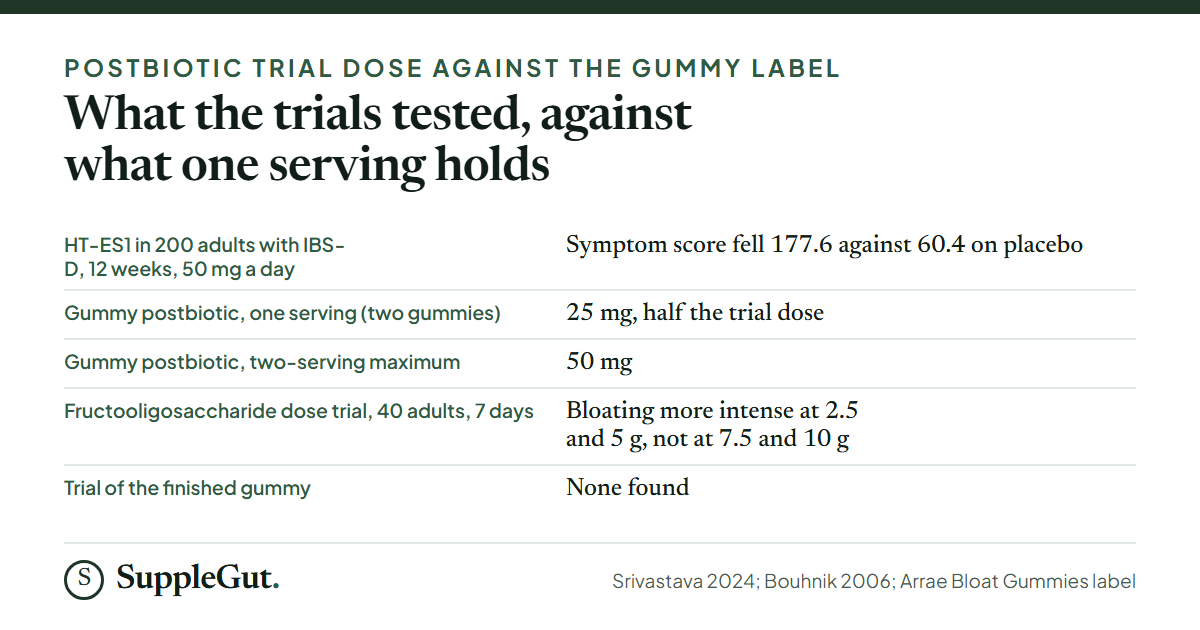
Arrae Bloat Gummies are a peach lemon gummy taken two at a time, holding ginger, a lemon balm and dandelion blend, a heat-treated Bifidobacterium postbiotic and 5 g of fiber. The postbiotic has one trial behind it, in people with IBS-D, at twice the amount this label prints for one serving. This page covers the label, that trial, the other ingredients, the reviews, the price and how the gummy differs from the brand’s capsules.
What Arrae Bloat Gummies are, and what they are not
The Supplement Facts panel gives a serving as two gummies, with 30 servings in the 60-gummy pouch. Each serving lists 10 calories, 6 g of carbohydrate, 5 g of dietary fiber (18% of the Daily Value), 0 g of total sugars and 25 mg of sodium. The actives are:
- Organic ginger (Zingiber officinale), 220 mg.
- A proprietary blend of 100 mg: organic lemon balm (Melissa officinalis) extract and organic dandelion (Taraxacum officinale) root extract. The panel does not print the two amounts separately.
- A postbiotic, Bifidobacterium longum CECT7347 heat-treated (ES1 HT), 25 mg. A postbiotic is a preparation of non-living bacteria, so this is not a live probiotic.
The other ingredients are short-chain fructooligosaccharides, L-arabinose (listed as Sukre), pectin, natural flavors, lactic, malic and citric acids, annatto extract for color and rebaudioside M, a stevia-derived sweetener. The gummy is sweetened, so it is a 0 g sugar product rather than an unsweetened one; the brand and Ulta also state no sugar alcohols.
The brand says in one FAQ that the gummies are sweetened with “a blend of prebiotic fibers like scFOS and acacia fiber,” but acacia fiber is not on the printed ingredient list, and the panel does not tie the 5 g to a named ingredient. The pouch front reads “clinically-studied for gut comfort” and the page uses the headline “1 hour to debloat,” both of which are the brand’s claims. The brand marks its percentage claims as “based on individual ingredient research.”
The gummy is not a gummy version of the brand’s capsule. It keeps the same 220 mg of ginger and changes the rest, as set out in the capsule comparison below.
Is there a trial of the gummies themselves?
We found none. Searches of PubMed and ClinicalTrials.gov for the postbiotic’s strain code and for the product turned up no trial of an Arrae product and no registered trial of the strain code. The one-hour relief claim cites no study on the page we read. The evidence sits with the individual ingredients, and the closest match to the label is the postbiotic.
The postbiotic trial: 200 adults with IBS-D, at twice this dose
The trial the brand cites is a randomized, double-blind, placebo-controlled study of 200 adults with diarrhea-predominant IBS (Rome IV criteria, with a baseline IBS Symptom Severity Score of 175 or higher), conducted in India. There were three arms: live B. longum CECT 7347, the heat-treated version (HT-ES1) and placebo. Participants took capsules once a day for 84 days, 12 weeks. The fall in the symptom severity score from baseline to day 84 was 177.6 points on HT-ES1 against 60.4 on placebo (p < 0.0001), with gains in IBS quality of life, abdominal pain, stool consistency and anxiety scores. The authors include employees of the strain’s maker and of a contract research organization (Srivastava et al., Gut Microbes, 2024).
Two things separate that trial from this label:
- The dose. The trial used 2.5 billion cells a day, which the full text gives as equivalent to 50 mg a day. The gummy has 25 mg a serving, half of that. Reaching 50 mg takes two servings, which is the brand’s stated daily maximum.
- The people. The participants had diagnosed IBS-D. The gummy is sold for occasional bloating, and the trial did not enroll that group.
The brand’s page also shows a chart reading “70% Bloating Severity Score Reduction vs. placebo” and says HT-ES1 improved the abdominal tightness and distension subdomain. We did not find that subdomain figure in the abstract or in the full-text passages we read.
A second trial gave HT-ES1 to 60 healthy adults with mild to moderate digestive symptoms for eight weeks. It reported “minimal changes” in gastrointestinal symptoms, with lower total and non-HDL cholesterol and more butyrate-producing bacterial genera than on placebo. It was partly funded by the strain’s maker (Naghibi et al., Nutrients, 2024).
So the postbiotic has one IBS-D trial with a clear symptom result at 50 mg a day, and one trial in people with milder symptoms where gut symptoms changed little. Neither tested a gummy.
Ginger, lemon balm and dandelion root
Ginger. The one trial of ginger and stomach emptying that we found was small: 11 patients with functional dyspepsia took 1.2 g of ginger or placebo in a crossover design before a soup meal. Half of the stomach contents emptied in 12.3 minutes on ginger and 16.1 on placebo, with “no impact on gastrointestinal symptoms or gut peptides” (Hu et al., World Journal of Gastroenterology, 2011). The label has 220 mg of ginger, a fraction of that dose, and the panel does not give the strength of the ginger.
Lemon balm and dandelion root. A PubMed check for human trials of dandelion root and of lemon balm for bloating or gut symptoms returned no randomized trial of either. A multi-herb liquid that includes lemon balm, known as STW 5 or Iberogast, has dyspepsia trials, but it is a different preparation and was not tested at 100 mg of two extracts (Melzer et al., Alimentary Pharmacology & Therapeutics, 2004).
The 5 g of fiber and what trials record about gas
Fructooligosaccharides are fermented by bacteria in the colon, which is why trials of them record gas and bloating as well as softer stool. The closest dose-response trial gave 40 healthy adults short-chain fructooligosaccharides at 2.5, 5, 7.5 or 10 g a day, or placebo, for seven days. Fecal bifidobacteria rose at every dose, and bloating was more intense at 2.5 and 5 g but not at 7.5 and 10 g; excess flatus, gut noises and abdominal pain did not differ from placebo (Bouhnik et al., Nutrition Journal, 2006). A 2024 meta-analysis of 17 trials with 713 people found that fructooligosaccharides raised bowel-movement frequency and softened stool in functional constipation, with mild bloating recorded as an adverse event (odds ratio 10.36, 95% CI 3.32 to 33.23) (Zhen et al., Foods, 2024).
Both findings are for the fiber class, not for this gummy, and the gummy’s fiber source is only partly stated. For a product sold for bloating, the point is that its 5 g serving sits at a dose where the dose-response trial recorded more bloating, and that the brand allows a second serving, which would bring the fiber to 10 g.
How to take it, and side effects
The brand’s directions are to take two gummies “anytime you feel bloated,” such as after meals, while traveling or before going out, and to take them as needed or daily. They do not require food. The brand’s FAQ says two gummies per serving give the full effect, that people who are sensitive to digestive supplements can start with one and work up, and that the limit is two servings (four gummies) a day.
We saw only the front of the pouch, so we have not read any warning printed on it. The brand’s FAQ advises checking with a doctor before starting a new supplement if you are pregnant, conceiving or breastfeeding, and again if your supplement routine is more complex. No medication warning was found. The Amazon review summary notes that some reviewers report severe cramps, and individual reviewers mention more bloating, gas and, in one case, a hot sensation on the tongue. The fiber and the sweeteners can also cause gas on their own. The allergen information is partial: Amazon says vegan and gluten-free, and Ulta lists the product as made without dairy, gluten, sugar, sugar alcohols, artificial dyes and tapioca syrup, which does not cover soy, tree nuts, eggs or the other major allergens by name.
The brand links a third-party certificate of analysis from each ingredient tile. The file we opened is an image that names no laboratory in readable text, and no NSF or USP mark appears on the page.
What the reviews say
Three sets of ratings exist, and they come from different places:
- Amazon: 4.2 out of 5 from 104 ratings. The split is 72% five-star, 6% four, 7% three, 3% two and 12% one. The seller is Arrae.
- Ulta: 4.8 out of 5 from 50 reviews, for the 28-count pack.
- The brand’s own page: 4.57 out of 5 from 791 reviews, collected by a review app the brand runs. In the newest 304 reviews we could page through, all are flagged as verified buyers and 286 are flagged “rewarded” by the review app, which marks reviews left in exchange for an incentive. The flag does not say what the incentive was.
Amazon’s summary of review text says customers find the gummies effective and like the taste, that opinions on digestive effects are mixed (some say they ease bloating, others report severe cramps), and that opinions on value are divided.
Praise in the reviews centers on bloating easing, sometimes in 30 minutes to an hour; on a peach lemon taste with a hit of ginger; and on a resealable pouch. Some reviewers who had tried the capsules say the gummies work faster for them. Complaints fall into three groups: no effect, or more bloating (“they caused 3x amount of bloating,” one 1-star review reads); price, including a 1-star review that the brand charges about double what Ulta does, which compares a 60-count pack with a 28-count pack; and delivery and customer service, such as orders that had not arrived and slow replies to email. Of the 304 newest reviews, 10 mention that the gummies did nothing or did not work, and 7 mention a subscription, cancellation or refund. We found no pattern of unwanted charges in that sample, but the sample is the newest reviews only, and we found no independent billing or refund record for the brand.
Price across Amazon, the brand site and Ulta
A serving is two gummies, so a 60-gummy pouch is 30 servings.
| Where | Pack | Price | Per day at one serving |
|---|---|---|---|
| Amazon | 60 gummies | $39.99 | $1.33 |
| Brand site, one time | 60 gummies | $45.00 | $1.50 |
| Brand site, 3-month delivery | 3 x 60 gummies | $135.00 | $1.50 |
| Brand site, one pack | 28 gummies | $25.00 | $1.79 |
| Ulta | 28 gummies | $19.99 | $1.43 |
The brand’s one-month and three-month delivery options carry the same per-serving price as a one-time purchase in the page data, and the product page gives no cancellation terms. Ulta lists 5% off a first subscription order and 5% off recurring orders, with cancellation at any time. We did not read the brand’s refund policy. At the two-servings-a-day maximum, every figure above doubles.
Gummies or capsules
The gummy and the capsule share one ingredient amount and differ on nearly everything else.
| Bloat Gummies | Bloat Capsules | |
|---|---|---|
| Ginger | 220 mg | 220 mg |
| Second blend | 100 mg: lemon balm, dandelion root | 1,080 mg: dandelion root, lemon balm, peppermint leaf, bromelain, slippery elm |
| Postbiotic | 25 mg heat-treated B. longum | None |
| Fiber | 5 g | None printed |
| Sweeteners | Rebaudioside M, fructooligosaccharides, L-arabinose | None |
| Serving | 2 gummies | 2 capsules |
| Servings per container | 30 | 30 |
The brand’s own FAQ says the gummies are built around many of the same herbal ingredients as the capsules, with the addition of fiber and a clinically studied postbiotic. Neither version has a trial of the finished product. Some reviewers prefer one form and some the other. The capsule’s label, price and reviews are on the Arrae Bloat Capsules page.
Who Arrae Bloat Gummies are for
- Someone who wants a chewable rather than a capsule and likes ginger in a peach lemon flavor.
- Someone who wants the heat-treated B. longum postbiotic and accepts that its trial used 50 mg a day in IBS-D, against 25 mg a serving here.
- Someone comfortable adding 5 g of fructooligosaccharide fiber a serving, with the option of starting at one gummy, as the brand says.
- Someone who wants a product with no sugar and accepts that it is sweetened with rebaudioside M and fiber sweeteners.
For other bloating products with their own labels and trials, see the Lemme Debloat guide, the Lemme Debloat gummies page and Olly Beat the Bloat. Ginger root capsules carry ginger alone. The quiz starts from the symptom instead of the product.
The products in this catalog
Common questions
Do Arrae Bloat Gummies work?
No trial of the gummy was found. Its postbiotic, HT-ES1, lowered IBS symptom scores in a 200-adult trial in IBS-D at 50 mg a day, while the gummy has 25 mg a serving. On Amazon the gummies hold 4.2 from 104 ratings, and the review summary says some reviewers find them effective while others report severe cramps.
What is in Arrae Bloat Gummies?
Two gummies hold 220 mg of organic ginger, a 100 mg blend of lemon balm and dandelion root extracts, 25 mg of heat-treated Bifidobacterium longum CECT7347 (HT-ES1) and 5 g of dietary fiber, with 0 g of sugars and 10 calories. They are sweetened with rebaudioside M, fructooligosaccharides and L-arabinose.
How many Arrae Bloat Gummies can you take a day?
A serving is two gummies. The brand says they can be taken as needed or daily, that people sensitive to digestive supplements can start with one gummy, and that the maximum is two servings (four gummies) a day. Food is not required.
How much do Arrae Bloat Gummies cost per day?
A 60-gummy pouch is 30 servings. It is $45.00 on the brand site and $39.99 on Amazon, about $1.50 and $1.33 a day at one serving. Ulta sells a 28-count at $19.99 (14 servings, about $1.43 a day). At the two-servings-a-day maximum, the cost doubles.
Do Arrae Bloat Gummies cause side effects?
Some reviewers mention cramps, more bloating, gas and a hot sensation on the tongue, and the fiber can cause gas on its own. The brand advises checking with a doctor if you are pregnant, conceiving or breastfeeding. We did not read the brand’s refund policy; Amazon and Ulta follow their own return rules.
Arrae Bloat Gummies or Bloat Capsules: what is the difference?
Both carry 220 mg of ginger. The gummy has a 100 mg lemon balm and dandelion blend, 25 mg of a heat-treated Bifidobacterium postbiotic and 5 g of fiber. The capsule has a 1,080 mg blend that includes peppermint, bromelain and slippery elm, and no postbiotic or fiber. Neither has a trial of the finished product.
What do the reviews say, and are any of them incentivized?
Amazon shows 4.2 from 104 ratings and Ulta 4.8 from 50. The brand’s own page shows 4.57 from 791, and 286 of the newest 304 reviews there are flagged “rewarded” by the review app, which marks reviews left in exchange for an incentive.
Sources
- Srivastava S, Basak U, Naghibi M, et al. “A randomized double-blind, placebo-controlled trial to evaluate the safety and efficacy of live B. longum CECT 7347 (ES1) and heat-treated B. longum CECT 7347 (HT-ES1) in participants with diarrhea-predominant irritable bowel syndrome.” Gut Microbes, 2024;16(1):2338322. PubMed 38630015
- Naghibi M, Pont-Beltran A, Lamelas A, et al. “Effect of Postbiotic B. longum CECT 7347 on Gastrointestinal Symptoms, Serum Biochemistry, and Intestinal Microbiota in Healthy Adults: A Randomised, Parallel, Double-Blind, Placebo-Controlled Pilot Study.” Nutrients, 2024;16(22). PubMed 39599737
- Hu ML, Rayner CK, Wu KL, et al. “Effect of ginger on gastric motility and symptoms of functional dyspepsia.” World Journal of Gastroenterology, 2011;17(1):105–110. PubMed 21218090
- Bouhnik Y, Raskine L, Simoneau G, et al. “The capacity of short-chain fructo-oligosaccharides to stimulate faecal bifidobacteria: a dose-response relationship study in healthy humans.” Nutrition Journal, 2006;5:8. PubMed 16569219
- Zhen H, Qian H, Liu X, et al. “Fructooligosaccharides for Relieving Functional Constipation: A Systematic Review and Meta-Analysis of Randomized Controlled Trials.” Foods, 2024;13(24). PubMed 39766936
- Melzer J, Rösch W, Reichling J, et al. “Meta-analysis: phytotherapy of functional dyspepsia with the herbal drug preparation STW 5 (Iberogast).” Alimentary Pharmacology & Therapeutics, 2004;20(11–12):1279–1287. PubMed 15606389
- Arrae Bloat Gummies: brand product page, product data, Supplement Facts panel image, FAQ and prices. arrae.com
- Amazon listing for Arrae Bloat Gummies (ASIN B0GWLVHY1F): price, ratings, star split and review summary. amazon.com
- Ulta Beauty listing for Bloat Gummies, 28 ct: price, ratings and formulated-without list. ulta.com
- Arrae Bloat capsules: brand product page, for the capsule comparison. arrae.com
Not sure which product fits your situation?
This guide covers the mechanics. The quiz takes your specific symptoms, routine and preferences and matches you to one product from the catalog.
Take the quiz →