Guide
Does Banyan CCF tea work? Cumin, coriander and fennel in one 3,840 mg line, and what the seed trials used
Quick answer
Does Banyan CCF tea work? No trial tested this blend. Cumin has a 57-person IBS pilot of its essential oil with no placebo group, fennel has a 159-person tea trial after surgery at 5 g of fruit a cup, and we found no human gut trial of coriander. The pouch prints one 3,840 mg proprietary-blend line for 2 teaspoons of the three seeds, with no per-seed weight. Amazon shows 4.6 from 856 ratings, and Banyan’s own widget shows 4.71 from 70 reviews.
Banyan Botanicals CCF Tea is a caffeine-free loose tea of cumin, coriander and fennel seeds, sold in half-pound and 3.5 oz pouches. The pouch prints a Supplement Facts panel with one 3,840 mg proprietary-blend line for the three seeds, and calls them well-known digestive spices in Ayurveda. This page covers the panel, what the trials of each seed used, the Prop 65 line on one listing, the detox wording and the price of a serving.
One 3,840 mg line for three seeds
The half-pound pouch and the 3.5 oz pouch print the same panel:
| Line on the panel | As printed |
|---|---|
| Serving size | 2 tsp (3.8 g) |
| Servings per container | 60 (half pound), 25 (3.5 oz) |
| Proprietary blend | 3,840 mg, daily value not established |
| Within the blend | Cumin seed Cuminum cyminum, coriander seed Coriandrum sativum, fennel seed Foeniculum vulgare, all certified organic |
| Amount of each seed | Not printed |
Three seeds in equal parts would put each near 1,280 mg, but the label does not say they are equal. For scale, the Traditional Medicinals fennel tea prints 2,000 mg of fennel alone in a bag. The pouch states certified organic by QAI and “Made in India,” and the brand page adds vegan, gluten free and caffeine free.
The servings figure differs by source. The pouch label says 60 servings in the half pound, which matches 227 g divided by 3.8 g. Banyan’s product page text says 44, and Amazon’s title says 90 servings on the basis of one teaspoon. We use the pouch. The page’s brew volume of 2 cups matches the pouch’s 16 oz.
The three seeds in Ayurvedic practice
Ayurveda, the traditional medicine of India (our overview), describes digestion as agni, a fire that the texts say can be strong or weak. Banyan’s page places the three seeds in that vocabulary. It gives the blend’s taste (rasa) as sweet, pungent and bitter, its action (virya) as cooling and its effect after digestion (vipaka) as pungent, and says the blend “strengthens the digestive fire without aggravating pitta,” pitta being the dosha the tradition links with heat and transformation. It adds that strong digestion helps prevent the accumulation of vata, pitta, kapha and ama, which the page glosses as toxins. The page does not call the blend tridoshic, and it names no Sanskrit herb names for the seeds.
These are the tradition’s categories for describing a herb and a body, and they are the brand’s reading of them. We found no trial that measured agni, a dosha or ama. Reviewers describe meeting CCF through a Panchakarma retreat and through practitioners, so the use has a practice behind it as well as a label. What the human trials measured is below.
Cumin: an oil pilot and a post-surgery trial
The cumin evidence is two small studies. A pilot case series gave 57 people with IBS 20 drops a day of cumin essential oil for 4 weeks, with 4 more weeks of follow-up and no placebo group. Abdominal pain, bloating, incomplete defecation, urgency and mucus decreased during and after treatment, and stool consistency and frequency improved in the constipation-predominant group (Middle East Journal of Digestive Diseases, 2013). The second was a triple-blind trial in 74 patients after abdominal surgery, who took 250 mg cumin extract capsules or starch placebo. First gas came at 9.03 against 11.72 hours and first defecation at 16.97 against 26 hours (BMC Complementary Medicine and Therapies, 2024). The abstract prints its p value as “>0.001,” which looks like a typing slip for “<”. One tested an oil and the other an extract, and neither tested seeds steeped in water.
Fennel: the only tea trial
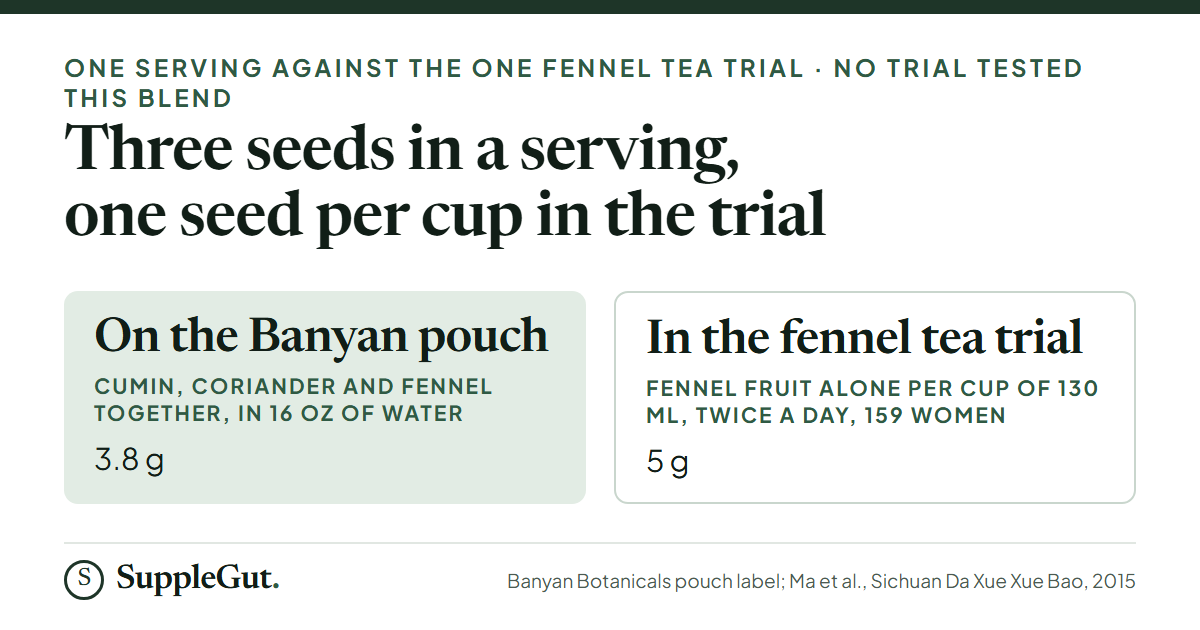
Fennel has the tea evidence. In 159 women recovering from gynecologic cancer surgery, fennel fruit tea (5 g of dried fruit in 130 mL, twice a day) against water brought first flatus at 53.1 against 64.2 hours, first defecation at 4.3 against 5.4 days and hospital discharge at 5.6 against 6.7 days, all p < 0.001 (Ma et al., Sichuan Da Xue Xue Bao, 2015). A Banyan serving holds 3.8 g of three seeds, so even if all of it were fennel it would sit below one trial cup, and it is made in 16 oz of water rather than 130 mL.
Other fennel studies used other forms. A capsule combining curcumin with fennel essential oil, in 121 people with IBS, lowered the IBS symptom score by 50.05% against 26.12% on placebo over 30 days (PubMed 27308645). Fennel capsules and dimethicone both reduced flatulence after cesarean section with no difference between them (PubMed 39309989). A fennel seed oil emulsion in 125 infants with colic eliminated colic in 65% against 23.7% on placebo, an infant study of an oil that does not carry over to an adult tea (PubMed 12868253). A registered trial of fennel tea against ginger tea and chewing gum after cesarean section planned 96 women and has posted no results (NCT07125742). Our fennel tea guide reads these in more detail.
Coriander and the blend as a whole
Searches on Coriandrum sativum with IBS, dyspepsia and trial returned no human gut trial of coriander seed. No study we found tests cumin, coriander and fennel together, as a tea or in any form, and PubMed and ClinicalTrials.gov list nothing on this product. The ClinicalTrials.gov studies that did use Banyan products, from the University of California Davis, involved tablets or powders such as triphala, not CCF.
The detox wording
Banyan’s page says CCF is famous in Ayurveda for supporting healthy digestion, soothing common digestive discomforts and supporting the body’s natural ability to detox. It calls the tea a “traditional Ayurvedic tea that supports gentle cleansing” and says it is “equally beneficial during an Ayurvedic cleanse or for simple daily sipping.” Each line ends with the FDA asterisk. These are brand claims. We found no trial of detoxification with these seeds, and the blend contains no laxative herb such as senna or cascara.
Safety, the Prop 65 line and testing
The pouch asks anyone who is pregnant, nursing, taking medications or living with a medical condition to consult a health care practitioner first, and carries the standard FDA statement. Vitacost’s listing prints “Reproductive Harm. Prop 65.” under warnings for the half-pound pouch. Prop 65 is California’s warning law, and Banyan’s quality page says it adds the warning to products sold in that state. The listing names no substance, and we did not see the line in the text of Banyan’s own CCF page.
Banyan states that its herbs and products are tested for arsenic, cadmium, lead and mercury at independent third-party laboratories, and for microbes. The statement is company-wide. We found no certificate, result, lab name or batch number for CCF Tea, and the CCF page does not repeat the statement.
Cumin, coriander and fennel all belong to the Apiaceae (celery) family, and the pouch says nothing about celery-family allergy; that is a point of botany, not a label statement. No “contains” or facility statement is printed for milk, wheat, egg, soy, tree nuts, fish or sesame. The published metal surveys of Ayurvedic products, such as the 2008 JAMA survey with its 20.7% detectable-metal rate (Saper et al.), looked at medicines, and the finding concerns that category and not culinary seeds. Our guide to Ayurvedic supplement safety lists what a buyer can check.
Preparing a cup
The pouch says to combine 2 teaspoons with 16 oz of hot water, steep 5 to 10 minutes and strain, any time. For a stronger tea, boil 2 teaspoons in 2 cups for 5 to 10 minutes. Sun tea uses 3 tablespoons in 6 cups for 2 to 6 hours. Banyan gives no number of cups a day and suggests mealtimes or sipping through the day. One Amazon reviewer notes that boiling the seeds leaves a strong smell in the house.
Ratings and review text
Banyan’s page runs the Judge.me review app and shows 4.71 from 70 reviews (63 five-star, 4 three-star, 3 one-star). That feed is hosted by the brand, and staff reply to critical reviews and offer refunds. Amazon shows 4.6 from 856 ratings on the half-pound listing (81% five-star, 3% one-star) and 4.6 from 87 on the 3.5 oz listing. Both Amazon listings are run by Banyan on Amazon’s platform. Amazon’s summary counts 59 quality mentions (57 positive), 48 on taste (36 and 12), 33 on healthiness (all positive), 31 on digestive effects (28 positive, 3 negative) and 14 on value (11 and 3). Vitacost holds 7 reviews, all imported from iHerb, and Trustpilot’s unclaimed brand-wide profile holds 8.
- Praise: less bloating and gas after meals, a mild and balanced flavor, and fresh-tasting seeds.
- Complaints: a taste or smell some do not like, a three-star reviewer who says it did not work as a practitioner suggested, and a few who find the price high.
Price per serving
| Where | Price | Servings | Per serving |
|---|---|---|---|
| Banyan, half pound | $21.99 | 60 | $0.37 |
| Banyan, 3.5 oz | $14.99 | 25 | $0.60 |
| Amazon, half pound, Subscribe & Save | $19.79 or $18.69 | 60 | $0.33 or $0.31 |
| Vitacost, half pound | $21.99 | 60 | $0.37 |
A serving is a 16 oz brew, so two 8 oz cups, which is about $0.18 a cup from the half-pound pouch. At the brand page’s own 44 servings the half pound would be $0.50. Banyan lists AutoShip at 15% off, free shipping over $60, a satisfaction guarantee and a 90-day return policy, and its staff replies show refunds given to two reviewers.
Who CCF tea suits
- Someone who likes a savory, mild seed tea to sip with meals or in the evening.
- Someone who wants the Ayurvedic framing with Latin names printed and a brand that teaches the vocabulary.
- Someone comfortable with a blend line in place of per-seed weights.
A reader who wants a single seed with a printed weight can compare the Traditional Medicinals fennel tea above. Banyan’s Vata Digest is another of its Ayurvedic digestive products, in tablet form.
Products this guide draws on
Common questions
Does Banyan CCF tea work for bloating?
Banyan says the tea supports digestion and a comfortable post-meal experience, and reviewers mention less bloating: on Amazon, 28 of 31 mentions of digestive effects are positive. No trial tested this blend. The nearest evidence is a 57-person IBS pilot of cumin oil without a placebo group and trials of fennel tea after surgery.
What is CCF tea, and why is it called that?
CCF is Banyan’s abbreviation for cumin, coriander and fennel. The pouch calls them well-known digestive spices in Ayurveda, the traditional medicine of India, and prints the Latin names Cuminum cyminum, Coriandrum sativum and Foeniculum vulgare. The page gives no Sanskrit names for the seeds.
Is CCF tea a detox tea?
Banyan describes it as supporting “gentle cleansing” and the body’s natural ability to detox, which are brand claims. The blend is three culinary seeds with no laxative herb, and we found no trial of detoxification.
Why does the Vitacost listing show a Prop 65 warning?
Vitacost prints “Reproductive Harm. Prop 65.” under warnings for the half-pound pouch, without naming a substance. Banyan’s testing page says it adds the California warning to products sold in that state. We did not see the line in the text of Banyan’s own CCF page.
How much does a serving of Banyan CCF tea cost?
The half-pound pouch is $21.99 at Banyan, Amazon and Vitacost, which is $0.37 for each 2-teaspoon serving at the label’s 60 servings. The 3.5 oz pouch is $14.99 for 25 servings, about $0.60. AutoShip takes 15% off at Banyan.
How do I brew it, and how many cups a day?
The pouch says to steep 2 teaspoons in 16 oz of hot water for 5 to 10 minutes and strain. For a stronger cup, boil 2 teaspoons in 2 cups for 5 to 10 minutes. Banyan gives no cups-a-day figure and suggests mealtimes or sipping through the day.
Does the tea contain caffeine or a laxative herb?
Neither. The pouch lists only cumin, coriander and fennel seed, all certified organic, and the brand calls the tea caffeine free.
Sources
- Pilot case series of cumin essential oil in 57 people with IBS (Rome II), 4 weeks plus 4 weeks of follow-up, no placebo group. Middle East Journal of Digestive Diseases, 2013. PubMed 24829694
- Triple-blind randomized trial of cumin extract capsules after abdominal surgery (74 patients). BMC Complementary Medicine and Therapies, 2024. PubMed 38965524
- Ma H-W, Zhao J-T, Zhao X. “The effect of fennel tea drinking on postoperative gut recovery after gynecological malignancies operation.” Sichuan Da Xue Xue Bao Yi Xue Ban, 2015;46(6):940–943. PubMed 26867333
- Randomized trial of curcumin with fennel essential oil in irritable bowel syndrome (121 people). Journal of Gastrointestinal and Liver Diseases, 2016. PubMed 27308645
- Double-blind comparison of fennel capsules and dimethicone for flatulence after cesarean section. Journal of Education and Health Promotion, 2024. PubMed 39309989
- Fennel seed oil emulsion in infantile colic (125 infants). Alternative Therapies in Health and Medicine, 2003. PubMed 12868253
- Registered trial of fennel tea against ginger tea, chewing gum and no intervention after cesarean section. ClinicalTrials.gov NCT07125742
- Saper RB, Phillips RS, Sehgal A, et al. “Lead, mercury, and arsenic in US- and Indian-manufactured Ayurvedic medicines sold via the Internet.” JAMA, 2008;300(8):915–923. PubMed 18728265
- Banyan Botanicals CCF Tea: product page and pouch label images (panel, directions, Ayurvedic description, price, reviews, return policy). banyanbotanicals.com
- Banyan Botanicals: herbs quality control and testing page. banyanbotanicals.com
- Amazon listings for Banyan CCF Tea: half pound (ASIN B06XBPG62G) and 3.5 oz (ASIN B0CL1DGXD1), with price, ratings and review summary. amazon.com/dp/B06XBPG62G
- Vitacost listing for Banyan CCF Tea (warnings, price, imported reviews). vitacost.com
Not sure which product fits your situation?
This guide covers the mechanics. The quiz takes your specific symptoms, routine and preferences and matches you to one product from the catalog.
Take the quiz →