Guide
Does fennel tea help bloating and gas? One tea trial at 5 g a cup, against a 2 g Traditional Medicinals bag
Quick answer
Does fennel tea help bloating and gas? Nothing found tested a fennel tea bag on everyday bloating or gas. The one fennel tea trial, in 159 women after surgery for gynecologic cancer, used 5 g of fennel fruit a cup and found earlier first flatus; this bag holds 2 g. Trials in infants and in IBS used fennel oil or extract, not tea. Amazon shows 4.7 from 1,945 ratings.
Traditional Medicinals Organic Fennel Tea is a one-herb bag: 2,000 mg of organic fennel fruit, which is the seed, and nothing else. The brand sells it for gas, bloating and a full feeling after meals. This page sets the fennel research beside what is in the bag. There is one trial of fennel tea, in surgery patients, at a larger dose; there are trials of fennel oil in infants and adults; there is a 2025 laboratory study on animal tissue. Nothing found tested a fennel tea bag on everyday bloating.
What one bag holds
The box reads “Fennel, Sweet & Herbal,” carries the line “Relieves Gas + Bloating,” and holds 16 wrapped bags in a 32 g (1.13 oz) carton. It is printed “Herbal Supplement,” and the brand’s Supplement Facts panel has a single row: organic fennel fruit, 2,000 mg per tea bag, with no daily value established. That matches the carton weight, 32 g across 16 bags, or 2 g a bag. A serving is one bag in 8 fluid ounces of water. No sweetener, flavor, caffeine or second herb is listed, and the box says “All Ingredients Certified Organic.”
The brand states USDA organic (CCOF), Non-GMO verified and kosher status. We saw no testing laboratory named and no certificate of analysis. The brand’s herb card calls fennel a carminative and a galactagogue, says the tea is made from the bitter fennel fruit, and credits two compounds in the seed: anethole, which gives the licorice-like taste, and fenchone, which the brand says “helps to calm discomfort.” The panel gives the weight of seed per bag. It gives no figure for how much of that oil ends up in a cup.
The one fennel tea trial: women recovering from cancer surgery
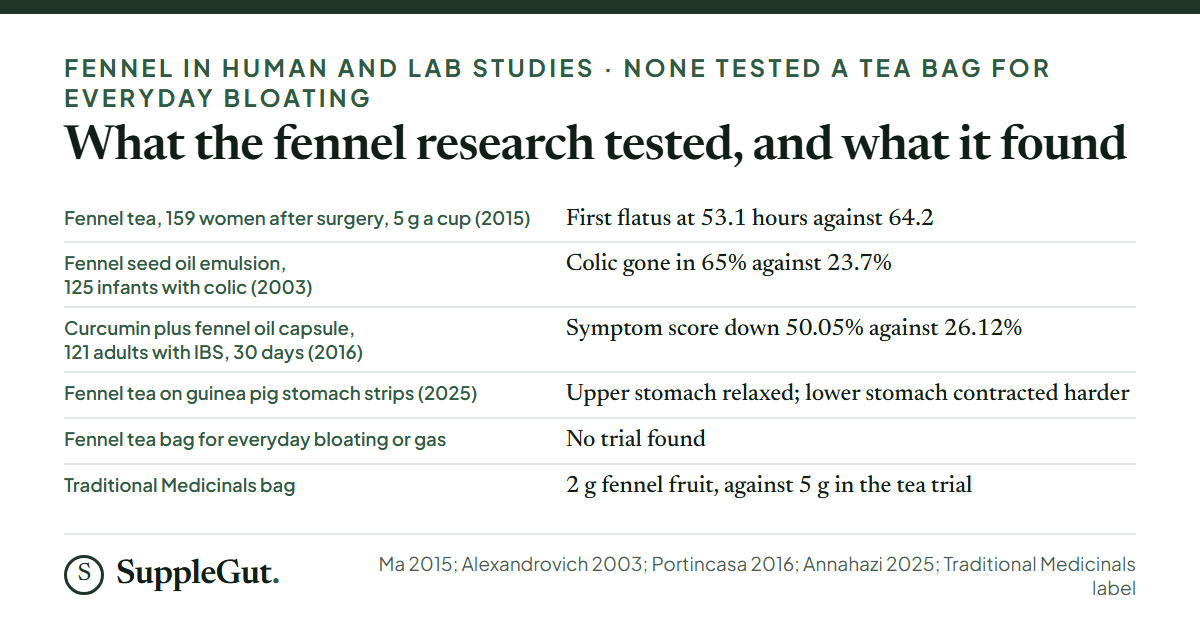
A single randomized trial gave people fennel tea. It enrolled 159 women who had abdominal surgery for gynecologic cancer, 78 in the tea group and 81 in the control group. Starting the morning after the operation and continuing until the first passage of gas, the tea group drank a cup of fennel fruit tea twice a day and the control group drank the same amount of water. Each cup was 5 g of dried fennel fruit in 130 mL of boiled water, and only the filtrate was drunk.
The tea group passed gas sooner (53.1 hours against 64.2), had a bowel movement sooner (4.3 days against 5.4) and went home sooner (5.6 days against 6.7), all with P below 0.001. Symptoms of ileus, a temporary stall of the bowel, were 2.6 times as common in the control group (95% confidence interval 1.5 to 4.5). This is the only trial of fennel tea found (Ma et al., Sichuan Da Xue Xue Bao Yi Xue Ban, 2015; the paper is in Chinese, with an English abstract).
Two features set it apart from a cup at home. The outcome was bowel recovery after an operation, a different problem from bloating after dinner. And the dose was larger: 5 g of fennel fruit a cup against 2 g in this bag. Two trial cups a day is 10 g of fruit. Three bags a day, the most the brand directs, is 6 g.
The trial result belongs to a 5 g cup in post-surgery patients. It does not show what a 2 g bag does for a healthy adult’s bloating, and the paper does not say.
Fennel oil and extracts: colicky infants and adults with IBS
The rest of the human trials used oil or extract, not tea.
- Infant colic, fennel seed oil emulsion. In 125 infants aged 2 to 12 weeks, colic was gone by the Wessel criteria in 65% (40 of 62) of those given the emulsion against 23.7% (14 of 59) on placebo, with no side effects reported (Alexandrovich et al., Alternative Therapies in Health and Medicine, 2003).
- Infant colic, a three-herb extract. In 93 breastfed infants, a standardized extract of chamomile, fennel and lemon balm taken for a week cut daily crying from about 201 minutes to about 77, against 199 to 170 on placebo (Savino et al., Phytotherapy Research, 2005). Fennel cannot be separated from the other two herbs here.
- Adults with IBS, fennel oil plus curcumin. In 121 adults with mild-to-moderate IBS, two capsules twice a day for 30 days lowered the relative symptom score by 50.05% against 26.12% on placebo, and 25.9% were symptom-free against 6.8%. The authors include employees of the capsule’s maker, and the effect cannot be split between the fennel oil and the curcumin (Portincasa et al., Journal of Gastrointestinal and Liver Diseases, 2016).
A systematic review of 15 trials of complementary medicines for infant colic found “encouraging results” for fennel extract and mixed herbal tea, while stating that all the trials had major limitations and that independent replications were missing (Perry et al., Pediatrics, 2011). Infants are a different group from adults drinking a cup after a meal, and a measured dose of oil is a different thing from a steeped bag.
From guinea pig tissue to a mug at home
A 2025 laboratory paper tested freshly brewed fennel tea on strips of guinea pig stomach wall. At concentrations from 0.78 to 100 microliters per milliliter, the tea relaxed the upper stomach (fundus and corpus) and increased the strength of contractions in the lower part (antrum). The authors link that pattern to functional dyspepsia, the medical name for recurring indigestion without a structural cause, and describe the clinical evidence for fennel as scarce (Annaházi et al., Neurogastroenterology & Motility, 2025). It was animal tissue in a dish, not people, and the fennel tea was applied directly to the strips rather than swallowed, and it does not say how much tea reaches the stomach or what a person would feel.
A PubMed search found no trial of fennel tea for bloating, gas or IBS in adults. The evidence comes in four separate pieces: a tea at 5 g in surgery patients, oils and extracts in infants and in IBS, tissue from an animal, and a long tradition of eating the seeds after meals. No piece covers a 2 g bag drunk for ordinary bloating.
Making a cup
The brand’s directions: pour 8 oz of freshly boiled water over one bag, cover, steep 10 to 15 minutes, squeeze the bag, and drink one to three cups a day. Its FAQ says the tea can be drunk daily and singles out the time after meals. The trial’s method differed: 5 g of fruit went into 130 mL of water, a much stronger infusion than one 2 g bag in a full 8 oz cup, and only the liquid was drunk. Reviewers describe drinking it hot after a meal, before bed because it has no caffeine, and iced.
Pregnancy, nursing and the parsley-family warning
Two statements about nursing sit side by side. The brand’s product page tags the tea “Pre & Postnatal,” lists “galactagogue” among fennel’s herbal actions, and says fennel has traditionally been used to support breastmilk production in nursing mothers. The label’s own warning says: consult your healthcare practitioner prior to use if you are pregnant or breastfeeding. The tea carries both.
The label also says not to use the product if you are allergic to plants in the parsley (Apiaceae) family, and the Amazon listing adds “such as fennel or dill.” Celery, carrot and parsley belong to that family. One Amazon reviewer reports being allergic to this tea. The panel prints no medication warning.
What buyers report
On one Amazon listing the tea shows 4.7 out of 5 from 1,945 ratings: 86% five-star, 8% four, 4% three, 0% two and 2% one. A second Amazon listing, sold by Amazon.com, shows 4.6 from 589. iHerb lists 4.7 from 2,200 reviews. The brand’s own site runs a review app showing 4.48 from 29 reviews, all marked verified buyer; that feed is hosted by the brand.
Amazon’s summary of review text counts 129 mentions of flavor (110 positive, 19 negative) and 109 of digestibility (101 positive, 8 negative). Buyers praise a settled stomach and less bloating after eating, a sweet anise-like flavor, and a caffeine-free cup that works hot or iced. The complaints are the licorice taste, which some find too strong; bags that some call weak or pricey; staples that came loose on one listing; and the one allergic reaction above. We found no pattern of subscription or refund complaints.
Several buyers say they could not find the tea in local stores, were pointed to it by someone for digestion, or bought it for a relative. The brand-site reviews run from 2015 into 2026. The brand-site score is based on 29 reviews, so it moves more with each added rating than the Amazon and iHerb scores do.
What a cup costs
| Where | Price | Bags | Per cup |
|---|---|---|---|
| Brand site, one box | $7.49 | 16 | $0.47 |
| Brand site, three boxes | $20.97 | 48 | $0.44 |
| iHerb, one box | $6.99 | 16 | $0.44 |
| Amazon, listing sold by Amazon.com | $6.99 | 16 | $0.44 |
| Amazon, six-box listing from a third-party seller | $38.51 | 96 | $0.40 |
The brand also offers a Subscribe & Save option, with shipments every 1, 2, 3 or 6 months and cancellation up to 48 hours before a shipment. The page text does not state the discount.
Fennel tea, fennel capsules, peppermint tea and Gas Relief
| Fennel Tea | Nature’s Way Fennel Seed | TM Peppermint Tea | TM Gas Relief Tea | |
|---|---|---|---|---|
| Form | Tea bag | Capsule | Tea bag | Tea bag |
| What is printed | 2,000 mg fennel fruit a bag | 480 mg fennel seed a capsule | 1,500 mg peppermint leaf a bag | 300 mg each of caraway, coriander, chamomile, lemon balm, peppermint |
| Directed amount | 1 to 3 cups a day | 3 capsules a day (1,440 mg) | 3 to 4 cups a day | 1 to 4 cups a day |
| Amazon rating | 4.7 from 1,945 | 4.6 from 1,197 | 4.7 from 3,922 | 4.5 from 1,766 |
| Trial of that form | None for bloating | None; the adult trial used oil with curcumin | None; IBS trials used coated oil capsules | None of the tea |
The fennel capsule holds the same herb as ground seed with no water and no steeping. Its 1,440 mg a day is less than a single trial cup’s 5 g, and like the tea it has no trial in its own form. Peppermint’s research is mainly coated oil capsules in IBS, and the peppermint tea guide goes through why those results do not transfer to a cup; peppermint tea also carries a heartburn caution for some people that fennel tea’s label does not print. Gas Relief is a five-herb blend from the same brand that includes peppermint and two other parsley-family herbs, caraway and coriander, so its label adds an Apiaceae and an Asteraceae allergy warning along with cautions for gallstones and acid reflux. A bag of fennel tea and a day of capsules sit in the same range of seed, but the tea is steeped and strained while the capsule is swallowed whole, so the two do not deliver the same thing. The ginger tea guide covers the third single-herb tea. Pages for the capsule and for peppermint tea: Nature’s Way Fennel Seed Capsules, Traditional Medicinals Peppermint Tea.
Who this tea is for
- Someone who wants a single-herb bag with the amount printed, 2,000 mg of seed, and no flavorings or added ingredients.
- Someone who likes a sweet, anise-like taste and wants a caffeine-free cup after meals or in the evening.
- Someone comfortable with a traditional-use product whose only tea trial was at a larger dose in a different group, and who is fine with a cup that the brand itself describes in terms of herbal tradition (“traditionally used in herbalism”) rather than trial results.
- Someone who wants to try a cup before moving to a blend, since a single-herb bag makes it simple to tell whether the taste and the effect on you come from fennel alone.
The label says to skip it with an allergy to parsley-family plants and to check with a healthcare practitioner first when pregnant or breastfeeding. For a symptom-first route, the quiz starts from what you notice rather than from an ingredient.
The products in this catalog
Common questions
Will a cup of fennel tea settle gas and a bloated stomach?
Nothing found tested a fennel tea bag on everyday gas or bloating. The one fennel tea trial gave surgery patients a 5 g cup twice a day and measured how soon they passed gas. Amazon buyers report relief after meals (4.7 from 1,945 ratings), but that is reviewer experience, not a trial.
How much fennel is in one bag, and how does it compare with the research dose?
Each bag holds 2,000 mg of organic fennel fruit, the only ingredient. The tea trial used 5 g of dried fruit per cup, so a bag is 40% of that cup, and the brand’s ceiling of three bags a day is 6 g against 10 g a day in the trial.
Is it fine to drink fennel tea daily, and when in the day?
The brand directs one to three cups a day, says the tea can be drunk daily and singles out the time after meals. It has no caffeine, and reviewers describe drinking it in the evening as well. The trial cups were taken twice a day after surgery, a different setting.
What do the label and the brand say about pregnancy and breastfeeding?
Both appear. The label says to consult a healthcare practitioner before use if pregnant or breastfeeding. The brand’s product page tags the tea “Pre & Postnatal” and lists galactagogue, a term for supporting milk production, as a traditional action of fennel.
Who should not drink fennel tea?
The label says not to use it with an allergy to plants in the parsley (Apiaceae) family, which includes celery, carrot, dill and fennel itself. If an allergy appears, the Amazon text says to stop use. One Amazon reviewer reports an allergic reaction to this tea.
Does fennel tea taste like licorice?
The brand describes it as sweet and herbal with a distinct taste of anise, and it credits anethole in the seed. Amazon reviewers split on it: 110 of 129 flavor mentions are positive, and the complaints call it strongly licorice-like.
How much does a cup cost?
A 16-bag box is $7.49 on the brand’s site (about $0.47 a cup) and $6.99 on iHerb and on the Amazon listing sold by Amazon.com (about $0.44). The brand’s three-box pack is also about $0.44 a cup, and a third-party six-box listing on Amazon is about $0.40.
Fennel tea or peppermint tea: which has more research behind it for gas?
Neither has a trial as a tea for everyday gas. Fennel’s tea trial was in surgery patients; peppermint’s IBS trials used coated oil capsules. The peppermint tea guide sets out that evidence and its heartburn caution.
Sources
- Ma HW, Zhao JT, Zhao X. “The Effect of Fennel Tea Drinking on Postoperative Gut Recovery after Gynecological Malignancies Operation.” Sichuan Da Xue Xue Bao Yi Xue Ban, 2015;46(6):940–943. PubMed 26867333
- Annaházi A, Kuch B, Ridzal L, et al. “Fennel Tea Has a Region-Specific Effect on the Motility of the Stomach.” Neurogastroenterology & Motility, 2025;37(12):e70201. PubMed 41214408
- Alexandrovich I, Rakovitskaya O, Kolmo E, et al. “The effect of fennel (Foeniculum vulgare) seed oil emulsion in infantile colic: a randomized, placebo-controlled study.” Alternative Therapies in Health and Medicine, 2003;9(4):58–61. PubMed 12868253
- Savino F, Cresi F, Castagno E, et al. “A randomized double-blind placebo-controlled trial of a standardized extract of Matricariae recutita, Foeniculum vulgare and Melissa officinalis (ColiMil) in the treatment of breastfed colicky infants.” Phytotherapy Research, 2005;19(4):335–340. PubMed 16041731
- Perry R, Hunt K, Ernst E. “Nutritional supplements and other complementary medicines for infantile colic: a systematic review.” Pediatrics, 2011;127(4):720–733. PubMed 21444591
- Portincasa P, Bonfrate L, Scribano ML, et al. “Curcumin and Fennel Essential Oil Improve Symptoms and Quality of Life in Patients with Irritable Bowel Syndrome.” Journal of Gastrointestinal and Liver Diseases, 2016;25(2):151–157. PubMed 27308645
- Traditional Medicinals Organic Fennel Tea: product page, directions, herb card, FAQ, price and Supplement Facts panel. traditionalmedicinals.com
- Amazon listings for Traditional Medicinals Organic Fennel Tea (ASIN B0089VPTVM and B014UHJUOA): ingredient and safety text, price, ratings and review summary. amazon.com
- iHerb listing for Traditional Medicinals Organic Fennel, 16 wrapped tea bags: price and review count. iherb.com
Which product is right for you?
This page explains how the products work. The quiz does the matching: it takes your symptoms, routine and preferences and names one product.
Take the quiz →