
Guide
Does the Bio Cleanse Herbal Detox Kit work? Three stimulant herbs in one blend, a five-day fast, and a plaque no trial has measured
Quick answer
Does the Bio Cleanse Herbal Detox Kit work? No trial of the kit was found. Its Digest Power capsule contains cape aloe leaf, cascara sagrada and Turkey rhubarb, stimulant laxative herbs in a 930 mg blend with no amounts printed, and the class has good evidence only for senna (69.2% improved against 11.7% on placebo in 90 adults over 28 days), which the kit does not contain. The “mucoid plaque” the brand says it removes has no trial support, and a 2015 review found no randomized trials of commercial detox diets. Amazon shows 3.7 from 263 ratings, with 54% five-star and 19% one-star.
The Bio Cleanse Herbal Detox Kit is three products sold as one program: a capsule called Digest Power, a bentonite and psyllium powder called Toxin Remover, and a probiotic capsule. What sets it apart from the fiber and magnesium products on the same shelf is the capsule: its 930 mg blend includes cape aloe leaf, cascara sagrada and Turkey rhubarb, three stimulant laxative herbs, and the program asks for a five-day juice and broth fast alongside them. It is a stimulant-laxative course that the site lists for reading, and the quiz does not recommend courses of this kind.
What the Bio Cleanse kit is, and what it is not
The kit holds 90 vegetarian capsules of Digest Power, 300 g of Toxin Remover powder, 30 capsules of the Vegan Probiotic and a 44-page instruction booklet. Each part carries a Supplement Facts panel, not a Drug Facts label.
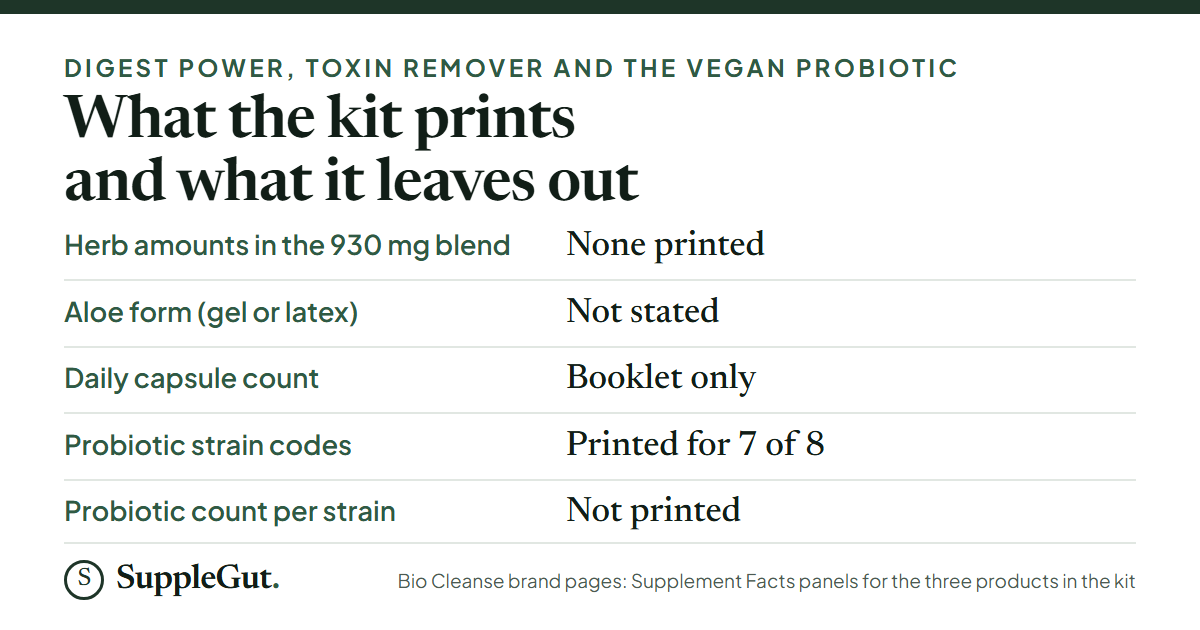
Digest Power is a serving of two capsules, with 45 servings in the bottle. The panel lists one proprietary blend of 930 mg per serving containing cape aloe leaf, organic cascara sagrada bark, organic Turkey rhubarb root, triphala (three fruits), barberry, dandelion, plantain, fennel, peppermint, licorice, fenugreek, ginger and meadowsweet. That is 13 entries, or 15 herbs counting triphala as three fruits, as the brand page does. No amount is printed for any of them, and senna is not listed.
Toxin Remover is a 6 g serving (1.3 teaspoons), 50 servings in 300 g, and lists one blend of bentonite clay, organic psyllium husk and organic ginger with no individual amounts. The Vegan Probiotic lists a blend of 20 billion CFU across eight organisms. Seven carry a strain code, and Bacillus coagulans is printed as “-39” with no complete designation. No count is printed for any single strain.
What the laxative herbs do
Cape aloe latex, cascara sagrada bark and rhubarb root contain anthraquinones, the same family of compounds as the sennosides in senna. Colon bacteria release the active forms, which stimulate the bowel wall and reduce water absorption. A daily fiber works differently, adding bulk and holding water over weeks. The label does not say whether the aloe is the gel or the latex and prints no aloin statement, so its laxative content cannot be read, and it gives no amount of cascara or rhubarb.
The 9-day program and the missing daily dose
The brand sells the kit for either “the full strength 9 day cleanse,” which includes 5 days of juice and broth fasting, or a longer, milder cleanse of 14 days or more. The capsule-by-capsule schedule is only in the booklet, which is published as a PDF whose text we could not read, so the daily number of Digest Power capsules, the repeat interval and any warnings in it are not stated here. The terms page says each person cleansing must read the booklet first.
The trial of the kit, and the plaque
We found no trial of the Bio Cleanse kit. PubMed searches for the brand name and for mucoid plaque returned none. The brand’s own customer survey is not a trial. Its central explanation is that the kit removes “mucoid plaque” from the colon, and reviewers describe long strands passing during the course. That is the brand’s explanation, and we found no trial that measured mucoid plaque or tested the idea. A 2015 critical review of detox diets found that no randomized controlled trials of commercial detox diets in humans had been conducted (Klein and Kiat), and a 1997 critical review examined colonic irrigation and the autointoxication idea behind cleanses of this kind (Ernst).
The evidence for the herbs
The strongest evidence for the class is for senna, which this kit does not contain. In a placebo-controlled trial of 90 adults with chronic constipation, 28 days of senna at 1.0 g a day improved 69.2% of people against 11.7% on placebo, and magnesium oxide at 1.5 g reached 68.3% (Morishita et al., 2021). A 2021 systematic review of 41 randomized trials of over-the-counter constipation therapies gave senna a grade A rating and listed diarrhea, nausea, bloating and abdominal pain as common adverse events (Rao and Brenner, 2021). Cascara and rhubarb are chemically similar to senna, but those trials tested senna at a known dose.
For rhubarb alone, a double-blind trial gave rhubarb extract supplying 12.5 mg or 25 mg of rhein a day for 30 days, and stool frequency and consistency improved against placebo (Neyrinck et al., 2022); the rhein content of the root in this kit is not printed. For aloe latex, the data we found are from rats, where aloin in drinking water for 13 weeks thickened the large intestine lining at 55.7 mg/kg and above (Boudreau et al., 2017).
On long-term use, a review of 43 publications on stimulant laxatives found no convincing evidence of colon cancer (Whorwell et al., 2024), and a review of melanosis coli lists long-term anthraquinone laxative use as a risk factor (Zhang et al., 2023). A 9 to 14 day course is shorter than the repeated use those papers describe.
The evidence for the powder and the probiotic
We found no human trial of bentonite for constipation or for binding toxins. For fiber, a meta-analysis of 16 randomized trials in 1,251 adults found 66% responding against 41% on control, with the effect seen only above 10 g a day (Am J Clin Nutr, 2022). The psyllium here is one of three ingredients in a 6 g serving, so its share is under 6 g and is not printed. For the probiotic, the only study we found of its coded strains is a mouse colitis experiment on B. longum CCFM760 (Chen et al., 2021); we found no human trial of the CCFM strains or of CN2018.
Side effects and who should not take it
The readable pages list no side effects, no pregnancy, nursing, age or medication warning and no allergen statement. The terms page says anyone with concerns should consult a medical practitioner after reading the booklet. The known effects of stimulant laxative herbs are cramping, diarrhea and loss of fluid and electrolytes. Amazon’s review summary says some customers report constipation, and one Trustpilot reviewer reported vomiting after the first dose. Pregnancy, medicines and bowel disease are questions for a doctor or pharmacist first.
What the reviews say
Amazon shows 3.7 from 263 ratings for the kit, split 54% five-star, 11% four, 12% three, 4% two and 19% one-star. The brand’s own page runs a built-in review module with 51 reviews, all 35 we read favorable, several copied from social media posts and none marked as a verified buyer. The home page also shows a typed “Rated 4.5 out of 5” with no count behind it. Trustpilot rates the brand as a whole at 4.1 from 57 reviews (88% five-star, 7% one-star), on a claimed profile.
The recurring praise is a large bowel clearout, not feeling hungry on the juice fast, and helpful support. The recurring complaints are the taste of the shakes, constipation or no effect, and, on Trustpilot, orders reported as not delivered and refunds not given, where the company replied that it had no matching order. We found no subscription billing complaint, and the brand site shows no subscription option.
Price, and the refund terms
The kit is $83.00 on the brand site and $93.00 on Amazon, or $83.70 on Subscribe & Save. A per-day figure describes the course only:
| Route | Price | Over 9 days | Over 14 days |
|---|---|---|---|
| Brand site | $83.00 | $9.22 a day | $5.93 a day |
| Amazon, one time | $93.00 | $10.33 a day | $6.64 a day |
| Amazon, Subscribe & Save | $83.70 | $9.30 a day | $5.98 a day |
The three parts are also sold separately on the brand site: Digest Power at $26.95, Toxin Remover at $28.95 and the Vegan Probiotic at $26.95 for a 60-capsule bottle, twice the 30 capsules in the kit.
What is Bio Cleanse’s refund policy? The terms page says refunds are accepted within 90 days of purchase, with prior approval by email; all bottles must be unopened, shipping is not refunded, and only one package of any product is eligible for return.
Who the kit is for, and what sits beside it
- Adults who want a short herbal laxative course with a juice fast, knowing it differs from a daily fiber.
- Someone who will read the 44-page booklet first, since the daily dose is only there.
Another stimulant-laxative course is covered at does Inno Cleanse work. Products taken daily for weeks, such as NBPure MagO7 (magnesium oxide) and Organic India Triphala, work differently; the evidence for daily options is at constipation treatments with strong evidence.
The products in this catalog
Common questions
Does the Bio Cleanse detox kit work?
No trial of the kit was found. Amazon shows 3.7 from 263 ratings (54% five-star, 19% one-star), and reviewers on the brand’s own page describe a large bowel clearout during the 9-day course. The “mucoid plaque” the brand says it removes is the brand’s explanation and has no trial support, and a 2015 review found no randomized trials of commercial detox diets in humans.
Is Digest Power a laxative, and does it contain senna?
The brand calls Digest Power a natural herbal laxative. Its panel lists cape aloe leaf, cascara sagrada bark and Turkey rhubarb root in a 930 mg blend, with no senna and no individual amounts. Cascara and rhubarb are stimulant laxative herbs, and the label does not say whether the aloe is the gel or the laxative latex.
How much does the Bio Cleanse Herbal Detox Kit cost?
The kit is $83.00 on the brand site and $93.00 on Amazon ($83.70 with Subscribe & Save). By the brand-site price that is $9.22 a day over the 9-day course or $5.93 over a 14-day course. Digest Power ($26.95), Toxin Remover ($28.95) and the probiotic ($26.95) are sold separately.
How do you take the Bio Cleanse kit?
The brand sells it for a 9-day program that includes 5 days of juice and broth fasting, or a milder program of 14 days or more. The daily capsule count is only in a 44-page instruction booklet whose text we could not read, so it is not stated here. The brand says each person should read the booklet before starting.
What are the side effects, and who should not use it?
The readable pages give no list of side effects and no pregnancy, nursing or medication warning; the brand says anyone with concerns should consult a medical practitioner and read the booklet first. Stimulant laxative herbs can cause cramping and diarrhea, Amazon’s summary notes some reports of constipation, and one Trustpilot reviewer vomited after the first dose.
What is Bio Cleanse’s refund policy?
The brand’s terms accept refunds within 90 days of purchase with prior approval by email, for unopened bottles only, and do not refund shipping. Its Trustpilot profile (claimed, 4.1 from 57 reviews for the whole brand) includes reports of orders not delivered and refunds not given, where the company replied it had no matching order. No subscription billing complaint was found.
How is it different from Inno Cleanse?
Both are stimulant laxative courses. Inno Cleanse is a single capsule blend taken for 14 days, with senna, cascara, cape aloe and frangula, while the Bio Cleanse kit has no senna and adds a bentonite and psyllium powder, a probiotic and a juice fast. The other course is covered at does Inno Cleanse work.
Sources
- Morishita D, et al. "Senna versus magnesium oxide for the treatment of chronic constipation: a randomized, placebo-controlled trial." American Journal of Gastroenterology, 2021. PMID 32969946. pubmed.ncbi.nlm.nih.gov/32969946
- Rao SSC, Brenner DM. "Efficacy and safety of over-the-counter therapies for chronic constipation: an updated systematic review." American Journal of Gastroenterology, 2021. PMID 33767108. pubmed.ncbi.nlm.nih.gov/33767108
- Whorwell P, et al. Review of 43 publications on the long-term safety of senna, bisacodyl and sodium picosulfate. Therapeutic Advances in Gastroenterology, 2024. PMID 38887508. pubmed.ncbi.nlm.nih.gov/38887508
- Zhang R, et al. Melanosis coli and anthraquinone herbs. Frontiers in Pharmacology, 2023. PMID 37214441. pubmed.ncbi.nlm.nih.gov/37214441
- Boudreau MD, et al. Aloin in drinking water for 13 weeks in rats. Toxicological Sciences, 2017. PMID 28525602. pubmed.ncbi.nlm.nih.gov/28525602
- Neyrinck AM, et al. Rhubarb extract in constipation, double-blind placebo-controlled trial, 2022. PMID 36499011. pubmed.ncbi.nlm.nih.gov/36499011
- Klein AV, Kiat H. Critical review of detox diets. Journal of Human Nutrition and Dietetics, 2015. PMID 25522674. pubmed.ncbi.nlm.nih.gov/25522674
- Ernst E. Colonic irrigation and the theory of autointoxication: a critical review, 1997. PMID 9252839. pubmed.ncbi.nlm.nih.gov/9252839
- Meta-analysis of fiber supplementation in chronic constipation (16 randomized trials, 1,251 adults). American Journal of Clinical Nutrition, 2022. PMID 35816465. pubmed.ncbi.nlm.nih.gov/35816465
- Chen et al. Bifidobacterium longum CCFM760 in a mouse colitis model. Journal of Agricultural and Food Chemistry, 2021. PMID 34843239. pubmed.ncbi.nlm.nih.gov/34843239
- Bio Cleanse brand pages: label, directions and price. thebiocleanse.com/herbal-detox-kit; digest-power; toxin-remover; vegan-probiotic; terms and refunds thebiocleanse.com/terms
- Amazon listing: price and ratings. amazon.com/dp/B00DSC34ZA; Trustpilot, Bio Cleanse (brand-wide): trustpilot.com/review/thebiocleanse.com
Not sure which product fits your situation?
This guide covers the mechanics. The quiz takes your specific symptoms, routine and preferences and matches you to one product from the catalog.
Take the quiz →