
Guide
Does Inno Cleanse work? Four stimulant laxatives in one blend, and what the label leaves out
Quick answer
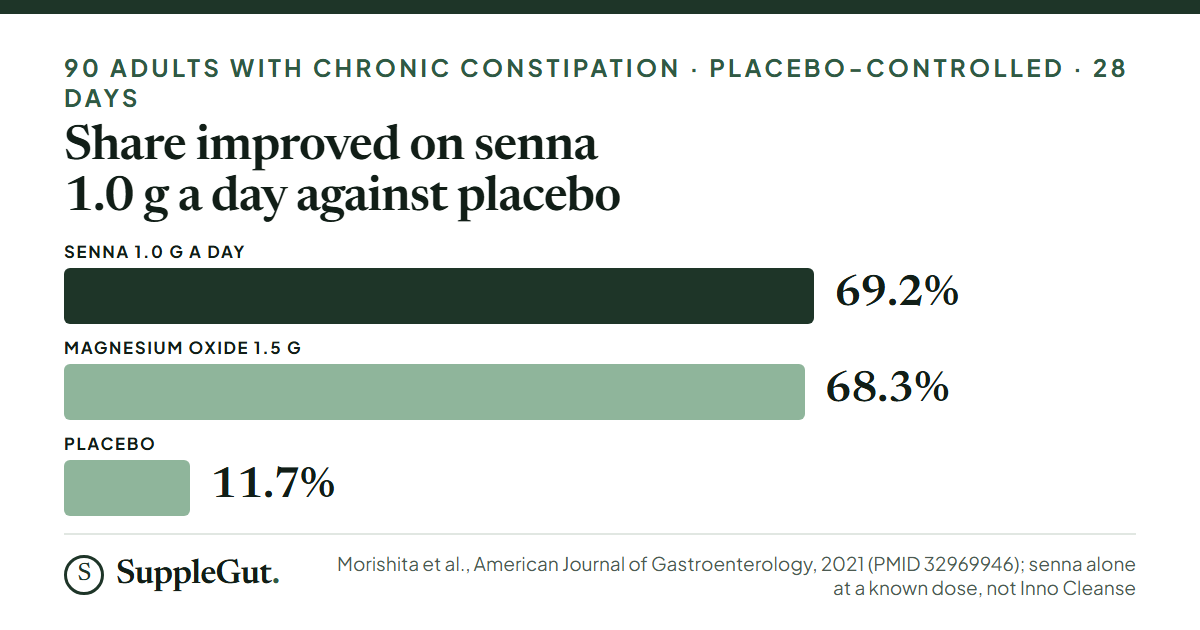
Does Inno Cleanse work? Inno Cleanse contains senna, cascara sagrada, cape aloe and frangula, four stimulant laxative herbs in one 824 mg blend with no amount printed for any of them. Senna alone at 1.0 g a day improved constipation in 69.2% of 90 adults against 11.7% on placebo over 28 days, but no trial of the other herbs for bloating was found, and the registered 30-person trial of Inno Cleanse itself (NCT07215351, completed July 2026) has no published results. The label directs a 14-day course, while over-the-counter senna labels set a limit of one week.
Inno Cleanse is a two-capsule herbal blend sold for bloating, regularity and a “waist-trimming” effect. What sets it apart from the fiber and magnesium products it is often compared with is on the label: four of its herbs (senna, cascara sagrada, cape aloe and frangula) are stimulant laxatives, and they sit together in one 824 mg blend with no amount printed for any of them. This page sets out the label, what the trials of the herbs and of the product show, how the directions compare with the limits on over-the-counter laxative labels, the reviews, the subscription terms and the cost.
What Inno Cleanse is, and what it is not
The serving is two vegetarian capsules, with 30 servings in the 60-capsule bottle. The Supplement Facts panel lists four proprietary blends and no individual amounts: a Waist-Trimming Complex of 824 mg (cascara sagrada bark powder, cape aloe leaves extract, senna leaf powder and frangula bark powder), an Advanced Digestion Complex of 300 mg (fennel seed powder and bentonite clay), an Enhanced Detox blend of 190 mg (burdock root, licorice root extract and slippery elm bark) and a Pro Gut Health Matrix of 40 mg (capsicum fruit and milk thistle seed). Together that is 1,354 mg a serving, and the laxative blend is 60.9% of it. Because 824 mg is the weight of four herbs combined, senna is necessarily less than 824 mg, and the label does not say how much less. Nor does it give the sennoside or hydroxyanthracene content of any herb.
It carries a Supplement Facts panel, not a Drug Facts panel, so it is sold as a dietary supplement. The brand’s own page calls cape aloe “a mild, natural laxative,” and the Amazon title includes the words “stool softener.” The brand’s page text names five ingredients (cascara sagrada, cape aloe, fennel seed, bentonite clay and milk thistle) and leaves out senna, frangula, burdock, licorice, slippery elm and capsicum, all of which are on the panel. Amazon’s ingredient field shows another Inno Supps product’s ingredients; the correct panel is on the label images. The other-ingredients list also differs between two versions of the label graphic, so check the bottle in hand.
A laxative course is not a daily fiber
Senna, cascara, aloe latex and frangula bark are anthranoid (anthraquinone) laxatives. Bacteria in the colon release active compounds from them that stimulate the bowel wall and reduce water absorption, which produces a bowel movement within hours. That is a different mechanism from a daily psyllium or other fiber product, which adds bulk and holds water over weeks, and from magnesium oxide, which works by another route again. The two kinds of product are used differently as well: fibers and magnesium are taken daily for weeks or months, while stimulant laxative labels set a short limit. The comparison of psyllium with magnesium is on psyllium vs magnesium for constipation.
The trial of the product itself
One trial of Inno Cleanse is registered, and no results are public. It is NCT07215351 at the University of Memphis, with the brand listed as a collaborator: randomized, double-blind and placebo-controlled, with 30 participants (15 and 15) taking 2 capsules a day for 2 weeks. It started in October 2025 and completed in July 2026, and it enrolled people with bloating or constipation two or more days a week. The record lists 111 primary outcomes, mostly blood chemistry, blood count, urine and lipid safety measures, alongside weight, the Bristol stool chart, a tolerability questionnaire, mood and skin age. Its own summary says there was no known clinical research supporting the product’s effectiveness before the study, and that about 1.4 million units had been sold since 2020. PubMed lists no paper on Inno Cleanse.
The brand page now says a double-blind, placebo-controlled trial of Inno Cleanse showed improved regularity, skin improvements and reduced fatigue in 14 days. That matches this trial’s design, but with no numbers public it cannot be checked. Earlier page graphics carried percentages (96% less bloated, 88% a slimmer waistline, 84% weight loss) captioned as a consumer survey of 200 men and women, which is a survey, not a trial.
The evidence for the herbs
The strongest evidence is for senna as a laxative. In a Japanese placebo-controlled trial of 90 adults with chronic idiopathic constipation (mean age 42, 93% women), 28 days of senna at 1.0 g a day left 69.2% of people improved overall against 11.7% on placebo, and magnesium oxide at 1.5 g reached 68.3% (P below 0.0001). Spontaneous bowel movements and quality of life improved, all 90 people completed the trial, and none had a severe treatment-related adverse event (Morishita et al., American Journal of Gastroenterology, 2021). A 2021 systematic review of over-the-counter constipation therapies (41 trials of four weeks or more, funded by Bayer, as disclosed) gave senna a grade A rating, and listed diarrhea, nausea, bloating and abdominal pain among the common adverse events (Rao and Brenner, 2021). A 2014 review found stimulant and nonstimulant laxatives beat placebo in 19 trials and 4 meta-analyses, with minor side effects (Pare and Fedorak, 2014).
Two limits apply. First, that is senna alone at a known dose, for constipation. Inno Cleanse prints one 824 mg figure for four herbs, and bloating, the brand’s lead claim, was not the outcome measured. We found no randomized trial of any ingredient in the formula for bloating. Second, the other three laxative herbs have little trial evidence of their own. We found no modern randomized trial of cascara sagrada, no human trial of the laxative effect of cape aloe, and no recent studies of frangula alone; the EU herbal committee’s conclusions on frangula rest on expert opinion, clinical experience and senna data.
For the non-laxative blends, we found no bloating trial of fennel, and the two small herbal-formula constipation trials that include fennel combine it with other herbs. We found no oral constipation or bloating trial of bentonite clay, and a pediatric case report describes severe low potassium after oral and rectal bentonite. For licorice, a 2023 narrative review documents low potassium and high blood pressure from glycyrrhizin; the extract’s glycyrrhizin content is not printed. There is no trial at these doses for the 40 mg capsicum and milk thistle blend.
On the cancer question that comes up for this class, a 2022 meta-analysis of five observational studies found an odds ratio of 1.41 (95% CI 0.94 to 2.11) for colorectal cancer with past use of anthraquinone laxatives against no use, not statistically significant, with moderate to low quality. The authors concluded it is not possible to link them, and called for better studies.
How long: the label against the laxative limits
The label directions are 2 capsules a day for 14 days at a time, once a month. The brand FAQ says to take 1 to 2 capsules with 8 oz of water and food, to start with 1 capsule for the first 2 to 3 days if sensitive, and to alternate 14 days on with 14 days off; another section says to take two capsules with a full glass of water, ideally in the evening. An older label wording recorded elsewhere allowed up to 3 capsules before bedtime for 10 days and use “as needed,” so the versions differ.
The 14 days is where the label meets the ordinary laxative guidance:
| Source | Stated duration |
|---|---|
| Inno Cleanse label | 14 days at a time, once a month |
| Senokot (sennosides) Drug Facts label | Not longer than 1 week unless directed by a doctor |
| LiverTox entry on cascara | Short-term use, under one week |
| EU herbal summary for frangula bark | Not longer than one week (single-ingredient preparations only) |
| Senna trial above | 28 days, in a supervised study |
The Senokot label also carries stop-use and pregnancy wording that the Inno Cleanse label text we could read does not: ask a doctor before use if you have stomach pain, nausea, vomiting or a sudden change in bowel habits lasting 2 weeks, stop and ask a doctor with rectal bleeding or no bowel movement after use, and ask a health professional first if pregnant or breastfeeding. The EU summary does not cover combinations.
What the FDA decided about aloe and cascara
In 2002 the US FDA ruled that aloe and cascara sagrada are “not generally recognized as safe and effective for OTC use” as laxative ingredients, because no new carcinogenicity data were submitted. That rule concerns over-the-counter drugs, which is why neither herb is in a drugstore laxative. Both remain on sale in dietary supplements. We did not assess whether any marketing claim crosses into a drug claim. The LiverTox entry for cascara gives a typical dose of 300 mg once daily, reports abdominal cramps and electrolyte imbalance, and describes clinically apparent liver injury in people using high doses for longer than recommended, with onset from a few days to two months and usually resolving on stopping.
Side effects and who should not take it
Cramping, diarrhea and electrolyte loss are the known effects of this class, and Amazon’s review summary says some customers experience severe cramping. The Amazon safety text says to keep it out of reach of children and that it is for adults; GNC lists it as 18 and over. We found no pregnancy, breastfeeding, medication, diarrhea or kidney warning in the label text we could read, though the bottle photos did not show the back panel in full. The brand FAQ says to consult a healthcare professional with digestive sensitivity or health concerns.
The registered trial excluded people who were pregnant, planning pregnancy or breastfeeding; with diabetes, high blood pressure or cardiovascular disease; with IBS, Crohn’s disease, ulcerative colitis, ulcers or reflux; with regular diarrhea; with breast, uterine or ovarian cancer, fibroids or endometriosis; or with a previous adverse experience with laxatives. It also excluded people taking diuretics, laxatives, anticoagulants, antiplatelets, blood pressure, cholesterol, NSAID, digoxin, corticosteroid, MAOI, insulin, estrogen-based contraceptive and liver-processed medicines. Those exclusions are the sponsor’s trial design, not label warnings, but they show who was kept out of the one study of the product. For allergens, there is no contains statement; the facility statement lists eggs, wheat, milk, tree nuts, peanuts, soybeans, crustacean shellfish and fish handled on shared equipment, and milk thistle is a daisy-family plant.
What the reviews say
Amazon shows 4.1 from 12,407 ratings (64% five-star, 12% one-star) for the 30-day listing, sold by Inno Supps, with the review text behind a sign-in. Trustpilot rates the brand, all products together, at 4.1 from 1,486 reviews (59% five-star, 31% one-star). The brand page claims “12,498+ verified five-star reviews” with no source shown. Amazon’s own summary counts effectiveness, bloating reduction and cleansing among the most-mentioned topics, with opinions on value divided, and says some customers experience severe cramping.
The recurring praise is quick relief from bloating and getting things moving, some reviewers saying it still does so after a year or more of use, and fast help from customer service. On Trustpilot, a search for reviews mentioning “cleanse” returned 18 five-star and 2 one-star out of 20 shown, mostly passing mentions inside brand-wide reviews. The one-star reviews are about the store, not the capsule: in a page of 20 brand-wide one-star reviews, 8 were mainly about billing, subscriptions or trial offers, 8 about shipping or customs, and 2 about the products not working as hoped. We did not read Reddit.
The subscription and refund terms
The brand site sells one bottle at $39.99 one time or $31.99 on Subscribe & Save (20% off, delivered every 28 days), and three bottles at $110.96 one time or $83.22 subscribed (delivered every 90 days). The ad landing page also shows a “Try it once, no autoship” button, while the generic product page says adding to the cart enrolls the buyer in AutoRefill. The published subscription terms say it auto-renews until canceled, and that the Subscribe & Save price depends on a minimum of two shipments: if the subscription is canceled before the second order is processed, the first order is repriced to the one-time price and the difference is charged to the original payment method. On the $31.99 bottle that difference is $8.00. Cancellation is through the account page, by email to customerservice@innosupps.com or by live chat, before the next processing date.
The product page offers a 30-day money-back guarantee. The refund policy page is worded differently: it requires an RMA number, does not cover shipping, and says the 100% guarantee covers the first 30-day supply of Inno Shred or Night Shred; for other products the item must be less than 50% consumed, and returns are limited to twice per household and once per product. The Amazon listing is marked non-returnable. A single bottle can be bought on Amazon at $38.97 ($35.07 with Subscribe & Save), or on the brand site as a one-time purchase.
On cadence, a subscription ships a 30-serving bottle every 28 days, while the label directs 14 days of use a month, which is 14 servings. A buyer following the label would hold about 16 spare servings after each delivery.
What the ads and the page claim
The brand’s ads describe a “gastroenterologist-approved” formula with “no cramping” and “no dependency,” and its landing page describes a 14-day flush that purges 5 to 20 pounds of waste and leads with GLP-1 users. These are brand claims. We found no source for the pounds-of-waste figures and no trial in GLP-1 users, and the one registered trial is the 30-person study above. The Amazon comparison table ticks “Third Party Tested,” but we found no laboratory name or certificate of analysis on the brand page.
Who Inno Cleanse is for
- Adults who want a short stimulant laxative course in capsule form and understand it is a different kind of product from a daily fiber.
- Someone who will follow the 14-day course and the 14 days off, with the label’s limit set against the one-week limit on OTC senna labels.
- Someone comfortable with undisclosed per-herb amounts, since the evidence is for senna at 1.0 g a day and the label does not say how much of it is in a capsule.
If the goal is daily regularity over weeks, the products with long-term trial records are covered in constipation treatments with strong evidence, and the magnesium oxide products are at does MagO7 work. For bloating that comes from food, gas or a changed bowel habit, the bloating and gas guide starts from the cause, and the quiz matches symptoms to products.
Cost
At two capsules a day and 30 servings a bottle, the brand site works out at $1.33 a day one time, $1.07 on the one-bottle subscription, $1.23 for three bottles one time and $0.92 for three bottles subscribed. Amazon works out at $1.30 a day one time and $1.17 with Subscribe & Save. A single 14-day course at the label directions costs $18.66 at the one-time price and $14.93 at the subscription price.
The products in this catalog
Common questions
Does Inno Cleanse work?
It contains senna, cascara, cape aloe and frangula, which are stimulant laxatives, and senna at 1.0 g a day beat placebo for constipation in a 28-day trial of 90 adults (69.2% against 11.7% improved). The label does not print how much senna it contains, and no trial of bloating relief has been published for any ingredient. A 30-person trial of Inno Cleanse itself finished in July 2026 and has no published results.
Is Inno Cleanse a laxative?
It is sold as a dietary supplement with a Supplement Facts panel, not as an OTC drug, but four of its ingredients are stimulant laxatives, and the brand’s own page calls cape aloe “a mild, natural laxative.” The FDA decided in 2002 that aloe and cascara are not generally recognized as safe and effective as OTC laxative ingredients, so they are not in drugstore laxatives, though they remain in supplements.
Is Inno Cleanse safe, and what are the side effects?
Cramping, diarrhea and electrolyte loss are the known effects of this class, and Amazon’s review summary mentions severe cramping for some users. We found no pregnancy, medication or kidney warning in the label text we could read, and the sponsor’s own trial excluded people with diabetes, high blood pressure, heart disease, bowel disease, pregnancy and many medicines. Anyone in those groups can check with a doctor or pharmacist first.
How long can you take Inno Cleanse?
The label says 2 capsules a day for 14 days at a time, once a month. An OTC senna Drug Facts label says not to use laxatives longer than 1 week unless a doctor directs it, the LiverTox entry for cascara says under one week, and the EU summary for frangula bark says not longer than one week for single-ingredient preparations.
How much does Inno Cleanse cost?
One 60-capsule bottle is $39.99 on the brand site ($1.33 a day at 2 capsules), $31.99 on its Subscribe & Save plan delivered every 28 days, and $38.97 on Amazon ($35.07 with Subscribe & Save). Used as the label directs, 14 days a month, one bottle covers two courses, so a 28-day subscription ships more than the label calls for.
How do I cancel an Inno Supps subscription or get a refund?
Cancel through the account page, by email to customerservice@innosupps.com or by live chat, before the next processing date. The terms set a two-shipment minimum for the Subscribe & Save price: canceling before the second order reprices the first to $39.99. The refund policy says the 100% guarantee covers the first 30-day supply of Inno Shred and Night Shred, and other products must be less than 50% consumed.
How is Inno Cleanse different from magnesium or fiber?
Senna, cascara, aloe and frangula are stimulant laxatives that act on the bowel wall within hours and carry short-course limits on labels, while magnesium oxide and psyllium are taken daily for weeks. The magnesium oxide arm of the senna study reached 68.3% improved at 1.5 g, and the comparison is at psyllium vs magnesium for constipation.
Sources
- Morishita D, et al. "Senna versus magnesium oxide for the treatment of chronic constipation: a randomized, placebo-controlled trial." American Journal of Gastroenterology, 2021. PMID 32969946. pubmed.ncbi.nlm.nih.gov/32969946
- Rao SSC, Brenner DM. "Efficacy and safety of over-the-counter therapies for chronic constipation: an updated systematic review." American Journal of Gastroenterology, 2021. PMID 33767108. pubmed.ncbi.nlm.nih.gov/33767108
- Pare P, Fedorak RN. "Systematic review of stimulant and nonstimulant laxatives for the treatment of functional constipation." Canadian Journal of Gastroenterology and Hepatology, 2014. PMID 25390617. pubmed.ncbi.nlm.nih.gov/25390617
- Lombardi N, et al. Anthraquinone laxatives and colorectal cancer: meta-analysis of observational studies. Phytotherapy Research, 2022. PMID 35040201. pubmed.ncbi.nlm.nih.gov/35040201
- "Liquorice Toxicity: A Comprehensive Narrative Review." Nutrients, 2023. PMID 37764649. pubmed.ncbi.nlm.nih.gov/37764649
- ClinicalTrials.gov NCT07215351: Impact of the Inno Cleanse Dietary Supplement on Gut Health and Associated Variables in Healthy Men and Women, University of Memphis. clinicaltrials.gov/study/NCT07215351
- US Food and Drug Administration. Federal Register 67 FR 31125, 9 May 2002: aloe and cascara sagrada, not generally recognized as safe and effective for OTC laxative use. govinfo.gov
- DailyMed. Senokot (sennosides 8.6 mg) Drug Facts label: duration, stop-use and pregnancy warnings. dailymed.nlm.nih.gov
- LiverTox. "Cascara." National Institute of Diabetes and Digestive and Kidney Diseases. ncbi.nlm.nih.gov/books/NBK548113
- European Medicines Agency. Frangulae cortex herbal summary. ema.europa.eu
- Inno Supps brand page: label, directions and price. innosupps.com; subscription policy innosupps.com/policies/subscription-policy; refund policy innosupps.com/policies/refund-policy
- Amazon listing: price, ratings and safety text. amazon.com/dp/B08DP57QF5; Trustpilot, Inno Supps (brand-wide): trustpilot.com/review/innosupps.com
Not sure which product fits your situation?
This guide covers the mechanics. The quiz takes your specific symptoms, routine and preferences and matches you to one product from the catalog.
Take the quiz →