
Guide
Does Bio.me Psyllium Husk Fiber work? Six and a half grams of psyllium, electrolytes, and the ten-gram trials
Quick answer
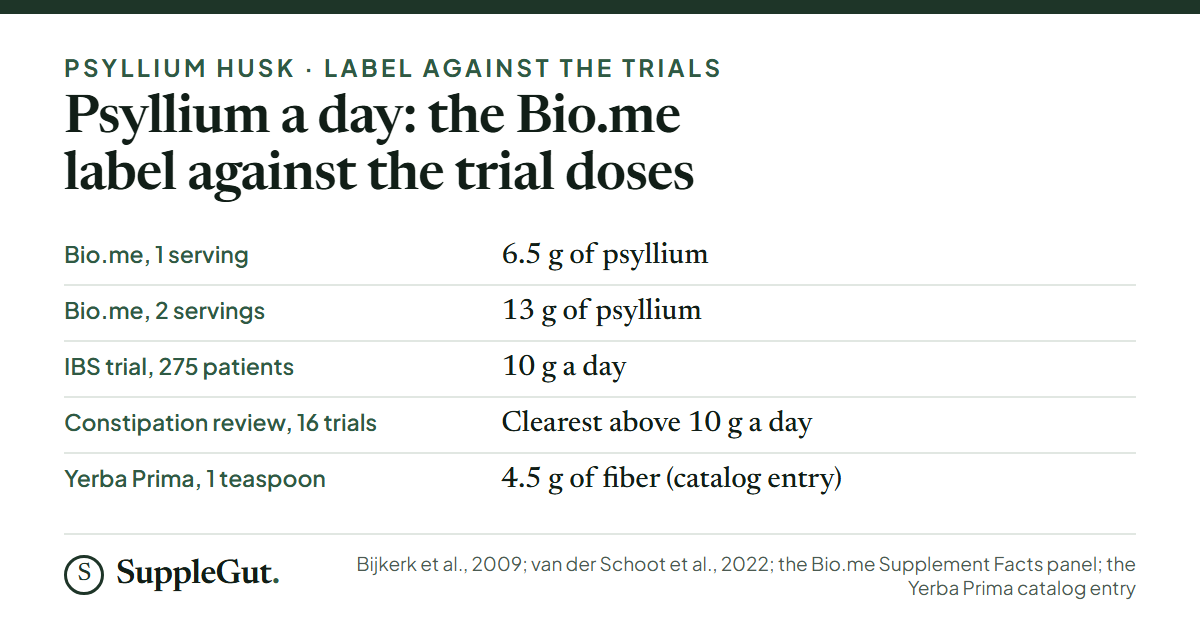
Does Bio.me Psyllium Husk Fiber work? No trial of the product exists. One 2-teaspoon serving prints 6.5 g of psyllium, below the 10 g a day that improved relief in 275 people with IBS (57% against 35% in month 1) and below the range a 2022 review of constipation trials found clearest, above 10 g a day. Two servings reach 13 g. Amazon shows 4.0 from 134 ratings, and reviewers split on grit and thickness.
Bio.me Psyllium Husk Fiber + Electrolytes, Lemonade (the brand also calls it Fiber Rescue) is a flavored psyllium powder: 6.5 g of organic psyllium husk in a 2-teaspoon serving, with magnesium, sodium, potassium and chloride added. The fiber is the one the IBS and constipation trials used, and the dose is the question. This page sets out the label, the trials at their doses, how to mix it, the reviews and the price.
What Bio.me Psyllium Husk Fiber is, and what it is not
The Supplement Facts panel lists one serving as 2 teaspoons (9 g), with about 30 servings in a 9.5 oz (270 g) pouch. Per serving it prints 30 calories, 6 g of carbohydrate that is all counted as dietary fiber (21% of the daily value), magnesium 45 mg (as magnesium malate and magnesium bisglycinate), chloride 440 mg, sodium 180 mg, potassium 180 mg and organic psyllium husk fiber at 6.5 g. Every amount is printed; there is no proprietary blend. The other ingredients are citric acid, natural flavors and stevia leaf extract, so it is sweetened, and the 6.5 g of psyllium is about 72% of the powder by weight.
The packaging carries Non-GMO Project Verified and Monash University Low FODMAP Certified marks, plus gluten free, dairy free, vegan and glyphosate residue free claims. The brand page shows a “Third Party Tested” icon and names no laboratory or certificate. On the Amazon listing the ingredients block reads “Manufactured in a facility that processes all major allergens,” which sits beside the dairy free and gluten free claims. The manufacturer is not named on the pages we read. The electrolytes are the brand’s addition; no psyllium trial tested them.
The trial of the product itself
There is none. A PubMed search for the brand returned nothing relevant, and the brand page cites no study. The evidence is for psyllium as an ingredient, in plain husk, at the doses below.
The evidence for psyllium, and how 6.5 g compares
IBS. In a randomized placebo-controlled trial in general practice, 275 adults with irritable bowel syndrome took 10 g of psyllium, 10 g of bran or placebo a day for 12 weeks. In month 1, 57% of the psyllium group reported adequate relief against 35% on placebo (relative risk 1.60), and symptom severity had fallen by 90 points against 49 after three months. Bran did no better than placebo. Only 64% of the psyllium group completed the trial, and quality of life did not differ (Bijkerk et al., BMJ, 2009). A 2026 meta-analysis pooled 30 randomized trials in 1,904 adults with IBS: fiber supplements produced a clinical response in 52% against 44% on control (risk ratio 1.21), and the six psyllium trials gave a risk ratio of 1.53. Overall symptom scores were not significantly different, a limit the authors report alongside the response finding (Staudacher et al., Gastroenterology, 2026).
Constipation. A 2022 meta-analysis of 16 randomized trials in 1,251 adults with chronic constipation found psyllium raised the response rate (risk ratio 1.82) and concluded that doses above 10 g a day for at least four weeks appear optimal. The review also found stool frequency rose by about three bowel movements a week but varied widely between trials, and that fiber overall increased flatulence (van der Schoot et al., American Journal of Clinical Nutrition, 2022).
One serving here is 6.5 g of psyllium, below the 10 g of the IBS trial and below the range the constipation review found clearest. Two servings a day, which the brand allows, reach 13 g, above both. These trials tested plain psyllium husk in people with IBS or chronic constipation; they are evidence for the ingredient, not for this formula.
How long a fair test takes is covered in the psyllium timing guide.
How to take it, and why it gels
The brand’s directions: mix 2 teaspoons (or one travel packet) into 12 ounces of water, stir until the powder is mixed and keep stirring as you drink, and drink it within 5 to 7 minutes to avoid gelling, with plenty of water through the day. Its FAQ says to avoid vigorous shaking or mixing, because that increases water absorption and makes it gel quickly. The brand suggests starting with a lower dose and building to a full serving once or twice a day, and taking it a few hours before bed if used at night.
Gelling is how psyllium works: the husk swells with water into a viscous gel that softens and bulks stool. Left to stand in the glass, the drink thickens.
Side effects and who should be careful
Amazon’s safety notice reads: taking this product without enough liquid may cause choking, and it should not be taken by anyone who has difficulty swallowing. The brand page carries a California Proposition 65 disclosure and no pregnancy, medication or age warning; the label image we read prints no medicine-spacing line, and we did not see the back of the pouch.
Each serving holds 180 mg of sodium (8% of the daily value) and 180 mg of potassium (4%). For most people that is small, but anyone on a sodium or potassium limit, will want to count it, and at two servings the figures double. The label does not warn about this. Fiber overall increased flatulence in the constipation review, and some reviewers describe an upset stomach.
What the reviews say
Amazon shows 4.0 out of 5 from 134 ratings (64% five-star, 9% four, 9% three, 5% two, 13% one-star) on an independent listing sold by Bio.me. The review text sat behind a sign-in wall, so what we could read is Amazon’s own topic summary. Taste drew 58 mentions, 46 positive, and effectiveness 48, 40 positive. Praise centers on a mild lemon flavor that is not too sweet, steadier regularity, feeling fuller between meals, and more fiber per serving than other powders. Dissolving and texture are where it splits: 12 of 18 mentions of dissolving and 10 of 14 of texture were negative, with reviewers describing grit, thickness and, in a few cases, a sour taste. On value, 7 of 14 mentions were negative.
The brand page runs a review widget that shows 4.42 stars from 31 reviews, hosted by the brand through a review app; we did not read its text. There is no Trustpilot profile for bio.me.
Price, subscription and refund terms
A 30-serving pouch is $29.99 on both the brand site and Amazon, which is $1.00 a day at one serving and $2.00 at two. Twenty travel packets are $34.99. Its subscription is listed as 30% off the first order and 15% off after that, with free shipping and cancel-or-skip any time; by our arithmetic that is about $20.99 for the first pouch ($0.70 a day) and $25.49 after ($0.85 a day), though the page prints no subscribed price. When read, the brand page showed “Sold out” beside the price.
For brand-site orders the shipping and returns page says refunds are given within 30 days on unopened items only, with the buyer paying return shipping and a $6 processing fee, and refunds taking 10 to 15 days after the return arrives. We found no guarantee for opened product. Amazon’s own return terms were not on the page text we read. For comparison, the catalog lists Yerba Prima Psyllium Husks Powder at $0.29 a day, a single-ingredient powder at one teaspoon with 4.5 g of fiber, and Metamucil 4-in-1 Sugar-Free Orange Powder at $0.50 a day.
Bio.me Psyllium versus Bio.me Daily Prebiotic Fiber
The two Bio.me powders are different fibers. The psyllium is a gel-forming husk that has to be drunk within minutes. The Daily Prebiotic Fiber is 7 g of fiber from a blend of partially hydrolyzed guar gum and resistant potato starch that dissolves without thickening and, as that guide sets out, has no trial of the blend and no psyllium-style constipation data. For the brand-wide details, including refund terms and the missing split between the two fibers, see the Daily Prebiotic Fiber guide.
Who Bio.me Psyllium Husk Fiber is for
- Someone who wants psyllium in a flavored, sweetened drink and will mix and drink it right away.
- Someone who looks for the Monash low FODMAP and Non-GMO marks on a fiber powder.
- Someone who accepts that one serving is under the trial doses and is prepared to use one or two, with plenty of water.
For a plain psyllium husk comparison across brands, the psyllium guide lines up the options, and the quiz matches symptoms to products.
The products in this catalog
Common questions
Does Bio.me Psyllium Husk Fiber work?
No trial of this product was found. Psyllium at 10 g a day improved symptom relief over placebo in 275 people with IBS (57% against 35% responders in month 1), and a 2026 meta-analysis of 30 trials gave psyllium a risk ratio of 1.53. One serving here has 6.5 g, and two reach 13 g. Amazon reviewers (4.0 from 134) most often mention regularity and feeling fuller.
How do you take Bio.me Psyllium Husk Fiber, and why does it gel?
Stir 2 teaspoons into 12 ounces of water and drink it within 5 to 7 minutes, with more water through the day. Psyllium swells into a gel, and the brand says vigorous shaking speeds that up. It suggests building from a lower dose to one or two servings a day.
Is Bio.me Psyllium Husk Fiber safe, and what are the side effects?
Amazon’s safety notice says taking it without enough liquid may cause choking and that it should not be used with difficulty swallowing. Each serving has 180 mg of sodium and 180 mg of potassium, which may matter to people on limits, and the label prints no pregnancy or medication warning. Some reviewers report an upset or bloated stomach.
How much does Bio.me Psyllium Husk Fiber cost?
A 30-serving pouch is $29.99 on the brand site and on Amazon, about $1.00 a day at one serving or $2.00 at two. The brand lists a subscription at 30% off the first order and 15% ongoing, and the brand page showed “Sold out” when read.
Bio.me Psyllium vs Bio.me Daily Prebiotic Fiber: what is the difference?
The psyllium powder has 6.5 g of psyllium husk with magnesium and electrolytes per 2-teaspoon serving and gels in water. The Daily Prebiotic Fiber has 7 g of fiber from PHGG and resistant potato starch and does not gel. The constipation review found psyllium clearest above 10 g a day.
Is Bio.me Psyllium Husk Fiber gritty or hard to mix?
Some Amazon reviewers say it does not dissolve well, turns thick or feels gritty, and a few find the taste sour. Others say it mixes easily and tastes mild. The brand’s advice is to stir gently, avoid vigorous shaking and drink within 5 to 7 minutes.
Does Bio.me Psyllium Husk Fiber have a refund policy?
On the brand site, refunds apply within 30 days to unopened items only, with the buyer paying return shipping and a $6 processing fee. We found no guarantee for opened product. Amazon orders follow Amazon’s return terms, which were not on the page text we read.
Sources
- Bijkerk CJ, de Wit NJ, Muris JW, Whorwell PJ, Knottnerus JA, Hoes AW. “Soluble or insoluble fibre in irritable bowel syndrome in primary care? Randomised placebo controlled trial.” BMJ, 2009;339:b3154 (PMID 19713235). pubmed.ncbi.nlm.nih.gov/19713235
- van der Schoot A, Drysdale C, Whelan K, Dimidi E. The effect of fiber supplementation on chronic constipation in adults: an updated systematic review and meta-analysis of randomized controlled trials. American Journal of Clinical Nutrition, 2022 (PMID 35816465). pubmed.ncbi.nlm.nih.gov/35816465
- Staudacher HM, et al. Fiber supplementation in irritable bowel syndrome, systematic review and meta-analysis of 30 randomized trials. Gastroenterology, 2026 (PMID 42600900). pubmed.ncbi.nlm.nih.gov/42600900
- Bio.me brand page: label, directions, subscription terms, review widget and price. bio.me
- Bio.me Supplement Facts panel image, as printed on the brand’s product carousel. cdn.shopify.com
- Bio.me shipping and returns page: return window, fee and refund timing. bio.me
- Amazon listing: price, rating, safety notice, ingredients block and customer topic summary. amazon.com
- Trustpilot: no profile found for bio.me. trustpilot.com
- Yerba Prima Psyllium Husks Powder: label and price as listed at iHerb. iherb.com

Not sure which product fits your situation?
This guide covers the mechanics. The quiz takes your specific symptoms, routine and preferences and matches you to one product from the catalog.
Take the quiz →