
Guide
Does Bio.me Daily Prebiotic Fiber work? Two named fibers, one blend, and a trial at a different dose
Quick answer
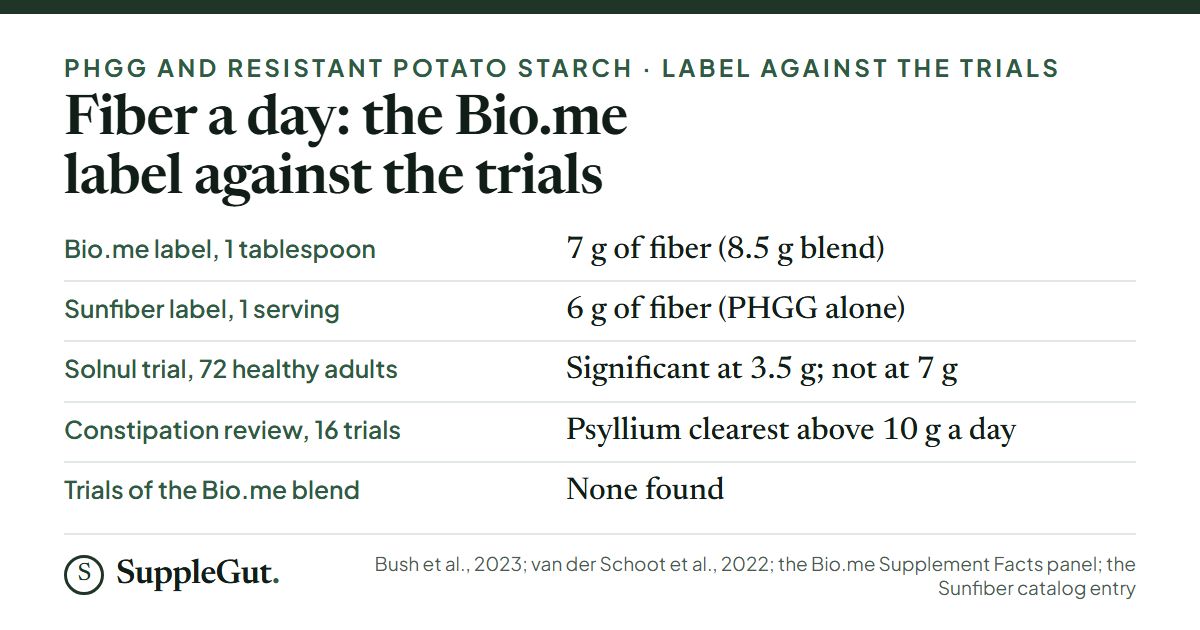
Does Bio.me Daily Prebiotic Fiber work? No trial of the product exists. A tablespoon prints 7 g of fiber from an 8.5 g blend of PHGG and Solnul resistant potato starch, with no split between the two. The Solnul trial in 72 healthy adults raised Bifidobacterium and Akkermansia at 3.5 g a day but not significantly at 7 g, and its maker funded it. A review of 16 fiber trials found psyllium clearest above 10 g a day. Amazon shows 4.1 from 314 ratings.
Bio.me Daily Prebiotic Fiber is an unflavored powder with two fibers and nothing else: partially hydrolyzed guar gum (PHGG) and resistant potato starch, taken as one tablespoon a day for 7 g of fiber. Both fibers are named on the panel, and the amount of each is not. This page sets out what the label prints, what the trials of each fiber found, how the reviews read and what it costs.
What Bio.me Daily Prebiotic Fiber is, and what it is not
The serving is one tablespoon (8.5 g), with 30 servings in a 9 oz pouch. The Supplement Facts panel prints 20 calories, 7 g of total carbohydrate and 7 g of dietary fiber (25% of the daily value). One line follows: the “Bio.me Fiber Blend” at 8.5 g, listing PHGG and resistant potato starch (as Solnul), with no other ingredients, no flavor and no sweetener. The panel gives no amount for either fiber, so the split cannot be read. The blend is 8.5 g and the fiber line is 7 g, which leaves about 1.5 g not counted as fiber; the label does not explain it.
The packaging carries a Monash University Low FODMAP Certified mark and a Non-GMO Project Verified mark, and states gluten free, dairy free and vegan. Those programs certify what is in a product, not what it does in the gut. The brand page says “Third Party Tested” and names no laboratory or certificate. The manufacturer is not named on the pages we read. It contains no bacteria and is not psyllium or pectin.
What PHGG and resistant potato starch are
PHGG is guar gum broken into shorter chains, so it dissolves in a drink without thickening it and is fermented slowly in the colon. Resistant starch is not digested in the small intestine; the kind here, sold as Solnul by MSP Starch Products, comes from potatoes, and colon bacteria ferment it. Fermentation produces gas, which is why fermentable fibers can add gas and bloating at first and why the brand tells new users to begin with one serving. The brand says the bacteria these fibers feed, such as Bifidobacterium and Akkermansia, ease bloating and irregularity. The Solnul trial below measured those bacteria, not bloating or bowel habit.
The trial of the product itself
There is none. A PubMed search for Bio.me returned no results, and searches on PHGG and Solnul turned up no trial of a blend of the two. The brand page cites only the Solnul trial described next.
The evidence for the two fibers
Solnul. A randomized, double-blind, placebo-controlled trial gave Solnul to healthy adults at 3.5 g or 7 g a day, or placebo, for four weeks: 75 were randomized into three arms of 25, and 72 were analyzed from stool sequencing. At 3.5 g a day, Bifidobacterium rose more than on placebo (p = 0.038) and so did Akkermansia (p = 0.014), and stool types 1 or 2 and type 7 were less frequent.At 7 g a day the rises did not reach significance (p = 0.14 for Bifidobacterium, p = 0.056 for Akkermansia). People with IBS and other significant gut disorders were excluded, so it does not speak to bloating or constipation. Solnul’s maker funded it and one author works for the company (Bush et al., Nutrients, 2023). The label blend is 8.5 g with no split, so the Solnul in a tablespoon could sit above or below the 3.5 g studied, and the 7 g arm does not show that more gives a larger change.
PHGG. The closest trial is open-label, with no placebo. In a multicenter study, 188 adults with IBS took wheat bran at 30 g a day or PHGG at 5 g a day for 12 weeks. Both groups improved in abdominal pain and bowel habit with no difference between them in the per-protocol analysis. By intention to treat the success rate was 60% on PHGG against 40% on bran, and at four weeks 49.9% of people switched from bran to PHGG against 10.9% going the other way (Parisi et al., Digestive Diseases and Sciences, 2002). The label does not name a brand of PHGG, so no trial of the specific PHGG in this powder could be identified.
Fiber and constipation. A 2022 meta-analysis of 16 randomized trials in 1,251 adults found psyllium and pectin effective, with the clearest response at doses above 10 g a day and over at least four weeks (van der Schoot et al., American Journal of Clinical Nutrition, 2022). A 2025 scoping review calls psyllium the strongest dietary recommendation and puts PHGG among approaches with improvements observed but limited well-designed evidence (Quan and Carey, Clinical Nutrition ESPEN, 2025).
This label gives 7 g of fiber from a blend whose split is unknown. Each fiber has a trial at a dose that may or may not match what a tablespoon holds, and no trial tested the two together.
The brand’s graphic claims “Supports GLP-1 use” and the Amazon title says “GLP-1 friendly”; no trial of fiber in people taking GLP-1 medicines is cited here.
How to take Bio.me Daily Prebiotic Fiber
The brand’s suggested use is one tablespoon daily, taken consistently, at any time of day and with or without food. Stir it into 8 oz of warm or cold liquid. For hot coffee the brand says to wait about five minutes, until the drink is below 140 F, or to add milk, creamer or ice first. More than one serving is not necessary, the brand says. The Solnul trial ran four weeks, so a fair test is a month.
Side effects and who should not take it
The one specific caution is on the brand page: people with a known nightshade sensitivity should check with a healthcare provider first, because the starch comes from potato, though the page says nightshade compounds in Solnul are below detectable levels. We found no pregnancy, medication or age warning on the panel image or in the page text, and did not read the back of the physical pouch. Gas and bloating are the expected effects of fermentable fibers at the start. No critical review text was readable, so there is no reported side-effect pattern to set beside the label.
What the reviews say
Amazon shows 4.1 out of 5 from 314 ratings on a listing shared across flavors and sizes; the star split and review text were not readable. The brand’s own page shows 67 reviews on a widget the brand hosts, with a star graphic and no numeric average. There is no Trustpilot profile for bio.me (the profile under a similar name is an unrelated UK company), and Thingtesting shows two reviews, too few to read.
The four testimonials on the brand page praise a “tasteless” powder that mixes into coffee without clumping, with less bloating, regularity and no cramping. That is a thin sample the seller chose, and we found no complaint text, so any recurring complaint is not known.
Refund terms and price by route
The brand accepts returns within 30 days of purchase on unopened items only, in original packaging. The buyer pays return shipping and a $6 processing fee, and refunds take 10 to 15 days after the warehouse receives the return. We found no guarantee for opened product. The brand advertises 30% off subscription orders and prints no cancellation terms on the pages we read. When read, the unflavored page on the brand site showed “Sold out” beside the $34.99 price.
| Route | Price | Per day (1 tablespoon) |
|---|---|---|
| Amazon, one time, 30 servings | $34.99 | $1.17 |
| Amazon, Subscribe & Save (15% off) | $29.74 | $0.99 |
| Brand site, one time, 30 servings | $34.99 | $1.17 |
| Brand site, 20 travel packets | $38.99 | $1.95 a packet |
| Brand site, subscription at the 30% banner | no price shown | about $0.82 (our arithmetic) |
Who Bio.me Daily Prebiotic Fiber is for
- Someone who wants an unflavored powder with two named fibers and no sweetener, stirred into a drink daily.
- Someone who looks for the Monash low FODMAP mark on a fiber product.
- Someone starting with 7 g of fiber who accepts that no trial tested this blend.
Plain PHGG powders: Tomorrow’s Nutrition Sunfiber and California Gold Nutrition Prebiotic Fiber each print 6 g of fiber per serving from PHGG alone. Supergut Foundational Daily Fiber also contains Solnul and Sunfiber (guide). For constipation, the 2022 review found psyllium effective above 10 g a day (psyllium guide). For gas and bloating, the bloating guide starts from the cause, and the quiz matches symptoms to products.
The products in this catalog
Common questions
Does Bio.me Daily Prebiotic Fiber work?
No trial of this product was found. Its Solnul resistant potato starch raised Bifidobacterium and Akkermansia versus placebo at 3.5 g a day in 72 healthy adults, but not significantly at 7 g, and the label does not say how much of the 8.5 g blend is Solnul. The brand’s testimonials mention less bloating and regularity, and Amazon shows 4.1 from 314 ratings.
What is in Bio.me Daily Prebiotic Fiber?
One tablespoon (8.5 g) is a “Bio.me Fiber Blend” of partially hydrolyzed guar gum (PHGG) and resistant potato starch (as Solnul), with 7 g of dietary fiber and 20 calories. There are no other ingredients, no flavor and no sweetener. The panel does not print how much of each fiber the blend holds, and it carries Monash low FODMAP and Non-GMO Project marks.
What are the side effects of Bio.me Daily Prebiotic Fiber?
Fermentable fibers can add gas and bloating at first, and the brand advises starting with one serving. The brand page says people with a nightshade sensitivity should check with a healthcare provider first because the starch comes from potato. We found no pregnancy or medication warning on the pages read, and no critical review text to set beside the label.
How do you take Bio.me Daily Prebiotic Fiber, and can it go in coffee?
The suggested use is one tablespoon a day, taken consistently, stirred into 8 oz of warm or cold liquid. For hot coffee the brand says to wait about five minutes, until the drink is below 140 F, or to add milk, creamer or ice first. A fair test is about a month, the length of the Solnul trial.
How much does Bio.me Daily Prebiotic Fiber cost?
A 30-serving pouch is $34.99 on Amazon and on the brand site, which is $1.17 a day. Amazon Subscribe & Save is $29.74, or $0.99 a day. The brand advertises 30% off subscriptions, about $0.82 a day by our arithmetic, and sells 20 travel packets for $38.99. The unflavored page on the brand site showed “Sold out” when read.
Bio.me vs Sunfiber or psyllium: how do they compare?
Bio.me gives 7 g of fiber per tablespoon from PHGG plus resistant potato starch, while Sunfiber prints 6 g from PHGG alone. A 2022 review of 16 trials found psyllium and pectin effective for constipation, with the clearest response above 10 g a day, so 7 g of a different fiber sits below that range. See the psyllium guide.
What is Bio.me’s refund policy?
The brand accepts returns within 30 days of purchase for unopened items in original packaging. The buyer pays return shipping and a $6 processing fee, and refunds take 10 to 15 days after the return arrives. We found no guarantee for opened product. Amazon purchases follow Amazon’s return terms, which were not readable on the listing.
Sources
- Bush JR, et al. Solnul resistant potato starch at 3.5 g and 7 g a day, randomized placebo-controlled prebiotic trial in 75 healthy adults. Nutrients, 2023 (PMID 37049425). pubmed.ncbi.nlm.nih.gov/37049425
- Parisi GC, et al. Partially hydrolyzed guar gum 5 g a day against wheat bran in 188 patients with irritable bowel syndrome. Digestive Diseases and Sciences, 2002 (PMID 12184518). pubmed.ncbi.nlm.nih.gov/12184518
- van der Schoot A, Drysdale C, Whelan K, Dimidi E. The effect of fiber supplementation on chronic constipation in adults: an updated systematic review and meta-analysis of randomized controlled trials. American Journal of Clinical Nutrition, 2022 (PMID 35816465). pubmed.ncbi.nlm.nih.gov/35816465
- Quan V, Carey S. Dietary management of functional constipation, scoping review. Clinical Nutrition ESPEN, 2025 (PMID 41390064). pubmed.ncbi.nlm.nih.gov/41390064
- Bio.me brand page: label, directions, nightshade note and price. bio.me
- Bio.me Supplement Facts panel image, as printed on the brand’s product carousel. cdn.shopify.com
- Bio.me shipping and returns page: return window, fee and refund timing. bio.me
- Amazon listing: price, rating and variations. amazon.com
- Trustpilot: no profile found for bio.me. trustpilot.com

Not sure which product fits your situation?
This guide covers the mechanics. The quiz takes your specific symptoms, routine and preferences and matches you to one product from the catalog.
Take the quiz →