
Guide
Does Doctor’s Biome work? The 15 strains, the company’s own evidence and the after-antibiotics claim
Quick answer
Does Doctor’s Biome work? No controlled trial of Doctor’s Biome exists. The brand’s evidence is an 80-person satisfaction survey written by its officers (scores of 5.60 to 6.39 on a 1 to 7 scale, no control group) and a company lab test in which the juice-hydrated blend fell from 36 million to 5,100 CFU per gram after 60 minutes in acid. Probiotics taken during antibiotics lower diarrhea risk in pooled trials, but a 2018 study found a multi-strain probiotic delayed recovery afterward, and nothing tests this product after antibiotics. It costs $6.00 a day.
Doctor’s Biome Gut Health is a 2 fl oz juice shot, one a day, sold in boxes of 30 and shipped cold. It is an organic fruit and vegetable juice with 15 named probiotic strains stirred in, and the brand’s case is that live cultures in juice reach the gut in better shape than dried cultures in a capsule. The evidence for that was produced by the company itself.
What Doctor’s Biome is, and what the label leaves out
The base is organic peppermint leaf, cucumber, apple, kale, lettuce, celery and lemon juice; the page says the bottle contains 76% juice and no added sugar. Into that goes the “Doctor’s Biome Signature Probiotic Blend”: 15 strains, each printed with a code (Limosilactobacillus reuteri 1E1, Lacticaseibacillus paracasei Lpc-37, Bifidobacterium animalis subsp. lactis Bi-07 and twelve more). The total is 27 billion CFU at the time of manufacture. No count is printed for any single strain, and the brand’s FAQ says the CFU figure on the label is not guaranteed once a bottle is past 120 days refrigerated.
Two things we could not settle. The back panel was not legible, so current sugar and calories per bottle are unconfirmed; older brand copy gives 4.5 g of natural sugar. And the brand’s own papers name different strain codes (B. bifidum SP 9, L. plantarum 14D and so on) from the product page; it does not say whether the formula changed.
The brand’s evidence, and why neither piece is a trial
The 80-person survey. In a 2021 paper, 80 people with assorted gut conditions drank one bottle a day for up to eight weeks and scored satisfaction from 1 (unacceptable) to 7 (excellent), where 4 meant no effect. Average scores rose from 5.60 in week 1 to 6.39 in week 6, and 71 of the 80 were still taking it at week 8. There was no control group, no blinding and no symptom measurement, so the scores show satisfaction, not an effect. Both authors are Doctor’s Biome officers (Robins and Kamarei, 2021). We found no controlled human trial of Gut Health; the one registered trial under the brand’s name tests a different product, its C. difficile Medical Food.
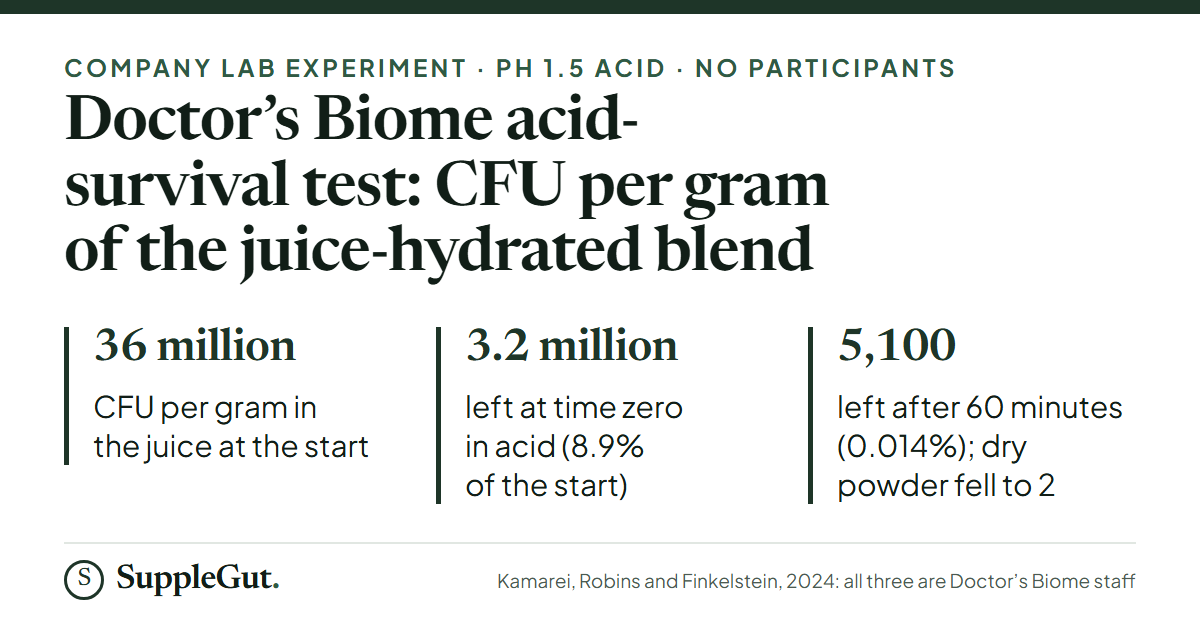
The acid-survival experiment. Three company staff exposed the blend to acid at pH 1.5 in a lab, pre-hydrated in the juice and as dry powder, and report the juice version surviving about 50 times better at time zero, 3,700 times at 30 minutes and 2,188 times at 60 minutes (Kamarei et al., 2024). The juice started at 36 million CFU per gram, fell to 3.2 million at time zero and to 5,100 per gram after 60 minutes; the powder fell to 64,000, 7 and 2. So the juice lost most of its cells too, and the test measured no one’s intestine. The page carries no funding statement. Amazon’s listing prints slightly different counts for the juice arm (25,960 and 5,300).
Neither piece compares Doctor’s Biome with a capsule in people. The claim that living probiotics “deliver what capsules & powders can’t” has a laboratory test behind it and no trial.
After antibiotics: what the evidence says
The brand’s Meta ad reads “Reset your gut after antibiotics.” Its FAQ calls probiotics during and after antibiotics a personal choice to discuss with a doctor. The research splits three ways.
Probiotics taken during antibiotics lower the risk of diarrhea. A meta-analysis of 42 trials in 11,305 adults found a risk ratio of 0.63 (95% CI 0.54 to 0.73), with only some species effective (Goodman et al., 2021). A Cochrane review of 33 trials in 6,352 children found diarrhea in 8% on probiotics against 19% on control, and a stronger effect at 5 billion CFU a day or more (risk ratio 0.37) than below it (0.68, 0.46 to 1.01) (Guo et al., 2019). For C. difficile diarrhea, 31 trials in 8,672 people found 1.5% against 4.0% (risk ratio 0.40), with the effect confined to trials where baseline risk was above 5% (Goldenberg et al., 2017). A review of 228 trials found efficacy depends on the strain and the condition (McFarland et al., 2018). All of these test probiotics started with the antibiotic to prevent diarrhea, not a product started afterward to restore the gut. The 27 billion CFU is above that 5 billion threshold at manufacture only.
One human study points the other way on recovery. After antibiotics, people given a multi-strain probiotic showed “a markedly delayed and persistently incomplete” return of their own gut microbiome compared with people who recovered unaided, while a transplant of their own stool restored it within days (Suez et al., 2018). It was not a test of Doctor’s Biome and it is one study, but it is the only one we found that measured recovery.
No trial of this product after antibiotics. Two of its strains do appear in antibiotic trials. In 120 hospital patients (mean age 78) on amoxicillin-clavulanate, a four-strain mixture with Lpc-37 and Bi-07 cut colonization with multi-drug-resistant bacteria from 25% to 8.3% (Wieërs et al., 2021), and added to treatment of a first C. difficile infection in 33 people it cut total diarrhea days from 12.0 to 3.5 with no difference in recurrence (Barker et al., 2017). Those blends also held NCFM and Bl-04, which are not on this label, and neither used a juice.
Side effects and who should check first
The brand’s FAQ says gas, bloating or diarrhea can occur at first and should fade, that people with immune system problems may be more likely to have them, and that anyone on immunosuppressants or steroids, or who is pregnant, should consult a doctor before starting. The 2021 survey reported no adverse events and two mild complaints, constipation and heartburn. Directions: one bottle daily on an empty stomach, 30 minutes before eating.
What the reviews say
The brand’s site shows 4.62 from 245 reviews (194 five-star, 28 four, 10 three, 7 two, 6 one), on a widget the brand hosts. Amazon shows 1.0 from a single rating, on a listing where the brand is the seller. We found no Trustpilot profile, so there is no independent billing record either way.
Reviewers praise the taste (34 mention it), less bloating and more regular bowel movements, and relief from long-running problems such as reflux. They complain about shipping and packaging (45 of 245 mention it), with lukewarm, leaked and broken bottles, about the price (10), and about changing a subscription.
Shipping, storage, subscription and refund terms
Orders ship cold with ice packs Monday to Thursday, and the FAQ says a box arriving less than cold is normal and should be refrigerated on arrival. The brand’s storage statements differ: refrigerate and use within 120 days on the product page, one month at room temperature in the FAQ, and no refrigeration needed in an owner reply to a reviewer.
The banner offers a 30-day money-back guarantee. The FAQ limits it to first-time purchasers and asks for your name, order number and the batch number on the bottle. The terms of service say all sales are final and no product may be returned for a refund, under a separate “30-Day Guarantee” heading. Return shipping terms are not published. The subscription delivers every 30 or 60 days at 10% off; we could not confirm whether it is preselected, and a single box can be bought one time.
Who is behind it
Newgen 27 LLC, doing business as Doctor’s Biome, Hauppauge, New York, started in 2017 according to a 2019 press release. The About page names Rich Finkelstein as CEO, Howard F. Robins, D.P.M. as Chief Medical Officer and A. Reza Kamarei, Ph.D. as Chief Science & Technology Officer; we did not verify credentials. It does not name the manufacturer. The brand says every batch is tested for pathogens by an independent lab, but names no lab and no potency testing.
Cost
A box of 30 is $179.99, or $6.00 a day, with free shipping; the subscription price of $161.99 is $5.40 a day if one box lasts 30 days, and Amazon lists $189.99 ($6.33 a day). Florastor costs $1.31 a day and Culturelle $0.75 a day at the catalog prices, and each is a capsule with trials of its own; Culturelle vs Florastor compares them, the alternatives guide covers cheaper equivalents, and the probiotic guide matches strains to symptoms.
Who Doctor’s Biome is for
- Someone who wants a daily liquid probiotic with every strain code printed and accepts that the evidence is the company’s survey and lab test.
- A person comfortable with a cold-shipped product and a price near $180 a month.
- Someone for whom the brand’s cautions on immunosuppressants, steroids and pregnancy do not apply.
For a probiotic taken with antibiotics, the trials sit with named products such as Florastor and Culturelle; Visbiome is the eight-strain formulation used in trials.
The products in this catalog
Common questions
Does Doctor’s Biome Gut Health work?
No controlled trial of the product exists. The brand’s evidence is an 80-person satisfaction survey by its own officers and a company laboratory test of acid survival. Reviewers on the brand’s site average 4.62 from 245 reviews and many describe less bloating and easier bowel movements, while a few report no effect; Amazon shows a single 1.0 rating.
Should you take Doctor’s Biome after antibiotics?
The brand’s ad says to reset your gut after antibiotics, but its FAQ calls taking probiotics during and after antibiotics a personal choice to discuss with a doctor. Pooled trials show probiotics taken during antibiotics lower diarrhea risk, with results that depend on the strain. A 2018 human study found a multi-strain probiotic delayed microbiome recovery compared with no probiotic, and we found no trial of this product after antibiotics. See the probiotic guide for strains with trials.
What strains and ingredients are in Doctor’s Biome?
Fifteen coded strains, among them L. reuteri 1E1, L. paracasei Lpc-37, B. lactis Bi-07 and L. plantarum Lp-115, totaling 27 billion CFU at manufacture with no per-strain counts. The base is 76% organic juice of peppermint leaf, cucumber, apple, kale, lettuce, celery and lemon. Older brand copy gives 4.5 g of natural sugar per bottle; the current panel was not legible.
Is Doctor’s Biome safe, and what are the side effects?
The brand says gas, bloating or diarrhea can occur at first and fade, and that people on immunosuppressants or steroids, or who are pregnant, should ask a doctor first. It says every batch is tested for pathogens by an independent lab but names no lab. The 2021 company survey reported no adverse events and two mild complaints, constipation and heartburn.
How much does Doctor’s Biome cost per day?
A box of 30 bottles is $179.99, which is $6.00 a day, with free shipping. The subscription takes 10% off ($161.99, about $5.40 a day) and delivers every 30 or 60 days, and Amazon lists $189.99 ($6.33 a day). For comparison, the catalog prices Culturelle at $0.75 a day and Florastor at $1.31; see Culturelle vs Florastor.
How does Doctor’s Biome ship, and how do refunds work?
Orders ship cold with ice packs Monday to Thursday, and some reviewers report warm, leaked or broken bottles (45 of 245 reviews mention shipping). The 30-day guarantee is for first-time purchasers and asks for the batch number on the bottle, while the terms of service also say all sales are final. Return shipping terms are not published.
Who makes Doctor’s Biome?
Newgen 27 LLC, doing business as Doctor’s Biome, in Hauppauge, New York, started in 2017 according to a 2019 press release. The brand’s About page lists Howard F. Robins, D.P.M. as Chief Medical Officer and A. Reza Kamarei, Ph.D. as Chief Science & Technology Officer; we did not verify credentials. It does not name the manufacturer.
Sources
- Robins HF, Kamarei AR. "Beneficial Effect of a Juice-Based Probiotic for Colon Health." Journal of Gastroenterology Research, 2021;5(1):190–196. doi.org/10.36959/621/619
- Kamarei AR, Robins HF, Finkelstein E. "Juice-based living probiotics survive stomach acid significantly better than dry powder live probiotics." Journal of Biochemistry and Physiology, 2024;7(4). doi.org/10.4172/jbpy.1000176
- Suez J, Zmora N, Zilberman-Schapira G, et al. "Post-Antibiotic Gut Mucosal Microbiome Reconstitution Is Impaired by Probiotics and Improved by Autologous FMT." Cell, 2018;174(6):1406–1423. doi.org/10.1016/j.cell.2018.08.047
- Goodman C, Keating G, Georgousopoulou E, Hespe C, Levett K. "Probiotics for the prevention of antibiotic-associated diarrhoea: a systematic review and meta-analysis." BMJ Open, 2021;11(8):e043054. doi.org/10.1136/bmjopen-2020-043054
- Guo Q, Goldenberg JZ, Humphrey C, El Dib R, Johnston BC. "Probiotics for the prevention of pediatric antibiotic-associated diarrhea." Cochrane Database of Systematic Reviews, 2019;4:CD004827. doi.org/10.1002/14651858.CD004827.pub5
- Goldenberg JZ, Yap C, Lytvyn L, et al. "Probiotics for the prevention of Clostridium difficile-associated diarrhea in adults and children." Cochrane Database of Systematic Reviews, 2017;12:CD006095. doi.org/10.1002/14651858.CD006095.pub4
- McFarland LV, Evans CT, Goldstein EJC. "Strain-Specificity and Disease-Specificity of Probiotic Efficacy: A Systematic Review and Meta-Analysis." Frontiers in Medicine, 2018;5:124. doi.org/10.3389/fmed.2018.00124
- Wieërs G, Verbelen V, Van Den Driessche M, et al. "Do Probiotics During In-Hospital Antibiotic Treatment Prevent Colonization of Gut Microbiota With Multi-Drug-Resistant Bacteria?" Frontiers in Public Health, 2021;8:578089. doi.org/10.3389/fpubh.2020.578089
- Barker AK, Duster M, Valentine S, et al. "A randomized controlled trial of probiotics for Clostridium difficile infection in adults (PICO)." Journal of Antimicrobial Chemotherapy, 2017;72(11):3177–3180. doi.org/10.1093/jac/dkx254
- Brand pages: label, ingredients, FAQ, terms of service and price (doctorsbiome.com/products/doctors-biome-colon-health); Amazon listing: price, rating and acid-survival claims (amazon.com/dp/B0HBRBS94Q); ClinicalTrials.gov NCT06367504 (clinicaltrials.gov)
Not sure which product fits your situation?
This guide covers the mechanics. The quiz takes your specific symptoms, routine and preferences and matches you to one product from the catalog.
Take the quiz →