
Guide
Is there a generic Culturelle? And a generic Florastor?
Culturelle and Florastor are the two single-strain probiotics a pharmacist is most likely to name, and both cost more than the shelf around them. The question people search for is whether there is a generic Culturelle or a generic Florastor: a cheaper bottle with the same words on the front that is the same thing. The answer depends on one line of small print — the strain — and it is different for the two products.
Quick answer
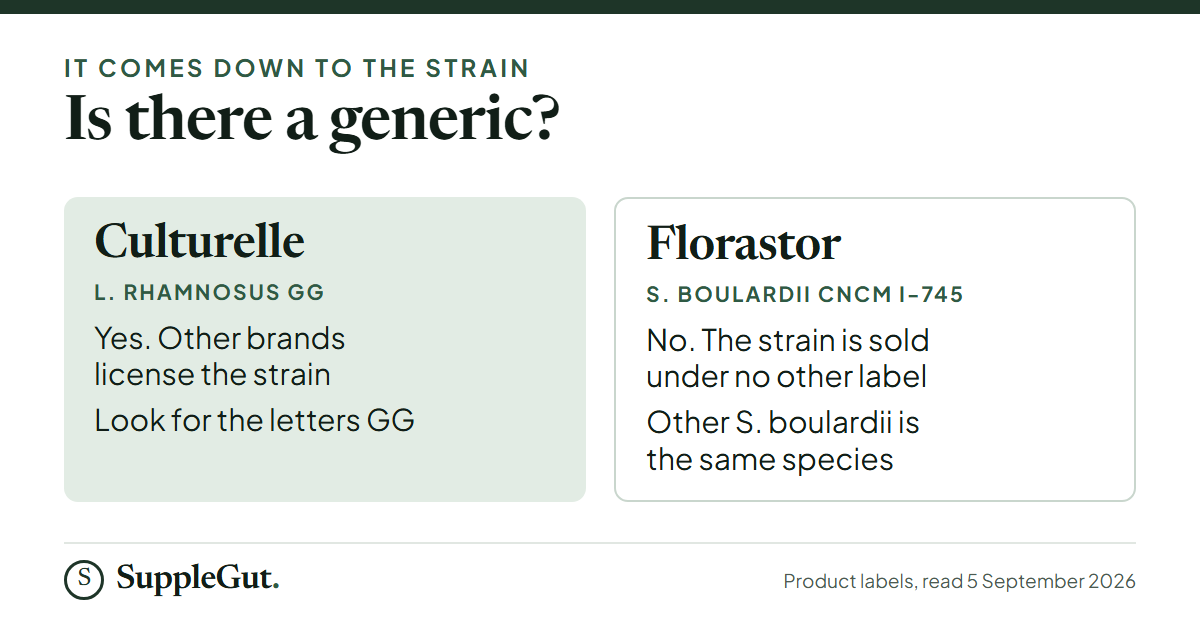
Culturelle does have a generic. Its strain, Lactobacillus rhamnosus GG, is a trademark of Chr. Hansen (now Novonesis) that other brands license. Pure Encapsulations PureGG 25B is the same strain at 25 billion CFU. Store-brand “compare to Culturelle” capsules usually are not: look for the letters GG.
Florastor has no generic. It is Saccharomyces boulardii CNCM I-745, a strain Biocodex owns and sells under no other label. Cheaper S. boulardii capsules from NOW and Jarrow are the same species at about a fifth of the price, and a 2026 genomic study found the lineage’s probiotic traits conserved across five commercial isolates — but the 21-trial record belongs to I-745.
What “generic” means for a probiotic
A generic drug has the same molecule as the brand. A probiotic has no molecule; it has an organism, and organisms come in strains. Lactobacillus rhamnosus is a species; L. rhamnosus GG is one strain of it, isolated from one human sample in 1985 and documented in more than a thousand studies since. A different L. rhamnosus strain is a different product with its own, usually much thinner, evidence, in the same way that two people with the same surname are not the same person.
So the two lines to read on any bottle are the strain designation (the letters or number after the species name) and the CFU figure, together with whether that figure is guaranteed through the best-by date or only at manufacture. The rest of the front of the pack does not change what the product does.
Generic Culturelle: the other LGG products
Culturelle’s strain is L. rhamnosus GG at 10 billion CFU per capsule (12 billion in the Pro Strength version). Unlike Florastor’s yeast, LGG is not exclusive to one finished product: the strain belongs to Chr. Hansen, now part of Novonesis, which sells it as an ingredient and licenses the LGG mark to brands that use it. That is why a genuine equivalent exists.
| Product | Strain | Dose | Cost per day | Rating |
|---|---|---|---|---|
| Culturelle Digestive Daily Probiotic | L. rhamnosus GG | 10 billion CFU | $0.75 | 4.7 from 3,383 (iHerb) |
| Culturelle Pro Strength Daily Probiotics | L. rhamnosus GG | 12 billion CFU | $0.52 | 4.7 from 12,172 (Amazon) |
| Pure Encapsulations PureGG 25B, 60 capsules | L. rhamnosus GG | 25 billion CFU | $0.74 | 4.4 from 152 (Amazon) |
PureGG’s other ingredients are the capsule itself (cellulose and water), so it is the closest thing to Culturelle in a different bottle, at a higher dose for about the same daily cost. Whether 25 billion is worth more than 10 billion is a separate question: for the outcomes where LGG has an evidence-based dose, 10 billion a day is already at or above it (see how many CFU do you need?).
The store-brand capsules shelved beside Culturelle are a different matter. In the online listings we read, products sold as “compare to Culturelle” do not consistently name GG; several give L. rhamnosus or a multi-strain blend and stop there. Treat a panel without the letters GG as a different strain, because it is one.
Generic Florastor: the cheaper S. boulardii capsules
Florastor’s strain is S. boulardii CNCM I-745, 250 mg per capsule, a live yeast rather than a bacterium. Its case rests on a meta-analysis of 21 randomized trials in 4,780 people in which the yeast cut the risk of antibiotic-associated diarrhea, and on the fact that, being a yeast, it is not killed by the antibiotic it is taken alongside. The manufacturer’s position is that there is no substitute, and on the trial record that is true: the studies were run on I-745.
Other brands sell S. boulardii from their own strains — CNCM I-1079, CNCM I-3799 and DBVPG 6763 are the ones named in the research literature — or list the species without a strain at all. What is known about how much that matters comes from a 2026 study in iScience that sequenced and tested five commercial S. boulardii isolates against three ordinary baker’s-yeast strains. The S. boulardii isolates shared a chromosomal inversion and other lineage-specific features, and all five showed the same probiotic-relevant behavior: acid tolerance, elevated acetate and succinate production, suppression of inflammatory signaling in gut cells. The authors describe the lineage as “functionally coherent.” That is the strongest available argument that a generic S. boulardii is doing the same kind of thing. It is a laboratory argument, and it is not a trial.
| Product | Strain on the listing | Dose | Cost per day | Rating |
|---|---|---|---|---|
| Florastor Unisex Daily Probiotic | CNCM I-745 | 250 mg per capsule | $1.31 | 4.6 from 1,292 (Walmart) |
| NOW Saccharomyces Boulardii, 60 or 120 capsules | I-3799 | 5 billion CFU per capsule | $0.22 (60) or $0.19 (120) | 4.6 from 4,363 (Amazon) |
| Jarrow Saccharomyces Boulardii + MOS, 90 capsules | None named | 5 billion CFU per capsule, with a prebiotic | $0.27 | 4.6 from 5,503 (Amazon) |
| Klaire Labs SFI Health Saccharomyces Boulardii, 120 capsules | None named | 3 billion CFU per capsule | $0.58 | 4.6 (Amazon) |
“None named” means the online listing we read gives the species and the CFU and no strain designation. If the bottle in your hand names one, that is more than the listing offers. NOW’s panel prints its strain as Saccharomyces cerevisiae var. boulardii I-3799. Across the probiotics in the catalog, the share of labels that name a strain is counted on its own page.
The caution is the same for all of them. S. boulardii is a live yeast. Every product on this list, Florastor included, carries the same warning for anyone immune-suppressed, critically ill or with a central venous line, because bloodstream yeast infections have been reported in those settings. A cheaper bottle does not change that; neither does a pricier one.
What to check before you switch
- The strain designation. CNCM I-745 for Florastor; the letters GG for Culturelle. A species name on its own is not a match.
- CFU “through expiry,” not “at manufacture.” The two can differ by orders of magnitude, and only the first tells you what is in the capsule when you take it.
- Storage. Both Florastor and Culturelle are shelf-stable; some cheaper capsules are not, and a refrigerated product that has spent a week in a delivery van is not the product on the label.
- The price per day, not per bottle. The table figures above are per capsule at the listed dose.
Products in this catalog
Common questions
Is there a generic for Florastor?
Not in the pharmacy sense. Florastor is Saccharomyces boulardii CNCM I-745, a strain owned by Biocodex and sold under no other label. Other brands sell S. boulardii from their own strains, or without naming one, at a fifth of the price: NOW at 5 billion CFU for about $0.19–0.22 a day, Jarrow at 5 billion CFU for about $0.27. They are the same species with conserved probiotic traits, but the trials behind Florastor’s claims were run on CNCM I-745.
Is NOW or Jarrow Saccharomyces boulardii the same as Florastor?
Same organism, different strain or no strain named, and a different evidence base. A 2026 genomic study of five S. boulardii isolates found probiotic-relevant traits conserved across the lineage, which is the best argument that a generic does the same kind of thing. It is not the same as the 21-trial record that belongs to CNCM I-745.
What strain is in Florastor?
Saccharomyces boulardii CNCM I-745, at 250 mg per capsule. Florastor is a live yeast rather than a bacterium, which is why it keeps working during a course of antibiotics.
Is there a generic Culturelle?
Culturelle is Lactobacillus rhamnosus GG, a trademarked strain owned by Chr. Hansen (now Novonesis) and licensed to other brands, so the same strain does exist under other labels — Pure Encapsulations PureGG 25B is one, at 25 billion CFU for about $0.74 a day. Store-brand capsules shelved as “compare to Culturelle” are often a different L. rhamnosus strain or a blend. The letters GG on the panel are the test.
Is a store-brand probiotic as good as Culturelle?
Only if it contains the same strain at a comparable dose. L. rhamnosus without the letters GG is a different strain with its own, usually thinner, evidence. If the label says GG and states the CFU through the best-by date, the difference is price and the other ingredients.
Sources
- Florastor. “The One Probiotic Strain You Need: Saccharomyces boulardii CNCM I-745.” florastor.com
- Florastor Healthcare Professionals. “There is no substitute for Florastor.” florastorhcp.com
- Duffey HE, Hedin KA, Gelli HP, Vaaben TH, Sommer MOA. “Genomic and phenotypic comparisons reveal lineage-specific traits of the probiotic Saccharomyces boulardii.” iScience, 2026;29(5):115706. pubmed.ncbi.nlm.nih.gov/42095083
- NOW Saccharomyces Boulardii, 5 billion CFU, 60 capsules: price and rating. amazon.com/dp/B0053W995W; 120 capsules: amazon.com/dp/B07YBKYPSX
- Jarrow Saccharomyces Boulardii + MOS, 5 billion CFU, 90 capsules: price and rating. amazon.com/dp/B0013OVW0E
- Klaire Labs SFI Health Saccharomyces Boulardii, 3 billion CFU, 120 capsules: price. amazon.com/dp/B003PQHBCQ
- Chr. Hansen / The Probiotics Institute. “Lactobacillus rhamnosus, LGG.” theprobioticsinstitute.com
- Pure Encapsulations PureGG 25B, 60 capsules: label, price and rating. amazon.com/dp/B07WJXVQJ5
- National Institutes of Health, Office of Dietary Supplements. “Probiotics — Health Professional Fact Sheet.” ods.od.nih.gov
Not sure which product fits your situation?
This guide covers the mechanics. The quiz takes your specific symptoms, routine and preferences and matches you to one product from the catalog.
Take the quiz →