
Guide
Do Grüns work? A multivitamin gummy with 6 g of fiber, and what the trials say about that dose
Quick answer
Do Grüns work? We found no trial of the gummy for digestion. It is a multivitamin with 6 g of fiber from a blend that does not split the grams between tapioca fiber, inulin and pectin, while fiber meta-analyses found benefit in constipation mainly above 10 g a day and an inulin trial used 12 g. The brand’s unpublished 12-week trial in 120 adults measured blood folate and vitamin C, not digestion. Amazon shows 4.2 from 7,353 ratings; three lawsuits over subscriptions, fiber content and the sugar-free claim are unproven allegations.
Grüns Superfood Gummies are a daily multivitamin in gummy form with fiber added: one 20 g pack of about eight strawberry-flavored gummies a day, sold on the promise of better digestion and greens in a handful. The thing that separates it from the greens powders and fiber products next to it is the format and the dose, 6 g of fiber from a blend that does not say how much of it is each ingredient. This page sets out what the label discloses, what the trials do and do not cover, how the reviews split, what the subscription terms say, and what the three pending lawsuits allege.
What Grüns is, and what it is not
It is a multivitamin-plus-fiber gummy. It is not a probiotic, and it is not a dedicated fiber supplement. One pack (20 g) supplies 50 calories, 15 g of carbohydrate and 6 g of dietary fiber, which is 21% of the 28 g Daily Value. The panel lists 13 vitamins, mostly at 100% of the Daily Value, and eight minerals at about 25%, with no calcium and no magnesium. The low-sugar version carries 8 g of added sugar; the sugar-free version has 20 calories, less than 0.5 g of sugar and uses allulose and Reb M as sweeteners.
The rest of the panel is an 8.7 g “Core Nutrients Blend”, about 44% of the pack by weight, printed as a proprietary blend with no per-ingredient amounts. Tapioca fiber (a soluble fiber sold under the name FiberSMART) and organic inulin root powder come first, followed by shiitake extract, kale, a long list of fruit and vegetable powders, spirulina, chlorella and grasses. The gummy base is pectin. There is no probiotic, postbiotic or enzyme anywhere on the label. The fiber figure rests on tapioca fiber, inulin and pectin, and the grams of each are not printed. ConsumerLab reads the greens in the blend as secondary to the added fibers as a source of the 6 g.
The label warns that accidental overdose of iron-containing products is a leading cause of fatal poisoning in children under 6, and says children, pregnant or nursing women should seek professional medical advice before taking it. A California Proposition 65 warning for lead is printed. The brand states third-party testing and manufacture in NSF, GMP and FDA-registered facilities, but we could find no laboratory certificate.
The trial of the product itself
The brand describes a 12-week, double-blind, placebo-controlled study in 120 healthy adults aged 23 to 59. It measured nutrient biomarkers, not digestion: blood folate rose 20.5% and vitamin C 40.1%, which the brand reports as 2.9 times and 2.7 times the change on placebo. The study is unpublished, ConsumerLab reports that key methods are missing, and we found no record of it on ClinicalTrials.gov or PubMed. No stool, regularity or gut outcome is reported from it.
The gut claim instead rests on a brand survey of more than 3,000 customers, in which 67% said they experienced better, more regular digestion. A survey of people who kept buying is not a trial, and it has no comparison group. We found no trial of the finished gummy in constipation, IBS or bloating.
The evidence for the fiber, and the dose
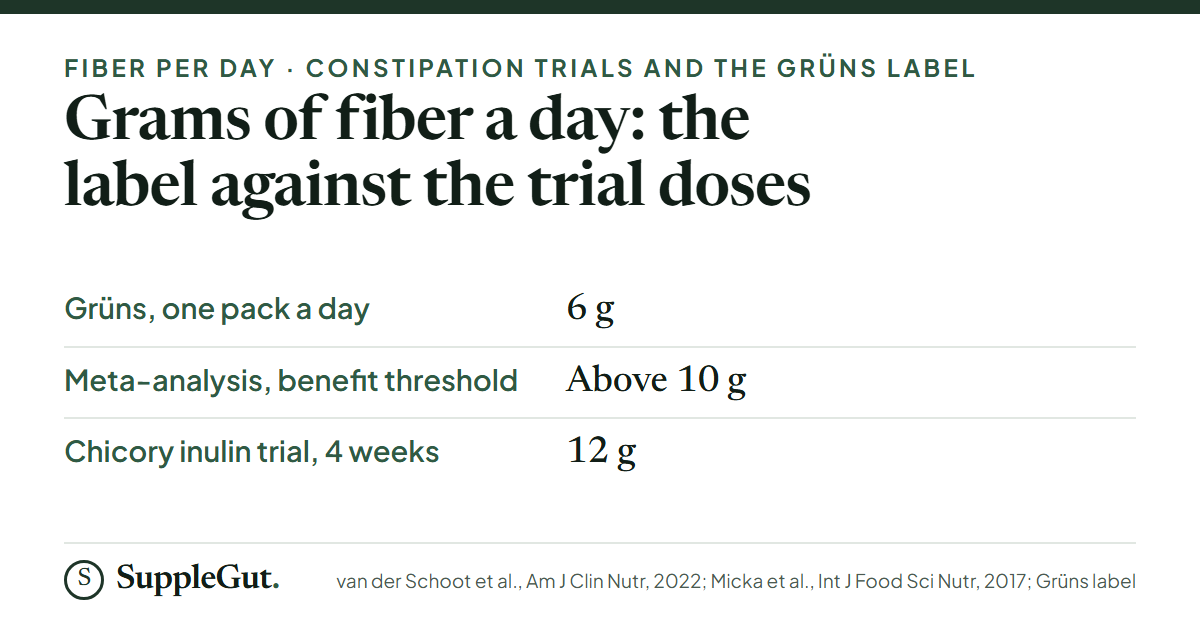
All of the relevant evidence is for fiber as a class, and mostly at doses above what one pack holds. A 2022 systematic review and meta-analysis of 16 randomized trials in 1,251 adults with chronic constipation found that 66% responded to fiber against 41% on control (relative risk 1.48), with stool frequency improving. The authors concluded the benefit appeared only with higher doses, above 10 g a day, over at least four weeks, and that psyllium and pectin had significant effects, with flatulence higher on fiber (van der Schoot et al., American Journal of Clinical Nutrition, 2022). A 2016 meta-analysis of seven trials reached a similar picture, 77% against 44% responders, while rating the overall quality of evidence as low (Christodoulides et al., 2016). One Grüns pack is 6 g.
For inulin, one of the two named fibers, a placebo-controlled crossover trial in 44 adults with constipation used 12 g of chicory inulin a day for four weeks and raised stool frequency from a median of 3.0 to 4.0 stools a week, with softer stools (Micka et al., International Journal of Food Sciences and Nutrition, 2017). A meta-analysis of five inulin trials found stool frequency and consistency improved while pain and bloating did not (Collado Yurrita et al., Nutricion Hospitalaria, 2014). Gas is the dose-related effect: in 84 healthy adults taking inulin-type fructans at 5 to 20 g a day, symptoms tended to rise with dose and were mild, reaching significance for one product at 20 g (Bruhwyler et al., 2009).
The first ingredient, the tapioca fiber, has no peer-reviewed efficacy trial that we could find. A trade-press report, supplier-linked, describes a tolerability study in 40 healthy adults at single servings of 10, 30 and 50 g. The closest published work is a 14-day crossover in 20 healthy adults that gave 12 g a day of four maize- or tapioca-derived fibers, which was tolerated with mild to moderate symptoms and left stool weight unchanged (Stewart et al., Annals of Nutrition and Metabolism, 2010). That is a related material, not the same one. Pectin, the gummy base, is among the fibers with significant effects in the constipation meta-analysis, but the amount in a pack is not printed.
The 6 g on the label is also disputed in court: a July 2026 lawsuit alleges independent testing found 5.27 g of fiber per serving. That is an unproven allegation, and the tester is not named. Whether it is 6 g or 5.27 g, the dose is below the 10 g threshold in the meta-analysis.
How to take Grüns
The directions are one pack a day, and the brand’s page calls it a small handful of gummies. No timing is given and no instruction about food. Because the meta-analysis found benefit over at least four weeks, a month is a fair test. The vitamins and minerals are at 100% and about 25% of Daily Values, so a second pack would double all of those along with the fiber, and the label does not suggest it.
Side effects and who should not take it
The fiber side effect in the trials is gas and bloating, and the same fermentation that makes inulin and tapioca fiber food for gut bacteria makes the gas. Amazon’s review summary for the low-sugar listing says some reviewers report improved digestion and others stomach pain, and the sugar-free version contains allulose, which can also cause gas and bloating. The iron in the multivitamin matters for households with young children: the pouch should be stored out of reach. The brand says the gummies are vegan, gluten free, dairy free and nut free, with no gelatin; we found no statement on egg, soy, fish or sesame, or on cross-contact in the facility. The label tells children, pregnant or nursing women to seek professional advice, and reviewers mention taking the gummies alongside GLP-1 medicines; we found no trial of that combination, so the question belongs with a prescriber.
What the reviews say
On Amazon, the low-sugar listings show 4.2 from 7,353 ratings (69% five-star, 10% four, 7% three, 3% two, 11% one), and the sugar-free listing shows 4.3 from 2,155. These are independent pools, though the seller is the brand. On Trustpilot the profile shows 4.6 from 2,453 reviews, with 87% five-star and 9.2% one-star (226 reviews); it covers the whole brand, including kids’ products and limited flavors, and the brand invites its customers to review there. Of the one-star reviews we read, most concern subscriptions, cancellations and charges rather than the gummies themselves. The brand’s own site shows about 4.8 from more than 100,000 reviews, a self-hosted figure that cannot be split by product. The brand also discloses that some testimonials come from people who received compensation or free product, and describes one featured athlete as a paid spokesperson and investor.
The recurring praise is the taste, which reviewers compare to a treat, the convenience of a single pack, and more regular digestion. The recurring complaints are billing, a hard or gritty texture, the price for about eight gummies, some stomach upset, and a few reports of packs with a different count or with nothing inside.
The subscription and refund terms
The brand’s product page selects a subscription by default: the first box of 28 packs is $29.99 with free shipping and renews at $49.99 every four weeks, with pause and cancel available through an account portal. The refund policy gives 30 days from receipt to request a refund and states that it applies only to the initial purchase; no return of product is needed. It also says the brand does not cancel orders after placement or cancel subscriptions for customers, who manage them through the portal. A one-time purchase is available at $66.65 for 28 packs, without free shipping. Reviewers describe a confirmation email shortly before each shipment with a short window to edit or skip, and several report being charged after choosing a one-time purchase or after canceling. A December 2025 lawsuit, described below, alleges the subscription terms were not adequately disclosed. Amazon sells single boxes and Subscribe & Save, and lists the product as non-returnable except for damaged or defective items.
The lawsuits, and the acquisition
Three class actions are pending, and all of their claims are unproven allegations; none has been decided on these points.
- Subscriptions (December 2025, Central District of California): alleges the terms of subscriptions were not adequately disclosed. Unproven; status pending.
- Fiber and niacin (July 2026, Central District of California): alleges independent testing found 5.27 g of fiber and 14.6 mg of niacin per serving against 6 g and 16 mg on the label, and challenges the proprietary-blend disclosure. Unproven; no ruling.
- “Sugar-free” (August 2026, District of New Jersey): alleges the claim is misleading because a serving has 6 to 9 g of allulose, which the plaintiffs say counts as sugar; Unilever United States Inc. is also named. Unproven; no ruling. ConsumerLab says the “zero added sugar” claim is not accurate and that the FDA has not generally acted on allulose labeling.
In April 2026 Unilever announced an agreement to acquire Grüns, with terms undisclosed and closing expected later in 2026. We could not confirm whether it has closed.
Who Grüns is for
- Someone who wants a daily multivitamin they will actually take, and values a gummy and a flavor they like.
- Someone who wants a modest fiber top-up of 6 g, about a fifth of the Daily Value, rather than a dose in the range the constipation trials used.
- Someone who prefers a single printed serving to measuring a powder, and who has read the subscription terms before ordering.
If regularity is the goal, the trials point to higher fiber doses, and psyllium is one of the fibers with a significant effect in the meta-analysis. The psyllium guide covers how long it takes, NOW Foods psyllium husk powder is a plain version, and Metamucil Fiber Gummies are the closest in format. For a greens powder, the Bloom Greens guide covers that format, and the quiz starts from symptoms instead of products.
Cost
On the brand site, 28 packs one time is $66.65 for the low-sugar version, or $2.38 a day, plus shipping, and $73.32 for sugar-free ($2.62 a day). The first subscription box is $29.99 ($1.07 a day) and the renewal is $49.99 every four weeks, or $1.79 a day. Amazon lists the sugar-free 28 count at $74.00 ($2.64 a day) with Subscribe & Save at 15% or 20% off ($2.25 or $2.11 a day), and a two-box low-sugar pack at $101.02, or $1.80 a day.
The products in this catalog
Common questions
Do Grüns gummies work for digestion or regularity?
We found no trial of the gummy for digestion. The label has 6 g of fiber from tapioca fiber, inulin and pectin, and a 2022 meta-analysis found benefit in constipation mainly above 10 g a day, with more gas as the usual side effect. The brand’s survey of more than 3,000 customers says 67% reported better, more regular digestion, which is a survey and not a trial.
What is in Grüns, and how much fiber does it have?
One 20 g pack has 50 calories, 6 g of fiber, 8 g of added sugar in the low-sugar version, 13 vitamins mostly at 100% of the daily value, eight minerals at about 25%, and an 8.7 g blend of fiber, fruit, vegetable, algae and mushroom powders with no amounts listed. There is no probiotic. A July 2026 lawsuit alleges tests found 5.27 g of fiber, which is an unproven allegation.
How much do Grüns cost?
The brand charges $66.65 for 28 packs one time, or $2.38 a day, and the first subscription box is $29.99, renewing at $49.99 every four weeks, about $1.79 a day. Amazon lists the sugar-free 28 count at $74.00, or $2.64 a day, with Subscribe & Save at 15% or 20% off. Shipping on one-time brand orders is not free.
How does the Grüns subscription work, and can you get a refund?
The brand’s page selects a subscription by default, renewals ship every four weeks, and the 30-day refund covers the first order only. The brand says customers manage subscriptions through an account portal. About 9% of Trustpilot reviews are one-star, and most of the one-star reviews we read concern charges, cancellations or refunds; a December 2025 lawsuit alleging inadequate subscription disclosure is unproven. Amazon sells single boxes, though it lists the item as non-returnable.
Grüns vs AG1 or a fiber supplement like psyllium?
AG1 is a powder with a different panel, and we found no head-to-head trial of Grüns against it or against psyllium. Psyllium and pectin were the fibers with significant effects in a 2022 meta-analysis of constipation trials, at doses above 10 g a day, while one Grüns pack has 6 g of mixed fiber plus vitamins and minerals. Our psyllium guide covers that fiber.
Are Grüns gummies really sugar-free?
The sugar-free version lists less than 0.5 g of sugar and 0 g of added sugar, and is sweetened with allulose and Reb M. An August 2026 lawsuit alleges each serving has 6 to 9 g of allulose and that the claim is misleading, which is unproven. The low-sugar version has 8 g of added sugar per pack.
What are the side effects of Grüns?
Gas and bloating are the usual fiber effects in trials, and allulose in the sugar-free version can add to them. Amazon reviewers split between improved digestion and stomach pain. The label warns that iron-containing products are a leading cause of fatal poisoning in children under 6 and advises children, pregnant or nursing women to seek medical advice first.
Sources
- van der Schoot A, Drysdale C, Whelan K, Dimidi E. "The effect of fiber supplementation on chronic constipation in adults: an updated systematic review and meta-analysis of randomized controlled trials." American Journal of Clinical Nutrition, 2022;116(4):953–969. pubmed.ncbi.nlm.nih.gov/35816465
- Christodoulides S, Dimidi E, Fragkos KC, et al. "Systematic review with meta-analysis: effect of fibre supplementation on chronic idiopathic constipation in adults." Alimentary Pharmacology & Therapeutics, 2016;44(2):103–116. pubmed.ncbi.nlm.nih.gov/27170558
- Micka A, Siepelmeyer A, Holz A, Theis S, Schon C. "Effect of consumption of chicory inulin on bowel function in healthy subjects with constipation: a randomized, double-blind, placebo-controlled trial." International Journal of Food Sciences and Nutrition, 2017;68(1):82–89. pubmed.ncbi.nlm.nih.gov/27492975
- Collado Yurrita L, San Mauro Martin I, Ciudad-Cabanas MJ, et al. "Effectiveness of inulin intake on indicators of chronic constipation; a meta-analysis of controlled randomized clinical trials." Nutricion Hospitalaria, 2014;30(2):244–252. pubmed.ncbi.nlm.nih.gov/25208775
- Bruhwyler J, Carreer F, Demanet E, Jacobs H. "Digestive tolerance of inulin-type fructans: a double-blind, placebo-controlled, cross-over, dose-ranging, randomized study in healthy volunteers." International Journal of Food Sciences and Nutrition, 2009;60(2):165–175. pubmed.ncbi.nlm.nih.gov/18608562
- Stewart ML, Nikhanj SD, Timm DA, Thomas W, Slavin JL. "Evaluation of the effect of four fibers on laxation, gastrointestinal tolerance and serum markers in healthy humans." Annals of Nutrition and Metabolism, 2010;56(2):91–98. pubmed.ncbi.nlm.nih.gov/20090313
- Grüns brand pages: label, directions, price, science page and refund policy. gruns.co/products/gruns
- ConsumerLab. "Do Grüns gummies work and are they safe?" consumerlab.com
- Trustpilot and Amazon listings: ratings, rating splits and review text. trustpilot.com/review/gruns.co
- Case listings: Scott v. Gruns Nutrition (2:26-cv-08019) and Ulberg v. Gruns Nutrition (2:26-cv-11269). claimdepot.com
Not sure which product fits your situation?
This guide covers the mechanics. The quiz takes your specific symptoms, routine and preferences and matches you to one product from the catalog.
Take the quiz →