
Guide
Does Bloom Greens work? What is in the scoop and what the trials say
Quick answer
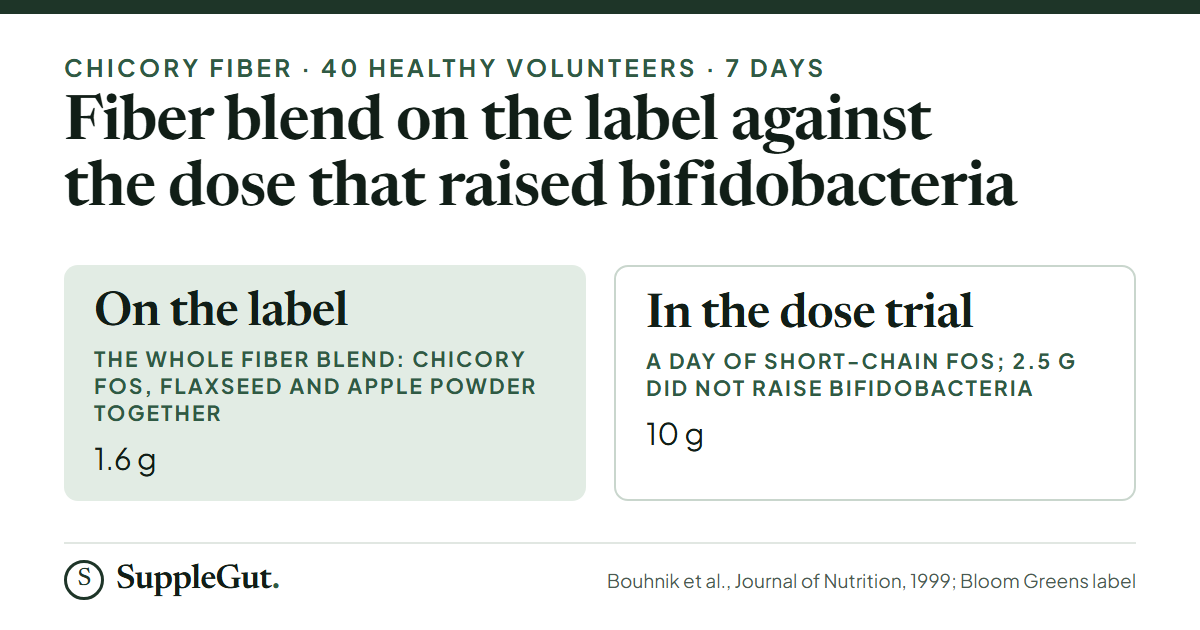
Does Bloom Greens work? We could find no trial of Bloom Greens itself. The label lists seven blends that together weigh about 5.0 g of the 5.44 g scoop, with no amount for any ingredient, 2 g of total fiber, and three probiotic species with no strain designations or CFU count. The fiber the label names raised bifidobacteria at 10 g a day or more in a dose trial, while the whole fiber blend here is 1.6 g. Reviews run from 4.2 to 4.4 stars on retail sites, with praise for taste and a recurring minority reporting no effect or more bloating.
Bloom Greens & Superfoods is a flavored greens powder: one scoop in water once a day, sold on the promise to relieve bloat, support digestion and promote energy. What sets it apart from the greens powders next to it is the pitch to the gut, since it adds fiber, three probiotic species and a digestive enzyme blend to the usual grasses and fruit powders. This page sets out what the label discloses, what the trials do and do not cover, how the reviews split by platform, and what it costs.
What Bloom Greens is, and what it is not
A scoop is 5.44 g on the Berry label and supplies 15 calories, 3 g of carbohydrate and 2 g of dietary fiber. Everything active sits inside seven proprietary blends, each printed with a total weight and no per-ingredient amounts: a fiber blend (1.606 g: chicory root fructo-oligosaccharides, flaxseed, apple powder), a green superfood blend (1.367 g: barley grass, spirulina, wheatgrass, alfalfa, chlorella), a pre and probiotic blend (648 mg), a fruit and vegetable blend (572 mg), an antioxidant blend (550 mg), a digestive enzyme blend (150 mg) and an adaptogenic blend (100 mg). The seven add up to about 5.0 g of the scoop. The sweetener is stevia leaf extract.
The probiotic line names Bifidobacterium bifidum, Lactobacillus rhamnosus and Lactobacillus acidophilus, shares its 648 mg with blue agave inulin, and prints no strain designations and no CFU. The enzyme line lists amylase, amyloglucosidase, protease, acid protease, cellulase and lipase with no activity units. The label also shows a “Third Party Tested” badge without naming a testing body, and we found no published lab certificates.
The trial of the product itself
There is none. We searched PubMed and ClinicalTrials.gov and found no study of Bloom Greens. The closest evidence is a different greens powder: AG1 was tested in a double-blind, placebo-controlled trial of 30 healthy adults for four weeks. Its digestive quality-of-life score moved +62.5% on AG1 against −50% on placebo, a difference that did not clear the usual threshold (p = 0.058), and bowel frequency and stool consistency did not change (La Monica et al., Journal of the International Society of Sports Nutrition, 2024). That formula states a probiotic dose and Bloom does not, so the result is not evidence for Bloom.
The evidence for the ingredients
Fiber. In a trial of 40 healthy volunteers, short-chain fructo-oligosaccharides raised fecal bifidobacteria at 10 and 20 g a day but not at 2.5 g over seven days, and excess gas was more frequent at 20 g than at 0, 2.5 or 5 g (Bouhnik et al., Journal of Nutrition, 1999). Bloom’s entire fiber blend is 1.6 g, and the chicory share is not printed. In 96 adults with IBS, 20 g a day of FOS did not beat placebo over 12 weeks (58% improved on FOS against 65% on placebo), and in 23 children with IBS fructans produced more bloating and gas than maltodextrin, both at doses far above this product’s (Olesen and Gudmand-Hoyer, 2000; Chumpitazi et al., 2018).
Probiotics. A 2023 meta-analysis of 82 trials in 10,332 adults with IBS rated the evidence for combination probiotics on bloating as very low certainty, and adverse events were not higher than on placebo (Goodoory et al., Gastroenterology, 2023). The effects are strain-specific: B. bifidum MIMBb75 improved global IBS symptoms by 0.88 against 0.16 on a 7-point scale in 122 people over four weeks (Guglielmetti et al., 2011), but Bloom names the species only, so that strain cannot be assumed. For the enzymes and adaptogens we found no bloating trial, and the label gives no doses to compare. Our enzymes versus probiotics guide covers the two classes side by side.
How to take Bloom Greens
The label and brand page direct one scoop mixed into 8 fl oz or more of water, juice or a smoothie, once a day, with no food instruction. No timeline for results is printed; reviewers who report a benefit describe a few weeks. Because the fiber is a fermentable type that can produce gas, and the label states no dose, how it sits with you is something only the first weeks show.
Side effects and who should not take it
The label image prints no warnings. The brand’s questions page recommends the product for ages 18 and over and says to consult a primary doctor in pregnancy. Target’s listing suggests age 13 and up, says to keep it out of reach of children, and carries a California Proposition 65 warning without naming the substance. Reviewers on Target and Walmart report stomach discomfort, gas, more bloating and, in a few cases, vomiting. One Walmart reviewer with celiac disease reports a reaction to a product that carries a gluten-free badge; it is a single report.
What the reviews say
The brand site shows 4.4 from 15,411 reviews (86% would recommend), but that pool includes reviews tagged to other Bloom products. Amazon shows 4.4 from 4,312 ratings, 73% five-star and 6% one-star, an independent pool. Target shows 4.2 from 5,240 ratings (72% five-star, 12% one-star, 60% would recommend) and Walmart 4.2 from 4,997 (73% and 11%); both include reviews originally posted on Bloom’s site or collected in promotions. Trustpilot shows 2.8 from eight reviews, five of them one-star, on an unclaimed profile.
The recurring praise is taste, easy mixing, smoother digestion and more energy. The recurring complaints are a medicinal, sweet or chalky taste; no effect or more bloating and stomach upset; and the price, with one Walmart reviewer reporting a 25-serving container more than half empty. Target’s sub-scores are quality 3.8, flavor 3.7 and value 3.4 out of 5.
The subscription and refund terms
Subscribe & Save takes 15% off, delivers every 30 days with free U.S. shipping, and can be modified, paused or canceled at any time. The refund policy accepts returns only of unopened, undamaged product within 15 days, with postage not provided. A single container can be bought one time on the brand site, and at Amazon, Target and Walmart. The eight Trustpilot reviews mention non-delivery and a refused refund on opened product, and none concern subscription billing.
Who Bloom Greens is for
- Someone who wants a flavored greens powder as a daily routine and puts taste and easy mixing first.
- Someone comfortable with blend weights in place of ingredient doses, since the label gives the first and not the second.
- Adults who are not pregnant and have no celiac disease, where the brand’s own guidance and the reviewer report above apply.
If gas and bloating are the main complaint, the bloating and gas guide starts from the cause. For a greens powder without probiotics or enzymes, the Amazing Grass greens blend is the plainer comparison, and for a probiotic with named strains see Seed DS-01.
Cost
On the brand site, $33.99 for 30 servings is $1.13 a day one time and $0.96 a day on subscription. Amazon lists the Mango container at $24.49 ($0.82 a day) and Walmart the Mixed Berry container at $39.99 ($1.33 a day). A review site puts AG1 near $3.33 a serving; we did not confirm that figure on AG1’s own site.
The products in this catalog
Common questions
Does Bloom Greens work for bloating?
We could find no trial of Bloom Greens itself. Reviews are split: Amazon’s review topics list bloating among the most mentioned and many reviewers report less of it, while others report no change or more bloating. The label contains chicory fiber and agave inulin, which can cause gas in some people, and probiotic species without strain designations or counts.
What are the side effects of Bloom Greens?
Reviewers on Target and Walmart mention stomach discomfort, gas and bloating, and a few mention vomiting; Amazon reviewers mention a sweet taste and grit. The label prints no warnings. The brand’s questions page says to consult a doctor if pregnant and recommends the product for ages 18 and over, and Target’s listing shows a California Proposition 65 warning.
How much does Bloom Greens cost?
On the brand site a 30-serving container is $33.99 ($1.13 a day) one time, or $28.89 ($0.96 a day) on a 15% Subscribe & Save plan delivered every 30 days. Amazon lists the Mango 30-serving container at $24.49 and Walmart lists the Mixed Berry 30-serving container at $39.99.
Bloom Greens vs AG1: what is different?
Bloom lists seven proprietary blends weighing about 5.0 g with no per-ingredient amounts, three probiotic species with no CFU figure, and 2 g of fiber. AG1 was tested in a 30-person, four-week placebo-controlled trial whose digestive quality-of-life score did not reach significance (p = 0.058). That trial says nothing about Bloom, and we found no trial of Bloom.
Does Bloom Greens have probiotics, and how many?
The label lists Bifidobacterium bifidum, Lactobacillus rhamnosus and Lactobacillus acidophilus in a 648 mg blend shared with blue agave inulin. No colony-forming unit count and no strain designations are printed, so the dose cannot be compared with the trials of specific strains. Our CFU guide explains why the count matters.
Is Bloom Greens gluten free?
The label carries a gluten-free badge, and Target’s listing says it contains none of the nine major allergens, though that is a retailer field rather than the label panel. One Walmart reviewer with celiac disease reports a reaction and questions the badge, given the wheatgrass and barley grass in the greens blend. That is a single report we could not verify.
Sources
- La Monica MB, Raub B, Hartshorn S, et al. "The effects of AG1 supplementation on the gut microbiome of healthy adults: a randomized, double-blind, placebo-controlled clinical trial." Journal of the International Society of Sports Nutrition, 2024;21(1):2409682. doi.org/10.1080/15502783.2024.2409682
- Goodoory VC, Khasawneh M, Black CJ, et al. "Efficacy of Probiotics in Irritable Bowel Syndrome: Systematic Review and Meta-analysis." Gastroenterology, 2023;165(5):1206–1218. doi.org/10.1053/j.gastro.2023.07.018
- Guglielmetti S, Mora D, Gschwender M, et al. "Randomised clinical trial: Bifidobacterium bifidum MIMBb75 significantly alleviates irritable bowel syndrome and improves quality of life." Alimentary Pharmacology & Therapeutics, 2011;33(10):1123–1132. doi.org/10.1111/j.1365-2036.2011.04633.x
- Bouhnik Y, Vahedi K, Achour L, et al. "Short-chain fructo-oligosaccharide administration dose-dependently increases fecal bifidobacteria in healthy humans." Journal of Nutrition, 1999;129(1):113–116. doi.org/10.1093/jn/129.1.113
- Olesen M, Gudmand-Hoyer E. "Efficacy, safety, and tolerability of fructooligosaccharides in the treatment of irritable bowel syndrome." American Journal of Clinical Nutrition, 2000;72(6):1570–1575. doi.org/10.1093/ajcn/72.6.1570
- Chumpitazi BP, McMeans AR, Vaughan A, et al. "Fructans Exacerbate Symptoms in a Subset of Children With Irritable Bowel Syndrome." Clinical Gastroenterology and Hepatology, 2018;16(2):219–225. doi.org/10.1016/j.cgh.2017.09.043
- Bloom Nutrition brand page: label, directions and price. bloomnu.com/products/greens-superfoods
- Bloom Nutrition questions page: age, pregnancy, subscription and return terms. bloomnu.com/pages/faq
- Amazon, Target, Walmart and Trustpilot listings: ratings, rating splits and review text. amazon.com/dp/B0B3D6TMKS
- Garage Gym Reviews. "Athletic Greens vs Bloom": AG1 price per serving. garagegymreviews.com
Not sure which product fits your situation?
This guide covers the mechanics. The quiz takes your specific symptoms, routine and preferences and matches you to one product from the catalog.
Take the quiz →