
Guide
Does Organics Ocean Magnesium Citrate work for constipation? 250 mg against trials that used about 900
Quick answer
Does Organics Ocean Magnesium Citrate work for constipation? No trial of this capsule was found. It supplies 250 mg of elemental magnesium from magnesium citrate in three capsules, while the placebo-controlled constipation trials used magnesium oxide at about 900 mg (68.3% against 11.7% on placebo in 90 patients), and the US guideline gives oxide a conditional recommendation. The NIH upper limit for supplemental magnesium is 350 mg, which is above this label. Amazon shows 4.5 from 584 ratings, mostly about sleep and leg cramps.
Organics Ocean Real Magnesium Citrate is a single-ingredient capsule: 250 mg of magnesium from 1,500 mg of magnesium citrate in a three-capsule serving, sold for regularity, relaxation and energy. What sets it apart from the magnesium next to it is how plain the panel is, one active and no blend, which makes a direct comparison with the doses the constipation trials used possible.
What Organics Ocean Magnesium Citrate is, and what it is not
The Supplement Facts panel lists one active per serving of three capsules: Chelamax magnesium, 250 mg, from 1,500 mg of magnesium citrate. The other ingredients are tapioca starch and a vegan HPMC capsule. There is no proprietary blend, no sweetener, and no aloe, senna, psyllium or other bowel-active ingredient. A bottle holds 90 capsules, which is 30 servings. The brand says the powder is sourced from the Dead Sea and tested for heavy metals; we found no laboratory named and no results.
It is a dietary supplement, not a laxative with a Drug Facts panel. The 1,500 mg is the compound; the 250 mg is the magnesium in it, about 17% by weight. The brand also states that its form gives “30% improved absorption” over a competitor and names no study. The only PubMed record we found for the Chelamax name is a laboratory gut-simulation comparison of two magnesium bisglycinate products, which is a different form and not a human trial.
How magnesium citrate acts in the bowel
Magnesium salts are not fully absorbed. The part that stays in the intestine holds water there, which softens stool and can loosen the bowels; the brand describes the same thing as drawing water into the digestive tract. Higher doses make that more likely, which is why diarrhea is the effect the brand lists. Magnesium also has roles in muscle and nerve function, which is the basis for the sleep and cramp claims that fill much of the listing and the reviews.
The NIH fact sheet notes that forms that dissolve well in liquid, citrate among them, tend to be absorbed better than oxide. Better absorption does not by itself show a stronger bowel effect.
The trial of the capsule itself
There is none that we could find. PubMed returns no trial of this product, and no placebo-controlled constipation trial of magnesium citrate capsules turned up either: a title and abstract search for magnesium citrate with constipation, randomized or placebo returned bowel-preparation and enema papers only. That is “none found”, not “none exist”.
The oxide trials, against a 250 mg label
The controlled constipation trials we found tested magnesium oxide. In 34 women with mild to moderate chronic constipation, oxide at 0.5 g three times a day for 28 days brought overall improvement in 70.6% against 25.0% on placebo, with more spontaneous bowel movements and a shorter colonic transit time (Mori et al., 2019). In 90 patients with chronic idiopathic constipation, oxide at 1.5 g a day, senna at 1.0 g or placebo for 28 days gave a response of 68.3% on oxide, 69.2% on senna and 11.7% on placebo, with no severe treatment-related adverse events (Morishita et al., 2021). A 2023 review of eight randomized trials of supplements in 787 adults pooled the two oxide trials at 68% responding against 19% on control (relative risk 3.32, 95% CI 1.59 to 6.92) and noted that the evidence was limited by the small number of studies (van der Schoot et al., 2023). The 2023 AGA and ACG guideline gives magnesium oxide a conditional recommendation for chronic idiopathic constipation, with strong recommendations for other agents such as polyethylene glycol (Chang et al., 2023).
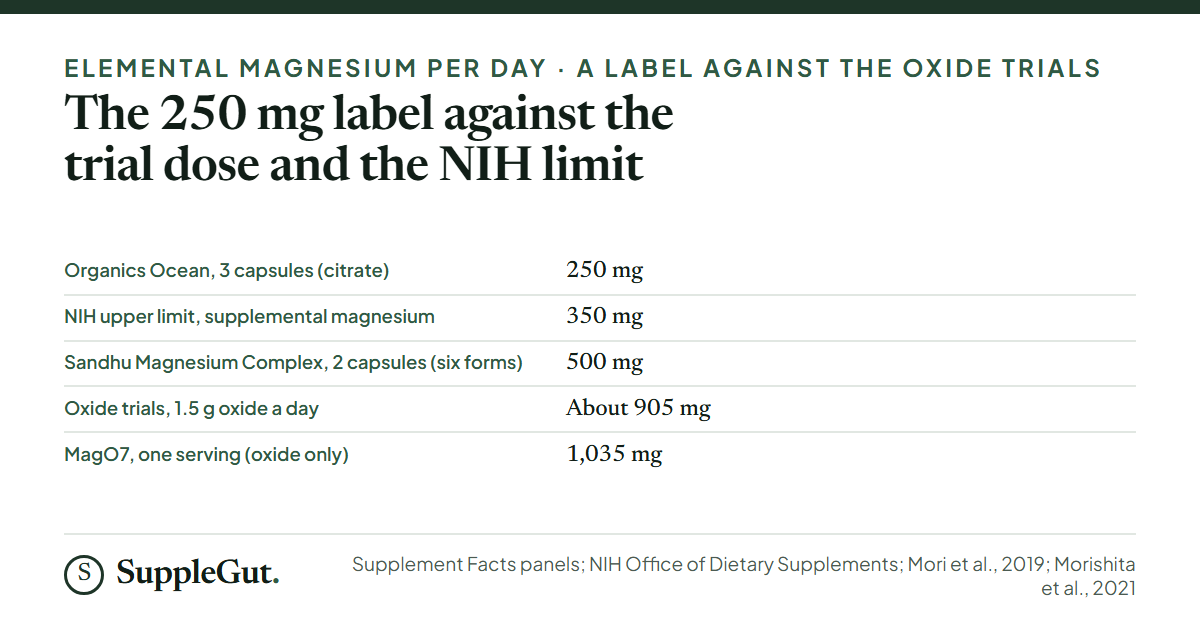
Oxide is about 60.3% magnesium by weight, so 1.5 g a day is about 905 mg of elemental magnesium. This label supplies 250 mg, about 28% of that. The NIH sets the upper limit for magnesium from supplements at 350 mg a day for adults, a limit set on diarrhea, so a dose in the range the trials used is above it, and this label is below it, at 71% of the limit. For scale, Sandhu Herbals Magnesium Complex is 500 mg of magnesium per serving from six forms, and the MagO7 oxide capsule is 1,035 mg per serving, as the catalog states them.
The trials tested a different salt at about 3.6 times this label’s magnesium, split into three doses in the first trial. Citrate at 250 mg a day may act more gently, and the evidence above cannot say how much, because no trial of citrate at this dose was found.
How to take it
The brand’s directions are three capsules once a day, with or without food, and it suggests the evening. If it upsets the stomach, the brand advises one capsule in the morning and two in the evening. The oxide trials ran 28 days; reviewers who mention bowel changes describe them within a day or a few days.
Side effects and who should not take it
The brand’s FAQ says high doses may cause gastrointestinal disturbance such as diarrhea or sleepiness, and to follow the recommended dose and consult a healthcare professional. An Amazon bullet says more than 1,000 mg can lead to dangerous side effects. NIH adds that magnesium from supplements can cause diarrhea, nausea and cramping above 350 mg a day, and can interact with some medicines, including bisphosphonates and certain antibiotics.
We found no pregnancy, nursing, age, kidney or medication warning on the pages we read, and the bottle label itself was not read. Kidney disease and interacting medicines are general magnesium cautions rather than statements about this product, so anyone with kidney disease or on scheduled medicines can check with a doctor or pharmacist first. Case reports of severe hypermagnesemia in older people exist after large laxative doses (Bokhari et al., 2018); those were laxative-scale amounts, not 250 mg a day.
What the reviews say
Amazon shows 4.5 from 584 ratings (78% five-star, 10% four, 6% three, 2% two, 4% one), shared across the 90-, 270- and 540-capsule listings and independent of the brand. In Amazon’s review summary, effectiveness draws 35 mentions (30 positive, 5 negative), sleep quality 19 (17 positive, 2 negative) and value 12 (9 positive, 3 negative). Bowel function is not a listed topic. The praise is for sleep, calmer legs and a short ingredient list, with some reviewers reporting regular bowel movements from the first day. A few snippets name the glycinate form, so part of the pool may be about the brand’s other magnesium.
The brand’s own page shows 4.66 from 74 reviews on a widget it hosts, with 81% in the top category and the brand replying to each. Trustpilot shows the brand at 2.6 from 12 reviews in the last 12 months, 58% of them one-star, mostly about the glycinate and other products. Its complaints are unexpected charges, unanswered calls and a refund described as unavailable; the company replied to 11% of the negative reviews. It is a small, brand-level sample, and we found no such complaint in the brand-page or Amazon reviews we could read.
Price, subscription and refund terms
| Route | Price | Per day |
|---|---|---|
| Amazon, 90 capsules | $35.99 | $1.20 |
| Amazon, Subscribe & Save (10% / 15%) | $32.39 / $30.59 | $1.08 / $1.02 |
| Amazon, 270 or 540 capsules | $87.99 / $149.99 | $0.98 / $0.83 |
| Brand site, one bottle | $35.00 | $1.17 |
| Brand site, 2, 3 or 6 bottles | $64.00 / $99.00 / $174.00 | $1.07 / $1.10 / $0.97 |
| Brand subscription, monthly or every 3 months | $29.99 / $84.99 | $1.00 / $0.94 |
Brand shipping is free from $75 and on subscriptions, and the brand says a subscription can be paused or canceled at any time. The brand states a 90-day money-back guarantee: customer care issues a return authorization number, the buyer photographs the returned package and sends the product back even if it is empty, and the refund follows 3 to 5 business days after receipt. Amazon lists the item as non-returnable for an ingestible product, with a replacement or refund only if it arrives damaged or defective.
Citrate or glycinate, from the same brand
Organics Ocean sells two magnesium products on different claims. The citrate is sold for regularity, relaxation and energy; the glycinate, which includes zinc, is sold for sleep and muscle cramps. The glycinate has the larger Amazon pool, 4.6 from 7,985, against 4.5 from 584 for the citrate. No constipation trial of either form was found. The brand’s fiber capsule is covered in the Better Fiber guide.
Who this capsule is for
- Someone who wants a one-ingredient magnesium capsule and is comfortable that its constipation evidence is borrowed from oxide at a higher dose.
- Someone who takes magnesium for sleep or cramps and wants regularity as a possible secondary effect, which is what most reviewers describe.
If the aim is the amount the trials used, constipation treatments with strong evidence lists options with their doses, and psyllium vs magnesium for constipation sets the two side by side. The quiz matches symptoms to products.
The products in this catalog
Common questions
Does Organics Ocean Magnesium Citrate work for constipation?
No trial of this product was found. Controlled trials of magnesium oxide at about 900 mg of elemental magnesium a day improved constipation (68.3% against 11.7% on placebo in 90 patients), and this label gives 250 mg of magnesium from citrate. Amazon reviewers mention sleep and leg cramps more than bowel changes, though some report regular movements within a day.
What are the side effects of Organics Ocean Magnesium Citrate?
The brand lists diarrhea or sleepiness at high doses, suggests splitting the three capsules across the day if it upsets the stomach, and says to consult a healthcare professional. The NIH sets an upper limit of 350 mg a day for magnesium from supplements, above this label’s 250 mg. We found no pregnancy, kidney or medication warning on the pages we read; kidney disease and some medicines are general magnesium cautions.
How do you take it, and how many capsules a day?
The brand’s directions are three capsules once a day, with or without food, and it suggests the evening. If it upsets the stomach, it advises one capsule in the morning and two in the evening. A 90 capsule bottle is a 30 day supply.
How much does Organics Ocean Magnesium Citrate cost?
A 90 capsule bottle is $35.99 on Amazon ($1.20 a day), $35.00 on the brand site ($1.17), $30.59 with Amazon Subscribe & Save at 15% ($1.02) and $29.99 a month on the brand’s subscription ($1.00). Amazon’s 540 capsule pack works out to $0.83 a day.
Magnesium citrate or magnesium glycinate from Organics Ocean: which is for regularity?
The brand sells the citrate for regularity, relaxation and energy, and the glycinate with zinc for sleep and muscle cramps. The glycinate has the larger Amazon pool (4.6 from 7,985) and the citrate 4.5 from 584. The constipation trials used oxide, not glycinate, and no constipation trial of either form was found.
What is Organics Ocean’s refund policy?
The brand states a 90 day money-back guarantee that needs a return authorization number and the product sent back, even if empty. On Amazon the item is non-returnable unless it arrives damaged or defective. Its Trustpilot profile (2.6 from 12 recent reviews, mostly about other products) has complaints of unexpected charges and unanswered calls, and the company replied to 11% of the negative reviews.
How much elemental magnesium is in it, and is that under the upper limit?
Three capsules hold 250 mg of elemental magnesium from 1,500 mg of magnesium citrate, with tapioca starch and a vegan capsule and no blend. The NIH upper limit for magnesium from supplements is 350 mg a day for adults, so the label is at 71% of it. The brand’s claim of 30% improved absorption names no study.
Sources
- Mori S, Tomita T, Fujimura K, et al. “A randomized double-blind placebo-controlled trial on the effect of magnesium oxide in patients with chronic constipation.” Journal of Neurogastroenterology and Motility, 2019. PMID 31587548. pubmed.ncbi.nlm.nih.gov/31587548
- Morishita D, Tomita T, Mori S, et al. Senna versus magnesium oxide for chronic constipation: a randomized, placebo-controlled trial in 90 patients. American Journal of Gastroenterology, 2021. PMID 32969946. pubmed.ncbi.nlm.nih.gov/32969946
- van der Schoot A, et al. Systematic review and meta-analysis of supplements in chronic constipation (8 randomized trials, 787 participants). Neurogastroenterology & Motility, 2023. PMID 37243443. pubmed.ncbi.nlm.nih.gov/37243443
- Chang L, et al. AGA and ACG clinical practice guideline on chronic idiopathic constipation. Gastroenterology, 2023. PMID 37211380. pubmed.ncbi.nlm.nih.gov/37211380
- Bokhari SR, et al. Fatal hypermagnesemia with laxative use, case report. American Journal of the Medical Sciences, 2018. PMID 29661354. pubmed.ncbi.nlm.nih.gov/29661354
- Duysburgh C, et al. In vitro gut-simulation comparison of two magnesium bisglycinate products, including Chelamax. Journal of Dietary Supplements, 2026. PMID 42709016. pubmed.ncbi.nlm.nih.gov/42709016
- NIH Office of Dietary Supplements. Magnesium fact sheets for consumers and health professionals: upper limit, forms, side effects and interactions. ods.od.nih.gov/factsheets/Magnesium-Consumer
- Brand page: label, directions, warnings, price, subscription and refund terms. organicsocean.com/products/magnesium-citrate; Supplement Facts panel image on the brand’s store.
- Amazon listing: price, rating and review summary. amazon.com/dp/B0DQ2VCWD5
- Trustpilot profile for the brand. trustpilot.com/review/organicsocean.com
Not sure which product fits your situation?
This guide covers the mechanics. The quiz takes your specific symptoms, routine and preferences and matches you to one product from the catalog.
Take the quiz →