
Guide
Does Happy Intestine Tea work? Four herbs, peppermint leaf not oil, and what the IBS trials show
Quick answer
Does Happy Intestine Tea work? No trial of the tea was found. The IBS evidence for peppermint comes from 10 trials of peppermint oil capsules in 1,030 people, rated very low quality, and the tea contains peppermint leaf, which has no IBS trial. Its four herbs each hold European traditional-use status at 1.5 to 5 g per cup, and calendula has no gut indication, while the brand’s servings count implies about 1 g of whole blend per cup. On the brand’s own site it scores 4.65 from 417 reviews.
Happy Intestine Tea is a loose-leaf herbal blend from The Loose Leaf, an Oceanside, California tea company, made of four herbs: peppermint, chamomile, marshmallow root and calendula. The brand sells it for bloating, gas, cramping and IBS, and its product page says it was “created for anyone with IBS, Crohn’s Disease, or any stomach or intestinal issue or inflammation.” It is a food, not a supplement, so there is no Supplement Facts panel and no printed amounts. This page sets out what is in the cup, what the IBS trials actually tested, what each herb has on record, and what the reviews on the brand’s own site show.
What Happy Intestine Tea is, and what it is not
The ingredient line on the product page reads organic peppermint, organic chamomile, organic marshmallow root and organic calendula, with a flavor profile of peppermint and chamomile. It is caffeine free, has no sweetener or flavoring, and is sold as whole-leaf herbs rather than tea bags, so it needs a strainer or infuser. The plant parts are not printed; the usual forms are peppermint leaf, chamomile flower, marshmallow root and calendula flower. No amount or ratio is given for any of the four herbs, and the pages we read carry no warning, no allergen or free-from statement and no third-party testing statement.
It is not a probiotic, not a fiber supplement and not a peppermint oil capsule like IBgard. That last difference matters more than any other fact about this product, and the next two sections explain why.
The trial of the tea itself
There is none. We searched PubMed and the web for the product name and for the four-herb combination, and the brand cites no trial. Every claim about the blend therefore rests on evidence for the individual herbs, and on how closely that evidence matches what is in the cup.
Peppermint leaf is not peppermint oil
The strongest IBS evidence in this blend belongs to an ingredient that is not in it. A 2022 meta-analysis pooled 10 randomized trials in 1,030 people with IBS and found peppermint oil beat placebo for overall symptoms (relative risk of not improving 0.65, 95% confidence interval 0.43 to 0.98, number needed to treat 4) and for abdominal pain (relative risk 0.76, 0.62 to 0.93, number needed to treat 7). Side effects were more frequent on peppermint oil (relative risk 1.57, 1.04 to 2.37), and the authors rated the quality of the evidence very low (Ingrosso et al., Alimentary Pharmacology & Therapeutics, 2022). A review of Western herbal medicines in IBS found that 17 of its 33 trials tested peppermint essential oil, called it efficacious and well tolerated in the short term, and noted that few positive herbal trials besides peppermint oil, aloe vera and asafoetida had been replicated (Hawrelak et al., Complementary Therapies in Medicine, 2020).
Those trials used oil capsules, usually coated to release in the intestine. A cup of leaf tea contains far less oil, and we found no randomized trial of peppermint leaf tea in IBS or in dyspepsia, so the oil results do not transfer directly. The IBgard guide covers the capsule trials in detail. The Cochrane review of herbal medicines for functional dyspepsia likewise reports its peppermint finding for peppermint plus caraway oil, not for the leaf (Báez et al., 2023).
What each of the four herbs has on record
For all four herbs the most specific official statement is the European Medicines Agency herbal monograph, which records “traditional use”: long-standing use, not trial-proven efficacy. The monograph doses are per cup, and they are the nearest reference for what a cup of each herb is meant to contain.
| Herb | EU traditional-use indication | Monograph dose |
|---|---|---|
| Peppermint leaf | Digestive disorders such as dyspepsia and flatulence | 1.5 to 3.0 g in 100 to 150 ml of boiling water, three times a day, up to 2 weeks |
| Chamomile flower | Minor gastrointestinal complaints such as bloating and minor spasms | 1.5 to 4 g in 150 ml of boiling water, 3 to 4 times a day |
| Marshmallow root | Demulcent for mild gastrointestinal discomfort | 2 to 5 g in 150 ml of water as a macerate, 3 times a day, maximum 15 g a day |
| Calendula flower | Skin (minor inflammations, minor wounds) and mouth and throat only; no gastrointestinal indication | Not applicable to the gut |
Chamomile is also one of the nine herbs in the liquid STW 5 (Iberogast), which Cochrane rates as improving functional dyspepsia symptoms against placebo with very low certainty; that is a different preparation from a tea. We found no placebo-controlled trial of chamomile alone in IBS. Marshmallow root is a mucilage herb, and the monograph’s preparation is a cold-water macerate, whereas this tea is brewed in boiling water for 5 to 10 minutes. We located no gut trial of it. Calendula has no digestive indication in the EU monograph, and the ad claims that calendula flowers “help repair and rebuild tissue” and that marshmallow root “coats and protects the intestinal lining” are not supported by a trial in the sources we read.
How much is actually in a cup
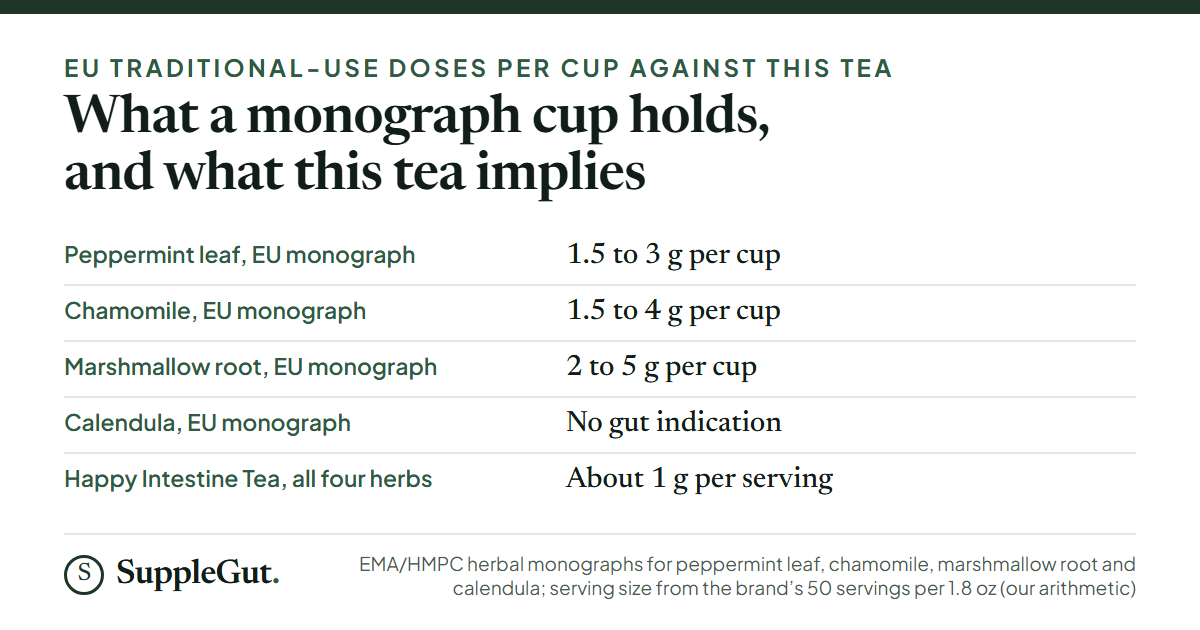
The brand sells 1.8 oz (about 51 g) as 50 servings, which implies about 1 g of the whole blend per serving (our arithmetic; the bag weight is not printed on the pages we read). The brand’s FAQ gives a brewing range of 1 to 2 teaspoons per 8 oz of water, so a cup could hold up to roughly twice that. Spread across four herbs, an equal split, which the brand does not state, would be about 0.25 to 0.5 g of each herb a cup.
Set against the monographs, the whole blend sits below the per-cup dose of any single herb: peppermint leaf 1.5 to 3 g, chamomile 1.5 to 4 g, marshmallow root 2 to 5 g. That does not mean the tea does nothing, and a brewed cup is not the same preparation as the monograph’s. It does mean the traditional-use doses are not the doses this tea delivers, and the trial doses of peppermint oil are a different material altogether.
Crohn’s disease, colitis and the IBS claim
The brand’s page and ads name IBS, Crohn’s disease and chronic gut inflammation. Crohn’s disease and ulcerative colitis are inflammatory bowel diseases, a different category from IBS, and the brand cites no trial for either; the sources we read contain none for herbal tea in Crohn’s. For IBS itself, an umbrella review of 58 meta-analyses of nutritional interventions reported that it did not support nutritional interventions for improving IBS symptoms overall, with low to very low certainty for most herbs, and singled out peppermint oil among those that did improve symptoms (Zeraattalab-Motlagh et al., Nutrition Reviews, 2025).
How to take it
The brand’s FAQ says to use 1 to 2 teaspoons of loose-leaf tea per 8 oz of boiling water and to steep herbals 5 to 10 minutes, adding that for stronger tea the steep time should increase, not the amount of herbs. For its medicinal blends it suggests 24 oz a day for full support or 8 oz a day for maintenance, which is three cups or one, and no more than one or two blends a day. There is no with-food or once-daily instruction. A spa boutique that lists the same four-ingredient tea prints a shorter brew of 1 teaspoon for 3 to 5 minutes. Reviewers who describe a benefit usually say it took a couple of weeks of regular cups, so a fair test is two to four weeks at a steady daily amount; the EU peppermint leaf monograph itself advises seeing a practitioner if symptoms last beyond 2 weeks.
Side effects and who should check first
The product page carries no warning, but the monographs for its herbs do:
- Heartburn or reflux. The EU peppermint leaf monograph says people with gastroesophageal reflux should avoid peppermint leaf preparations because heartburn may increase, and advises caution with gallstones.
- Daisy-family allergy. Chamomile and calendula are Asteraceae plants, and both monographs list hypersensitivity to Asteraceae as a contraindication. This applies to people allergic to ragweed, daisies or chrysanthemums.
- Pregnancy and breastfeeding. The monographs for peppermint leaf, chamomile and calendula say use is not recommended because safety data are lacking.
- Medicines. The marshmallow root monograph says absorption of other medicines may be delayed and advises spacing them 30 to 60 minutes apart.
Reviewers on the brand’s site report nausea, stomach ache, bloating, constipation and, in one case, diarrhea within minutes of a cup. One reviewer on a low-FODMAP diet wrote that chamomile does not suit that diet; we did not check the Monash FODMAP position on chamomile tea. Anyone with ongoing bowel symptoms, blood in the stool or unexplained weight loss needs a diagnosis rather than a tea.
What the reviews say
The brand’s own product page shows 4.65 out of 5 from 417 reviews. The widget would load 165 of them, and in that set 139 are five-star, 13 four-star, 4 three-star, 4 two-star and 5 one-star. The other 252 could not be read. The reviews sit on the brand’s own Squarespace store with no verified-buyer flag shown, there is no Trustpilot profile for the domain, and the brand does not sell on Amazon (lookalike listings there are other sellers’ tea bags). Some loaded reviews carry a star rating with no text, one describes a different tea from the same shop, and one two-star rating sits on text that praises the tea.
The recurring praise is taste (about 70 of the 165 mention it, many saying it needs no sweetener), a calmer gut with IBS or colitis symptoms improving after a few weeks, and less bloating and gas after meals. These are self-reported, and some reviewers also take medication. The recurring complaints are orders not received, which account for most of the one-star ratings; slow replies to email and phone; a bland or unpleasant taste; fine particles passing through strainers; and a few reports of stomach upset.
Price, subscription and returns
A 1.8 oz bag of 50 servings is $18.00, which is $0.36 a cup and $1.08 a day at the brand’s three cups. Subscribing is from $16.20 (10% off) every one or two months, about $0.32 a cup, and a 1 lb bulk bag is $105.00, about $0.24 a cup by our arithmetic. At 2 teaspoons per cup a bag lasts about half as long. A spa boutique lists the same four-ingredient tea at $26.00 for 50 servings. Shipping is extra and we did not find the rate.
The brand’s return policy allows unopened tea to be returned within 30 days of purchase; opened tea cannot be returned because it is a food item, the buyer pays return shipping, and original shipping is not refunded. There is no satisfaction guarantee. We found no subscription billing or cancellation terms on the pages we read, and no independent billing complaints, though with no Trustpilot profile and no Reddit, Google or Yelp pages read, that is an absence of data.
Who Happy Intestine Tea is for
- Someone who wants a caffeine-free peppermint and chamomile tea after meals and likes the taste, with no expectation of a trial-level effect.
- Someone with mild, occasional bloating or minor cramping, the complaints the EU monographs describe for peppermint and chamomile.
- Someone with no reflux, no daisy-family allergy and who is not pregnant or breastfeeding.
If IBS-type cramping and urgency are the main complaint, the peppermint oil trials point to a capsule such as IBgard rather than a tea. If a simple single-herb cup is the aim, plain organic peppermint tea or organic chamomile tea carry the same monograph status per herb. The gut supplement quiz starts from the symptom instead of the product.
The products in this catalog
Common questions
Does Happy Intestine Tea work for IBS?
No trial of this tea was found, and the brand’s claim that it is created for anyone with IBS is not backed by a trial in the sources we read. The IBS evidence for peppermint is for peppermint oil capsules, not leaf tea, and a 2022 meta-analysis rated it very low quality. On the brand’s own site the average is 4.65 from 417 reviews, and many reviewers describe fewer IBS or colitis symptoms after a few weeks while a few report no help or stomach upset.
What is in Happy Intestine Tea and how do you make it?
Organic peppermint, chamomile, marshmallow root and calendula, caffeine free and loose leaf with no tea bags. The brand’s FAQ says 1 to 2 teaspoons per 8 oz of boiling water, steeped 5 to 10 minutes, and up to 24 oz a day for “full support” or 8 oz for maintenance. No amount is printed for any herb.
Is peppermint tea the same as peppermint oil for IBS?
No. The IBS trials tested peppermint oil capsules, and a cup of leaf tea holds far less oil. We found no randomized trial of peppermint leaf tea in IBS. The leaf has its own European traditional-use status for mild digestive complaints at 1.5 to 3 g per cup, and this tea’s servings count implies about 1 g of whole blend per cup. For the capsule evidence see the IBgard guide.
Is Happy Intestine Tea safe, and what are the side effects?
The product page has no warning. The European monographs for its herbs advise people with heartburn to avoid peppermint leaf, list allergy to the daisy family as a contraindication for chamomile and calendula, and do not recommend them in pregnancy or breastfeeding. Marshmallow root may delay the absorption of medicines taken at the same time. Reviewers report nausea, bloating, constipation or diarrhea after a cup in a small number of cases.
Does Happy Intestine Tea help with Crohn’s disease or colitis?
The brand’s page and ads name Crohn’s disease and chronic gut inflammation, but it cites no trial, and the sources we read contain none of herbal tea in Crohn’s disease. Some reviewers describe colitis symptoms improving, and some of them also take medication. Inflammatory bowel disease needs medical care, and a tea is not a substitute for it.
How much does Happy Intestine Tea cost?
A 1.8 oz bag of 50 servings is $18.00, or $0.36 a cup and $1.08 a day at the brand’s three cups. Subscribing is from $16.20 every one or two months, and a 1 lb bulk bag is $105.00. Shipping is extra and the rate was not found. A spa boutique lists the same four-ingredient tea at $26.00.
Can Happy Intestine Tea be returned, and what do the reviews say about orders?
Unopened tea can be returned within 30 days of purchase at the buyer’s cost; opened tea cannot be returned, and there is no satisfaction guarantee. Of the 165 reviews we could read, 5 are one-star, mostly reports of orders not received, and one reviewer says emails and calls went unanswered. There is no Trustpilot profile, and we found no independent billing complaints.
Sources
- Ingrosso MR, et al. Meta-analysis of peppermint oil in irritable bowel syndrome (10 randomized trials, 1,030 patients). Alimentary Pharmacology & Therapeutics, 2022. PMID 35942669. pubmed.ncbi.nlm.nih.gov/35942669
- Hawrelak JA, et al. Review of Western herbal medicines in irritable bowel syndrome (33 trials). Complementary Therapies in Medicine, 2020. PMID 31987249. pubmed.ncbi.nlm.nih.gov/31987249
- Báez G, et al. "Non-Chinese herbal medicines for functional dyspepsia." Cochrane Database of Systematic Reviews, 2023. PMID 37323050. pubmed.ncbi.nlm.nih.gov/37323050
- Zeraattalab-Motlagh S, et al. Umbrella review of nutritional interventions in irritable bowel syndrome. Nutrition Reviews, 2025. PMID 39110917. pubmed.ncbi.nlm.nih.gov/39110917
- European Medicines Agency. Community herbal monograph on Mentha x piperita L., folium (EMA/HMPC/572705/2014). ema.europa.eu
- European Medicines Agency. Community herbal monograph on Matricaria recutita L., flos (EMA/HMPC/55843/2011). ema.europa.eu
- European Medicines Agency. Community herbal monograph on Althaea officinalis L., radix (EMA/HMPC/436679/2015). ema.europa.eu
- European Medicines Agency. Community herbal monograph on Calendula officinalis L., flos (EMA/HMPC/437450/2017). ema.europa.eu
- Brand page: ingredients, claims, sizes, prices and reviews (thelooseleaftea.com), brewing FAQ and return policy; Meta Ad Library results for the brand’s domain; Cal-a-Vie Boutique listing (boutique.cal-a-vie.com)
Not sure which product fits your situation?
This guide covers the mechanics. The quiz takes your specific symptoms, routine and preferences and matches you to one product from the catalog.
Take the quiz →