Guide
Does Himalaya Organic Trikatu work? Ginger and two peppers, piperine and the trials
Quick answer
Does Himalaya Organic Trikatu work? No trial of this caplet turned up, and the brand’s reference to its own clinical studies carries no citation. The human work on its herbs is mostly piperine research: 20 mg a day raised blood levels of propranolol and theophylline in healthy volunteers, and the label states about 1 mg of piperine plus an unstated amount in its extract. Amazon shows 4.4 from 381 ratings and carries a California warning about lead.
Himalaya Organic Trikatu is a USDA organic caplet of ginger, black pepper and long pepper, taken once a day after a meal. The three together are trikatu, and what sets this guide apart from most digestive-supplement questions is that the most-studied property of the caplet’s herbs is not digestion at all. It is how the peppers change the absorption of other substances.
The three lines on the panel
| Line as printed | Amount | Marker stated |
|---|---|---|
| Organic ginger (rhizome) and pepper powder (stem) | 390 mg | 0.15% piperine (0.59 mg) |
| Organic trikatu extract: ginger, long pepper, pepper | 280 mg | None |
| Organic ginger and pepper CO2 extract | 20 mg | 15% gingerols (3 mg), 2.5% piperine (0.5 mg) |
The lines total 690 mg a caplet, with 60 caplets in the bottle. The percentages check against the amounts: 390 mg at 0.15% is 0.585 mg of piperine and 20 mg at 2.5% is 0.5 mg, which makes 1.09 mg in the two lines that state it. The panel gives no split between ginger, black pepper and long pepper, and it is not labeled a proprietary blend. The first line says “pepper powder (stem),” and the pages do not say whether that means black pepper stem or long pepper stem, since the part of long pepper used in classical formulas is the fruit.
The caplet has no listed binder; the brand says the plant material holds it together without magnesium stearate or gelatin. Himalaya prints common names only, not Latin binomials, so a buyer has to take the identity of the three peppers from the brand’s description.
What trikatu means in the tradition
Trikatu is Sanskrit for three pungents. Ayurveda, the traditional medicine of India, pairs ginger (shunthi), black pepper (maricha) and long pepper (pippali) as a warming trio for digestion. Himalaya’s product text describes the texts as treating digestion as a fire that turns food into the body’s own life-force, and says trikatu “primes the stomach” for that work. The brand also notes traditional use for breathing and for the urinary tract. Its pages use no dosha language (vata, pitta, kapha).
These are the tradition’s ideas, reported as the brand reports them. A 1992 review of trikatu proposed that its Ayurvedic use alongside other medicines reflects the peppers raising how much of those medicines reaches the blood (Johri and Zutshi, 1992). That is a different claim from easing a meal, and it is the one with the human data.
Piperine and the studies on propranolol and theophylline
Piperine inhibits drug-metabolizing enzymes in rats (Atal et al., 1985). In people, a crossover study in healthy volunteers, six per group, gave 20 mg of piperine a day for 7 days with propranolol 40 mg or theophylline 150 mg, and both drugs showed higher peak blood levels and total exposure (Bano et al., 1991). In a second study, 20 mg of piperine given with 2 g of curcumin raised curcumin bioavailability by about 2,000% in healthy volunteers (Shoba et al., 1998).
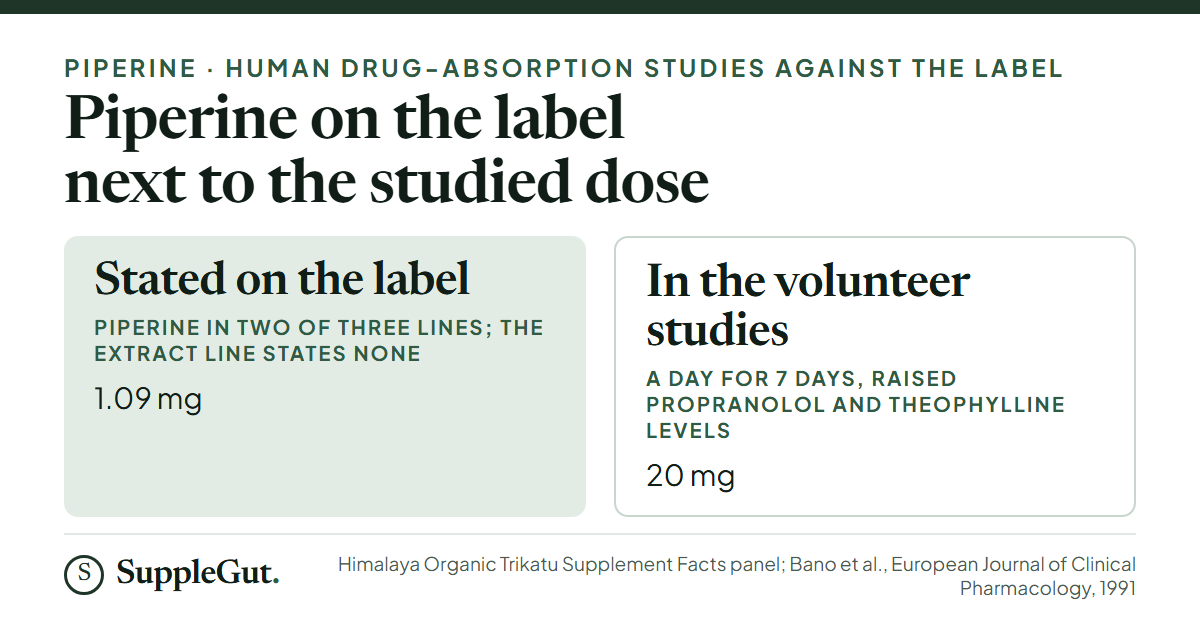
The doses are the point. The caplet states 1.09 mg of piperine across two lines and nothing for its 280 mg trikatu extract, against 20 mg in the human work. We found no study of this caplet and any drug. What the studies show is a mechanism that is real at a studied dose, which is why the label’s advice to consult a healthcare practitioner before use if you take medication applies directly.
The trials for digestion, and the brand’s clinical studies
We found no trial of a trikatu supplement for digestion in people. PubMed returns one hit for Himalaya with trikatu, an unrelated dentifrice trial, and 31 for trikatu or its Sanskrit variant, made up of reviews, rat studies, one topical mosquito-bite trial and one single-arm cognitive study. ClinicalTrials.gov lists one trikatu study, a protocol for chronic kidney disease.
Amazon’s description says that in Himalaya’s clinical studies the caplet gave effective support for indigestion and bloating and helped with belching and flatulence, and gives no citation. We could not locate such a study in PubMed or in a registry, so the claim is the brand’s, uncited.
The ginger evidence is the nearest on-topic human result. In a randomized, double-blind crossover of 11 patients with functional dyspepsia, 1.2 g of ginger against placebo made gastric emptying faster and antral contractions trended higher (P=0.06), while symptoms and gut hormones did not differ (Hu et al., 2011). The caplet does not print its ginger amount. For piperine and the gut itself, we found only animal work, in which it slowed gastric emptying and transit in rats and mice (Bajad et al., 2001).
The lead warning, and what testing the brand states
Amazon’s safety text for this caplet reads: “Can expose you to lead, a reproductive toxicant.” California’s Proposition 65 requires a warning when a product contains a listed chemical above a state threshold, and the notice does not give the amount or say where the lead comes from. Himalaya’s own site tags the product, and its cart shows California visitors a Proposition 65 warning. The static Vitacost text shows none.
The brand states a cGMP facility and that the product is tested “for identity, strength and safety.” It names no laboratory, no metals and no certificate, and we found no country of manufacture on the three pages. The organic claim names Control Union Certifications on Vitacost, and Vitacost also lists Non-GMO Project verification. Across the category, 20.7% of 193 Ayurvedic medicines bought online had detectable lead, mercury or arsenic (95% CI 15.2 to 27.1), 21.7% of the US-made and 19.5% of the Indian-made (Saper et al., JAMA, 2008). That describes a category and does not name this caplet. The guide to Ayurvedic supplement safety covers what to check.
In the United States the caplet is a dietary supplement under the 1994 law known as DSHEA, so the FDA does not approve it before sale, and no state licenses Ayurvedic practitioners. India recognizes Ayurveda as a state system with a degree (BAMS) and the ministry AYUSH. Himalaya’s label asks anyone who is pregnant, nursing, taking medication, living with a medical condition or planning a medical procedure to consult a healthcare practitioner, and to stop and consult one if an adverse reaction occurs. It prints no separate pregnancy prohibition.
Ratings from Amazon and Vitacost
Amazon shows 4.4 from 381 ratings: 72% five-star, 13% four, 9% three, 1% two and 5% one. Vitacost shows 4.60 from 42 reviews, all collected from another provider, and the ones we read were first posted on iHerb. Himalaya’s own page has a review app hook but shows no score. Both retailers are independent of the brand.
Reviewers praise relief of gas and bloating after meals, a caplet that is not oversized, and organic ingredients. The main complaint is the pepper: a strong taste and smell, and heartburn for some, with a three-star reviewer advising anyone prone to heartburn to avoid it. Others report no effect, one comparing it unfavorably with plain trikatu powder. One reviewer said halving the caplet helped with stomach discomfort. One Amazon review reports glass particles in a container, a single report. One Amazon reviewer says it is often out of stock.
Prices and terms
| Route | Price | Per day |
|---|---|---|
| Amazon, 60 caplets | $17.99 | $0.30 |
| Amazon Subscribe & Save (10% off) | $16.19 | $0.27 |
| Vitacost | $17.99 | $0.30 |
| Himalaya site, one-time | $20.99 | $0.35 |
| Himalaya site, subscription (10% off) | $18.89 a delivery | $0.31 |
Himalaya’s page prints a satisfaction guarantee and free shipping over $35, and marks the subscription as a recurring purchase with a cancellation policy link. We found no billing or refund complaints in the reviews we read.
Who this caplet suits
- Readers who want one caplet a day after a meal rather than a powder or a multi-tablet dose.
- Readers who want organic, additive-free ingredients and accept that the herb split is not printed.
- Readers on prescription medicines, for whom the piperine studies above are the part of the page to read first.
Banyan’s Vata Digest tablet carries a related spice set, and Himalaya’s Organic Triphala sits alongside it for readers choosing between the two traditional formulas. The full label and review record are on the product page.
The products in this catalog
Common questions
Does Himalaya Organic Trikatu work for bloating?
We found no trial of this caplet. Reviewers on Amazon (4.4 from 381 ratings) and Vitacost (4.60 from 42) mostly describe less gas and bloating after meals, and a minority report no effect or heartburn. The brand’s page cites unnamed clinical studies for indigestion, belching and flatulence and gives no reference.
Can trikatu change how medicines work?
Piperine, the pungent compound in black pepper and long pepper, raised the blood levels of propranolol and theophylline in a small crossover study of healthy volunteers at 20 mg a day for a week. The label here states about 1.09 mg of piperine in two of its three lines and none for the third, so the amount the caplet delivers is not known. The label advises talking to a healthcare practitioner before use if you take medication.
Why does Amazon show a lead warning on Himalaya Trikatu?
Amazon’s safety text reads that the product can expose you to lead, a reproductive toxicant, and points to California’s Proposition 65 site. The brand’s own page tags the product so that California visitors see a Proposition 65 warning at the cart. The warning does not state an amount, and the brand publishes no heavy-metal result.
How much ginger, black pepper and long pepper is in it?
The panel does not split them. It prints three lines of 390 mg, 280 mg and 20 mg that total 690 mg a caplet, and only two of the lines state a marker: 0.15% piperine and 15% gingerols with 2.5% piperine. One line reads “pepper powder (stem),” which the brand does not identify further.
How much does Himalaya Organic Trikatu cost per day?
A 60 caplet bottle is $17.99 at Amazon and Vitacost, which is 60 days at one caplet and about $0.30 a day. Himalaya’s site lists $20.99, about $0.35, or $18.89 a delivery on a 10% subscription.
Is it taken before or after food?
The directions say adults take one caplet a day after food. Ayurveda treats trikatu as a preparation for the digestive fire, agni, and the brand’s pages describe it as supporting digestion after you eat. No trial we found compared timings.
Sources
- Bano G, et al. Effect of piperine on bioavailability and pharmacokinetics of propranolol and theophylline in healthy volunteers. European Journal of Clinical Pharmacology, 1991. PMID 1815977. pubmed.ncbi.nlm.nih.gov/1815977
- Shoba G, et al. Influence of piperine on the pharmacokinetics of curcumin in animals and human volunteers. Planta Medica, 1998. PMID 9619120. pubmed.ncbi.nlm.nih.gov/9619120
- Atal CK, et al. Biochemical basis of enhanced drug bioavailability by piperine. Journal of Pharmacology and Experimental Therapeutics, 1985. PMID 3917507. pubmed.ncbi.nlm.nih.gov/3917507
- Johri RK, Zutshi U. An Ayurvedic formulation ‘Trikatu’ and its constituents. Journal of Ethnopharmacology, 1992. PMID 1434692. pubmed.ncbi.nlm.nih.gov/1434692
- Hu ML, et al. Effect of ginger on gastric motility and symptoms of functional dyspepsia. World Journal of Gastroenterology, 2011. PMID 21218090. pubmed.ncbi.nlm.nih.gov/21218090
- Bajad S, et al. Piperine inhibits gastric emptying and gastrointestinal transit in rats and mice. Planta Medica, 2001. PMID 11301872. pubmed.ncbi.nlm.nih.gov/11301872
- Saper RB, Phillips RS, Sehgal A, et al. “Lead, mercury, and arsenic in US- and Indian-manufactured Ayurvedic medicines sold via the Internet.” JAMA, 2008;300(8):915–923. PMID 18728265. pubmed.ncbi.nlm.nih.gov/18728265
- FDA. Dietary supplements and the Dietary Supplement Health and Education Act of 1994. fda.gov/food/dietary-supplements; Ministry of Ayush, Government of India. ayush.gov.in
- Himalaya Wellness: Organic Trikatu product page (label, directions, price, subscription, Proposition 65 tag). himalayausa.com
- Vitacost: Himalaya Organic Trikatu, 60 caplets (Supplement Facts, warnings, price, reviews). vitacost.com
- Amazon: Himalaya Organic Trikatu listing, ratings, safety information. amazon.com/dp/B0011Y0YKK
Want this narrowed to one product?
Reading is one thing, choosing is another. Answer the quiz and it weighs your own symptoms and routine and picks one product.
Take the quiz →