Discomfort and cramping
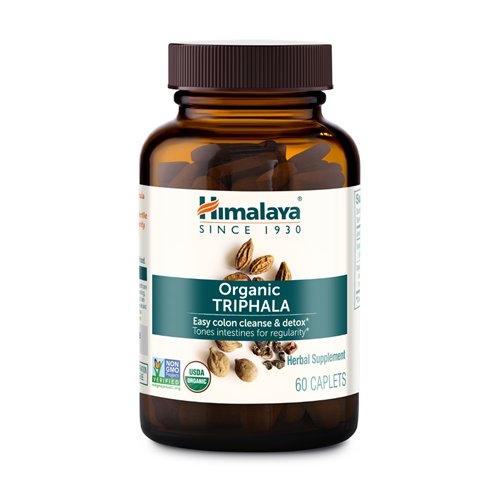
Himalaya Organic Triphala
A once-a-day organic triphala caplet combining chebulic myrobalan leaf powder with a three-fruit triphala extract, sold for gentle regularity.
- Format
- Tablet, once a day
- Type
- Herbal and traditional herbal
- Tradition
- Ayurvedic formula
- Cost
- $0.33 per day at one caplet ($19.99 for 60 at Vitacost and Amazon); $0.39 on the brand site
- Customer rating
- 4.4 out of 5 from 2,434 ratings from Amazon
What the reviews repeat
- Gentle regularity without harsh laxative effects
- Clean organic ingredients with no fillers
- An easy-to-swallow caplet taken once a day
Those are the themes that recur across the reviews. Moderate review confidence — Amazon shows 4.4 from 2,434 independent ratings; Vitacost’s 4.64 from 131 reviews is mostly (113) imported from iHerb, and no brand-hosted widget rating was readable; no Trustpilot profile could be checked.
What the ingredients do, in theory
Triphala is a traditional Ayurvedic blend of three fruits, amla, belleric myrobalan and chebulic myrobalan, which the brand says has been used in India for centuries for digestion and gentle regularity. The tannin-rich extract and powder are described as toning the intestines and supporting a gentle cleanse. Human trials of triphala for bowel symptoms are small or mix it with other herbs. This label shows no per-fruit amounts for the extract and no heavy-metal results, so what reaches the gut and what else comes with it cannot be checked.
Reading the label
Both actives are printed with amounts, 438 mg of chebulic myrobalan leaf powder and 250 mg of a three-fruit triphala extract, each with a tannin percentage, but the first line is leaf, not fruit, and the extract ratio is not given. The label says product of India, certified organic by Control Union, USDA Organic and Non-GMO Project Verified, and the brand says it is tested for identity, strength and safety in a cGMP facility. It states no heavy-metal testing and names no lab.
Each herb on the label has its own page: Triphala, Haritaki. The pages cover traditional use, trials, doses and interactions.
What the research supports
The evidence is for the ingredient class, not this formula. A 4-week placebo-controlled pilot of 2,000 mg a day of triphala in 31 healthy adults found no consistent change in gut bacteria, and the one constipation study found used a formula that also contained senna and psyllium. One caplet here is 688 mg, part of it a 50 percent-tannin extract whose herb equivalent is not printed, so no trial dose can be compared with it. No trial of this caplet was found.
The people it is built for
We match this product to people reporting irregular bowel habits, constipation and bloating. Someone whose aim is a steady daily routine, regularity or resetting after a course of antibiotics or an upset is who it is matched to. It is still only a candidate until your other answers are in: previous products, the format you will take, and the things that have to be excluded.
When to look elsewhere
Its packaging states gluten-free, dairy-free and vegan. Organic Triphala is held back from the results of anyone pregnant or breastfeeding or taking prescription medication; a prescriber should weigh it for them, which is a statement about the decision rather than the product. The format matters too: a tablet asks you to take it once a day, every day.
What to watch for
A minority report no effect, a few mention a chalky uncoated caplet that is hard to swallow, and some report worsened constipation or pain. The label says to ask a practitioner first if pregnant, nursing, taking medication, with a medical condition or planning a medical procedure.
What people want to know
Does Himalaya Organic Triphala work?
Amazon reviewers who mention effectiveness are 114 positive and 71 negative out of 185, so experiences are mixed. Triphala trials are small, none tested this caplet, and none tested triphala alone for constipation.
Is Himalaya Organic Triphala safe?
The label says to consult a healthcare practitioner if pregnant, nursing, taking medication, with a medical condition or planning a medical procedure, and to stop if adverse reactions occur. The brand says it is tested for identity, strength and safety but does not state heavy-metal testing. A 4-week study of a triphala extract at 2,500 mg a day in 20 healthy adults found no serious adverse effects.
What are Himalaya Triphala side effects?
Reviewers mention stomach pain, nausea or looser stools, and a few say constipation got worse. Several note the caplet is uncoated and chalky and can stick in the throat.
How much does Himalaya Organic Triphala cost?
A 60-caplet bottle is $19.99 at Vitacost and Amazon and $23.49 on Himalaya’s site, which at one caplet a day is about $0.33 to $0.39 a day. Himalaya’s subscription takes 10 percent off each delivery.
Himalaya Triphala vs Banyan or Planetary Herbals triphala?
Himalaya prints 438 mg of chebulic myrobalan leaf powder plus 250 mg of triphala extract in one caplet taken once a day. Banyan lists a 1,000 mg three-fruit blend per two tablets and states third-party heavy-metal testing, and Planetary Herbals prints a 2 g blend per two tablets taken twice daily.
Who should ask first. People who are pregnant or breastfeeding, or taking prescription medication: a doctor or pharmacist should see Organic Triphala before you do. No supplement diagnoses, treats, cures or prevents disease.
Does it fit your routine?
The quiz takes about three minutes and tells you whether Organic Triphala is the right call for your symptoms, your medicines and your routine.
Take the quiz →No sign-up, no email, about three minutes.
What else does this job
Discomfort and cramping: that is the job Himalaya Organic Triphala does, and these are the other entries doing it.
See all the products we have researched →
Guides that explain the category
Background on how this type of product works, read from the trial evidence.