Guide
Does Himalaya Organic Triphala work? Leaf powder, a 50% tannin extract and one caplet a day
Quick answer
Does Himalaya Organic Triphala work? No trial tested this caplet. One caplet holds 688 mg: 438 mg of chebulic myrobalan leaf powder and 250 mg of a triphala extract with 50% tannins, and the extract’s herb equivalent is not printed. The triphala trials we found used 2,000 to 2,500 mg a day. On Amazon, 114 of the 185 reviewers who mention effectiveness are positive and 71 are negative, from 2,434 ratings averaging 4.4.
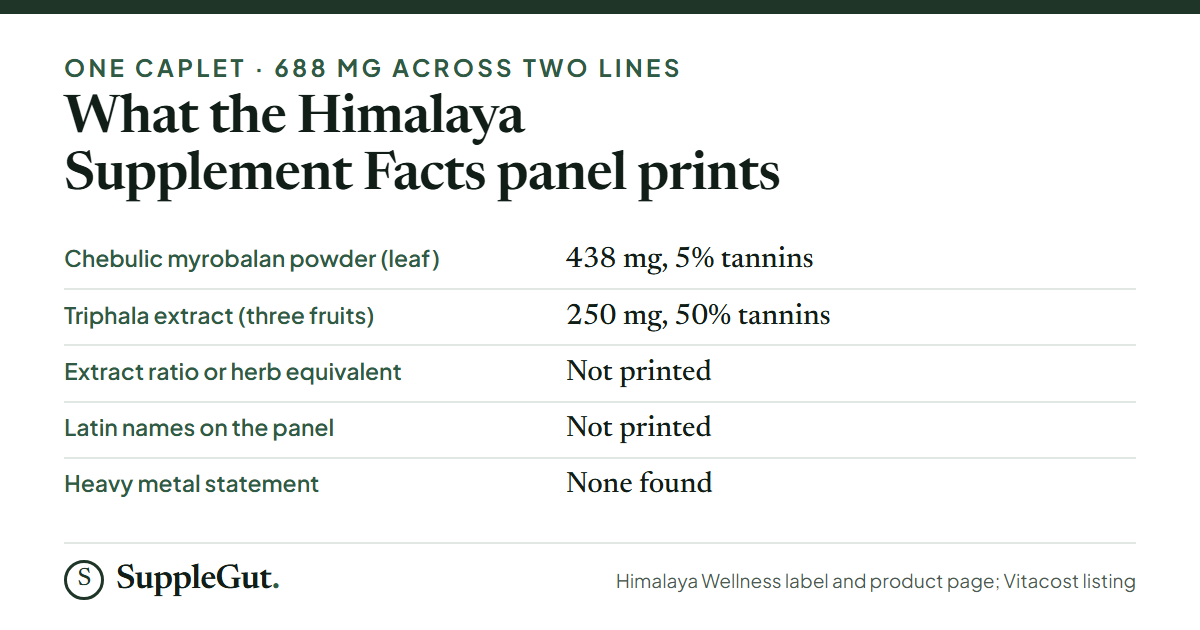
Himalaya Organic Triphala is a once-a-day caplet from a company founded in India in 1930. It differs from the other triphala tablets we read in what it puts in the caplet: a powder of chebulic myrobalan (haritaki) listed as leaf, and a water extract of the three triphala fruits standardized to tannins. This page reads that panel line by line and sets it beside the trials, the reviews and the price. For the tradition behind it, see our Ayurveda section.
Two lines on the panel, 688 mg in total
One caplet is the serving, with 60 servings in the 60 caplet bottle (30 and 90 count sizes are sold too). The Supplement Facts panel prints two lines:
- Organic chebulic myrobalan powder (leaf), 438 mg, marked 5% tannins, 22 mg;
- Organic triphala extract, 250 mg, naming amla, belleric myrobalan (bibhitaki) and chebulic myrobalan fruit, marked 50% tannins, 125 mg.
The Amazon title gives the sum, 688 mg, and calls the product capsules, though the brand describes an uncoated caplet held together by plant material, without magnesium stearate or gelatin. The panel prints no “other ingredients” line and no Latin binomials. The extract line does not say how much of each fruit it holds, nor the ratio of fruit to extract, so its weight in whole fruit is unknown.
Leaf on the panel, fruit in the copy
Triphala is defined as a blend of three fruits. The brand’s page names them as amla (amalaki), chebulic myrobalan (haritaki) and belleric myrobalan (vibhitaki), and the extract line lists fruit. The first line, though, reads leaf. The brand page, Vitacost and Amazon do not say whether that is deliberate or a labeling slip. The difference matters when setting the caplet beside fruit-only triphala such as Banyan’s tablets, because the traditional formula is defined as the fruit of three plants.
Reading the tannin percentages
Adding the two printed tannin amounts gives 147 mg of tannins in 688 mg, roughly a fifth of the caplet by weight. That is the only marker the label offers; no vitamin C, gallic acid or other compound is stated. A tannin percentage shows how concentrated the extract is in that one class of compounds. It does not tell a buyer how many grams of dried fruit went into the extract, which is the figure the whole-fruit trials report, so trial doses cannot be laid directly over this caplet.
What the trials of extracts and of triphala show
No study of this caplet turned up in PubMed or ClinicalTrials.gov, and none tested its extract. The closest match to an extract is a four-week open-label safety study of 20 healthy adults who took 2,500 mg a day of a triphala aqueous extract at bedtime; it reported no serious adverse effects, along with higher HDL cholesterol and lower blood sugar in secondary, uncontrolled measures (Phetkate et al., 2020). That dose is about 3.6 times the 688 mg in a caplet, before allowing for the extract being only part of it.
A placebo-controlled pilot gave 2,000 mg a day of triphala to healthy adults for four weeks and saw no uniform change in gut bacteria (Peterson et al., 2020). The constipation figure often quoted, a rise in weekly bowel movements from 10.19 to 18.29 over 14 days in 34 adults, came from a formula that also held psyllium husk and senna extract (Munshi et al., 2011). A literature review found that triphala holds potential for lower gut symptoms in IBS and asked for clinical studies (Tarasiuk et al., 2018). The triphala evidence guide sets these out in full.
The brand’s claims
Himalaya’s page says people in India have turned to triphala for centuries and that the caplet “tones the intestines for gentle regularity” and offers an “easy colon cleanse and detox.” Its benefit list reads gentle regularity, cleanse and detox, and relief of occasional constipation, and it adds help with occasional bloating. These are the company’s statements, and the page cites no trial for them. It uses no dosha vocabulary: vata, pitta and kapha do not appear, and the only reference to the tradition is to Ayurveda as an old science in a general brand-values block.
One caplet before food
The label and brand page say adults take one caplet a day before food. The Amazon listing’s own directions field reads one or two capsules twice daily with meals, which is a different regimen from the one printed on the bottle. A 60 caplet bottle lasts 60 days on the label. The warning text asks anyone pregnant, nursing, taking medication, living with a medical condition or planning a medical procedure to consult a healthcare practitioner, and to stop and consult one if an adverse reaction occurs.
Testing, metals and the rules that apply
Himalaya says the caplet is produced in a cGMP certified facility and tested for identity, strength and safety with instruments it calls sophisticated. We searched the brand page, the Vitacost page and the Amazon page for heavy metal, lead, mercury, arsenic and cadmium and found no statement, no laboratory name and no certificate. The carton prints “Product of India,” an Indian manufacturing licence number, a Control Union organic certification number, and the USDA Organic and Non-GMO Project Verified seals.
Why metals come up at all: in a survey of 193 Ayurvedic medicines bought online, 20.7% (95% CI 15.2 to 27.1) held detectable lead, mercury or arsenic, and 40.6% of products made with metal preparations did against 17.1% of the others (Saper et al., JAMA, 2008). No product was named and the panel here lists no mineral ingredient, so the result describes a category. Our safety guide lists what a buyer can look for on a label.
In the United States the caplet is a dietary supplement under the 1994 law called DSHEA, sold without FDA approval before sale. Ayurvedic practitioners hold no state license. In India, Ayurveda is a state-recognized system run through the AYUSH ministry.
Amazon and the Vitacost feed
Amazon shows 4.4 from 2,434 ratings (71% five-star, 6% one-star). Among reviewers who mention effectiveness, 114 of 185 are positive and 71 are negative; for quality, 128 of 172 mentions are positive. Himalaya’s own page printed no rating we could read. Vitacost’s Judge.me feed shows 4.64 from 131 reviews, but 113 of those are tagged as originally posted on iHerb and only 18 were written on Vitacost.
Reviewers praise a gentle effect on regularity without harsh laxative effects, ingredients they call clean and organic, and a caplet they find easy to swallow. The recurring complaints are no effect (“this just didn’t help me at all”), an uncoated, chalky surface that some say catches in the throat (7 of 18 Amazon swallowability mentions are negative), and for a few, worsened constipation or abdominal pain. We found no reviews that mention billing or refunds.
Prices and terms
| Where | Size and price | Per day at one caplet |
|---|---|---|
| Amazon or Vitacost | 60 caplets, $19.99 | $0.33 |
| Himalaya site, one time | 60 caplets, $23.49 | $0.39 |
| Himalaya site, subscription (10% off) | 60 caplets, $21.14 | $0.35 |
| Himalaya site, one time | 90 caplets, $33.99 | $0.38 |
The brand site offers monthly, two-monthly or three-monthly delivery with the discount on every shipment, free shipping over $35, and a 100% satisfaction guarantee. Amazon lists the item as not returnable because it is ingestible, with damaged or defective items refundable.
Who the caplet is for
- A reader who wants a fixed once-a-day regimen with a printed dose, not a range.
- A reader comparing standardized extract against whole-fruit powder and who reads the tannin figures as the point of comparison.
- A reader who prefers USDA Organic and Non-GMO Project Verified seals on the carton, with the 60 caplet pack at $19.99.
Fruit-only tablets are Banyan’s 1,000 mg blend and Planetary Herbals’ 2 g blend. This caplet’s own page is Himalaya Organic Triphala.
Products researched for this topic
Common questions
Does Himalaya Organic Triphala work?
No trial of this caplet turned up, and none of triphala alone for constipation. Among Amazon reviewers who mention effectiveness, 114 of 185 are positive and 71 are negative, so experiences are mixed. The brand describes the caplet as toning the intestines for gentle regularity.
Why does the panel say leaf powder?
The first line of the Supplement Facts reads organic chebulic myrobalan powder (leaf), 438 mg, while the extract line below it lists three fruits. The brand’s page copy speaks only of three fruits. The public pages do not explain the difference, so we report both as printed.
What does 50% tannins mean on the label?
It is a standardization figure: the 250 mg extract is printed as 50% tannins, 125 mg, and the leaf powder as 5% tannins, 22 mg. Together that is 147 mg of tannins in 688 mg. The panel gives no extract ratio, so it cannot be converted into grams of whole fruit.
Does Himalaya test its triphala for heavy metals?
The brand says the product is made in a cGMP certified facility and tested for identity, strength and safety. We found no mention of lead, mercury, arsenic or cadmium on its page, the Vitacost page or the Amazon listing, and no laboratory or certificate is named.
How many caplets a day, with or without food?
The label and the brand page say one caplet a day before food. The Amazon listing’s directions field instead reads one or two capsules twice daily with meals, which conflicts with the label.
How much does it cost per day?
A 60 caplet bottle is $19.99 at Vitacost and on Amazon, about $0.33 a day at one caplet. On Himalaya’s site it is $23.49 ($0.39), or $21.14 on the 10 percent subscription ($0.35). The 90 caplet size is $33.99 there.
Sources
- Phetkate et al. Open-label phase I safety study of a triphala aqueous extract, 2,500 mg a day for four weeks, in 20 healthy adults (Thai registry TCTR20180423002). Journal of Integrative Medicine, 2020. PMID 31680053. pubmed.ncbi.nlm.nih.gov/31680053
- Peterson et al. Four-week double-blind placebo-controlled pilot of triphala and manjistha on the gut microbiome in healthy adults (NCT03477825). Journal of Alternative and Complementary Medicine, 2020. PMID 32955913. pubmed.ncbi.nlm.nih.gov/32955913
- Munshi et al. Open-label study of an isabgol, senna and triphala formula in functional constipation. Journal of Ayurveda and Integrative Medicine, 2011. PMID 22022157. pubmed.ncbi.nlm.nih.gov/22022157
- Tarasiuk et al. Review of triphala in functional gastrointestinal disorders. Chinese Medicine, 2018. PMID 30034512. pubmed.ncbi.nlm.nih.gov/30034512
- Saper RB, Phillips RS, Sehgal A, et al. “Lead, mercury, and arsenic in US- and Indian-manufactured Ayurvedic medicines sold via the Internet.” JAMA, 2008;300(8):915–923. PMID 18728265. pubmed.ncbi.nlm.nih.gov/18728265
- FDA. Dietary supplements and the Dietary Supplement Health and Education Act of 1994. fda.gov/food/dietary-supplements; Ministry of Ayush, Government of India. ayush.gov.in
- Himalaya Wellness: product page for Organic Triphala (label, directions, claims, price, subscription). himalayausa.com
- Vitacost: Himalaya Organic Triphala 60 caplets (Supplement Facts text, price, Judge.me reviews). vitacost.com
- Amazon: Himalaya USDA Organic Triphala listing, ratings and review summary. amazon.com/dp/B002BFEUGC
Which of these fits you?
Three minutes with the quiz turns this background into one named product, with the reasons shown.
Take the quiz →