Guide
Does triphala work? The three fruits, the trials and the doses
Quick answer
Does triphala work for constipation? No placebo-controlled trial of triphala alone for constipation turned up in PubMed. The nearest human study is an open-label trial of 34 people on a blend of psyllium, senna and triphala extract, where weekly bowel movements rose from 10.19 to 18.29 in 14 days. A four-week placebo-controlled pilot of 2,000 mg a day in 31 healthy adults looked at gut bacteria, not stool. The classical dose is up to 3 to 6 g of powder a day, and the Organic India label gives 1.92 g.
Triphala is a mix of three dried fruits, amla, haritaki and bibhitaki, taken in Ayurveda as a powder at night for the bowel. This page covers what the mix is, what the tradition uses it for, every human trial we could find with its numbers, the gap between the classical dose and a capsule, and what is known about its safety.
What triphala is, and the forms it comes in
The name is Sanskrit for three fruits. The classical recipe combines amla (amalaki, Phyllanthus emblica), bibhitaki (Terminalia bellirica) and haritaki (Terminalia chebula) generally in equal proportions, and the triphala entry in our herb encyclopedia sets out each fruit. It is sold as churna, the traditional powder stirred into warm water, and as tablets and capsules. A water decoction of it has also been used as a mouth rinse in dental trials. A 2017 review traces the formula to the Charaka Samhita and the Sushruta Samhita, which describe it taken daily with honey and ghee as a rejuvenating tonic, a rasayana.
What the tradition says it is for
Ayurveda classes triphala as tridoshic: the tradition holds that it suits all three constitutional types, the doshas. The same review lists its classical actions as digestive, carminative, a mild laxative at normal doses, a bowel tonic at a low dose and a purgative at a high dose, and the texts credit it with use on ulcers and wounds. Those are the tradition’s categories, not measurements of the bowel. Read plainly, they describe a dose-dependent remedy: the same fruits are said to be gentle at one amount and strongly purgative at a larger one, which is why the dose section below matters. The vocabulary is explained in Ayurveda key concepts for the gut and what Ayurveda is.
What the human trials show for the gut
We searched PubMed for triphala with constipation, bowel, irritable bowel and dyspepsia, and found no placebo-controlled trial of triphala alone for constipation. The nearest is an open-label study with no control group: 34 people with functional constipation took a powder of psyllium husk, senna extract and triphala extract for 14 days, and weekly bowel movements rose from 10.19 to 18.29, with mean stool form on the Bristol scale moving from 2.97 to 4.61 (Munshi et al., 2011). Because the blend holds two other laxatives, it cannot isolate triphala. The 2017 review also cites an older human study in people with gastrointestinal disorders that reported less constipation, abdominal pain, hyperacidity and flatulence; we could not find that study’s methods in PubMed.
The one placebo-controlled human trial on the gut is a pilot of gut bacteria. Thirty-one healthy adults were randomized to 2,000 mg a day of triphala, 2,000 mg of manjistha or placebo for four weeks, and 29 finished (9, 9 and 11). Responses varied from person to person, no bacterial group changed uniformly, and the trial had no bowel-habit endpoint (Peterson et al., 2020). The common line that triphala feeds Bifidobacterium rests on laboratory work summarized in the 2017 review, not on this trial.
For irritable bowel syndrome and dyspepsia we found no trial of triphala. A 2018 review gathers the laboratory and animal findings on the three fruits and concludes that triphala may help lower gut symptoms in IBS; it reports no new trial (Tarasiuk et al., 2018). One of the three fruits does have a placebo-controlled trial: in 68 people with non-erosive reflux, amla tablets (two 500 mg tablets twice a day) for four weeks lowered the frequency and severity of heartburn and regurgitation more than placebo (p < 0.001). That tests amla alone, in reflux.
The dental trials, which show antimicrobial activity in the mouth
Most randomized trials of triphala are of mouth rinses. In 90 people with gingivitis, a triphala rinse twice a day cut plaque, gum inflammation and bacterial counts against placebo, with no significant difference from chlorhexidine at 7, 30 or 60 days (Pradeep et al., 2016). In 120 schoolchildren aged 13 to 16, a 10% triphala rinse once a day for a month lowered plaque and gingival scores against a negative control and matched chlorhexidine (Chainani et al., 2014). A meta-analysis of seven trials against chlorhexidine found mean differences of −0.29 on the gingival index and −0.43 on the plaque index, with very high heterogeneity (I2 of 92% and 96%) (AlJameel and Almalki, 2020). These show the extracts act on bacteria in the mouth. A rinse is not a swallowed dose, and none of these trials measured the bowel.
The classical dose against a capsule
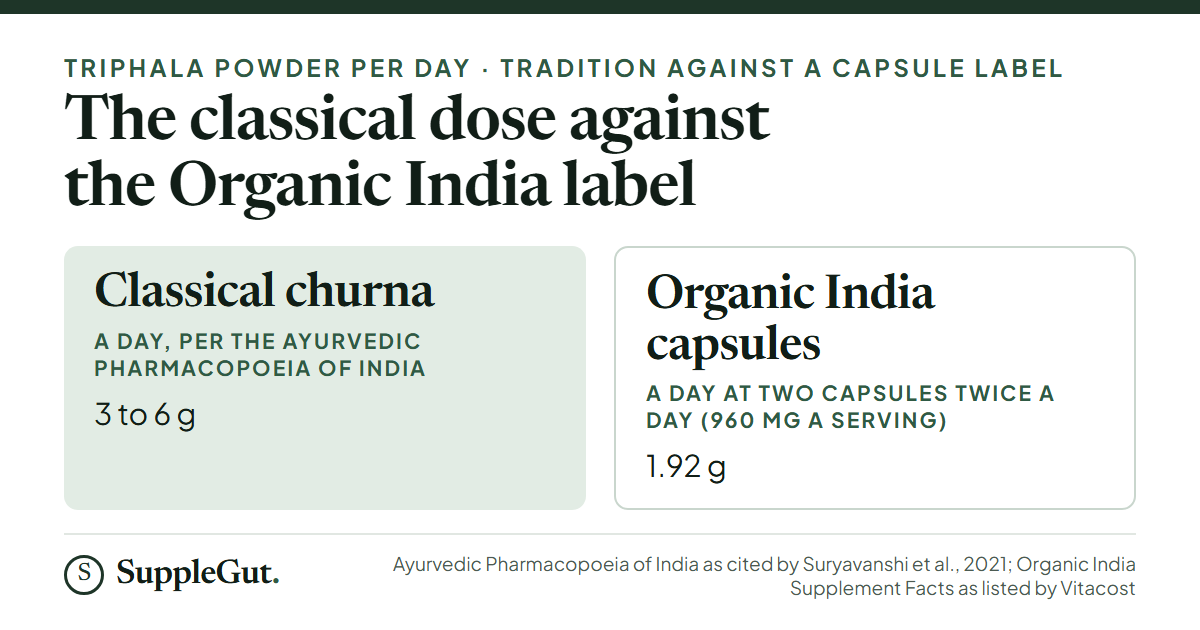
A 2021 paper citing the Ayurvedic Pharmacopoeia of India gives triphala churna at up to 3 to 6 g a day. The Organic India capsule label, as printed by retailers, lists 320 mg of each of the three organic fruits per serving of two capsules (960 mg), with a suggested use of two capsules twice a day. That is 1.92 g a day, below the low end of the classical range.
| Source | Amount | What it is |
|---|---|---|
| Classical churna | Up to 3 to 6 g a day | Powder |
| Organic India Triphala Capsules | 960 mg a serving; 1.92 g at two servings a day | Three fruits, 320 mg each |
| Gut bacteria pilot | 2,000 mg a day for 4 weeks | Triphala, 31 healthy adults |
| Thai safety study | 2,500 mg a day at bedtime for 4 weeks | Water extract, five 500 mg capsules |
| Lanural Regularity Reset | 300 mg per three capsules | Triphala extract (10:1), with magnesium oxide and kiwifruit extract |
| Bluegrass Move Easy | 300 mg per two capsules | Blend of Cape aloe and triphala; amounts of each not printed |
A powder and an extract are not equal gram for gram, and no trial compared a capsule dose with the classical one.
Side effects, interactions and metals
In an open-label safety study, 20 healthy volunteers took 2,500 mg a day of a triphala water extract at bedtime for four weeks with no serious adverse effects; HDL cholesterol rose and blood sugar fell on some of the measured days (Phetkate et al., 2020). In a laboratory test on liver enzymes, triphala inhibited CYP3A4 and CYP2D6 at concentrations near 120 and 105 µg/ml, less than the positive control (Ponnusankar et al., 2011). That is a test tube result, and we found no human trial or case report of a triphala drug interaction.
On metals, we found no published survey that tests triphala products by name. The surveys test Ayurvedic products as a category. Among 193 products bought online, 20.7% held detectable lead, mercury or arsenic, and 17.1% of the herb-only products, those not made by rasa shastra, the metal-processing branch, still did (Saper et al., 2008). The Organic India label as listed by retailers carries a California Proposition 65 warning that the product can expose a person to lead, and a line to consult a physician if pregnant or nursing. People who take prescription medicines can also ask a pharmacist before starting. Metals, bhasmas and label checks are covered in Are Ayurvedic supplements safe?
None of the trials above names Organic India or any other product sold here, and none tested triphala powder at the classical 3 to 6 g for constipation. The evidence for what triphala does in the bowel is a tradition, an open trial of a three-herb blend, a gut bacteria pilot and laboratory work.
Triphala against psyllium and magnesium for constipation
The constipation trials with placebo arms are of other ingredients. A meta-analysis of 16 randomized trials of fiber in 1,251 adults with chronic constipation found 66% responding to fiber against 41% on control (relative risk 1.48), with psyllium among the types that worked and the benefit clearest above 10 g a day and from four weeks (van der Schoot et al., 2022). Magnesium oxide at 1.5 g a day for 28 days improved 68.3% of 90 adults against 11.7% on placebo, with senna at 69.2% (Morishita et al., 2021), and met its primary endpoint in 70.6% of 34 women against 25.0% on placebo (Mori et al., 2019). Triphala has no trial of that design. Psyllium vs magnesium for constipation sets those two side by side, and constipation treatments with strong evidence lists the options.
Where triphala appears in other products
Several products here pair triphala with a second ingredient. Lanural Regularity Reset adds 300 mg of triphala extract to magnesium oxide and kiwifruit extract (guide). Bluegrass Move Easy holds 200 mg of magnesium as citrate and a 300 mg Cape aloe and triphala blend (guide). Revival Point Total Bowel Release combines kiwifruit, triphala, aloe inner leaf gel and Bifidobacterium lactis (guide). The herbs in this series are covered trial by trial in Ayurvedic herbs for digestion, the way the system reaches Western shelves in Ayurveda in the West, and the whole section at Ayurveda for the gut.
The entries this page refers to
Common questions
Does triphala help constipation?
We found no placebo-controlled trial of triphala alone for constipation. The closest is an open-label study of 34 people on a blend of psyllium, senna and triphala extract, where weekly bowel movements rose from 10.19 to 18.29 in 14 days. Ayurveda describes triphala as a mild laxative at normal doses and a purgative at high ones, which is the tradition’s account rather than a trial result.
What are the three fruits in triphala?
Amla (amalaki, Phyllanthus emblica), bibhitaki (Terminalia bellirica) and haritaki (Terminalia chebula), generally combined in equal proportions. The Organic India capsule lists 320 mg of each per serving of two capsules. The triphala herb page covers each fruit.
How much triphala is the usual dose?
A 2021 paper citing the Ayurvedic Pharmacopoeia of India gives churna at up to 3 to 6 g a day. The Organic India label suggests two capsules twice a day, which is 1.92 g. Trials have used 2,000 mg a day for four weeks (a gut bacteria pilot in 31 adults) and 2,500 mg a day of a water extract at bedtime (a safety study in 20 volunteers).
Does triphala contain lead or other metals?
We found no published survey of triphala products by name. Surveys of Ayurvedic products found detectable lead, mercury or arsenic in 20.7% of 193 products bought online, and in 17.1% of those not made by rasa shastra. The Organic India label as listed by retailers carries a California Proposition 65 lead warning. Are Ayurvedic supplements safe? covers the surveys and label checks.
Is triphala better than psyllium or magnesium for constipation?
The trials with placebo arms are of psyllium and magnesium oxide, not triphala. Fiber, with psyllium among the types that worked, drew a 66% response against 41% on control in 16 trials of 1,251 adults, and magnesium oxide improved 68.3% against 11.7% on placebo in 90 adults. See psyllium vs magnesium.
Why do dental trials use triphala?
Triphala extracts reduced plaque and gum inflammation as mouth rinses. In 90 people with gingivitis a rinse matched chlorhexidine and beat placebo, and a meta-analysis of seven trials found mean differences of −0.29 on the gingival index and −0.43 on the plaque index against chlorhexidine. A rinse is not a swallowed dose, and the trials did not measure the bowel.
What are the side effects of triphala?
In a four-week safety study of 20 healthy volunteers at 2,500 mg a day of water extract, there were no serious adverse effects. Ayurveda describes a purgative action at high doses. The Organic India label tells pregnant or nursing readers to consult a physician, and we found no human report of a drug interaction, only a laboratory test on liver enzymes.
Sources
- Peterson CT, Denniston K, Chopra D. “Therapeutic Uses of Triphala in Ayurvedic Medicine.” Journal of Alternative and Complementary Medicine, 2017;23(8):607–614. PMID 28696777. pubmed.ncbi.nlm.nih.gov/28696777
- Peterson CT, Pourang A, Dhaliwal S, et al. “Modulatory Effects of Triphala and Manjistha Dietary Supplementation on Human Gut Microbiota: A Double-Blind, Randomized, Placebo-Controlled Pilot Study.” Journal of Alternative and Complementary Medicine, 2020;26(11):1015–1024. PMID 32955913. pubmed.ncbi.nlm.nih.gov/32955913
- Munshi R, Bhalerao S, Rathi P, et al. “An open-label, prospective clinical study to evaluate the efficacy and safety of TLPL/AY/01/2008 in the management of functional constipation.” Journal of Ayurveda and Integrative Medicine, 2011;2(3):144–152. PMID 22022157. pubmed.ncbi.nlm.nih.gov/22022157
- Tarasiuk A, Mosińska P, Fichna J. “Triphala: current applications and new perspectives on the treatment of functional gastrointestinal disorders.” Chinese Medicine, 2018;13:39. PMID 30034512. pubmed.ncbi.nlm.nih.gov/30034512
- Karkon Varnosfaderani S, Hashem-Dabaghian F, Amin G, et al. “Efficacy and safety of Amla (Phyllanthus emblica L.) in non-erosive reflux disease: a double-blind, randomized, placebo-controlled clinical trial.” Journal of Integrative Medicine, 2018;16(2):126–131. PMID 29526236. pubmed.ncbi.nlm.nih.gov/29526236
- Pradeep AR, Suke DK, Martande SS, et al. “Triphala, a New Herbal Mouthwash for the Treatment of Gingivitis: A Randomized Controlled Clinical Trial.” Journal of Periodontology, 2016;87(11):1352–1359. PMID 27442086. pubmed.ncbi.nlm.nih.gov/27442086
- Chainani SH, Siddana S, Reddy C, et al. “Antiplaque and antigingivitis efficacy of triphala and chlorhexidine mouthrinse among schoolchildren: a cross-over, double-blind, randomised controlled trial.” Oral Health & Preventive Dentistry, 2014;12(3):209–217. PMID 25197734. pubmed.ncbi.nlm.nih.gov/25197734
- AlJameel AH, Almalki SA. “Effect of triphala mouthrinse on plaque and gingival inflammation: A systematic review and meta-analysis of randomized controlled trials.” International Journal of Dental Hygiene, 2020;18(4):344–351. PMID 32383334. pubmed.ncbi.nlm.nih.gov/32383334
- Suryavanshi SV, Barve K, Addepalli V, et al. “Triphala Churna: A Traditional Formulation in Ayurveda Mitigates Diabetic Neuropathy in Rats.” Frontiers in Pharmacology, 2021;12:662000 (the 3 to 6 g a day dose is cited there to the Ayurvedic Pharmacopoeia of India). PMID 34149415. pubmed.ncbi.nlm.nih.gov/34149415
- Phetkate P, Kummalue T, Rinthong PO, et al. “Study of the safety of oral Triphala aqueous extract on healthy volunteers.” Journal of Integrative Medicine, 2020;18(1):35–40. PMID 31680053. pubmed.ncbi.nlm.nih.gov/31680053
- Ponnusankar S, Pandit S, Babu R, et al. “Cytochrome P450 inhibitory potential of Triphala: a Rasayana from Ayurveda.” Journal of Ethnopharmacology, 2011;133(1):120–125. PMID 20883765. pubmed.ncbi.nlm.nih.gov/20883765
- Saper RB, Phillips RS, Sehgal A, et al. “Lead, mercury, and arsenic in US- and Indian-manufactured Ayurvedic medicines sold via the Internet.” JAMA, 2008;300(8):915–923. PMID 18728265. pubmed.ncbi.nlm.nih.gov/18728265
- van der Schoot A, Drysdale C, Whelan K, Dimidi E. “The Effect of Fiber Supplementation on Chronic Constipation in Adults: An Updated Systematic Review and Meta-Analysis of Randomized Controlled Trials.” American Journal of Clinical Nutrition, 2022;116(4):953–969. PMID 35816465. pubmed.ncbi.nlm.nih.gov/35816465
- Morishita D, Tomita T, Mori S, et al. “Senna Versus Magnesium Oxide for the Treatment of Chronic Constipation: A Randomized, Placebo-Controlled Trial.” American Journal of Gastroenterology, 2021;116(1):152–161. PMID 32969946. pubmed.ncbi.nlm.nih.gov/32969946
- Mori S, Tomita T, Fujimura K, et al. “A Randomized Double-blind Placebo-controlled Trial on the Effect of Magnesium Oxide in Patients With Chronic Constipation.” Journal of Neurogastroenterology and Motility, 2019;25(4):563–575. PMID 31587548. pubmed.ncbi.nlm.nih.gov/31587548
- Vitacost: Organic India Triphala, 180 vegetarian capsules (Supplement Facts, suggested use, warnings and California Proposition 65 notice as listed). vitacost.com
- Brand pages for the other products named: Lanural Regularity Reset (lanural.com) and Bluegrass Supplements Move Easy (bluegrassvitamins.com); Revival Point Total Bowel Release (revivalpoint.com).
Want this narrowed to one product?
Reading is one thing, choosing is another. Answer the quiz and it weighs your own symptoms and routine and picks one product.
Take the quiz →