
Guide
Does Lanural Regularity Reset work? Magnesium oxide, kiwifruit and triphala against the trial doses
Quick answer
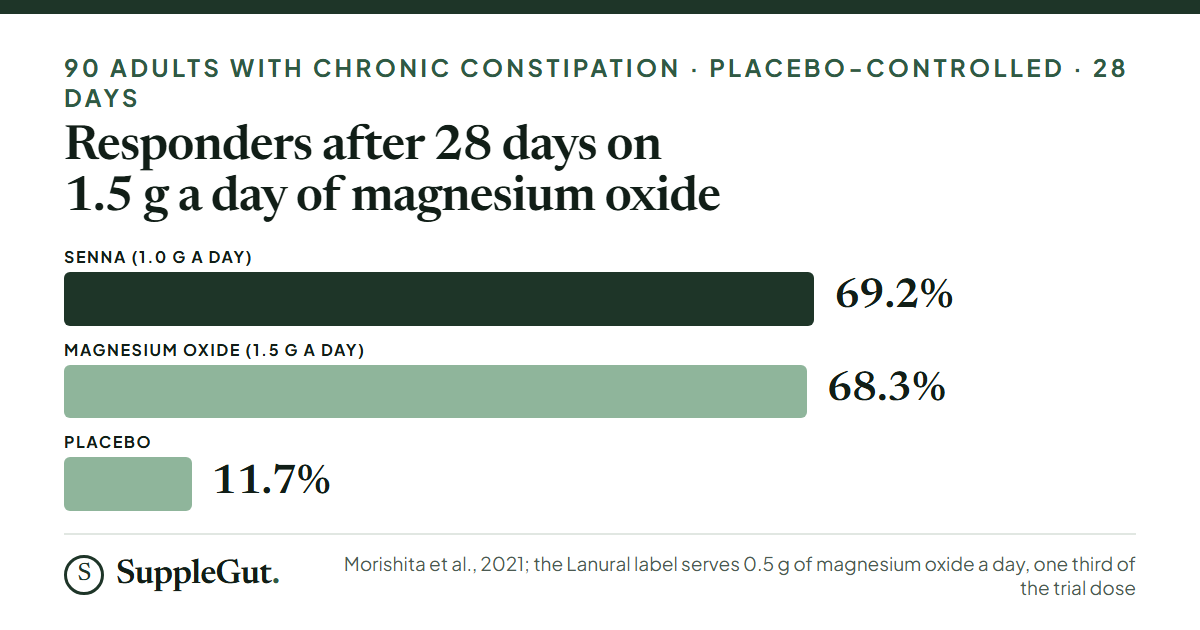
Does Lanural Regularity Reset work? No trial of Regularity Reset exists that we could find. Its magnesium oxide is 500 mg a day; both placebo-controlled trials used 1.5 g a day for 28 days (70.6% against 25.0% improved in one, 68.3% against 11.7% in the other). Kiwifruit helped mainly as two whole fruits a day; a 1 g extract showed no difference, and no placebo-controlled trial of triphala alone for constipation was found.
Lanural Regularity Reset is three capsules taken at night, built from three ingredients: magnesium oxide, kiwifruit extract and triphala extract. Each has its own line and amount on the panel, with no proprietary blend, which makes it easy to check against the trials. This page does that, then covers the brand’s citations, reviews and refund terms.
What Regularity Reset is, and what the label prints
| Ingredient | Per serving (3 capsules) |
|---|---|
| Magnesium, from magnesium oxide | 300 mg (71% of the Daily Value), from 500 mg of magnesium oxide |
| Kiwi fruit extract, 10:1 | 500 mg |
| Triphala extract, 10:1 | 300 mg |
The only full panel we found is on Amazon’s listing for a 120-capsule bottle (40 servings) sold by “Lanural Official”; the brand’s own pages sell 90 capsules (30 servings) and print the three amounts without a panel image. The panel states “Contains kiwi”. The brand calls the kiwi extract equal to a whole kiwifruit. A 10:1 extract means 500 mg comes from about 5 g of starting material; the label does not say whether that is fresh or dried, or which kiwi species, and prints no triphala species or marker compound. NIH sets the upper limit for supplemental magnesium at 350 mg a day; one serving is 300 mg.
Magnesium oxide: the label dose against the trials
Magnesium oxide has the best evidence of the three. In Japan, 34 women with chronic constipation took 0.5 g three times a day for 28 days; 70.6% improved against 25.0% on placebo (Mori et al., 2019). A 90-person trial of 1.5 g a day against senna and placebo found 68.3%, 69.2% and 11.7% responding (Morishita et al., 2021). A meta-analysis of both found 68% responders against 19% (RR 3.32, 1.59 to 6.92) and 3.72 more bowel movements a week (van der Schoot et al., 2023). A 2021 review of over-the-counter constipation therapies graded magnesium salts and kiwi B, and polyethylene glycol and senna A (Rao and Brenner, 2021).
Both trials used 1.5 g of magnesium oxide a day, three times the 500 mg on this label. We found no trial of 500 mg a day. 1.5 g is about 900 mg of elemental magnesium, above the 350 mg supplemental limit, and the trials were run under medical supervision.
Kiwifruit: whole fruit against extract
The best-known trial used two whole green kiwifruit a day in 184 people for four weeks. Complete spontaneous bowel movements rose by 1.53 a week in functional constipation and 1.73 in IBS-C from baseline (Gearry et al., 2023). The sponsor was Zespri, a kiwifruit marketer, and the brand’s advertorial words the 1.5 as additional bowel movements that outperformed psyllium; 1.5 was the rise from baseline, not the margin over psyllium.
Extracts and capsules have mixed results. A 1 g a day green kiwifruit extract showed no difference from placebo in 32 adults (Kindleysides et al., 2015). In 186 people with IBS-C, 575 mg twice a day raised the share with more frequent bowel movements (54% against 36%) but missed the combined primary endpoint (24% against 26%) (Holtmann et al., 2025). Across three trials of kiwifruit supplements, stool frequency changed by 0.24 a week (95% CI −0.32 to 0.80), not significant (van der Schoot, 2023). The label’s 500 mg of 10:1 extract is a different quantity and type from each.
Triphala
We found no placebo-controlled trial of triphala alone for constipation. The one prospective study of a formula, 34 people for 14 days with no control group, also contained psyllium husk and senna (Munshi et al., 2011). A placebo-controlled trial of 2,000 mg a day in 31 healthy adults measured gut bacteria, not bowel habit (Peterson et al., 2020). The brand’s claim that triphala raised colon mucus by more than 300% turned up in none of our PubMed searches. A 2017 review describes a laxative action alongside other uses (Peterson et al., 2017).
The funnel’s citations
The brand’s ad page lists six citations. Two are on topic: the kiwifruit trial above (PMID 36537785) and a triphala review (28696777). Three of the six cited PMIDs are unrelated: 33988216 is a Nanoscale paper on a photodetector and electrochromic device, 31403492 is an erratum on postmortem hyperthermia in a forensic journal, and 33228217 is a mouse study of dry-eye pain. We did not open the sixth, an NCBI Bookshelf entry. The page also quotes “Dr. Karen Mitchell MD” and an advertorial by “Linda R., RN”; we could match neither to a named practitioner.
How to take it, and side effects
Three capsules at night with a full glass of water; we found no food instruction. Both magnesium trials ran 28 days. The NIH lists diarrhea, nausea and cramping from high magnesium doses. In 320 hospitalized Japanese patients prescribed magnesium oxide, 75 (23%) developed high blood magnesium, with kidney function a risk factor (Wakai et al., 2019). The brand tells people on blood pressure medication or with a kidney condition to check with a doctor; we found no pregnancy, nursing or age statement on its pages. It says there is no senna or other stimulant.
What the reviews say
The brand’s counts differ by page: 4.8 from 4,463 on the ad page, 4.8 with “9738+ Happy Customers” on the store page whose code says 4.5 from 6,296, and “Over 44,724 5 Star Reviews” on the home page. All are self-hosted, and the same testimonial names appear on both the ad page and the store page. The brand’s Amazon listing shows 5.0 from 1 rating; four other Amazon listings use the Lanural name under other sellers, with ratings of 5.0 from 1, 2.0 from 5, 5.0 from 3 and none. We found no Trustpilot profile.
The testimonials praise softer morning bowel movements within one to four weeks without cramping, capsules that are easy to swallow, and less bloating than with fiber. We found no complaint text on any platform where review text could be read; Amazon’s was behind a sign-in.
Cost and the three refund windows
On the ad page, one 90-capsule bottle is $59 plus $4.95 shipping ($1.97 a day), three are $49 each ($1.63) and six $39 each ($1.30). The store lists $69 ($2.30). Amazon’s 120-capsule bottle is $39.99, $1.00 per serving, though its bullet calls 40 servings a 30-day supply.
The brand’s pages state three different refund windows: 90 days on the ad page, 60 days on the store pages and refund policy, and 30 days in the terms of service. Shipping is non-refundable, no return is needed under the refund policy, and renewals after the 60-day window are excluded. The terms contain an auto-renewal clause and say to log in and cancel at least 24 hours before billing. The ad page mentions no subscription, and we did not test checkout.
Who Regularity Reset is for
- Someone who wants magnesium oxide in a capsule rather than a powder and accepts it at one third of the trial dose.
- Someone who wants each ingredient and amount printed.
- A person with no kidney condition or blood pressure medication, and no kiwi allergy.
The constipation treatments guide grades the options, and psyllium vs magnesium compares two of them. Catalog pages: Nature Made Magnesium Oxide, Natural Vitality CALM and Enzymedica Kiwi Regularity.
The products in this catalog
Common questions
Does Lanural Regularity Reset work?
No trial of Regularity Reset itself exists that we could find. Placebo-controlled trials of magnesium oxide in 34 and 90 adults over 28 days improved symptoms, but they used 1.5 g a day and the label has 500 mg. Kiwifruit trials were positive mostly for two whole fruits a day, and a meta-analysis of kiwifruit supplements found no change in stool frequency. We found no placebo-controlled trial of triphala alone for constipation.
Is Regularity Reset safe, and what are the side effects?
A serving has 300 mg of magnesium from magnesium oxide; the NIH lists diarrhea, nausea and cramping from high magnesium doses and sets its upper limit for supplemental magnesium at 350 mg a day. The brand tells people on blood pressure medication or with a kidney condition to check with a doctor. The panel says it contains kiwi, and the brand lists no senna or other stimulant.
What are the ingredients in Regularity Reset?
Per three-capsule serving: magnesium oxide (500 mg, providing 300 mg magnesium), kiwi fruit extract 10:1 (500 mg) and triphala extract 10:1 (300 mg), in a vegetarian hypromellose capsule. Each has its own amount and there is no proprietary blend. The label does not give the kiwi species or the triphala species.
What do the brand’s citations show?
The ad page lists six citations. Two concern kiwifruit and triphala. Three of the six cited PMIDs are unrelated papers: a photodetector device paper in Nanoscale, a forensic erratum on postmortem hyperthermia, and a mouse study of dry-eye pain. We did not open the sixth. The kiwifruit trial it cites used two whole fruits a day and was sponsored by a kiwifruit marketer.
How much does Regularity Reset cost?
The brand’s ad page lists $59 for one 90-capsule bottle plus $4.95 shipping, $49 each for three and $39 each for six, which is $1.97, $1.63 and $1.30 a day at three capsules. The store lists $69. Amazon’s 120-capsule bottle sold by “Lanural Official” is $39.99, about $1.00 a serving.
What is the refund policy?
The brand’s pages state three windows: 90 days on the ad page, 60 days on the store pages and refund policy, and 30 days in the terms of service. The refund policy excludes shipping and renewals processed after the 60-day window, and the terms include an auto-renewal clause. Refund contact addresses differ by page (.com and .co).
Regularity Reset vs MiraLAX or plain magnesium?
Regularity Reset is a supplement with no drug claims on its panel. Magnesium oxide at 1.5 g a day matched senna in a 90-person trial, but the label serves one third of that dose. MiraLAX (polyethylene glycol) is a separate over-the-counter laxative; a 2021 review of over-the-counter constipation therapies graded polyethylene glycol and senna A and magnesium salts and kiwi B. See psyllium vs magnesium.
Sources
- Mori S, Tomita T, Fujimura K, et al. “A Randomized Double-blind Placebo-controlled Trial on the Effect of Magnesium Oxide in Patients With Chronic Constipation.” Journal of Neurogastroenterology and Motility, 2019;25(4):563–575. doi.org/10.5056/jnm18194; Morishita D, Tomita T, Mori S, et al. “Senna Versus Magnesium Oxide for the Treatment of Chronic Constipation: A Randomized, Placebo-Controlled Trial.” American Journal of Gastroenterology, 2021;116(1):152–161. doi.org/10.14309/ajg.0000000000000942
- Rao SSC, Brenner DM. “Efficacy and Safety of Over-the-Counter Therapies for Chronic Constipation: An Updated Systematic Review.” American Journal of Gastroenterology, 2021;116(6):1156–1181. doi.org/10.14309/ajg.0000000000001222
- van der Schoot A, Creedon A, Whelan K, et al. “The effect of food, vitamin, or mineral supplements on chronic constipation in adults: A systematic review and meta-analysis of randomized controlled trials.” Neurogastroenterology & Motility, 2023;35(11):e14613. doi.org/10.1111/nmo.14613
- Gearry R, Fukudo S, Barbara G, et al. “Consumption of 2 Green Kiwifruits Daily Improves Constipation and Abdominal Comfort.” American Journal of Gastroenterology, 2023;118(6):1058–1068. doi.org/10.14309/ajg.0000000000002124
- Kindleysides S, Kuhn-Sherlock B, Yip W, et al. “Encapsulated green kiwifruit extract: a randomised controlled trial investigating alleviation of constipation in otherwise healthy adults.” Asia Pacific Journal of Clinical Nutrition, 2015;24(3):421–429. doi.org/10.6133/apjcn.2015.24.3.15
- Holtmann G, Talley NJ, Nandurkar S, et al. “Randomized, Placebo-Controlled, Double-Blind 8-Week Trial on the Efficacy of A Proprietary Kiwifruit Extract on Constipation-Predominant Irritable Bowel Syndrome.” JGH Open, 2025;9(8):e70250. doi.org/10.1002/jgh3.70250
- Munshi R, Bhalerao S, Rathi P, et al. “An open-label, prospective clinical study to evaluate the efficacy and safety of TLPL/AY/01/2008 in the management of functional constipation.” Journal of Ayurveda and Integrative Medicine, 2011;2(3):144–152. doi.org/10.4103/0975-9476.85554
- Peterson CT, Pourang A, Dhaliwal S, et al. “Modulatory Effects of Triphala and Manjistha Dietary Supplementation on Human Gut Microbiota.” Journal of Alternative and Complementary Medicine, 2020;26(11):1015–1024. doi.org/10.1089/acm.2020.0148; Peterson CT, Denniston K, Chopra D. “Therapeutic Uses of Triphala in Ayurvedic Medicine.” 2017;23(8):607–614. doi.org/10.1089/acm.2017.0083
- Wakai E, Ikemura K, Sugimoto H, et al. “Risk factors for the development of hypermagnesemia in patients prescribed magnesium oxide.” Journal of Pharmaceutical Health Care and Sciences, 2019;5:4. doi.org/10.1186/s40780-019-0133-7; NIH Office of Dietary Supplements, “Magnesium” (ods.od.nih.gov)
- Brand pages: label amounts, prices, citations, guarantee and policies (secure.lanural.com; lanural.com); Amazon listing: Supplement Facts panel and price (amazon.com/dp/B0HHGXHHQN)
Not sure which product fits your situation?
This guide covers the mechanics. The quiz takes your specific symptoms, routine and preferences and matches you to one product from the catalog.
Take the quiz →