Guide
Does Let Loose Daily Capsules work? Magnesium oxide at 400 mg, an oxygen claim with no trial, and a 4.0 on Amazon
Quick answer
Does Let Loose Daily Capsules work? No trial of the capsule or of ozonated magnesium oxide was found. Plain magnesium oxide at 1.5 g a day, about 905 mg of magnesium, beat placebo for constipation in two 28-day Japanese trials (70.6% against 25.0%, and 68.3% against 11.7%). One capsule carries 400 mg of magnesium on the brand panel, 44% of that dose, and Amazon prints 300 mg. Amazon shows 4.0 from 481 ratings, with 16% one-star.
Let Loose Daily Capsules is a magnesium oxide capsule sold for smoother bowel movements and less bloating, taken at bedtime. The brand calls its version “ozonated” and says the capsule carries active oxygen. This page covers the label and the two magnesium figures printed for it, the research on plain magnesium oxide, what the brand’s own Science page says and cites, the directions, the safety limits, the reviews on Amazon and on the brand’s site, and the cost.
What is in the capsule
The brand’s Supplement Facts panel lists a serving of one capsule and 30 servings per bottle. It prints 400 mg of magnesium as magnesium oxide (95% of the daily value) and, on the next line, a 790 mg “Proprietary Ozonated Magnesium Blend” with no daily value. The page text says each capsule holds 790 mg of the blend, which includes the 400 mg of elemental magnesium. The other ingredients are citric acid, a hypromellose vegetable capsule, microcrystalline cellulose, silicon dioxide, magnesium stearate and blue spirulina for color. The panel is headed Supplement Facts, not the Drug Facts panel an over-the-counter laxative carries.
Magnesium is about 60.3% of magnesium oxide by weight, so 400 mg of magnesium is roughly 663 mg of the oxide. Subtract that from 790 mg and about 127 mg remains for citric acid; that is arithmetic, because the panel does not print the citric acid amount and does not say whether the two lines add together.
The Amazon listing prints a different figure for what appears to be the same product: 300 mg of magnesium (71% of the daily value) inside the blend, with citric acid. The two pages do not reconcile the 400 mg and 300 mg, and we could not tell which one matches the bottle you would receive. The numbers below use 400 mg and show the 300 mg alongside it.
The brand states vegan and gluten-free. There is no “contains” line and no facility statement, so milk, egg, soy, tree nuts, fish and sesame are not addressed. The Amazon title calls it “Constipation Relief Pills” and a “Gut Cleanse Detox,” and the brand’s own FAQ says the capsule is “designed for daily use but can also be used as a stronger laxative when needed.” The warning text says it “may have a laxative effect.” It contains no senna, cascara, aloe latex or rhubarb.
Has anyone studied this capsule, or ozonated magnesium oxide?
A PubMed search for the brand name and for ozonated magnesium with constipation returned no results, and the brand cites no trial of the capsule. The Science page says its own ozone references “are not clinical studies of Let Loose capsules.” We found no study of ozonated magnesium oxide in people. The product page also quotes survey figures, such as “92% of users reported feeling more regular” and “88% … less bloated,” with an asterisk and no study named.
What the magnesium oxide trials found
The research on magnesium oxide for constipation is on the plain compound, not the ozonated one. Two placebo-controlled Japanese trials ran for 28 days at 1.5 g of magnesium oxide a day, given as 0.5 g three times a day. That is about 905 mg of magnesium.
- 34 women with mild to moderate chronic constipation (16 on placebo and 17 on magnesium oxide analyzed). The main outcome, overall improvement, was reached by 70.6% on magnesium oxide and 25.0% on placebo (P = 0.015). Spontaneous bowel movements and stool form improved and colonic transit time shortened, but the rate of complete spontaneous bowel movements did not differ significantly (Mori et al., 2019).
- 90 adults (mean age 42, 93% women) assigned to senna 1.0 g, magnesium oxide 1.5 g or placebo. Overall improvement was 68.3% on magnesium oxide, 69.2% on senna and 11.7% on placebo (P < 0.0001). All completed, and none had a severe treatment-related adverse event (Morishita et al., 2021). It is the larger of the two trials.
A 2023 pooled analysis of food, vitamin and mineral supplements for chronic constipation found eight randomized trials in 787 people, two of them on magnesium oxide. In those two, 68% responded on magnesium oxide against 19% on control (relative risk 3.32, 95% CI 1.59 to 6.92), with about 3.7 more bowel movements a week (van der Schoot et al., 2023).
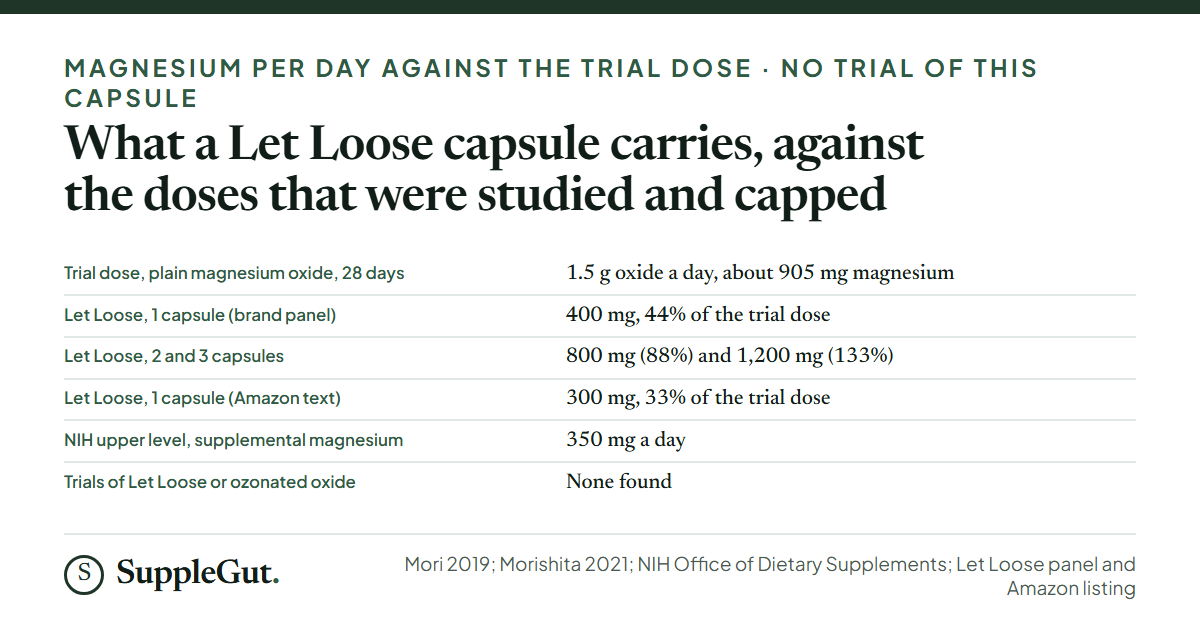
Set against that dose, one Let Loose capsule is 400 mg of magnesium on the brand’s panel, which is 44% of the trials’ 905 mg. Two capsules is 88% and three capsules is 133%. On Amazon’s 300 mg figure, one capsule is 33%. The trials also divided the dose into three parts across the day, where this product is taken once, before bed. Both trials were two small, 28-day studies in Japan, so they say nothing about the ozonation, and they did not test a single bedtime dose.
The “active oxygen” claim and the Science page
The brand’s Science page reports 28,186 ppm of active oxygen per dose, which it describes as 13 times more than “the leading competitor” at 2,050 ppm, measured by iodometric titration and credited to “manufacturer lab testing, 2026.” The competitor is not named and neither is the laboratory. The brand says stomach acid and citric acid release oxygen from the ozonated oxide, which it says breaks down buildup and supports beneficial bacteria. We found no human study of that step, and no potency, purity or heavy-metal testing by a named third party. The brand states a GMP-certified facility in Arizona without naming it.
The same page lists the two trials above, and both citations carry an error. It prints the Mori trial as Toxicology and Industrial Health, 2019; PubMed has it in the Journal of Neurogastroenterology and Motility, 2019. It prints the Morishita trial as 2020; the paper is dated 2021 in the American Journal of Gastroenterology. The authors and results match the trials. The brand’s sister product, Let Loose Koji Digestive Enzymes, has its own page.
Directions: the first nights and maintenance
The panel image says: take one capsule daily with a full glass of water before bed, two to three hours after your last meal, and increase by one or two capsules as needed. The product page is more specific: start with two to three capsules before bed for the first one to two nights, then drop to one capsule nightly to maintain regularity. It says results build over 45 to 60 days of consistent use; no study backs that timeline. It is taken on an empty stomach.
At two to three capsules, the first nights supply 800 to 1,200 mg of magnesium by the brand’s panel. Reviewers describe the same pattern, some settling at one capsule and others at two.
Side effects, the NIH limit and kidney disease
NIH sets the tolerable upper intake level for supplemental magnesium at 350 mg a day for adults. The limit is based on diarrhea, which is the effect this product is sold for. One capsule carries 400 mg, which is 1.14 times that limit, and the first-night directions are 2.3 to 3.4 times it. NIH also says high supplemental doses often cause diarrhea with nausea and abdominal cramping, and that the risk of magnesium toxicity rises with impaired kidney function.
The label warning reads: ask a doctor before use if you have kidney disease; consult your healthcare provider before use if you are pregnant, nursing, taking medication or have a medical condition; discontinue use if adverse reactions occur. On medicines, NIH says magnesium can lower absorption of oral bisphosphonates (osteoporosis drugs), which should be taken at least two hours apart, and can bind tetracycline and quinolone antibiotics, which should be taken at least two hours before or four to six hours after magnesium.
Amazon’s review summary counts 21 mentions of side effects, 11 positive and 10 negative, and the negative ones describe stomach pain and nausea.
The reviews, counted
Amazon shows 4.0 out of 5 from 481 ratings: 70% five-star, 5% four, 5% three, 4% two and 16% one. The listing is sold and fulfilled by Let Loose. Amazon’s review summary counts 248 mentions of effectiveness (181 positive, 67 negative), 129 of consistency (100 positive, 29 negative), 43 of ease of use (39 positive), 29 of gentleness (28 positive) and 64 of value for money (27 positive, 37 negative).
The brand’s page runs a Judge.me review widget showing 4.74 from 327 reviews: 274 five-star, 36 four, 6 three, 6 two and 5 one. In the 323 reviews the public feed returned, 163 are flagged verified buyers and 160 are not, so about half carry no purchase check. Of the 323, 22 are marked as collected from another provider and 118 carry a product title ending in “BACKUP.” Reviews arrive in bursts, with 16 on the busiest single day and 18 days with four or more. Trustpilot has no profile for takeletloose.com.
Praise on both platforms falls into three groups: regular mornings without cramping or urgency, less bloating, and easy-to-swallow capsules with no taste. The complaints are no effect (some used the whole bottle as directed), price, and a few reports of nausea, stomach pain or worse constipation. Several reviewers say they needed two capsules a night, which doubles the daily cost. One verified-buyer one-star review on the brand’s widget says email requests to cancel a subscription went unanswered and the card was still charged.
Cost and the billing small print
A 30-capsule bottle is $54.00 on the brand’s site, which is $1.80 a day at one capsule; two or three bottles are $108.00 and $162.00 with no bundle discount. Subscriptions run $48.60 a bottle monthly ($1.62 a day, 10% off), $45.90 every two months ($1.53) and $43.20 every three months ($1.44, 20% off). Amazon sells it for $44.96 ($1.50 a day). At two capsules a night the brand’s one-time price is $3.60 a day.
The subscription option appears first on the page, and the static page does not show whether it is pre-selected. The brand says to skip, pause, swap or cancel anytime, and lists perks for staying subscribed: a free travel tin on the first order, an extra 10% off on the second and fourth orders, and free wipes on the third. The banner offers free shipping on orders over $100 and on subscriptions, while the product page also says free US shipping always.
The guarantee is 30 days by email to the brand. It applies to one bottle per order, the customer pays return shipping, and refunds follow within 10 business days after the return is inspected. The brand’s FAQ words it as 100% hassle-free returns without the one-bottle limit.
Let Loose against plain magnesium oxide, Mag O7 and Oxy-Powder
Against a plain tablet such as Nature Made Magnesium Oxide, Let Loose is the same compound with a brand process claim and a different price per day; the trials above used plain oxide. The two other ozonated capsules in the catalog print more magnesium per serving and a different schedule:
| Product | Magnesium per capsule | Serving on the label |
|---|---|---|
| Let Loose Daily Capsules | 400 mg (Amazon text: 300 mg) | 1 capsule at bedtime; 2 to 3 for the first nights |
| NB Pure Mag O7 | 345 mg | 3 capsules at bedtime, 1,035 mg |
| Global Healing Oxy-Powder | 350 mg | 4 capsules, 1,400 mg |
None of the three has a randomized trial of its own capsule. Oxy-Powder has a paid seven-day questionnaire study of 50 adults with no placebo group, covered on the Oxy-Powder guide, and the Mag O7 guide sets out that product’s label and trials.
Who Let Loose is for
- Someone with occasional constipation who wants a magnesium oxide capsule they can take as one a night, knowing the trials used about 905 mg of magnesium a day.
- Someone without kidney disease and not on bisphosphonates or tetracycline- or quinolone-type antibiotics, or who can space them by the gaps above.
- Someone comfortable with a brand-run oxygen measurement and no trial of the ozonated form.
For a daily approach that is not a laxative, psyllium has its own evidence: see psyllium vs magnesium for constipation and the constipation treatments guide, and the quiz starts from your symptoms.
Products this guide draws on
Common questions
Is there evidence behind Let Loose for constipation?
None for the capsule or its ozonated form. The evidence is for plain magnesium oxide: two 28-day placebo-controlled trials in Japan at about 905 mg of magnesium a day, in 34 and 90 people. One capsule has 400 mg, or 44% of that dose. On Amazon it is 4.0 from 481 ratings, with 70% five-star and 16% one-star.
Does Let Loose count as a laxative?
The label says it “may have a laxative effect,” and the brand’s FAQ says it can be used “as a stronger laxative when needed.” It is a magnesium oxide supplement with no senna, cascara or aloe, and its panel is a Supplement Facts panel, not a Drug Facts panel.
How many Let Loose capsules should you take at night?
The brand’s page says to start with two to three capsules before bed for the first one to two nights, then drop to one capsule nightly. The panel says one capsule with a full glass of water, two to three hours after your last meal, and to increase by one or two as needed. Some reviewers settle on two a night.
What are the side effects of ozonated magnesium oxide capsules?
Reviewers mostly describe no cramping or urgency, while a few report nausea, stomach pain or worse constipation. NIH says high supplemental magnesium doses often cause diarrhea, nausea and cramping, and sets the upper limit at 350 mg a day. The label asks people with kidney disease to see a doctor first.
What does a bottle of Let Loose cost per day?
A 30-capsule bottle is $54.00 on the brand site ($1.80 a day at one capsule), $48.60 to $43.20 a bottle on a subscription, and $44.96 on Amazon ($1.50). At two capsules a night the daily cost doubles.
Is Let Loose different from ordinary magnesium oxide?
The compound is the same; the brand says its version is ozonated and reports 28,186 ppm of active oxygen by its own laboratory test, against 2,050 ppm for an unnamed competitor. No study shows the ozonation changes the effect in people, and the trials used plain oxide.
How do you get a refund or cancel a Let Loose subscription?
The brand offers a 30-day guarantee by email to hello@takeletloose.com, applying to one bottle per order, with the customer paying return shipping and refunds paid within 10 business days of inspection. It says subscriptions can be skipped, paused, swapped or cancelled anytime.
Why does Amazon show 300 mg when the brand panel says 400 mg?
The two pages print different magnesium figures for the same product: 400 mg (95% of the daily value) on the brand’s panel image and 300 mg (71%) in Amazon’s ingredient field. Neither page explains the difference, so check the bottle you receive.
Sources
- Mori S, Tomita T, Fujimura K, et al. “A Randomized Double-blind Placebo-controlled Trial on the Effect of Magnesium Oxide in Patients With Chronic Constipation.” Journal of Neurogastroenterology and Motility, 2019;25(4):563–575. PubMed 31587548
- Morishita D, Tomita T, Mori S, et al. “Senna Versus Magnesium Oxide for the Treatment of Chronic Constipation: A Randomized, Placebo-Controlled Trial.” American Journal of Gastroenterology, 2021;116(1):152–161. PubMed 32969946
- van der Schoot A, Creedon A, Whelan K, Dimidi E. “The effect of food, vitamin, or mineral supplements on chronic constipation in adults: A systematic review and meta-analysis of randomized controlled trials.” Neurogastroenterology & Motility, 2023;35(11):e14613. PubMed 37243443
- NIH Office of Dietary Supplements. “Magnesium: Fact Sheet for Health Professionals”: upper limit, diarrhea, kidney function and drug interactions. ods.od.nih.gov
- Let Loose: product page, Supplement Facts image, FAQ, Science page, refund policy and price. takeletloose.com; Science page
- Amazon listing for Let Loose Daily Capsules (ASIN B0FWD8TN1R): ingredient field, price, ratings and review summary. amazon.com
Not sure which product fits your situation?
This guide covers the mechanics. The quiz takes your specific symptoms, routine and preferences and matches you to one product from the catalog.
Take the quiz →