
Guide
Does Let Loose work? Sixteen koji enzymes with printed units, in one blend, and the trials that exist
Quick answer
Does Let Loose work? We could find no trial of this capsule. Its label prints an activity unit for each of 16 koji enzymes, though all 16 share one 355 mg blend, and a 120-person trial of a different fungal-fermentation enzyme blend improved functional dyspepsia scores over two months. Amazon shows 4.4 from 58 ratings. At the label directions it costs about $1.87 a day.
Let Loose Koji Digestive Enzymes is a capsule of 16 enzymes made by fermenting koji, the mold Aspergillus oryzae, taken 5 to 10 minutes before the two largest meals of the day. Its label prints an activity unit for every enzyme, so it can be read line by line against other enzyme labels. This page sets out what is printed, how it compares with HoloZyme and Digest Gold, what the enzyme trials found, and what the reviews and the brand’s own references show.
What Let Loose Koji Digestive Enzymes is
One capsule holds a 355 mg “Koji Enzyme Blend” of 16 enzymes, plus trace mineral, NuFlow (a rice concentrate used as a flow agent) and a vegetable capsule. Each enzyme has its own activity unit, but all 16 sit under the one blend weight, so the enzyme protein behind each unit cannot be read. There are no probiotics, sweeteners or flavors.
| Enzyme as printed | Per capsule |
|---|---|
| Protease I; Protease II; Protease (acid stable) | 20,000 HUT; 50,000 HUT; 200 SAPU |
| Peptidase; Peptidase DPP-IV | 4,000 HUT; 72 DPPIV |
| Alpha amylase; Invertase | 12,000 DU; 400 SU |
| Lactase; Alpha galactosidase | 400 ALU; 300 GALU |
| Cellulase; Hemicellulase; Xylanase | 2,000 CU; 2,000 HCU; 300 XU |
| Beta glucanase; Pectinase | 50 BGU; 14 ENDO PG |
| Lipase I; Lipase II | 100 FIP; 1,300 FIP |
The label does not spell out the unit abbreviations, and suppliers do not always use the same assay behind the same abbreviation. The brand says one capsule supports roughly 40 to 60 g of protein, 40 to 80 g of carbohydrate and 20 to 25 g of fat, which its Science page calls biochemical modeling, not clinical claims. Gluten, dairy and soy are stated absent; egg, tree nuts, fish and sesame are not addressed.
What koji is, and what the label does not say
Koji is a food material fermented with Aspergillus oryzae, the mold used for miso, soy sauce and sake. The mold secretes large amounts of digestive-type enzymes into the medium it grows on, which is why industry uses it as an enzyme source. The pack says “100% Koji-Fermented Enzymes”.
Not stated: the strain, the grain or bean the koji was grown on, and whether the enzymes are purified from the culture or are a dried culture extract.
The trial of the product itself
There is none. PubMed and ClinicalTrials.gov searches for the capsule and for koji enzymes returned no record of a study of this product, and the brand cites none. The nearest human data are for other fungal enzyme blends, covered below.
The evidence for the enzymes
A fungal-fermentation blend in dyspepsia. In a double-blind trial of 120 adults with functional dyspepsia, a multi-enzyme blend “obtained from fungal fermentation” at 200 mg a capsule, two capsules a day (400 mg), was compared with placebo for two months. Dyspepsia-index, pain and sleep scores improved more on the enzymes, with no side effects reported. The abstract names no organism, strain or per-enzyme activity; two Let Loose capsules would be 710 mg of a different blend.
Eighteen enzymes plus herbs after a pizza. In a double-blind crossover of 25 adults with daily post-meal bloating (20 completed both visits), one dose of a capsule with 18 digestive enzymes plus ginger, fennel and peppermint was taken before two slices of pizza. Waist measurement rose 0.93 cm on the capsule against 1.50 cm on placebo at 30 minutes, and 0.94 against 2.12 cm at 90 minutes; self-reported bloating, distension, gas and indigestion scores did not differ significantly. HUM Nutrition funded the trial, and the capsule matches the catalog’s HUM Flatter Me, covered in its own guide.
Alpha-galactosidase. In 8 healthy volunteers eating a bean meal, 1,200 GalU lowered breath hydrogen and flatulence, and 300 GalU lowered the total symptom score. In irritable bowel syndrome a 12-week trial in 125 patients found no routine benefit over placebo, and a trial in 20 patients at 1,200 GalU a meal found no difference. One Let Loose capsule supplies 300 GalU, 600 in a two-capsule meal.
The rest. Let Loose carries a DPP-IV peptidase but not the AN-PEP enzyme from gluten trials. We found no trial pinned to its 400 ALU of lactase, none of koji enzymes on fructans or lactose in people, and none testing whether 16 enzymes outperform a smaller blend. The digestive enzymes guide covers where single-purpose enzymes have trial support.
Let Loose against HoloZyme and Digest Gold
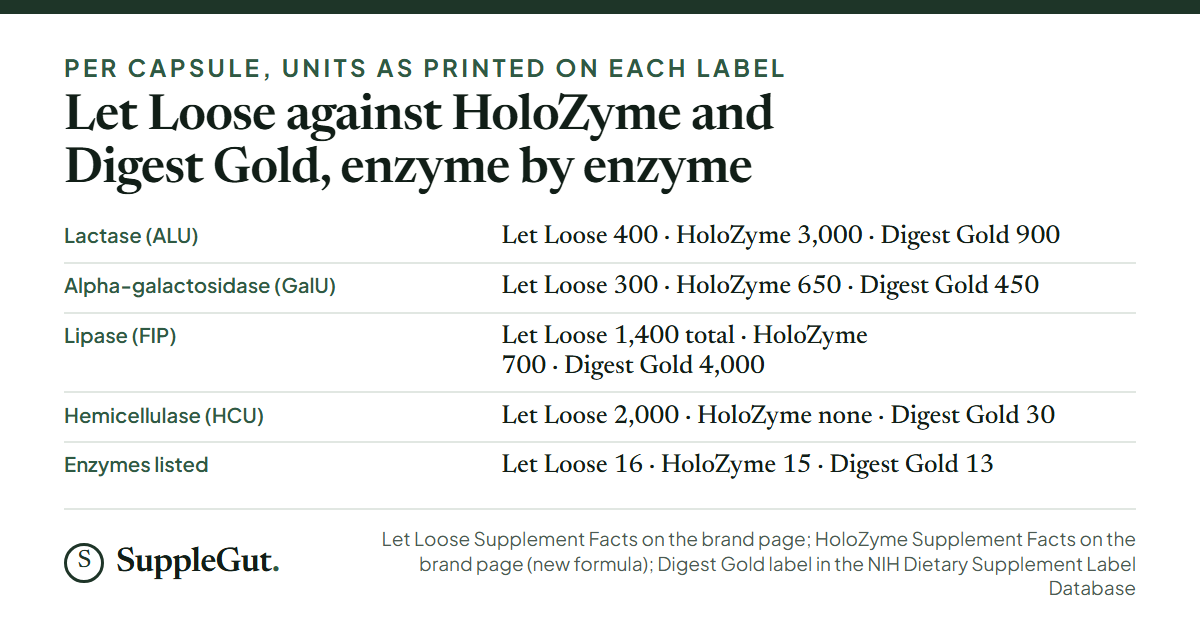
Because all three labels print units, matching lines can be read side by side. HoloZyme lists 15 enzymes, Digest Gold 13, Let Loose 16. Per capsule, Let Loose against HoloZyme against Digest Gold:
- Higher on Let Loose: hemicellulase 2,000 HCU (none; 30), beta-glucanase 50 BGU (none; 25) and invertase 400 SU against Digest Gold’s 240 (HoloZyme 500).
- Lower on Let Loose: lactase 400 ALU (3,000; 900), alpha-galactosidase 300 GalU (650; 450), xylanase 300 XU (2,000; 550) and total lipase 1,400 FIP (700; 4,000), where it is above HoloZyme and below Digest Gold.
Amylase and DPP-IV are printed in different units and cannot be compared. None of the three has a trial of its own formula.
How to take it
The directions on the pack and page: one capsule 5 to 10 minutes before the two largest meals of the day, and two capsules for heavier meals. The page calls the bottle a 30-day supply, which is two capsules a day, and says best results come after 45 to 60 days of consistent use; no trial exists to test that claim.
Side effects and who should check first
The pack says to consult a healthcare provider before use if pregnant, nursing, taking medication or having a medical condition, and to discontinue if adverse reactions occur. The product page adds “ask a doctor before use if you have kidney disease” and “may have a laxative effect”. No side-effect pattern was readable in the brand’s reviews.
What the reviews say
- Amazon: 4.4 from 58 ratings, the independent pool.
- Brand site (Judge.me widget): 4.86 from 76 reviews, 65 five-star and 11 four-star, none at three stars or below. Of the 75 entries the public feed returned, 10 are flagged as verified buyers and 65 are not. On two days the entries are stamped seconds apart, about 30 seconds between neighbors.
- Trustpilot: no profile exists for the brand’s domain.
Recurring praise in the brand-hosted reviews: less bloating after big meals, eating dairy and beans again, and an easy-to-pack capsule. Complaints: no difference yet, and the price.
The brand’s references
The Science page lists eight references with links; six carry an author name, DOI or link that leads to a different paper from the one named.
- “Morell P, et al. (2022)”: the DOI resolves to a Food Chemistry review of olive mill wastewater; the printed title is a paper by Garvey et al.
- “Yang L, et al. (2022)”: the DOI has no record at Crossref; the printed title is a paper by Zhang et al.
- “Hiroi M, Nagao S. (2021)”: the link leads to an automotive electronics paper; the printed title is by Kitagaki.
- “Spagnuolo R, et al. (2024)”: the link goes to an article by Martin-Biggers.
- “Graziani C, et al. (2023)”: the PubMed link leads to a paper on platelet-rich plasma and MRSA wounds; the printed title is by Ullah et al.
- “Majeed M, et al. (2018)”: the PubMed link leads to a pomegranate juice paper; the printed title is by Majeed et al.
The Ullah and Majeed papers tested other products. The label names no laboratory or factory.
Price, subscriptions and returns
A 60-capsule bottle is $56.00 one time on the brand site and on Amazon, or $0.93 a capsule. At the directions that is $1.87 a day at two capsules, and up to $3.73 at four. Brand-site subscriptions are $50.40 monthly, $47.60 every two months and $44.80 every three months ($1.49 a day at two capsules); Amazon’s Subscribe & Save price is $44.80. HoloZyme is $0.83 a capsule on its brand site and Digest Gold $0.45 in the catalog. The brand’s guarantee is 30 days on one bottle per order, with the customer paying return shipping. Amazon lists the item as non-returnable.
Who it is for
- Someone who wants a unit printed for every enzyme and plans to compare labels.
- Someone whose trigger meals involve plant fiber, dairy or beans, knowing the alpha-galactosidase IBS trials are mixed.
- Someone who can take a capsule before two meals a day for six to eight weeks.
For bloating that does not follow particular meals, the enzymes against probiotics guide compares the approaches, and the quiz starts from symptoms.
The products in this catalog
Common questions
Does Let Loose Koji Digestive Enzymes work?
We could find no trial of this capsule. Its ingredients are koji (Aspergillus oryzae) enzymes with printed activity units, and a 120-person trial of a different fungal-fermentation enzyme blend improved functional dyspepsia scores over two months. On Amazon it holds 4.4 from 58 ratings; the brand’s own review widget shows 4.86 from 76.
What is koji, and how do koji enzymes differ from other digestive enzymes?
Koji is grain or beans fermented with the mold Aspergillus oryzae, used for miso, soy sauce and sake; the mold secretes protein-, starch- and fat-cutting enzymes. The trials of enzyme blends draw on several sources, and we found no trial that compares koji enzymes with the others. The label names no strain and does not say whether the enzymes are purified from the culture.
Let Loose vs HoloZyme or Digest Gold: how do the enzymes compare?
Let Loose lists 16 enzymes in a 355 mg blend, HoloZyme 15 and Digest Gold 13. Per capsule Let Loose has more hemicellulase (2,000 HCU against 30 on Digest Gold), beta-glucanase and invertase than Digest Gold, and less lactase (400 ALU against 900 and 3,000), alpha-galactosidase and xylanase. None of the three has a trial of its own formula.
How much does Let Loose Koji Digestive Enzymes cost per day?
A 60-capsule bottle is $56.00 one time on the brand site and on Amazon, or $0.93 a capsule. One capsule before each of the two largest meals is $1.87 a day, and two capsules before heavier meals is up to $3.73 a day. Subscribing on the brand site is $44.80 to $50.40 a bottle, and Amazon’s Subscribe & Save price is $44.80.
Are there side effects, and who should not take it?
The pack says to consult a healthcare provider before use if pregnant, nursing, taking medication or having a medical condition, and to stop if adverse reactions occur. The site adds “ask a doctor before use if you have kidney disease” and “may have a laxative effect”. No side-effect pattern was readable in the brand’s reviews.
Can Let Loose be returned?
On the brand site the guarantee is 30 days for one bottle per order, and the customer pays return shipping. Amazon lists the item as non-returnable. Subscriptions on the brand site can be skipped, paused, swapped or canceled.
Do the brand’s cited studies show the capsule works?
The brand cites no study of the capsule. Six of the eight references on its Science page carry an author name, DOI or link that points to a different paper from the one named, and two of the papers it names tested other products.
Sources
- Ullah H, et al. A multi-enzyme blend from fungal fermentation in 120 adults with functional dyspepsia: randomized, double-blind, placebo-controlled trial. Biomedicine and Pharmacotherapy, 2023. PMID 37976892
- Martin-Biggers J, et al. A multi-digestive enzyme and herbal dietary supplement and post-meal bloating: double-blind crossover trial funded by HUM Nutrition. Nutrition and Dietary Supplements, 2024. doi.org/10.2147/NDS.S453377
- Di Stefano M, et al. Alpha-galactosidase and gas after a bean meal in 8 healthy volunteers. Digestive Diseases and Sciences, 2007. PMID 17151807
- Hillila M, et al. Alpha-galactosidase in 125 patients with irritable bowel syndrome. Scandinavian Journal of Gastroenterology, 2016. PMID 26133538
- Bohn L, et al. Alpha-galactosidase in 20 patients with irritable bowel syndrome. Neurogastroenterology and Motility, 2021. PMID 33619835
- Ido H, et al. An enzyme mixture including an Aspergillus oryzae peptidase in non-celiac gluten sensitivity: single-blind crossover trial. Clinical and Translational Gastroenterology, 2018. PMID 30228265
- Kitagaki H. Medical application of substances derived from non-pathogenic fungi Aspergillus oryzae and A. luchuensis-containing koji. Journal of Fungi, 2021. PMID 33804991; Daba GM, et al. Aspergillus oryzae as a biotechnology tool, review, 2021. PMID 38650252
- Brand page: label, directions, warnings, price, subscription and refund terms; the Science page and its reference list. takeletloose.com/products/koji-digestive-enzymes; takeletloose.com/pages/the-science-behind
- Amazon listing (rating, price, returns) and the Judge.me review feed the brand page loads. amazon.com/dp/B0GX86S6QJ
- NIH Dietary Supplement Label Database: Enzymedica Digest Gold label; HoloZyme Supplement Facts on the brand page, used for the unit-by-unit comparison. dsld.od.nih.gov/label/328881; healthygut.com/products/holozyme
Not sure which product fits your situation?
This guide covers the mechanics. The quiz takes your specific symptoms, routine and preferences and matches you to one product from the catalog.
Take the quiz →