
Guide
Does Oxy-Powder work? Four capsules of magnesium oxide, an ozonated label and the trial dose
Quick answer
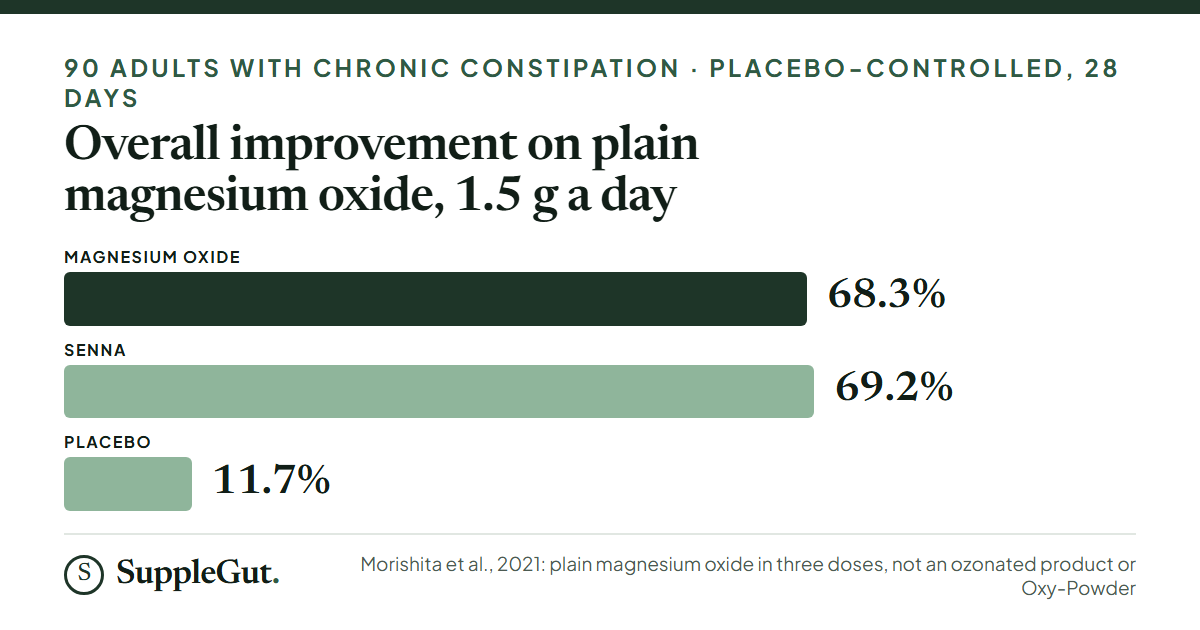
Does Oxy-Powder work? No trial of Oxy-Powder or of ozonated magnesium oxide exists; the brand’s own study is a 50-person, 7-day survey with no placebo group. Plain magnesium oxide at 1.5 g a day beat placebo in two Japanese trials (70.6% against 25.0% improved in 34 women; 68.3% against 11.7% in 90 adults), and one Oxy-Powder serving is about 1.5 times that dose in magnesium. At 1,400 mg of magnesium, a serving is 4 times NIH’s 350 mg upper limit. Amazon shows 4.6 from 19,004 ratings.
Oxy-Powder is a magnesium oxide capsule from Global Healing of Houston, sold as a bedtime “colon cleanse” and for occasional constipation and bloating. What sets it apart from the magnesium oxide tablets on the next shelf is the word “ozonated” on the label and a serving of four capsules that carries 1,400 mg of magnesium. This page sets out what is in it, what the one study of the product is and is not, what the constipation trials of plain magnesium oxide found, how the dose sits against NIH’s upper limit, and what the reviews report.
What Oxy-Powder is, and what “ozonated” means
The Supplement Facts panel lists two active lines per four-capsule serving: 1,400 mg of magnesium (350% of the daily value, which uses the older 400 mg reference) from ozonated magnesium oxides, and 90 mg of natural citric acid from tapioca. The other ingredients are the vegetable-cellulose capsule and organic gum acacia. It is not a proprietary blend, and it has no sweeteners or flavors. The bottle says “dietary supplement”, and NIH’s label database holds the same panel; it is not the Drug Facts panel an over-the-counter laxative carries.
The 1,400 mg is elemental magnesium: NIH’s fact sheet says a Supplement Facts panel declares the magnesium, not the weight of the whole compound. Magnesium is 60.3% of magnesium oxide by weight, so one serving is about 2.3 g of magnesium oxide, or 350 mg of magnesium per capsule.
“Ozonated” is the brand’s term for a “proprietary super-ozonation process” that it says bonds extra oxygen to the magnesium, which stomach acid and the citric acid then release as “nascent oxygen” in the intestine. No oxygen content, specification or analysis of the material is printed, and we found no published study of it. A PubMed search for “ozonated magnesium” returned 92 records, none about this ingredient in people.
The study of Oxy-Powder itself
There is no published trial. The brand links one study from its product page, a 2025 report by Citruslabs, a research firm the brand paid. It was an at-home questionnaire study of 50 adults with BMI 25 or higher, self-reported constipation and low energy, who took Oxy-Powder at night for seven days, with no placebo group and no randomization. Participants started at four capsules, added one a night up to seven if they did not reach three to five bowel movements the next day, and took away two if they had more than five; the average was between 3.55 and 3.95 capsules a night.
At day 7, 95% agreed with the statement that their constipation had been relieved since using the product, 87.5% said the same of bloating and 85% of cramps, and bowel movements a week rose 85% from a baseline mean of 4.44. The brand’s page headlines these as “95% constipation relief”. The report does not say how many people answered at each point; the percentages imply about 40. Those are agreement scores in a group with nothing to compare against, so they cannot separate the product from the placebo response, which was 25.0% and 11.7% in the magnesium oxide trials below. The report’s own conclusion says larger randomized controlled trials are warranted. Its participants also took the capsules every night for a week, where the bottle’s maintenance schedule is two to three nights a week.
The evidence for plain magnesium oxide
Magnesium oxide has trials; ozonated magnesium oxide does not. Two placebo-controlled trials in Japan tested plain magnesium oxide at 1.5 g a day for 28 days, given as 0.5 g three times a day. In the first, 34 women with chronic constipation took magnesium oxide or placebo, and overall improvement was reported by 70.6% on magnesium oxide against 25.0% on placebo (Mori et al., 2019). In the second, 90 adults were split between senna, magnesium oxide and placebo, and overall improvement was 68.3% on magnesium oxide, 69.2% on senna and 11.7% on placebo (Morishita et al., 2021). A 2023 pooled analysis counted these as the only two magnesium oxide trials and found 68% responding against 19% on control (van der Schoot et al., 2023). The 2023 AGA and ACG guideline on chronic constipation gives magnesium oxide a conditional recommendation (AGA-ACG guideline, 2023). The full trial detail is on the MagO7 guide, which covers the other ozonated magnesium oxide capsule.
Two trials, both in Japan, both 28 days, both plain magnesium oxide in three doses across the day. None tested an ozonated product or a single bedtime dose.
Label dose against trial dose
The trial dose of 1.5 g of magnesium oxide is about 905 mg of magnesium. One Oxy-Powder serving, 1,400 mg, is about 1.5 times that (1.55), taken once at bedtime instead of in three parts. At seven capsules, the most the brand’s study allowed, it is 2,450 mg, about 2.7 times the trial dose.
How to take Oxy-Powder
The directions on the brand page: 4 capsules with a full glass of purified water before bed, at least two hours after the last meal. If three to five bowel movements are not reached the next day, the label says to increase by two capsules each night until they are, and to take the serving two to three times a week or as recommended by a healthcare provider. The brand’s FAQ says the capsules can be opened and mixed into water, to expect loose or watery stools, and that using it more often than two to three times a week is at the user’s discretion with at least one rest day between.
Side effects, the upper limit and who should not take it
NIH sets the Tolerable Upper Intake Level for supplemental magnesium at 350 mg a day for adults. One Oxy-Powder serving of 1,400 mg is 4.0 times that limit, and seven capsules is 7.0 times. The limit is based on diarrhea: NIH says high doses from supplements often cause diarrhea that can come with nausea and abdominal cramping. Loose stools are the intended effect here (the label’s aim is three to five bowel movements the next day), so the limit marks where the effect begins, not a separate threshold.
Kidney and heart. NIH says the risk of magnesium toxicity rises with impaired kidney function. The label record in NIH’s database says to keep the product out of reach of children and to consult a healthcare provider with a history of cardiac or kidney disease. The brand says it is mainly intended for adults 18 and over because of its potency and has no children’s serving. The pregnancy and breastfeeding statement is on the brand’s FAQ and not in the label record: it says the ingredients are generally safe but to discuss a serving size with a healthcare provider first. We found no medication statement.
Medicines. Per NIH, magnesium can reduce absorption of oral bisphosphonates, the osteoporosis drugs, and can bind tetracycline and quinolone antibiotics, so these doses are spaced by hours.
What the reviews say
Amazon shows 4.6 from 19,004 ratings, shared across sizes, with the brand as the seller. The brand’s own page shows 4.78 from 11,659 reviews (88.9% five-star, 2.4% one-star) on a widget it hosts, and 8.7% of the reviews we retrieved from it are flagged as rewarded with loyalty points. Trustpilot shows 3.4 from 309 reviews, but that profile covers the whole brand, not this product.
The praise is an overnight effect, a gentle one with no cramping for many people, and years of use as a routine. The complaints, among the 428 one- and two-star reviews on the brand’s page, are mostly no effect (about 27%), then cramps, nausea, vomiting, gas or watery stool (about 15%), then a price or formula change that some reviewers say they noticed. We could not confirm a formula change from the labels: the earlier record shows 100 mg of citric acid against 90 mg now.
Refund and subscription terms
The brand offers a one-year money-back guarantee, but its policy requires a physical return of the item (opened product is accepted), allows one return per product per customer or household, and deducts a $9.99 return shipping charge from the refund in the US; original shipping is not refunded. Amazon shows the listing as non-returnable. Autoship is 15% off every delivery on one, two, three, six or twelve month cycles; the brand’s terms say it can be changed, skipped or cancelled in the account, that it renews automatically, and that prices “are subject to change at any time” during the term. Of the 428 one- and two-star reviews, about 23 mention a refund or return and about 4 mention cancelling. MagO7’s terms differ: 60 days, shipping not refunded, no return shipping charge.
Oxy-Powder and MagO7 side by side
| Oxy-Powder | MagO7 | |
|---|---|---|
| Magnesium per serving | 1,400 mg in 4 capsules (350 mg each) | 1,035 mg in 3 capsules (345 mg each) |
| Times NIH’s 350 mg limit | 4.0 | 2.96 |
| Price per serving, 120 or 90 capsules | $1.67 ($49.95) | $0.93 ($27.95) |
| Study of the product | One brand-funded survey, 50 people, 7 days | None found |
| Amazon rating | 4.6 from 19,004 | 4.6 from 48,174 |
| Refund | 1 year, return required, $9.99 return shipping deducted | 60 days, shipping not refunded |
Both list magnesium from ozonated magnesium oxides at about 350 mg of magnesium a capsule.
Who Oxy-Powder is for
- Someone with occasional constipation who wants a bedtime capsule on a two-to-three night schedule and has no kidney or heart condition that calls for a doctor’s sign-off on magnesium.
- A person comfortable that the supporting trials are of plain magnesium oxide, with one uncontrolled survey for the product itself.
- Someone who can keep it apart from antibiotics and osteoporosis drugs by the gaps NIH gives.
For a plain magnesium oxide tablet, the catalog has Nature Made Magnesium Oxide, and for a magnesium citrate powder, Natural Vitality CALM. For a daily fiber approach, see psyllium vs magnesium for constipation, the constipation treatments guide and NOW Foods Psyllium Husk Powder. If the symptom is bloating rather than constipation, the quiz starts from the symptom.
Cost
The 120-capsule bottle is $49.95 on the brand site and Amazon: $1.67 a serving, or $1.42 on the brand’s subscription ($42.46). The 60-capsule bottle is $29.95 ($2.00 a serving). The price per day depends on the schedule. Taken every night, a serving a day is $1.67. On the label’s two to three nights a week the spend is $3.33 to $5.00 a week, about $0.48 to $0.71 a day, and a 30-serving bottle lasts 10 to 15 weeks. At the seven capsules a night the brand’s study allowed as a maximum, a night costs about $2.91.
The products in this catalog
Common questions
Does Oxy-Powder work for constipation?
No published trial of Oxy-Powder exists. The brand’s own 50-person, 7-day survey, with no placebo group, found 95% agreed their constipation had been relieved. Plain magnesium oxide at 1.5 g a day beat placebo in two Japanese trials (70.6% against 25.0% in 34 women; 68.3% against 11.7% in 90 adults), and one Oxy-Powder serving is about 1.5 times that magnesium. About 27% of the one- and two-star reviews on the brand’s page say it did not work.
What is ozonated magnesium oxide, and is it different from plain magnesium oxide?
The brand says a proprietary ozonation process bonds extra oxygen to the magnesium oxide and that stomach acid and citric acid release it in the intestine. No oxygen figure is printed, and we could find no study of the ozonated material in people. Whether it behaves differently from plain magnesium oxide is untested; MagO7 uses the same wording.
Is Oxy-Powder safe, and what are the side effects?
One serving carries 1,400 mg of magnesium, 4.0 times the 350 mg a day NIH sets as the upper limit for supplemental magnesium, a limit based on diarrhea, which is the intended effect here. NIH says high doses often cause diarrhea with nausea and abdominal cramping, and reviewers report cramps, nausea, vomiting and gas. The label record says to consult a healthcare provider with a history of cardiac or kidney disease, and NIH says the risk of magnesium toxicity rises with impaired kidney function.
How do you take Oxy-Powder, and how often?
The label says 4 capsules at bedtime with a full glass of water, at least 2 hours after the last meal. If 3 to 5 bowel movements are not reached the next day, it says to add 2 capsules each night until they are, and to take it 2 to 3 times a week. In the brand’s study participants averaged about 3.6 to 3.9 capsules a night for 7 days, with a maximum of 7.
How much does Oxy-Powder cost per day?
The 120-capsule bottle is $49.95 on the brand site and Amazon, which is $1.67 a serving, and the 60-capsule bottle is $29.95 ($2.00 a serving). Subscribing takes 15% off on the brand site ($42.46, or $1.42 a serving). At the label’s 2 to 3 nights a week the cost is about $0.48 to $0.71 a day, and a bottle lasts 10 to 15 weeks.
Oxy-Powder vs MagO7: what is the difference?
Both list magnesium from ozonated magnesium oxides at about 350 mg a capsule: Oxy-Powder has 1,400 mg in 4 capsules, MagO7 1,035 mg in 3. MagO7 costs $0.93 a serving for 90 capsules against $1.67 for Oxy-Powder’s 120, and has no study of its own, while Oxy-Powder has one uncontrolled 7-day survey. The refund is 1 year with a $9.99 return charge for Oxy-Powder and 60 days with shipping not refunded for MagO7.
What do Oxy-Powder reviews say, and can you get a refund?
Amazon shows 4.6 from 19,004 ratings and the brand’s own page 4.78 from 11,659 reviews, 8.7% of those we retrieved rewarded with loyalty points; Trustpilot shows 3.4 from 309 reviews for the whole brand. Reviewers praise an overnight, gentle effect, and the complaints are no effect, cramps or nausea, and price. The brand’s policy allows a refund within a year, requires a physical return and deducts $9.99 for return shipping; Amazon lists it as non-returnable.
Sources
- Mori S, Tomita T, Fujimura K, et al. "A Randomized Double-blind Placebo-controlled Trial on the Effect of Magnesium Oxide in Patients With Chronic Constipation." Journal of Neurogastroenterology and Motility, 2019;25(4):563–575. doi.org/10.5056/jnm18194
- Morishita D, Tomita T, Mori S, et al. "Senna Versus Magnesium Oxide for the Treatment of Chronic Constipation: A Randomized, Placebo-Controlled Trial." American Journal of Gastroenterology, 2021;116(1):152–161. doi.org/10.14309/ajg.0000000000000942
- van der Schoot A, Creedon A, Whelan K, Dimidi E. "The effect of food, vitamin, or mineral supplements on chronic constipation in adults: A systematic review and meta-analysis of randomized controlled trials." Neurogastroenterology & Motility, 2023;35(11):e14613. doi.org/10.1111/nmo.14613
- American Gastroenterological Association and American College of Gastroenterology. Clinical practice guideline on the pharmacological management of chronic idiopathic constipation, 2023. pubmed.ncbi.nlm.nih.gov/37211380
- NIH Office of Dietary Supplements. "Magnesium: Fact Sheet for Health Professionals": upper limit, diarrhea, kidney function, drug interactions and how Supplement Facts declares magnesium. ods.od.nih.gov
- NIH Dietary Supplement Label Database, Oxy-Powder label records: Supplement Facts panel and warnings. dsld.od.nih.gov/label/231212, dsld.od.nih.gov/label/231210, earlier label dsld.od.nih.gov/label/204523
- Citruslabs Research Team. "Evaluating Consumer Perceptions of a Magnesium Powder on Digestive Health, Energy, and Overall Well-Being." Brand-funded report, 2025. PDF on globalhealing.com
- Brand page: label, directions, review widget and price. globalhealing.com; refund policy, subscription policy, shipping policy
- Amazon listing: price, ratings and review summary. amazon.com/dp/B00ZDYWUTC
- Trustpilot, Global Healing Center (brand-wide profile). trustpilot.com
Not sure which product fits your situation?
This guide covers the mechanics. The quiz takes your specific symptoms, routine and preferences and matches you to one product from the catalog.
Take the quiz →