
Guide
Does Liver Medic Leaky Gut Repair work? Nine ingredients in one blend, and a glutamine dose that cannot reach the trials
Quick answer
Does Liver Medic Leaky Gut Repair work? We could find no trial of Leaky Gut Repair. Its L-glutamine shares a 981.26 mg blend with eight other ingredients, so it is at most 981 mg a serving, against 15 g a day in the one placebo-controlled trial in post-infectious IBS-D (79.6% against 5.8% reaching a 50-point improvement). A 10-trial meta-analysis found no overall effect on gut permeability and a benefit only above 30 g a day. Amazon shows 4.1 from 3,474 ratings, with praise for less bloating and heartburn and complaints of little effect.
Liver Medic Leaky Gut Repair is a two-capsule bedtime formula that pairs zinc with a nine-ingredient blend led by L-glutamine, slippery elm, marshmallow root and DGL licorice. Only the zinc has its own amount on the panel; the nine other ingredients share one figure. This page sets out the panel, the glutamine trials against what the label can hold, the reviews, and the price and refund terms.
What Leaky Gut Repair is, and what it is not
The 60-capsule bottle is 30 servings of two capsules. The panel, read from the Amazon label image because the brand page’s ingredients tab did not load, prints two lines per serving.
| Item as printed | Per serving (2 capsules) |
|---|---|
| Zinc (as zinc orotate) | 25 mg (227% of the Daily Value) |
| “Gut Repair Propriety Blend” (as printed): L-glutamine, organic slippery elm, organic marshmallow root, N-acetyl-D-glucosamine (NAG), licorice root extract (DGL), aloe vera leaf powder, MSM, quercetin dihydrate 95%, bromelain | 981.26 mg for all nine, no individual amounts |
The other ingredients are cellulose (the vegetarian capsule) and rice flour. It is not a probiotic or a fiber. The Amazon title’s “1000mg” is the blend total, not an amount of glutamine, and the label does not say what form of aloe leaf powder is used or how much aloin it carries.
The trial of the product itself
There is none. We found no trial of Leaky Gut Repair on PubMed, and the NIH Dietary Supplement Label Database has no record of it. The brand page lists several benefits in its own words, among them that the product “supports repair of peptic ulcers and intestinal openings”; that is a brand claim, and we found no trial of this formula in ulcers or in any other condition.
The glutamine evidence against the label dose
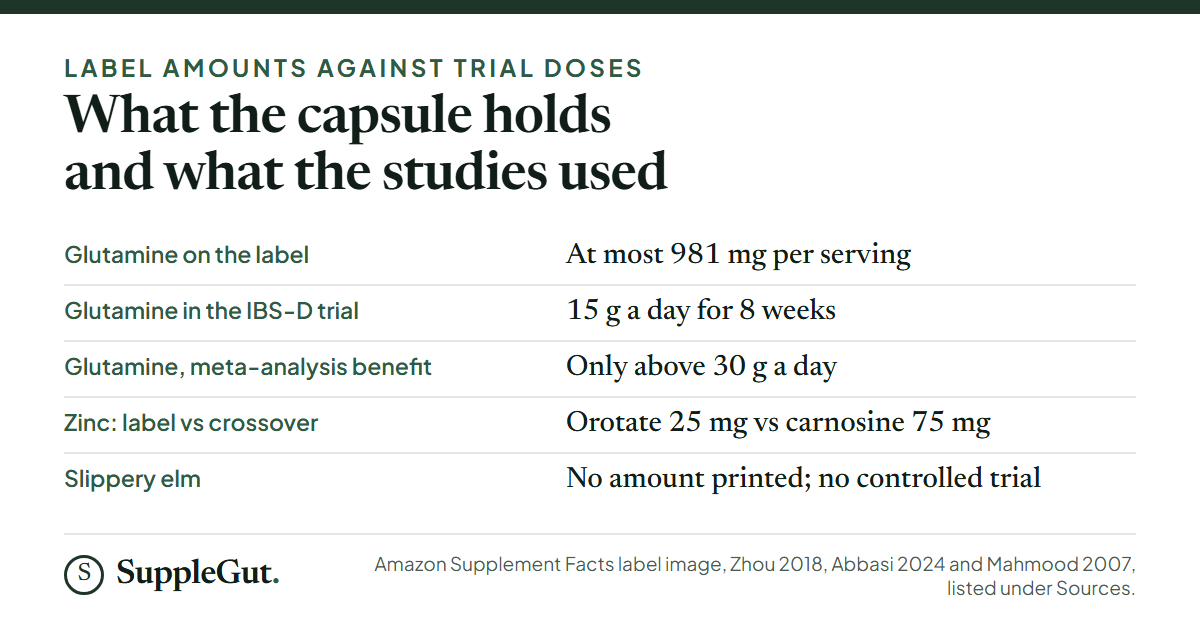
L-glutamine is the first ingredient in the blend and the one with the most human data. The trial usually cited enrolled 106 adults with post-infectious IBS-D and increased intestinal permeability. They took 5 g of glutamine three times a day, 15 g a day, for 8 weeks. A fall of 50 points or more on the IBS symptom score came in 79.6% of the glutamine group (43 of 54) against 5.8% on placebo (3 of 52), and the permeability ratio normalized in the glutamine group. Adverse events were low and similar in both arms (Zhou et al., Gut, 2018).
The label cannot reach that. Because all nine ingredients share 981.26 mg per two capsules, glutamine is at most 981 mg a serving, about 6.5% of the 15 g trial dose. At the label’s advanced dose of six capsules, the ceiling is about 2.9 g a day, roughly a fifth of it, and that assumes the whole blend were glutamine. The actual amount is not printed.
The wider record is less favorable to glutamine as a permeability treatment. A 2024 meta-analysis of 10 randomized placebo-controlled trials in 352 participants found no significant overall effect on intestinal permeability, with a reduction only in the subgroup taking more than 30 g a day (Abbasi et al., Amino Acids, 2024).
Zinc: orotate here, carnosine in the studies
The zinc studies people cite for gut lining are about zinc carnosine, which this product does not contain. In a randomized crossover in 10 healthy volunteers, 37.5 mg of zinc carnosine twice a day (75 mg a day) or placebo was given with the anti-inflammatory drug indomethacin for 5 days. On placebo the permeability ratio rose from 0.35 to 0.88; on zinc carnosine there was no significant rise (Mahmood et al., Gut, 2007). This capsule has 25 mg of zinc as zinc orotate, a different compound with no carnosine in it, and we found no trial of zinc orotate for gut permeability.
The closest study to this label’s zinc-plus-glutamine pairing is a trial in 120 Brazilian shantytown children, where glutamine alone or with zinc and vitamin A preserved barrier function against a glycine placebo (Lima et al., Clinics, 2014). The zinc also scales with the dose: at the advanced 4 to 6 capsules a day it comes to 50 to 75 mg, against a 40 mg adult upper intake level set by the NIH Office of Dietary Supplements. For products that do contain zinc carnosine, see the Doctor’s Best PepZin GI page.
Slippery elm and the other blend ingredients
We found no placebo-controlled trial of slippery elm alone. It appears inside multi-ingredient formulas in uncontrolled work: an open pilot in 31 patients with IBS and a before-and-after study in 43 participants. Neither tested this formula or a stated slippery elm dose. For the other seven blend ingredients this page does not weigh trials, because the label prints no amount for any of them.
“Leaky gut,” meaning increased intestinal permeability, is a laboratory finding, usually measured by how much of two sugars crosses the gut wall. It is a research concept, not a diagnosis used in everyday care.
How to take it
The label image directs two capsules daily, ideally on an empty stomach before bedtime, with an advanced use of four to six capsules a day or as directed by a health practitioner. The brand page’s text still says “1-2 scoops at night,” wording from the powder version. The glutamine trial ran 8 weeks.
Side effects, shellfish and who should check first
The panel states “Contains Shellfish”: the NAG is the source. The brand sells a “Shellfish Free” 60-capsule version at the same price; we did not see its panel. The page footer advises consulting a physician before use, especially if pregnant, nursing, taking medication or with a medical condition.
Amazon’s review summary says reports on side effects are mixed, with some people feeling nauseous and others no discomfort. One 1-star reviewer linked MSM to a sulfa allergy and described swollen, itchy eyes, headache and numbness; that is the reviewer’s own statement, not a label warning. A Trustpilot reviewer reported worse bloating and new constipation; the company replied that this was a Herxheimer reaction, which is its statement, not an established effect of this product.
What the reviews say
Amazon shows 4.1 from 3,474 ratings on the capsule listing: 57% five-star, 16% four, 14% three, 5% two and 8% one. The recurring praise is less bloating, cramping and heartburn, eating foods people had cut out, and easy-to-swallow capsules. The recurring complaints are little or no effect and the cost of a bottle that lasts about two weeks at the higher dose.
The brand’s product page runs a real review app, Opinew, showing 4.6 from 375 reviews, of which 68 are marked verified; the older reviews we sampled are imported from Amazon. The home page’s “4.8/5 from 12,000+ verified reviews” is typed text with no review app behind it, and it covers the whole brand. Trustpilot shows 4.5 from 62 reviews for livermedic.com, none of them in the last 12 months.
Cost, subscriptions and the return policy
A 60-capsule bottle is $29.99 on the brand site and on Amazon, which is $1.00 a day at the two-capsule serving. Amazon Subscribe & Save is $26.99 ($0.90 a day), and the 120-capsule bottle is $55.99 on the brand site ($0.93 a day). At the advanced 4 to 6 capsules, a bottle lasts 10 to 15 days and costs $2.00 to $3.00 a day. The brand page carries an auto-ship notice and lists monthly and every-three-months plans, and single bottles are sold at the prices above.
The brand states a 90-day return policy: a return must be requested first, items sent back without a request are not accepted, and the item must be in the condition received, in its original packaging. The home page calls it a 90-day risk-free trial; how an opened bottle is handled is not stated. We found no billing or refund complaint on Trustpilot or in the Amazon text.
Testing statements
The brand states GMP certification, an NSF-registered facility and third-party testing of every batch. A registered facility is not a certified product, no laboratory is named, and we found no certificate of analysis.
Who Leaky Gut Repair is for
- Someone who wants a bedtime capsule with 25 mg of zinc and a mix of mucilage plants and amino-sugar ingredients, and is comfortable with blend amounts that are not printed.
- Someone without a shellfish allergy, or who will buy the shellfish-free version and read its label.
If glutamine at a studied gram dose is the point, a plain powder such as NOW Foods L-Glutamine Powder lets the dose be chosen and counted, and the Silver Fern Gut Repair guide covers a scoop with 5 g of glutamine and zinc carnosine. DGL on its own comes as a chewable, Natural Factors Chewable DGL. For loose stools, the IBS-D guide sets out what has trial support, and the quiz starts from symptoms.
The products in this catalog
Common questions
Does Liver Medic Leaky Gut Repair work?
No trial of this formula was found. Amazon shows 4.1 from 3,474 ratings (57% five-star, 8% one-star), and reviewers describe less bloating and heartburn while others report little effect. The largest glutamine trial used 15 g a day; this label has a 981 mg blend of nine ingredients per serving.
What is in Leaky Gut Repair, and how much glutamine does it have?
Two capsules have zinc (as zinc orotate) 25 mg and a 981.26 mg blend of L-glutamine, organic slippery elm, organic marshmallow root, N-acetyl-D-glucosamine, licorice root extract (DGL), aloe vera leaf powder, MSM, quercetin and bromelain, with no amount for each. Glutamine therefore cannot exceed 981 mg a serving, about 6.5% of the 15 g a day used in the IBS-D trial.
Does it contain zinc carnosine?
No. The zinc is zinc orotate at 25 mg a serving, and zinc carnosine, studied at 75 mg a day in a crossover of 10 healthy volunteers, is not on the panel. We found no trial of zinc orotate for gut permeability. The Terra Origin Healthy Gut guide covers a product that does contain it.
What side effects are reported, and does it contain shellfish?
The panel states it contains shellfish (the NAG), and the brand sells a shellfish-free version at the same price. Amazon’s summary says some reviewers feel nauseous, and one reviewer reported a reaction they linked to MSM and a sulfa allergy. The page says to consult a physician if pregnant, nursing, taking medication or with a medical condition.
How much does Leaky Gut Repair cost per day?
A 60-capsule bottle is $29.99 on the brand site and on Amazon, which is 30 servings of two capsules, or $1.00 a day. Amazon Subscribe & Save is $26.99 ($0.90 a day). At the label’s advanced dose of 4 to 6 capsules a day, a bottle lasts 10 to 15 days and costs $2.00 to $3.00 a day.
Is the “12,000+ reviews” rating real, and what is the refund policy?
The home page’s “4.8/5 from 12,000+ verified reviews” is typed text with no review app behind it. The product page’s review app shows 4.6 from 375 with 68 marked verified, Amazon shows 4.1 from 3,474, and Trustpilot shows 4.5 from 62 with none in the last year. The brand states a 90-day return policy that asks for a return request first and unused product in its original packaging.
Is “leaky gut” a diagnosis, and does glutamine help it?
Increased intestinal permeability is a laboratory finding measured with sugar tests, not a diagnosis used in everyday care. A 2024 meta-analysis of 10 placebo-controlled trials found no overall change in permeability, with a reduction only above 30 g a day. For other glutamine formulas see the Silver Fern Gut Repair guide.
Sources
- Zhou Q et al. Glutamine 5 g three times a day in post-infectious IBS-D with increased permeability: randomized placebo-controlled trial, 106 completers. Gut, 2018. PMID 30108163
- Abbasi F et al. Glutamine and intestinal permeability: meta-analysis of 10 randomized placebo-controlled trials, 352 participants. Amino Acids, 2024. PMID 39397201
- Mahmood A et al. Zinc carnosine and indomethacin-induced permeability: randomized crossover in 10 healthy volunteers. Gut, 2007. PMID 16777920
- Lima AAM et al. Glutamine alone or with zinc and vitamin A in 120 Brazilian shantytown children. Clinics, 2014. PMID 24714829
- Hawrelak JA, Myers SP. Two natural formulas including slippery elm in IBS: open pilot study, 31 patients, 2010. PMID 20954962; and Ried K et al. Multi-ingredient gut formula including slippery elm, 43 participants, 2020. PMID 32151878
- NIH Office of Dietary Supplements. Zinc: health professional fact sheet (adult upper intake level). ods.od.nih.gov
- Liver Medic: product page, refund policy and home page (benefit wording, directions, price, return terms, Opinew reviews). livermedic.com/products/leaky-gut-repair; livermedic.com/policies/refund-policy
- Amazon listing for Leaky Gut Repair, 60 capsules: Supplement Facts label image, price, directions, ratings and reviews. amazon.com/dp/B09CJW53VC
- Trustpilot profile for livermedic.com. trustpilot.com/review/livermedic.com
Not sure which product fits your situation?
This guide covers the mechanics. The quiz takes your specific symptoms, routine and preferences and matches you to one product from the catalog.
Take the quiz →