Guide
Does The Mate Factor Digestive Tea work? Eight herbs in a 3.5 g bag, a prebiotic claim, and no trial of the tea
Quick answer
Does The Mate Factor Digestive Tea work? No trial of this tea was found. Its "prebiotic" claim rests on chicory and burdock root, and the two chicory inulin trials in constipated adults used 12 g a day for 4 weeks against a 3.5 g bag that holds eight herbs and does not print the inulin amount. Ginger and fennel have small trials at gram doses, and no adult gut trial of burdock, cardamom or coriander turned up. Licorice root is one of the eight herbs and the box warning does not name it. Amazon shows 4.5 from 345 ratings.
The Mate Factor Digestive Tea with Prebiotics is a caffeine-free, USDA organic tea bag of fennel, peppermint, burdock, chicory, ginger, cardamom, licorice and coriander, sold in 20-bag boxes to be drunk after meals. Its difference from the herbal teas beside it is the word “prebiotic” on the box, which rests on two roots that contain inulin. This page walks through the panel, the inulin trials, the evidence for the other herbs, the licorice question, the brewing directions, the reviews and what a cup costs.
What the panel prints: one 3,500 mg blend, eight herbs, no split
This is a tea, which makes it a food and not a capsule or powder supplement, yet the panel on the box is headed Supplement Facts. A serving is one tea bag of 3.5 g, and a box holds 20. The panel gives these lines:
| Line on the panel | Per tea bag |
|---|---|
| Proprietary blend of herbs | 3,500 mg |
| Organic fennel seed, peppermint leaf, burdock root, chicory root | No separate amounts |
| Organic ginger rhizome, cardamom seed, licorice root, coriander seed | No separate amounts |
| Daily value | Not established |
The herbs are listed in descending order, so by labeling convention fennel is the largest share and coriander the smallest. That is an ordering and not a printed figure. The brand’s page lists the same eight in the same order, and Amazon’s ingredient field lists them in a different one, with ginger first. The panel shows no other ingredient, sweetener or flavor, and Amazon labels the tea unsweetened.
The brand describes the 3,500 mg bag as about double a standard one. The box carries the USDA Organic seal, certified by QCS. It prints no “contains” line and no free-from or facility statement for milk, wheat, egg, soy, tree nuts, fish or sesame, and vegan, gluten-free and non-GMO are not stated. No testing laboratory or certificate of analysis is named.
The “prebiotic” claim: chicory and burdock inulin against a 3.5 g bag
The brand’s page says inulin “increases the volume of good bacteria in the intestinal system by up to 10 times,” with no source beside it. Chicory root and burdock root are the two inulin-bearing herbs in the blend. The label does not print how much inulin a bag carries, so the claim can only be set beside the trials of chicory inulin as an ingredient.
Two randomized, placebo-controlled crossover trials tested it. In 44 adults with constipation, 12 g a day of chicory inulin (3 doses of 4 g) for 4 weeks raised median stool frequency to 4.0 a week against 3.0 on maltodextrin (P = 0.038), with softer stools; the authors include employees of the inulin maker’s research institute (Micka et al., International Journal of Food Sciences and Nutrition, 2017). In 39 adults with functional constipation, 12 g a day for 4 weeks improved stool frequency and symptoms against placebo; the authors had to analyze the first period alone because of a carry-over effect, and they include employees of a chicory company (Puhlmann et al., BMC Gastroenterology, 2025).
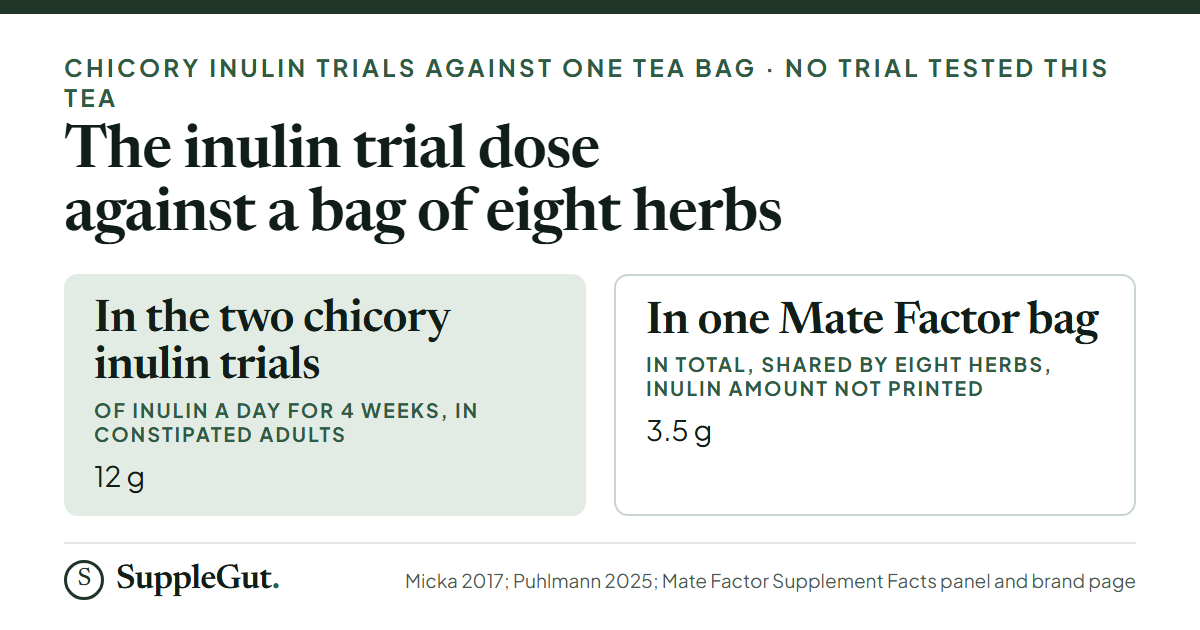
One tea bag weighs 3.5 g in total, and eight herbs share it. If the entire bag were chicory root, which it is not, it would still be under a third of the trial amount. A steeped bag also releases an unmeasured share of what is in it. So the trials show what purified chicory inulin does at 12 g in constipation, and they cannot be read across to this cup. We found no trial of burdock root as a prebiotic in adults either.
Ginger, fennel and peppermint: trials at gram doses
Ginger. In 11 people with functional dyspepsia, 1.2 g of ginger in capsules shortened gastric half-emptying to 12.3 minutes against 16.1 on placebo, with no change in symptoms (Hu et al., World Journal of Gastroenterology, 2011). A meta-analysis of 12 trials in 1,278 pregnant women found ginger improved nausea but not vomiting, on low-quality evidence (Viljoen et al., Nutrition Journal, 2014). Ginger’s share of the bag is not printed, and the ginger tea guide sets those doses beside a single-herb tea bag.
Fennel. The one tea trial is in 159 women recovering from gynecologic cancer surgery. A cup of 5 g of dried fennel fruit in 130 mL twice a day brought first flatus at 53.1 hours against 64.2 on water (P < 0.001) (Ma et al., Sichuan Da Xue Xue Bao, 2015). That is a post-surgery group and more fennel in one cup than a whole Mate Factor bag weighs. The IBS trial of fennel used an essential oil combined with curcumin, in 121 patients, with 25.9% symptom-free against 6.8% on placebo (Portincasa et al., Journal of Gastrointestinal and Liver Diseases, 2016). The fennel tea guide covers both.
Peppermint. A 2006 review found trials of peppermint tea absent (McKay and Blumberg, Phytotherapy Research, 2006). The IBS evidence is for oil in capsules: 10 randomized trials in 1,030 patients, graded very low quality (Ingrosso et al., Alimentary Pharmacology & Therapeutics, 2022). The peppermint tea guide has the detail.
Cardamom, coriander and burdock. A broad PubMed search on each of these with digestive outcomes and randomized trials in people returned no adult gut trial. None has a measured gut effect on record here.
Licorice root sits seventh in the blend, and the box does not name it
Licorice root contains glycyrrhizin. A toxicology review names hypertension and low potassium, with the disorders that follow from it, as the most important side effects of licorice and glycyrrhizin (Nazari et al., Phytotherapy Research, 2017).
The label does not say how much licorice root is in a bag, whether it still carries its glycyrrhizin, or how many cups a day would matter. The only warning on the box is the general line to consult a healthcare provider if you are pregnant or nursing, taking any medication or living with a medical condition. Licorice, blood pressure and potassium are not mentioned.
The review measured licorice and glycyrrhizin, not this tea, and it names no number of cups. Licorice is listed seventh of eight, so by labeling order it is one of the smaller shares of the 3,500 mg. The same herb is in the Yogi Stomach Ease blend, where it is listed first.
A cup after meals: 200 to 212 degrees and a 5 to 7 minute steep
The directions on the Amazon listing: place one tea bag in a cup, heat water to between 200°F and 212°F, pour 8 ounces over it and steep for 5 to 7 minutes. Swanson’s copy says to use 8 to 12 ounces of water per bag. The tea is caffeine free, and the brand says to enjoy it after meals or whenever desired and calls it safe to use after every meal. It gives no daily limit. One Amazon reviewer writes that a single bag makes a full 12 ounces. Reviewers describe a mild, soft flavor, and one says no sugar was needed.
Safety: the box line and two opposite bowel reports
Apart from the licorice question above, the bag holds no caffeine and none of the stimulant laxative herbs. The box warning covers pregnancy, nursing, medication and any medical condition, which is most people, and it is the only warning printed.
Among the Amazon reviews we could read, two describe a strong bowel effect in opposite directions. The most-voted review, marked helpful by 16 people, says the tea clears the reviewer out after a meal. Another, from a reviewer with stress-induced colitis, says daily cups for more than a week stopped bowel movements altogether. Those are single reports and not a pattern, and chicory and burdock inulin is the herb fiber that can loosen stool.
Ratings: 4.5 from 345 on Amazon, and few ratings anywhere else
Amazon shows 4.5 out of 5 from 345 ratings for the 20-bag box, sold by a third-party seller and shipped by Amazon. The star split is 76% five-star, 12% four, 6% three, 1% two and 5% one. Amazon’s summary of the review text counts 27 mentions of digestive effects (21 positive, 6 negative), 24 of flavor (18 positive, 6 negative) and 24 of taste (21 positive, 3 negative). Only seven reviews could be read on the page itself.
Swanson Vitamins shows 5.0 from 6 reviews and Walmart 5.0 from 3, counts too small to set beside Amazon’s. The brand’s own page has no review widget, and its store-wide review feed (4.98 from 47 reviews) does not break out this tea. Trustpilot has no profile for the brand.
- Praise: calming an occasional upset stomach, especially at night; a mild flavor that needs no sugar; a cup after a meal that reviewers say helps digestion.
- Complaints: “It did nothing for me,” in one reviewer’s words; a flavor some could not drink; and the strong bowel effects described above.
What a cup costs at four stores
| Where | Price | Bags | Per cup |
|---|---|---|---|
| Brand store, one box | $6.47 | 20 | $0.32 |
| Amazon, third-party seller | $8.04 | 20 | $0.40 |
| Swanson Vitamins | $9.29 | 20 | $0.46 |
| Walmart | $9.97 | 20 | $0.50 |
The brand’s page lists a struck-through $6.74 beside its $6.47 and offers no subscription. The Amazon listing is sold by Vendible Goods, and its return line cites food safety as the reason it takes no returns. We found no billing or refund complaint in the reviews we could read.
Mate Factor beside Gas Relief and Stomach Ease
Two other blends in the catalog sit close to this tea. The Traditional Medicinals Gas Relief tea prints a milligram figure for each of its five herbs, and Yogi Stomach Ease prints one for fennel and groups six more.
| Mate Factor Digestive | TM Gas Relief | Yogi Stomach Ease | |
|---|---|---|---|
| Herbs | Eight | Five | Seven, plus rice and flavors |
| Printed amounts | 3,500 mg, no split | 300 mg per herb | Fennel 337 mg; six herbs 1,361 mg |
| Licorice root | Seventh of eight | None | Listed first |
What separates them is what the label lets you check. A printed 300 mg can be set against a trial dose, and a single 3,500 mg figure for eight herbs cannot. No trial compares the three, and none has a trial as a tea.
Who this tea suits
- Someone who wants a caffeine-free, organic cup after meals and likes ginger, fennel and cardamom together in one bag.
- Someone who is curious about chicory and burdock root in a tea and accepts that the inulin amount is not printed.
- Someone not in a group the box warning singles out, or who has checked it with a provider, given that licorice is one of the eight herbs.
- Someone who prefers to know each herb’s weight can compare the single-herb and printed-amount teas above, and the quiz starts from symptoms and goals.
The products in this catalog
Common questions
Is there any proof that Mate Factor Digestive Tea works?
No trial of this tea turned up in PubMed, and the brand’s page cites none. The nearest evidence is for single ingredients at gram doses, such as 12 g a day of chicory inulin in constipated adults. On Amazon’s review summary, 21 of 27 mentions of digestive effects are positive.
How much of each herb is in one bag?
The panel prints one figure: a proprietary blend of 3,500 mg per bag. Fennel seed, peppermint leaf, burdock root, chicory root, ginger rhizome, cardamom seed, licorice root and coriander seed sit under it in descending order, with no amount for any of them.
Does the tea contain licorice, caffeine or a laxative herb?
It contains licorice root, listed seventh of the eight herbs. It has no caffeine and no stimulant laxative such as senna, cascara or aloe latex. The warning on the box is the general one for pregnancy, nursing, medication and medical conditions, and it does not mention licorice.
Is the tea really a prebiotic?
The brand calls it one because chicory root and burdock root contain inulin, a fermentable fiber. The amount of inulin is not printed, and the trials of chicory inulin used 12 g a day. One bag weighs 3.5 g in total and is shared by eight herbs.
What does a cup of Mate Factor Digestive Tea cost?
A 20-bag box is $6.47 on the brand’s store, about $0.32 a cup, and $8.04 on Amazon from a third-party seller, about $0.40. Swanson lists it at $9.29, about $0.46.
How is it different from Traditional Medicinals Gas Relief or Yogi Stomach Ease?
Mate Factor puts eight herbs under one 3,500 mg figure. Gas Relief prints 300 mg for each of its five herbs, and Yogi Stomach Ease prints 337 mg of fennel and groups six herbs at 1,361 mg. No trial compares the three, and none has a trial as a tea.
Can it be drunk after every meal?
The brand says it is safe to use after every meal and the directions say to enjoy it after meals or whenever desired. It gives no daily limit. Two Amazon reviewers describe a strong bowel effect, one an urgent one after a meal and one a stopped bowel after a week of daily cups.
Sources
- Micka A, Siepelmeyer A, Holz A, Theis S, Schön C. “Effect of consumption of chicory inulin on bowel function in healthy subjects with constipation: a randomized, double-blind, placebo-controlled trial.” International Journal of Food Sciences and Nutrition, 2017;68(1):82–89. PubMed 27492975
- Puhlmann ML, Wegh CAM, van der Zalm SCC, et al. “Inulin-induced improvements on bowel habit and gut microbiota in adults with functional constipation: findings of a randomized, double-blind, placebo-controlled study.” BMC Gastroenterology, 2025;25(1):806. PubMed 41233756
- Hu M-L, Rayner CK, Wu K-L, et al. “Effect of ginger on gastric motility and symptoms of functional dyspepsia.” World Journal of Gastroenterology, 2011;17(1):105–110. PubMed 21218090
- Viljoen E, Visser J, Koen N, Musekiwa A. “A systematic review and meta-analysis of the effect and safety of ginger in the treatment of pregnancy-associated nausea and vomiting.” Nutrition Journal, 2014;13:20. PubMed 24642205
- Ma H-W, Zhao J-T, Zhao X. “The effect of fennel tea drinking on postoperative gut recovery after gynecological malignancies operation.” Sichuan Da Xue Xue Bao Yi Xue Ban, 2015;46(6):940–943. PubMed 26867333
- Portincasa P, Bonfrate L, Scribano ML, et al. “Curcumin and fennel essential oil improve symptoms and quality of life in patients with irritable bowel syndrome.” Journal of Gastrointestinal and Liver Diseases, 2016;25(2):151–157. PubMed 27308645
- McKay DL, Blumberg JB. “A review of the bioactivity and potential health benefits of peppermint tea (Mentha piperita L.).” Phytotherapy Research, 2006;20(8):619–633. PubMed 16767798
- Ingrosso MR, Ianiro G, Nee J, et al. “Systematic review and meta-analysis: efficacy of peppermint oil in irritable bowel syndrome.” Alimentary Pharmacology & Therapeutics, 2022;56(6):932–941. PubMed 35942669
- Nazari S, Rameshrad M, Hosseinzadeh H. “Toxicological effects of Glycyrrhiza glabra (licorice): a review.” Phytotherapy Research, 2017;31(11):1635–1650. PubMed 28833680
- The Mate Factor Digestive Tea with Prebiotics: brand page and product data, label, directions and price. matefactor.com
- Amazon listing for Mate Factor Digestive Tea with Prebiotics (ASIN B01FT2DPK0): Supplement Facts image, ingredient fields, directions, price, ratings and review summary. amazon.com
- Swanson Vitamins: Mate Factor Digestive Tea with Prebiotics, label transcription, directions and price. swansonvitamins.com
Not sure which product fits your situation?
This guide covers the mechanics. The quiz takes your specific symptoms, routine and preferences and matches you to one product from the catalog.
Take the quiz →