
Guide
Does Organics Ocean Better Fiber work? 1.6 g of psyllium, an aloin-standardized aloe, and the dose the trials used
Quick answer
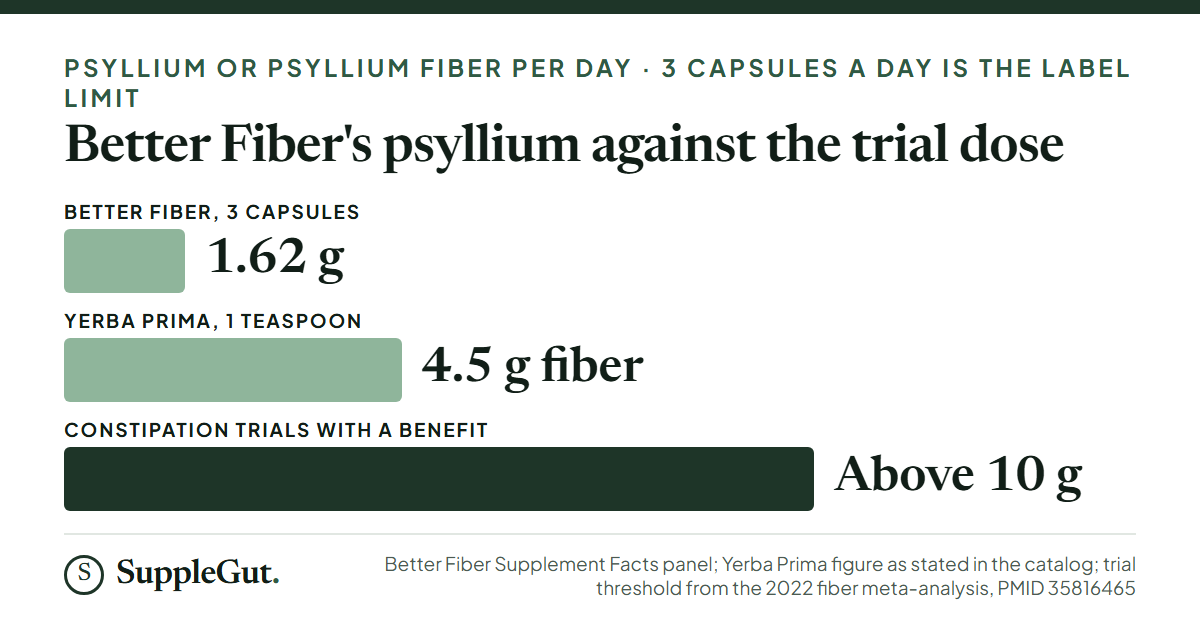
Does Organics Ocean Better Fiber work? No trial of Better Fiber was found. It supplies 1.62 g of psyllium in three capsules, and the label caps the dose at three, while the constipation trials that showed a benefit used more than 10 g a day. Its aloe ferox is standardized to 18% aloin, a stimulant-laxative form, so part of any regularity effect may come from the aloin rather than the fiber. The panel also prints a tree nut allergen and a 378 mg blend with no amounts.
Organics Ocean Better Fiber is a psyllium husk capsule with an unusual supporting cast: slippery elm, an aloe standardized to 18% aloin, chlorella, ginger and a 378 mg blend of six more plants. What sets it apart from a tub of psyllium is the format, and the cost of that format is the dose. This page sets out what the label prints, how the psyllium compares with the trial amounts, what the aloe changes, the reviews and the refund terms.
What Better Fiber is, and what it is not
The serving is three capsules, with 90 in the bottle for 30 servings. The Supplement Facts panel on the brand’s label image lists psyllium husk powder at 1,620 mg (1.62 g), then four lines of 75 mg each: slippery elm bark, aloe ferox powder, chlorella and ginger root. The last line is a proprietary blend of 378 mg holding black walnut hull, hyssop, papaya, inulin, acai extract and lycopene, with no amount printed for any of the six. Psyllium is about 70% of the 2,298 mg listed.
It is sold as a dietary supplement, not a drug. The panel prints dietary fiber 1.3 g, 5% of the daily value; the brand’s product page text says 65%, which does not match its own panel. The brand says the product is tested twice and GMP certified; we found no laboratory named and no results.
The trial of the capsule itself
There is none that we could find: PubMed returns only unrelated matches, and we found no published trial of any formula combining these ingredients. The evidence sits with the ingredients, and the fiber evidence is the part that can be checked against the label.
The psyllium dose against the trial dose
A 2022 meta-analysis of 16 randomized trials in 1,251 adults with chronic constipation found that 66% responded to fiber against 41% on control (relative risk 1.48), with significant effects for psyllium and pectin. The benefit appeared only above 10 g a day (American Journal of Clinical Nutrition, 2022). In irritable bowel syndrome, a 12-week trial of 275 adults gave 10 g a day of psyllium, 10 g of bran or placebo: 57% of the psyllium group responded in the first month against 35% on placebo (BMJ, 2009).
Better Fiber supplies 1.62 g of psyllium in its three-capsule serving, about 16% of 10 g. At 540 mg a capsule, reaching 10 g would take about 18 to 19 capsules, roughly six times the label’s limit of three a day. The label cannot be taken to the trial dose. For scale, the catalog lists Yerba Prima Psyllium Husks Powder at 4.5 g of fiber in one teaspoon,; which psyllium husk to buy compares the plain powders, and how long psyllium takes covers a fair test.
Slippery elm, aloe ferox and the rest
Slippery elm. It has its own 75 mg line, outside the blend. We found no placebo-controlled trial of slippery elm alone. It appears inside multi-ingredient formulas in uncontrolled studies: an open pilot in 31 people with IBS (Journal of Alternative and Complementary Medicine, 2010) and a before-and-after study of 43 people on a multi-herb formula at 5 then 10 g a day (Nutrition Research, 2020). Neither tested 75 mg of slippery elm. A single-ingredient capsule is Nature’s Way Slippery Elm Bark.
The aloe is a stimulant-laxative form. The panel lists 75 mg of aloe ferox powder, standardized to 18% aloin (printed as “Alion 18%”), which is about 13.5 mg of aloin. Aloin is one of the hydroxyanthracene compounds in the leaf latex of aloe, the part with a laxative effect, and a 2026 review describes safety concerns for those compounds. So part of any effect on regularity may come from the aloin and not from the fiber. We found no laxative warning on the pages we read. By contrast, the Natural Colon guide covers a capsule whose label does not say whether its aloe is gel or latex.
The 378 mg blend. Black walnut hull, hyssop, papaya, inulin, acai and lycopene share 378 mg with no split. For inulin, a trial in constipation used 12 g a day (PMID 27492975), against 0.378 g for this whole blend. We did not search trials for the other plants, because no dose is printed for them.
How to take it
The brand’s directions: three capsules a day with a full glass of water (12 ounces in its FAQ), no more than three, at least two hours apart from other medications and supplements, and increasing gradually over a few days if new to fiber. It does not say whether to take the capsules with food.
Side effects and who should not take it
The brand’s page says some people get bloating and gas that often eases as the body adjusts, and that “the fiber can form a gel and may affect absorption of vitamins, minerals, and medications,” which is the reason for the two-hour spacing. The label prints “Contains: Tree Nuts (Black Walnut Hulls)”, so anyone with a tree nut allergy has the ingredient named on the panel. We found no pregnancy, nursing, age or medical-condition warning on the pages we read, and the bottle label itself was not read. Anyone who is pregnant, takes medicines on a schedule or has a bowel condition can check with a doctor or pharmacist first.
What the reviews say
Amazon shows 4.4 from 726 ratings across the one-, three- and six-bottle packs, independent of the brand. We could not read the review text. The brand’s own product page shows 255 reviews, 81% of them in the top category, labeled verified; it is hosted on the brand’s site and shows no average. Its home page claims 4.7 from “15,000+” reviews across the whole brand, a self-stated total. The recurring praise is digestion that settled within days, daily regularity, and capsules easier than powders or gummies.
Trustpilot shows the brand at 2.6 from 12 reviews in the last 12 months: 58% one-star, 17% five-star. Most concern the brand’s other products, mainly magnesium, not Better Fiber. The complaints are unexpected charges, unanswered phone messages, a missing shipment and a refund policy one reviewer called nonexistent; the company replied to 11% of its negative reviews. It is a small, brand-level sample. We found no billing complaint in the six brand-page reviews we read.
An Instagram ad attributed to Organics Ocean in a search of ads used the line “Want To End Your Sleepless Nights, Cramps And Bloating?” The Better Fiber page makes no sleep or cramp claim, while the home page tags the brand’s magnesium glycinate “Sleep & Muscle Cramping Support,” so the ad appears to describe the magnesium range. The ad itself was not readable, so which product it sells is not confirmed.
Price, subscription and refund terms
| Route | Price | Per day |
|---|---|---|
| Amazon, one bottle | $35.99 | $1.20 |
| Amazon, Subscribe & Save | $30.59 | $1.02 |
| Amazon, 3 or 6 bottles | $99.99 / $174.99 | $1.11 / $0.97 |
| Brand site, one bottle | $35.00 | $1.17 |
| Brand site, 3 or 6 bottles | $99.00 / $174.00 | $1.10 / $0.97 |
| Brand subscription, monthly or every 3 months | $29.99 / $84.99 | $1.00 / $0.94 |
At the Amazon one-bottle price the psyllium costs about $0.74 a gram. Brand shipping is free from $75 and on subscriptions; the pages we read state no cancellation terms for them. The brand states a 90-day money-back guarantee that requires a return authorization number from customer care, a photo of the package and the product sent back even if the bottle is empty, and the refund follows 3 to 5 business days after the return arrives. Amazon purchases follow Amazon’s own returns.
Who Better Fiber is for
- Someone who wants a capsule and accepts that 1.62 g of psyllium is a fraction of the trial dose.
- Someone comfortable with an aloin-standardized aloe in a fiber product and with no tree nut allergy.
If the aim is the psyllium amount the trials used, NOW Foods Psyllium Husk Powder is one single-ingredient option, and constipation treatments with strong evidence lists the others with their doses. The quiz matches symptoms to products.
The products in this catalog
Common questions
Does Organics Ocean Better Fiber work?
No trial of this formula was found. Psyllium helped constipation in a review of 16 trials only above 10 g a day, and Better Fiber supplies 1.62 g of it in three capsules. Amazon shows 4.4 from 726 ratings, and brand-page reviewers mention quicker digestion and regularity; part of any effect may also come from its aloe, which is standardized to 18% aloin.
How much psyllium is in Better Fiber compared with plain psyllium?
Three capsules hold 1.62 g of psyllium husk powder and the label caps the dose at three a day, so about 18 capsules would be needed to reach 10 g. The catalog lists Yerba Prima Psyllium Husks Powder at 4.5 g of fiber per teaspoon. The panel prints 1.3 g of dietary fiber (5% of the daily value), while the brand’s page text says 65%.
What is in Better Fiber besides psyllium?
Slippery elm bark, aloe ferox powder (standardized to 18% aloin), chlorella and ginger root at 75 mg each, plus a 378 mg blend of black walnut hull, hyssop, papaya, inulin, acai and lycopene with no amounts for any of them. No placebo-controlled trial of slippery elm alone was found. The panel states “Contains: Tree Nuts (Black Walnut Hulls).”
What are the side effects of Better Fiber, and can it be taken with medicine?
The brand says some people get bloating and gas that often eases, and that the fiber can form a gel and affect absorption of vitamins, minerals and medications. It directs taking it at least two hours apart from other medications and supplements, with a full glass of water and no more than three capsules a day. Aloin is a stimulant-laxative compound, so loose stools are possible, and the label lists a tree nut allergen.
How much does Better Fiber cost?
A 90 capsule bottle is a 30 day supply at three capsules a day. It is $35.99 on Amazon ($1.20 a day), $35.00 on the brand site ($1.17), $30.59 with Amazon Subscribe & Save ($1.02) and $29.99 a month on the brand’s subscription ($1.00). Multi-bottle packs and the three-month subscription bring it to about $0.94 to $1.11 a day.
Who makes Better Fiber, and what is its refund policy?
The Organics Ocean site names no owner, founder or address on the pages we read, and does not say who makes the capsules. It states a 90 day money-back guarantee that needs a return authorization number and the product sent back, even if empty. Its Trustpilot profile (2.6 from 12 recent reviews, mostly about other products) has complaints of unexpected charges and unanswered calls, and the company replied to 11% of the negative reviews.
What do the Better Fiber reviews say?
Amazon shows 4.4 from 726 ratings. The brand’s product page shows 255 reviews with 81% in the top category, and its home page claims 4.7 from “15,000+” across all products, a figure the brand states itself. Reviewers praise quick digestion, daily regularity and easy capsules; the complaints we found are brand-level billing and service reports on Trustpilot.
Sources
- van der Schoot A, Drysdale C, Whelan K, Dimidi E. Meta-analysis of fiber supplementation in chronic constipation (16 randomized trials, 1,251 adults; response above 10 g a day). American Journal of Clinical Nutrition, 2022. PMID 35816465. pubmed.ncbi.nlm.nih.gov/35816465
- Bijkerk CJ, de Wit NJ, Muris JWM, et al. "Soluble or insoluble fibre in irritable bowel syndrome in primary care? Randomised placebo controlled trial." BMJ, 2009. PMID 19713235. pubmed.ncbi.nlm.nih.gov/19713235
- Hawrelak JA, Myers SP. "Effects of two natural medicine formulations on irritable bowel syndrome symptoms: a pilot study." Journal of Alternative and Complementary Medicine, 2010. PMID 20954962. pubmed.ncbi.nlm.nih.gov/20954962
- Ried K, et al. Multi-herb formula in Australian adults with digestive disorders (43 participants). Nutrition Research, 2020. PMID 32151878. pubmed.ncbi.nlm.nih.gov/32151878
- Micka A, et al. Chicory inulin, 12 g a day, in constipation. 2017. PMID 27492975. pubmed.ncbi.nlm.nih.gov/27492975
- Review of aloe vera, including hydroxyanthracene compounds in the leaf latex. Food Research International, 2026. PMID 42680334. pubmed.ncbi.nlm.nih.gov/42680334
- Brand page: label, directions, warnings, price, subscription and refund terms. organicsocean.com/products/better-fiber; Supplement Facts panel image on the brand’s store.
- Amazon listing: price, rating and rank. amazon.com/dp/B0D4651Y95
- Trustpilot profile for the brand. trustpilot.com/review/organicsocean.com
Not sure which product fits your situation?
This guide covers the mechanics. The quiz takes your specific symptoms, routine and preferences and matches you to one product from the catalog.
Take the quiz →