Guide
Does Planetary Herbals Triphala work? A 2 g blend per serving, taken twice a day, and the largest tablets we read
Quick answer
Does Planetary Herbals Triphala work? No trial tested this tablet, and we found no randomized trial of triphala alone for constipation. The label gives a 2 g blend per two tablets, twice a day, which is 4 g and twice the 2,000 mg a day used in a placebo-controlled pilot. On Amazon, 100 of the 127 reviewers who mention effectiveness are positive and 27 are negative, from 2,416 ratings averaging 4.5.
Planetary Herbals Triphala is a 1,000 mg tablet with a twice-a-day label, formulated by herbalist Michael Tierra and sold through shops, supermarkets and online stores rather than the brand itself. It is the largest dose per serving of the three triphala tablets we read. Here is what the panel prints, what the trials used, and what reviewers say about the size of the tablets.
Two tablets, twice a day
The Supplement Facts serving is two tablets, and the suggested use is two tablets twice daily. That is four tablets and 4 g of triphala blend a day. The 180 count bottle gives 90 servings, so on the label it lasts 45 days. The tablet label we read gives no direction on food, and the brand’s separate 500 mg capsule says to take it between meals.
The panel’s other figures per serving are 10 calories, 2 g of carbohydrate, 1 g of dietary fiber and 15 mg of sodium.
A proprietary blend of three organic fruits
The one active line is a proprietary blend of 2 g (1 g a tablet): organic chebulic myrobalan fruit (haritaki), organic amla fruit and organic belleric myrobalan fruit (bibhitaki). A proprietary blend discloses a total weight and no individual amounts, so how much of each fruit sits in a serving is unknown. The panel prints no Latin names for the tablet, though the brand’s powder panel lists Terminalia chebula, Emblica officinalis (now Phyllanthus emblica) and Terminalia belerica. No extract and no tannin or other marker is printed; the same brand’s liquid shows a 1:3 herb strength ratio and the tablet shows none.
Other ingredients are microcrystalline cellulose, modified cellulose gum, stearic acid, magnesium stearate and silica. No allergen or free-from statement was printed on the label or pages we read, and no vegan or vegetarian claim, so a reader with a dietary restriction would check the bottle. The panel marks the fruits organic, while the bottle photo shows a “Non GMO Validated” seal and no organic certifier’s seal.
The tradition as the brand tells it
The brand calls triphala a three-fruit complex that has been the cornerstone herbal formula for gut wellness in the East for more than 1,000 years. Its page says the formula “cleanses, tonifies, and revitalizes the tissues of the entire GI tract” and that the tablet “normalizes peristalsis,” and it states that triphala can be taken long term without concern. The page gives no citation for those statements beyond a reference to emerging science. It uses no dosha terms; its language is of maintaining or restoring balance in the body as the principle of traditional medicine. For the Ayurvedic framework that triphala comes from, see the Ayurveda section. The human trials we found ran between two and four weeks, so the long-term claim rests on traditional use.
The label dose against what was studied
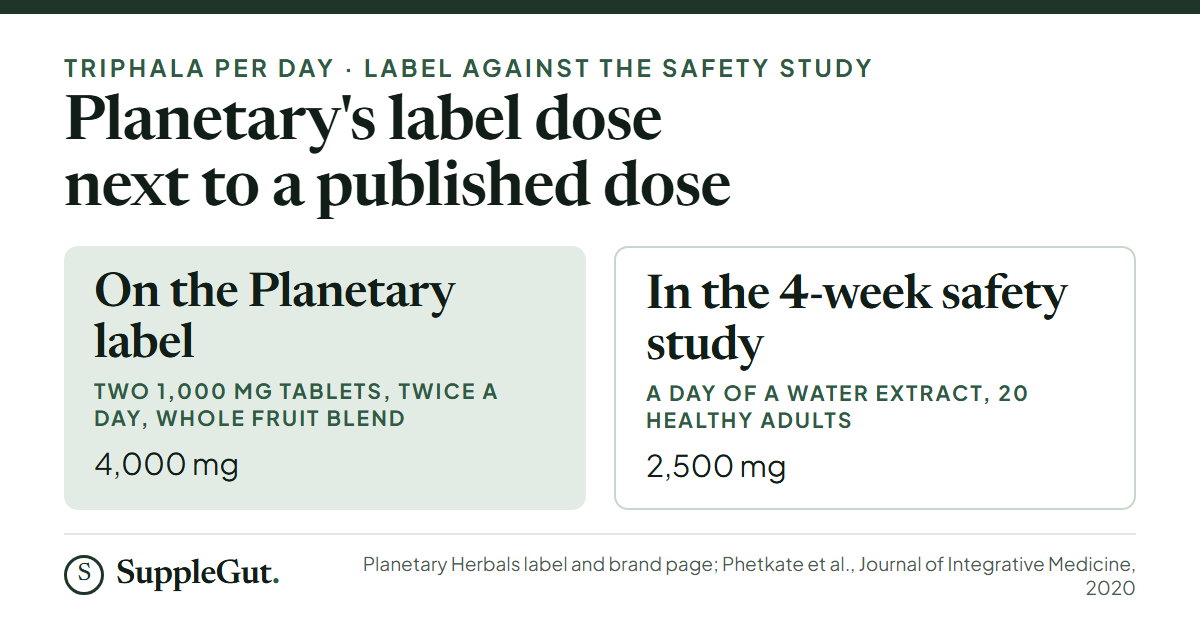
We found no study of Planetary’s tablet in PubMed or ClinicalTrials.gov. Four grams a day of whole fruit is double the 2,000 mg used in a four-week, placebo-controlled pilot of 31 healthy adults, which found no bacterial group that changed in everyone, with only a trend toward more Akkermansia muciniphila (Peterson et al., 2020). It is also 1.6 times the 2,500 mg a day of triphala water extract given for four weeks to 20 healthy adults, who had no serious adverse effects (Phetkate et al., 2020). One is a whole fruit blend and the other an extract, so the match is rough.
For a bowel outcome the only study we found was an open-label, 14-day trial in 34 adults with functional constipation, in which weekly bowel movements rose from 10.19 to 18.29 (Munshi et al., 2011). Its formula also contained psyllium husk and senna extract. A review of triphala in functional gut disorders judged it promising for IBS symptoms and called for trials (Tarasiuk et al., 2018). See Does triphala work? for the wider evidence.
Where it is made and what is tested
Country of manufacture is not printed on the label photo or stated by the brand, Vitacost or Amazon; the brand says its ingredient sources are located all over the world and are proprietary. Its FAQ says ingredients are sampled and inspected for purity and potency. The Amazon text says the product is made under FDA-established good manufacturing practices, with no auditor named. Nothing we read mentions lead, mercury, arsenic or cadmium, and no certificate is posted. The Amazon listing shows the manufacturer as Threshold Enterprises.
The published survey that makes metals a standing question for Ayurvedic products found detectable lead, mercury or arsenic in 20.7% (95% CI 15.2 to 27.1) of 193 products bought online, 21.7% of the US-made and 19.5% of the Indian-made, and 75% of the metal-containing ones claimed good manufacturing practice (Saper et al., JAMA, 2008). It named no products, and this panel lists no mineral ingredient. The safety guide covers the checks a buyer can make.
Safety and the label warning
The only warning asks anyone who is pregnant, may become pregnant or is breastfeeding to consult a health care professional, and notes the tamper-evident seal, storing in a cool, dry place and keeping the bottle from children. It carries no line on medications or medical conditions. Reviewers report nausea, stomach upset and, in one Amazon account, diarrhea for 24 hours; 14 of 23 Amazon side-effect mentions are negative.
In the United States the tablet is a dietary supplement under the 1994 law called DSHEA and is not approved by the FDA before sale. No state licenses Ayurvedic practitioners, whereas India recognizes Ayurveda officially, with a degree and a ministry for it.
Tablet size, effect and gentleness in the reviews
Amazon shows 4.5 from 2,416 ratings, 77% of them five-star and 4% one-star, on an offer from a third-party seller. Among reviewers who mention effectiveness, 100 of 127 are positive; digestive effects are 49 of 64 positive, quality 96 of 111 and value for money 32 of 41. Vitacost’s feed reads 4.62 from 381 reviews, with 270 tagged as originally posted on iHerb.
Praise runs to regular, easy bowel movements (63 of the 381 Vitacost reviews mention regularity), a gentle feel without cramps (45 use words such as gentle, mild or smooth) and a tablet some prefer to powder for taste. The loudest complaint is size: 21 of 22 Amazon pill-size mentions are negative, and one reviewer wrote “Don’t choke!!” Others report no effect (27 of 127), including one reviewer who identifies as Vata dosha, or nausea. We found no mention of billing or refunds.
The price per serving and per day
| Source | Size and price | Per serving of 2 tablets | Per day, 4 tablets |
|---|---|---|---|
| Vitacost or Amazon | 180 tablets, $16.45 | $0.18 | $0.37 |
| Brand suggested retail | 90 tablets, $12.75 | $0.28 | $0.57 |
| Brand suggested retail | 180 tablets, $23.50 | $0.26 | $0.52 |
| Brand suggested retail | 270 tablets, $33.98 | $0.25 | $0.50 |
There is no brand store and no subscription from the brand. Amazon lists the item as not returnable because it is ingestible, with damaged or defective items refundable, and the brand’s FAQ says quality concerns go back to the store of purchase under a 100% satisfaction guarantee.
Who the 2 g twice-daily tablet suits
- A reader who wants whole-fruit tablets without an extract and is content with a total blend weight.
- A reader who would rather swallow tablets than mix a powder, and who is willing to take four a day.
- A reader shopping at a supermarket or store chain where Planetary’s bottles are stocked.
For one or two tablets a day see Banyan’s 1,000 mg blend; for a single caplet a day see Himalaya’s. This product’s own listing is Planetary Herbals Triphala 1,000 mg Tablets.
The entries this page refers to
Common questions
Does Planetary Herbals Triphala work?
No trial of this tablet turned up. Among Amazon reviewers who mention effectiveness, 100 of 127 are positive and 27 are negative, and reviewers on Vitacost describe it as gentle and regular. The brand’s page cites emerging science and names no study.
How many tablets a day does the label say?
The label says two tablets twice daily, which is four tablets and 4 g of blend a day. The panel’s serving is two tablets and the 180 count bottle holds 90 servings. No instruction on food was printed on the tablet label we read.
Why are the tablets described as large?
Each tablet is 1,000 mg, and 21 of the 22 Amazon reviewers who mention pill size call them big. On swallowability, 18 of 22 mentions are negative, and a Vitacost reviewer wrote that they are sometimes hard to swallow.
Where is Planetary Herbals Triphala made, and is it tested for metals?
We found no country of manufacture on the label photo or in the brand, Vitacost or Amazon pages, and the brand says its ingredient sources are located all over the world. It states that ingredients are sampled and inspected for purity and potency, with no mention of lead, mercury, arsenic or cadmium and no laboratory or certificate.
Who sells it, since the brand does not sell direct?
Planetary Herbals says it does not sell directly to consumers. Vitacost lists the 180 tablet bottle at $16.45, and the Amazon offer at the same price is from a third-party seller, Health Chest, shipping from Amazon. The brand’s FAQ sends quality returns to the store of purchase.
What does a day cost?
At $16.45 for 180 tablets, one serving of two tablets is about $0.18 and the label’s four tablets a day is about $0.37. At the brand’s suggested retail of $23.50 for 180 tablets, a day at the label dose is about $0.52.
Sources
- Peterson et al. Four-week double-blind placebo-controlled pilot of triphala and manjistha on the gut microbiome in healthy adults (NCT03477825). Journal of Alternative and Complementary Medicine, 2020. PMID 32955913. pubmed.ncbi.nlm.nih.gov/32955913
- Phetkate et al. Open-label phase I safety study of a triphala aqueous extract in 20 healthy adults (Thai registry TCTR20180423002). Journal of Integrative Medicine, 2020. PMID 31680053. pubmed.ncbi.nlm.nih.gov/31680053
- Munshi et al. Open-label study of an isabgol, senna and triphala formula in functional constipation. Journal of Ayurveda and Integrative Medicine, 2011. PMID 22022157. pubmed.ncbi.nlm.nih.gov/22022157
- Tarasiuk et al. Review of triphala in functional gastrointestinal disorders. Chinese Medicine, 2018. PMID 30034512. pubmed.ncbi.nlm.nih.gov/30034512
- Saper RB, Phillips RS, Sehgal A, et al. “Lead, mercury, and arsenic in US- and Indian-manufactured Ayurvedic medicines sold via the Internet.” JAMA, 2008;300(8):915–923. PMID 18728265. pubmed.ncbi.nlm.nih.gov/18728265
- FDA. Dietary supplements and the Dietary Supplement Health and Education Act of 1994. fda.gov/food/dietary-supplements; Ministry of Ayush, Government of India. ayush.gov.in
- Planetary Herbals: Triphala brand page (Supplement Facts, directions, claims, suggested retail) and FAQ. planetaryherbals.com; FAQ
- Vitacost: Planetary Herbals Triphala 180 tablets (label text, price, Judge.me reviews). vitacost.com
- Amazon: Planetary Herbals Triphala 1000 mg 180 tablets listing, ratings and review summary. amazon.com/dp/B00O18U1P6
Which product is right for you?
This page explains how the products work. The quiz does the matching: it takes your symptoms, routine and preferences and names one product.
Take the quiz →