
Guide
Does Promix Debloat work? The three Bacillus species, the trial the brand describes and what the reviews say
Quick answer
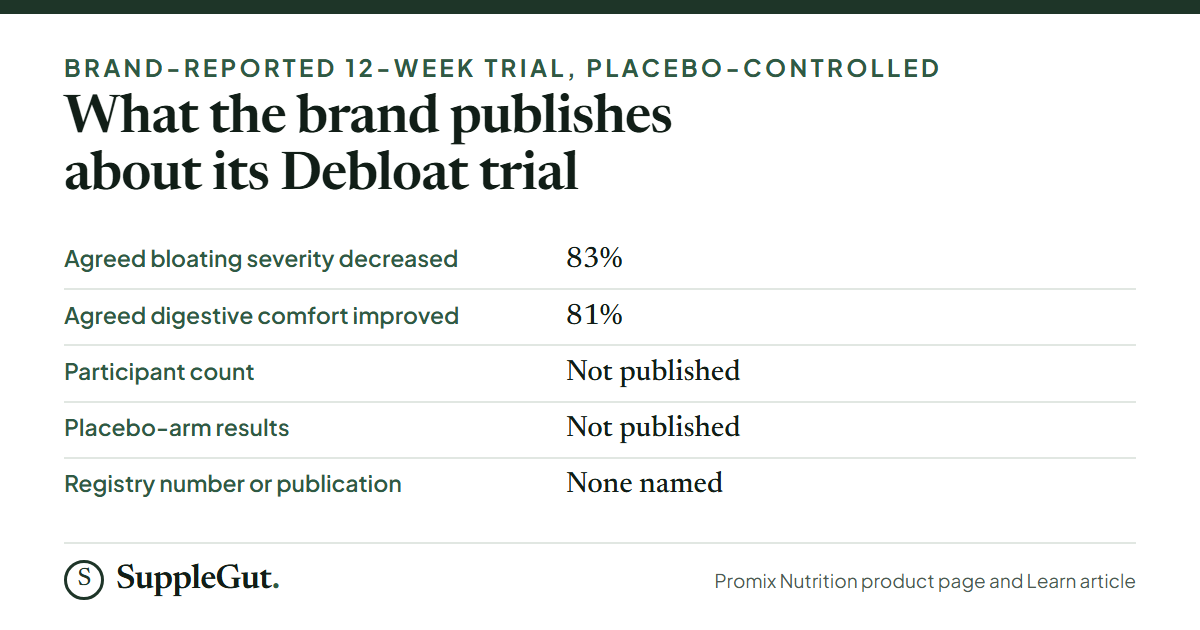
Does Promix Debloat work? We could find no published trial of Promix Debloat. The brand says it ran a 12-week, triple-blind, placebo-controlled trial in which 83% of participants agreed their bloating had decreased and 81% agreed their digestive comfort improved, but it publishes no participant count, sponsor, registry number or placebo-arm figures, so the percentages cannot be compared with placebo. The label names three Bacillus species with no strain codes and one combined 5 billion CFU, and the American Gastroenterological Association’s 2023 practice update advises against using probiotics to treat bloating.
PROMIX Debloat is a once-a-day powder in single-serve sticks from Promix Nutrition of Gainesville, Florida: three Bacillus species, baobab fruit powder and vitamin C, stirred into water in the morning. What sets it apart from the capsules on the next shelf is the claim that the finished formula went through a placebo-controlled trial. This page sets out what the label prints, what that trial has disclosed, what the nearest published trials show, and what the reviews and refund terms say.
What Debloat is, and what it is not
The Supplement Facts panel is short. Each stick carries 5 billion CFU of Bacillus coagulans, Bacillus subtilis and Bacillus clausii, as one combined figure “at the time of manufacture”, so the count at the end of shelf life is not stated. It also carries 2,000 to 2,600 mg of wild organic African baobab (2,600 mg in Florida Orange, 2,500 in Fresh Watermelon, 2,000 in Unflavored), which the panel counts as 1 g of dietary fiber, and vitamin C at 100% of the Daily Value with the amount not printed. The flavored sticks are sweetened with monk fruit; there are no enzymes.
No strain designation is printed for any of the three species, and there is no count per species, so the share of the 5 billion that is B. coagulans is not known. The brand says so itself: its article states that strain designations are not published on the product page, only the species, and that readers can ask the company for them. All three organisms are spore-formers, which is why the sticks are shelf stable, and the brand calls baobab the prebiotic.
The trial the brand describes
The brand says Debloat “was studied as the finished formula, in a triple-blind, placebo-controlled, IRB-approved trial” lasting 12 weeks, with results at week 8 and week 12. It publishes participant agreement statements: 83% agreed the severity of their bloating had decreased, 81% agreed the product improved their digestive comfort, and 81% said they had experienced less bloating.
Not given: the number of participants, the sponsor or investigator, a registry number, a protocol, a publication, or the same percentages for the placebo group. The brand calls its figures “a participant agreement statement rather than a measured clinical endpoint”, so 81 to 83% cannot be compared with anything. We searched PubMed and the web for a Debloat trial and a ClinicalTrials.gov record and found none. The brand’s article captions its Fresh Watermelon image as the formula covered by the study, so which flavor was tested is also unclear.
Placebo response is why the missing arm matters. In the GBI-30 trial below, the authors wrote that a strong placebo effect was evident.
The evidence for the ingredients
The nearest trials are of single, named B. coagulans strains in other products:
- MTCC 5856: 70 adults with functional gas and bloating took 2 billion spores a day or placebo for four weeks; 66 completed. The GSRS indigestion score fell from 8.91 to 3.06 on the probiotic against 9.42 to 8.43 on placebo (P<0.001 for the difference). The authors are from the strain’s maker (Majeed et al., 2023).
- GBI-30, 6086: 61 adults with gas after meals, four weeks, in a Digestive Advantage product. The probiotic beat placebo on GSRS abdominal pain (P=0.046) and total score (P=0.048); distension was a trend (P=0.061) (Kalman et al., 2009).
Debloat prints no strain code, so these results are not shown to apply to it, and its 5 billion CFU is shared across three species against 2 billion spores of one strain in the MTCC 5856 trial. For B. subtilis and B. clausii in adults with bloating we found no randomized trial (our search was not exhaustive).
For baobab we found no completed human trial on gut bacteria or bowel outcomes. An industry-funded laboratory study found the powder raised short-chain fatty acids with human fecal bacteria (Foltz et al., 2021), and a 45-day trial in 50 adults with obesity has a published protocol only (Riedel et al., 2025). At 1 g of fiber a stick, the label dose is small.
What guidelines say about probiotics and bloating
The American Gastroenterological Association’s 2023 practice update on belching, bloating and distention advises against using probiotics to treat abdominal bloating and distention; it is an expert review, not a graded guideline (Moshiree et al., 2023). An umbrella review of 27 systematic reviews of probiotics in IBS found small or inconsistent effects on bloating, with mostly low or very low certainty (Ballena-Caicedo et al., 2026). The brand quotes the AGA statement and says to judge the specific formula: is the strain named, is the dose stated per serving, was the finished formula tested?
How to take Debloat
The flavored panels say to mix one packet into 12 to 20 oz of water and drink it in the morning on an empty stomach. The Unflavored panel says to mix one packet with 12 to 16 oz of water and that it may be combined with food. The brand’s trial read out at 8 and 12 weeks; both named-strain trials above lasted four weeks, and reviewers who report a change usually put it at a week or two. A month at the label dose covers those timelines.
Side effects and who should not take it
The panels carry only the FDA disclaimer. We found no pregnancy, breastfeeding, medication or age warning on the panels or the product page, and the panel lists no allergens. The brand’s article tells people with persistent or worsening bloating, weight loss, bleeding, vomiting, swallowing difficulty, fever or a change in bowel habit to see a clinician. Reviewers report a salty or unpleasant aftertaste in some flavors; one Trustpilot reviewer wrote that bloating got worse, and one brand-site reviewer wrote that it almost sent them to hospital, with no detail.
What the reviews say
The brand’s own site shows 4.93 from 1,762 reviews in a widget it hosts, pooled across flavors and sizes: 1,655 five-star, 102 four-star, none at three stars, 1 at two and 4 at one. Amazon shows 4.6 from 328 ratings (81% five-star, 9% four, 6% three, 1% two, 3% one), with the review text behind a sign-in. TikTok Shop shows 4.7 from 814 reviews. Trustpilot shows 1.7 from 50 reviews for the whole brand, not Debloat alone: 10% five-star and 76% one-star, on a profile the company has not claimed.
Recurring praise: a light flavor, less bloating within days to a couple of weeks, and the convenient sticks. Recurring complaints: no change in bloating, an aftertaste in some flavors, and, on Trustpilot, subscription and refund handling.
The subscription and refund terms
The brand’s published refund policy gives a 90-day guarantee on one-time orders, with a full refund to the original payment method. It covers one container per order, original shipping is not refunded, return shipping is the buyer’s, and opened product can be returned. A first subscription order gets an exchange or store credit within 30 days, with contact within 14 days of delivery. Later subscription orders are “not eligible for a cash refund”, orders placed with a discount code get store credit rather than cash, and Amazon purchases are excluded. Subscriptions renew automatically with a notice three days before each charge; a cancellation has to be made in the account before 8:00 AM Eastern on the charge date.
Trustpilot reviewers describe these terms as the main complaint. They write that subscribers and discount-code buyers were refused cash refunds, that renewal warnings arrive only by email, and that one cancellation request was not honored; one says the subscription is selected automatically on product pages, which we could not confirm from the page text. The brand-site reviews we read in the one- and two-star set contain no billing complaints. A single box bought once, on the brand site or Amazon, avoids the subscription terms.
Who Debloat is for
- Someone who wants a once-a-day powder in a stick rather than capsules or gummies.
- Someone who has read the label and is comfortable buying on species-level information, without strain codes or per-species counts.
If a named strain is the priority, Thorne Bacillus Coagulans is a single-species spore product whose listing does not name the strain either. A two-strain Bacillus gummy with a prebiotic is covered in the Lemme Debloat guide, and the bloating guide starts from the cause instead of the product.
Cost
On the brand site, 30 single sticks or a 30-serving jar is $58.00 one time ($1.93 a serving), or $46.40 on subscribe and save at 20% off ($1.55) with free shipping. The cart shows free shipping from $90, so a one-time order under that appears to pay shipping; we did not find the amount. A 12-stick variety pack is $29.00. On Amazon the 30-count is $58.99 ($1.97) or $53.09 on Subscribe & Save ($1.77).
The products in this catalog
Common questions
Does Promix Debloat work for bloating?
The brand says a 12-week placebo-controlled trial of the finished formula found 83% of participants agreed their bloating severity had decreased and 81% agreed their digestive comfort improved. It publishes no participant count, registry number or placebo-arm figures, and calls the results agreement statements rather than measured endpoints. The label names species with no strain codes, so the published trials of named strains such as MTCC 5856 cannot be matched to it.
What is in Promix Debloat, and what are the side effects?
Each stick has 5 billion CFU of Bacillus coagulans, Bacillus subtilis and Bacillus clausii as one figure, 2,000 to 2,600 mg of baobab fruit powder (1 g of fiber) and vitamin C at 100% of the Daily Value, with monk fruit in the flavored versions. The panels carry only the FDA disclaimer and list no allergens. Reviewers mention an aftertaste in some flavors and, in a few cases, no change or worse bloating.
How much does Promix Debloat cost?
On the brand site 30 sticks or a 30-serving jar is $58.00 one time ($1.93 a serving) and $46.40 on a subscription with 20% off ($1.55 a serving). A 12-stick variety pack is $29.00. Amazon lists $58.99 one time and $53.09 on Subscribe & Save.
What is the Promix refund policy, and how do I cancel a subscription?
The published policy gives a 90-day guarantee on one-time orders, limited to one container per order, with return shipping paid by the buyer. A first subscription order gets an exchange or store credit within 30 days, later renewals are not eligible for a cash refund, and a cancellation has to be made before 8:00 AM Eastern on the charge date. Trustpilot reviewers (1.7 from 50, an unclaimed profile) report being refused refunds on subscription and discount-code orders; Amazon purchases follow Amazon’s rules.
Promix Debloat vs a probiotic with a named strain: what is the difference?
Debloat lists three species and one combined 5 billion CFU, with 1 g of fiber from baobab. A product that prints a strain code can be matched to published trials, though those trials ran four weeks in about 60 to 70 adults, and the MTCC 5856 trial’s authors work for the strain’s maker. For the Seed comparison see the DS-01 guide.
Why do the brand site, Amazon and Trustpilot rate Debloat so differently?
They measure different things. The brand-site widget (4.93 from 1,762) is hosted by the company and has no three-star reviews, Amazon shows 4.6 from 328 ratings for the product, and the Trustpilot score (1.7 from 50) covers the whole brand and is driven by billing and refund comments. Comments about the powder itself are similar across them: easy to drink, with some reporting less bloating and some reporting no change.
Sources
- Majeed M, Nagabhushanam K, Paulose S, et al. “The effects of Bacillus coagulans MTCC 5856 on functional gas and bloating in adults: A randomized, double-blind, placebo-controlled study.” Medicine (Baltimore), 2023;102(9):e33109. doi.org/10.1097/MD.0000000000033109
- Kalman DS, Schwartz HI, Alvarez P, et al. “A prospective, randomized, double-blind, placebo-controlled parallel-group dual site trial to evaluate the effects of a Bacillus coagulans-based product on functional intestinal gas symptoms.” BMC Gastroenterology, 2009;9:85. doi.org/10.1186/1471-230X-9-85
- Moshiree B, Drossman D, Shaukat A. “AGA Clinical Practice Update on Evaluation and Management of Belching, Abdominal Bloating, and Distention: Expert Review.” Gastroenterology, 2023;165(3):791–800.e3. doi.org/10.1053/j.gastro.2023.04.039
- Ballena-Caicedo J, Zuzunaga-Montoya FE, Acosta-Porzoliz R, et al. “Probiotics in Irritable Bowel Syndrome: An Umbrella Review of 27 Systematic Reviews on Methodological Quality and Certainty of Evidence.” Journal of Clinical Medicine, 2026;15(5). doi.org/10.3390/jcm15051727
- Foltz M, Zahradnik AC, Van den Abbeele P. “A Pectin-Rich, Baobab Fruit Pulp Powder Exerts Prebiotic Potential on the Human Gut Microbiome In Vitro.” Microorganisms, 2021;9(9):1981. doi.org/10.3390/microorganisms9091981
- Riedel S, de Buys K, Tshivhase AM, et al. “Effects of Baobab fruit powder on gut and cardiometabolic health in obesity: Protocol for a randomised placebo-controlled trial.” PLoS One, 2025;20(8):e0328774. doi.org/10.1371/journal.pone.0328774
- Brand pages: label, directions, price, trial summary, refund policy and subscription terms (product page, Learn article, refund policy, subscription page)
- Amazon listing: price and ratings (amazon.com/dp/B0CF2RNJ7L); TikTok Shop listing: ratings; Trustpilot, promixnutrition.com: brand-wide reviews (trustpilot.com)
Not sure which product fits your situation?
This guide covers the mechanics. The quiz takes your specific symptoms, routine and preferences and matches you to one product from the catalog.
Take the quiz →