Guide
Does Pukka Three Ginger tea work? Ginger at about 0.9 g a bag, licorice in the blend, and no trial of the tea
Quick answer
Does Pukka Three Ginger tea work? No trial of this tea was found. Ginger has trials for nausea, but they used capsules or powder, and one bag holds roughly 0.9 g of ginger if the UK listings' 52% applies, against 1.2 g in capsules in a small dyspepsia trial. The blend also contains licorice root, and trials of chronic glycyrrhizic acid intake found systolic blood pressure about 5.45 mm Hg higher. A cup costs $0.38 at Vitacost, and Amazon shows 4.6 from 712 ratings on the 4-pack.
Pukka Three Ginger is a caffeine-free tea bag of ginger, galangal, licorice and turmeric roots, sold as a 20-sachet box and an 80-bag Amazon 4-pack. Its US listings name the four roots in order and print no weights, while UK retailer pages print percentages. This page sets those percentages beside the doses the ginger trials used, looks at the licorice in the blend, and prices a cup.
What the US listings print, and what UK listings add
Vitacost and Amazon list ginger root, galangal root, licorice root and turmeric root, all organic, in that order. Neither page prints a percentage, a weight per bag or a botanical name. The box holds 36 g across 20 sachets, so a bag averages about 1.8 g by our arithmetic. UK retailers print shares for the UK recipe, and applying them to that bag weight gives this:
| Root | Share on UK listings | Approximate amount in a 1.8 g bag |
|---|---|---|
| Ginger | 52% | 0.94 g |
| Galangal | 28% | 0.50 g |
| Licorice | Not printed; 16% remains | 0.29 g |
| Turmeric | 4% | 0.07 g |
The 16% for licorice comes from two sources. Vitacost prints “16% FairWild certified ingredients (licorice) by dried weight,” and 52, 28 and 4 add to 84, which leaves the same 16. The shares come from UK pages and the bag weight from the US box, and we could not read the US box back, so the table is an estimate. The UK listings also disagree with one another: one prints ginger at 51% with a 1% ginger essential oil flavor, and another prints 62% ginger, 21% galangal and 4% turmeric. The US pages print neither an essential oil nor a percentage.
Ginger in capsules, ginger in a bag
Ginger is the herb with a research record, and nearly all of it used capsules or powder. A meta-analysis of 12 randomized trials in 1,278 pregnant women found ginger improved nausea against placebo (mean difference 1.20, 95% CI 0.56 to 1.84), did not significantly reduce vomiting episodes (p = 0.06), and favored daily doses under 1,500 mg for nausea (Viljoen et al., Nutrition Journal, 2014). In 103 adults having chemotherapy, 84 mg a day of gingerols and shogaols in four capsules for 5 days over 3 cycles improved nausea-related quality of life against placebo (p = 0.003; Journal of the Academy of Nutrition and Dietetics, 2024). A systematic review of 23 chemotherapy trials found no significant overall difference in acute or delayed nausea and vomiting, though people taking no more than 1 g a day for over four days had less acute vomiting (odds ratio 0.30, 95% CI 0.12 to 0.79; Nutrients, 2022).
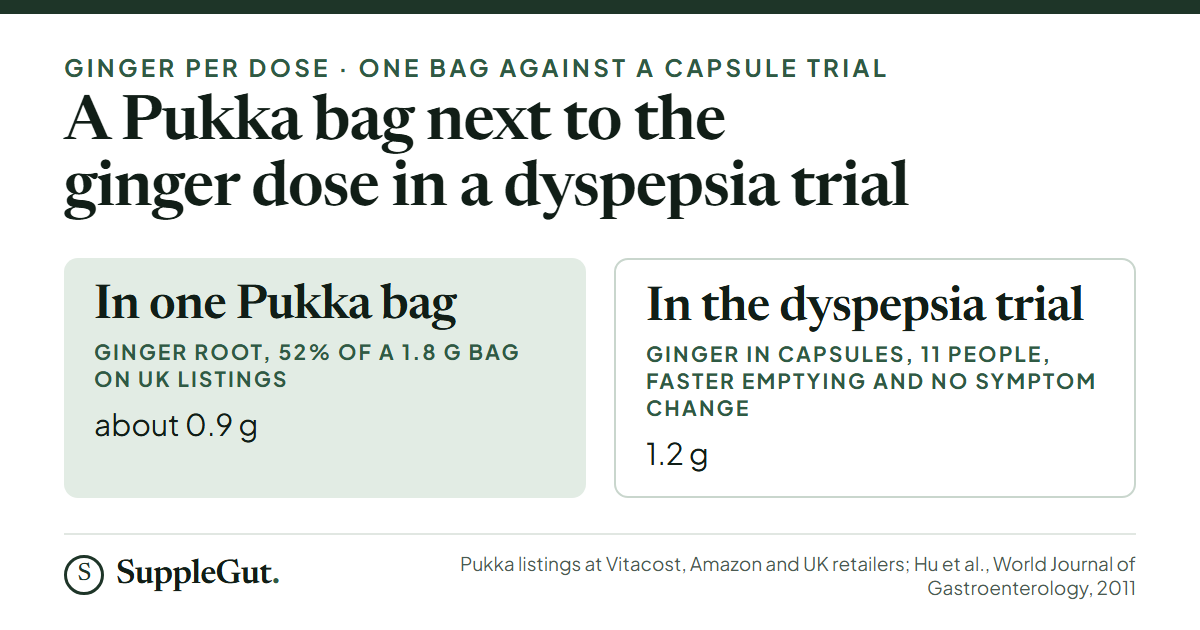
An overview of 15 meta-analyses rated the methodological quality of this literature as low to critically low, while finding support for ginger in chemotherapy nausea and postoperative nausea severity and promise for pregnancy nausea (International Journal of Food Sciences and Nutrition, 2024). For digestion the closest study is small: 11 people with functional dyspepsia took 1.2 g of ginger in capsules, and their stomachs half-emptied in 12.3 minutes against 16.1 on placebo, with no difference in symptoms (Hu et al., World Journal of Gastroenterology, 2011).
By the UK-percentage arithmetic a bag holds roughly 0.94 g of ginger, which is near the 1 g to 1.2 g in those capsule studies. The trials gave ginger in capsules or powder, and we found none that measured what steeping puts into a cup. The tea prints no gingerol amount to set beside the 84 mg in the chemotherapy trial. A registered trial of ginger tea (2 g of fresh ginger in 150 mL, twice) against fennel tea, chewing gum and no intervention after cesarean section planned 96 women, and it has posted no results (NCT07125742). The Traditional Medicinals ginger tea prints 1,500 mg of ginger rhizome a bag, and our ginger tea guide sets those doses beside a tea bag in more detail.
Galangal and turmeric: little to compare
We found no human gut trial of galangal root in PubMed, and Pukka does not print which galangal species it uses. Turmeric at 4% is about 70 mg of root in a bag, a small fraction of the amounts used in curcumin capsule trials, such as the 121-person IBS trial that paired curcumin with fennel oil (PubMed 27308645). That trial tested a different product.
Licorice and blood pressure
Licorice root is third in the ingredient order and, by the figures above, about 16% of the bag, or roughly 0.29 g. Its glycyrrhizin is the compound behind the safety literature. A meta-analysis of chronic glycyrrhizic acid intake of at least 100 mg a day found systolic blood pressure higher by 5.45 mm Hg on average (PubMed 28660884). No page we read states how much glycyrrhizin a bag yields, so that 100 mg threshold cannot be set against a cup.
UK retailer pages carry a licorice notice saying that the root can raise blood pressure when taken excessively and that people with hypertension should limit the tea to one cup a day. One UK listing adds a potassium-depletion note and a six-week limit. The US pages we read carry no licorice warning: Amazon’s safety line says only that the herbs may cause allergic reactions in some people. The US box back, which may carry its own warnings, was not read.
Licorice also has a trial on the benefit side. A branded licorice extract at 75 mg twice a day for 30 days lowered functional dyspepsia symptom scores against placebo at days 15 and 30 (PubMed 21747893). That was an extract, not root in a bag.
A Pukka blend with Ayurvedic framing
Three Ginger is not a classical formula with a Sanskrit name. Pukka’s own explanation, in Amazon copy, is that “Pukka means genuine in Hindi.” Pukka’s UK product record tags the tea with a Vata filter and a Digestion family, next to a dosha quiz on the same site. Ayurveda, the traditional medicine of India (our section on it), describes vata as the principle of movement, and the tag is the brand’s way of placing the tea in that vocabulary. The US listings use no dosha word and say “traditional herbal wisdom.” We found no trial that measured a dosha.
Pukka’s own wording is modest: “warm yourself anytime with this soothing delicious brew” on Vitacost, and “pre-meal stimulation and post-meal comfort” on the UK page. The stronger wording, “supports gut health and wellness” and “aids digestion naturally after meals,” sits in Amazon bullets written by the listing seller. Amazon’s manufacturer field reads Lipton Tea & Infusions Company, and trade press reports that Unilever bought Pukka in 2017.
Steeping and serving
One sachet makes a serving. Vitacost’s directions say to boil only what you need and infuse for 5 to 15 minutes, and Amazon’s bullet says 3 to 5 minutes in freshly boiled water, any time of day. The listings give no number of cups a day and no timing around meals. The tea is caffeine free, and reviewers mention drinking it in the evening, some with warm milk and honey.
Price per cup
| Where | Price | Bags | Per cup |
|---|---|---|---|
| Vitacost, one box | $7.54 | 20 | $0.38 |
| Amazon 4-pack, one time | $23.56 | 80 | $0.29 |
| Amazon Subscribe & Save, 5% | $22.38 | 80 | $0.28 |
| Amazon Subscribe & Save, 15% | $20.03 | 80 | $0.25 |
Amazon applies the 15% rate when five or more products are in one auto-delivery. We found no US brand shop and so no brand subscription or refund terms. Amazon shows more than 400 bought in the past month on the 4-pack.
Ratings and review text
Amazon shows 4.6 out of 5 from 712 ratings on the 4-pack: 80% five-star, 11% four, 4% three, 1% two and 4% one. Its summary counts 55 taste mentions (44 positive, 11 negative), 51 on flavor (38 and 13), 15 on soothing (14 and 1) and 10 on value for money (5 and 5). Vitacost’s Judge.me widget shows 4.53 from 170 reviews (116 five-star, 35 four, 14 three, 3 two, 2 one), and all 170 are imported from iHerb, so they are independent of the brand without being native to Vitacost. Pukka’s brand-wide Trustpilot profile for its UK business sits at 1.5 from 99 reviews, unclaimed, with weak flavor, split bags and price as the themes; it covers the whole brand and not this tea.
- Praise: a warming ginger flavor with a kick, a caffeine-free cup for the evening, and a soothing effect on the stomach.
- Complaints: a flavor weak enough that some reviewers use two bags, a taste too spicy for others (one reviewer reports throat and gum irritation), and split or leaky bags. Value mentions on Amazon split five positive and five negative.
Testing and safety
The listings state organic certification (USDA, Soil Association), FairWild licorice, Fair for Life, B Corp and kosher status. They state no testing for heavy metals, pesticides or potency. Pukka does not sell metal-containing preparations, and the 2008 JAMA survey that found detectable lead, mercury or arsenic in 20.7% of 193 internet-bought Ayurvedic medicines concerned a different category of product (Saper et al., 2008); our guide on Ayurvedic supplement safety covers what a buyer can check. The listings have no “contains” or facility statement for milk, wheat, egg, soy, tree nuts, fish or sesame. The one documented adverse-effect literature in this blend is the licorice one above.
Who Three Ginger suits
- Someone who wants a spicy, caffeine-free ginger cup for after a meal or the evening, and enjoys a galangal and turmeric note.
- Someone comfortable with licorice in the blend, who has read the blood-pressure figure above.
- Someone buying by the cup, with $0.25 to $0.38 a cup across the routes read.
A reader who wants a single herb with a printed weight can compare the Traditional Medicinals ginger tea or the fennel tea, and our fennel tea guide covers the trials of that seed.
Products researched for this topic
Common questions
Is there evidence that Pukka Three Ginger helps nausea or digestion?
No trial of this tea turned up in PubMed or ClinicalTrials.gov. The ginger trials we found used capsules or powder, mostly for nausea in pregnancy and chemotherapy, and an overview of 15 meta-analyses rated the quality of that evidence low to critically low. Amazon’s review summary says customers find the tea effective for stomach issues.
How much ginger is in one Pukka Three Ginger bag?
The US listings print no weight or percentage. UK retailer pages give ginger as 52% of the blend, and a 36 g box of 20 sachets averages about 1.8 g a bag, which puts ginger near 0.94 g. That figure applies a UK percentage to the US box weight, so it is an estimate.
Does the licorice in Three Ginger raise blood pressure?
A meta-analysis of chronic glycyrrhizic acid intake of at least 100 mg a day found systolic blood pressure higher by 5.45 mm Hg on average. The tea does not state its glycyrrhizin amount, and UK retailer pages suggest people with high blood pressure limit it to one cup a day. The US pages we read carry no licorice warning.
What does a cup of Pukka Three Ginger cost?
A 20-bag box is $7.54 at Vitacost, about $0.38 a cup. The Amazon 4-pack of 80 bags is $23.56, about $0.29 a cup, and Subscribe & Save brings it to about $0.28 or $0.25 depending on how many items are in the delivery.
How long should the tea steep?
Vitacost’s directions say to use freshly boiled water and infuse for 5 to 15 minutes, while Amazon’s bullet says 3 to 5 minutes. The listings give no number of cups a day and no timing around meals. The tea is caffeine free.
Is Three Ginger an Ayurvedic formula?
It is a blend Pukka designed, not a classical formula with a Sanskrit name. Pukka’s UK site files it under a Vata filter and a dosha quiz, while the US listings use no dosha word. The tradition’s categories describe the blend and were not measured in any trial.
Sources
- Viljoen E, Visser J, Koen N, Musekiwa A. “A systematic review and meta-analysis of the effect and safety of ginger in the treatment of pregnancy-associated nausea and vomiting.” Nutrition Journal, 2014;13:20. PubMed 24642205
- Randomized, double-blind, placebo-controlled trial of ginger capsules for chemotherapy-related nausea (103 adults). Journal of the Academy of Nutrition and Dietetics, 2024. PubMed 37699474
- Systematic review of 23 randomized trials of ginger for chemotherapy-induced nausea and vomiting. Nutrients, 2022. PubMed 36501010
- Overview of 15 meta-analyses of ginger for nausea and vomiting. International Journal of Food Sciences and Nutrition, 2024. PubMed 38072785
- Hu M-L, Rayner CK, Wu K-L, et al. “Effect of ginger on gastric motility and symptoms of functional dyspepsia.” World Journal of Gastroenterology, 2011;17(1):105–110. PubMed 21218090
- Meta-analysis of chronic glycyrrhizic acid intake and blood pressure. PubMed 28660884
- Randomized placebo-controlled trial of a licorice extract (GutGard) in functional dyspepsia. Evidence-Based Complementary and Alternative Medicine, 2012. PubMed 21747893
- Randomized trial of curcumin with fennel essential oil in irritable bowel syndrome (121 people). Journal of Gastrointestinal and Liver Diseases, 2016. PubMed 27308645
- Registered trial of ginger tea against fennel tea, chewing gum and no intervention after cesarean section. ClinicalTrials.gov NCT07125742
- Saper RB, Phillips RS, Sehgal A, et al. “Lead, mercury, and arsenic in US- and Indian-manufactured Ayurvedic medicines sold via the Internet.” JAMA, 2008;300(8):915–923. PubMed 18728265
- Pukka Three Ginger: Vitacost listing (ingredients, certifications, directions, price, reviews). vitacost.com
- Pukka Three Ginger 4-pack: Amazon listing (ingredients, safety information, price, ratings, review summary). amazon.com/dp/B0CCQFZC3N
- Pukka Herbs UK: Three Ginger product page and UK retailer listings (ingredient percentages, licorice notice). pukkaherbs.com
One answer for your symptoms
If this page raised more questions than it settled, the quiz asks the ones that matter for you and answers with one product.
Take the quiz →