
Guide
Does Rae Pre + Probiotic work? Fourteen species, no strains and what the evidence covers
Quick answer
Does Rae Pre + Probiotic work? We could find no trial of this capsule or of its SL14 blend. The 2023 meta-analysis of 82 probiotic trials in IBS rated the evidence for combination probiotics on bloating very low certainty, and the mixtures that did well were specific named products. The label names 14 species with no strain designations and prints no CFU total; the printed figures work out to about 4 billion. About 85% of the brand-hosted reviews are five stars, most of them dating from before the brand paused in 2023.
Rae Pre + Probiotic is a white capsule taken in the morning, two a day, that combines a 14-species probiotic blend with apple cider vinegar powder, sold to support digestion and minimize bloating. What sets it apart from the probiotic on the next shelf is the “pre” in the name, which on this label is the vinegar powder rather than a fiber. This page sets out what the label prints and leaves out, what the probiotic trials cover, how the reviews split, and what it costs.
What Rae Pre + Probiotic is, and what it is not
The Supplement Facts panel has two lines for a two-capsule serving: 300 mg apple cider vinegar powder (5% acetic acid), which is about 15 mg of acetic acid by our arithmetic, and a 10 mg “SL14 14 Strain Probiotic Blend” at 400B CFU per gram. The 14 are Lactobacillus acidophilus, Bifidobacterium breve, L. fermentum, L. rhamnosus, L. gasseri, L. plantarum, B. lactis, L. casei, L. paracasei, L. salivarius, B. longum, B. bifidum, B. infantis and Streptococcus thermophilus. None carries a strain designation and none has its own count. Other ingredients are the hypromellose capsule, rice flour, magnesium stearate and silicon dioxide.
Two things are missing. The label prints no CFU total; 10 mg at 400 billion CFU per gram is about 4 billion CFU per serving, our calculation, and presumably the count when it was made rather than at expiry. And no prebiotic fiber is listed: no inulin, FOS or GOS. “SL14” is a trademark for the whole 14-species blend; another brand prints the same name and species, which suggests a shared supplier blend. We found no third-party testing statement.
The trial of the product itself
There is none. PubMed returned no results for “SL14 probiotic,” and ClinicalTrials.gov had no relevant study of Rae or SL14. Other brands’ pages describe SL14 with supplier “clinically proven” wording, a claim we could not verify. With no branded single strain, there is no strain-level trial to cite either.
The evidence for the ingredients
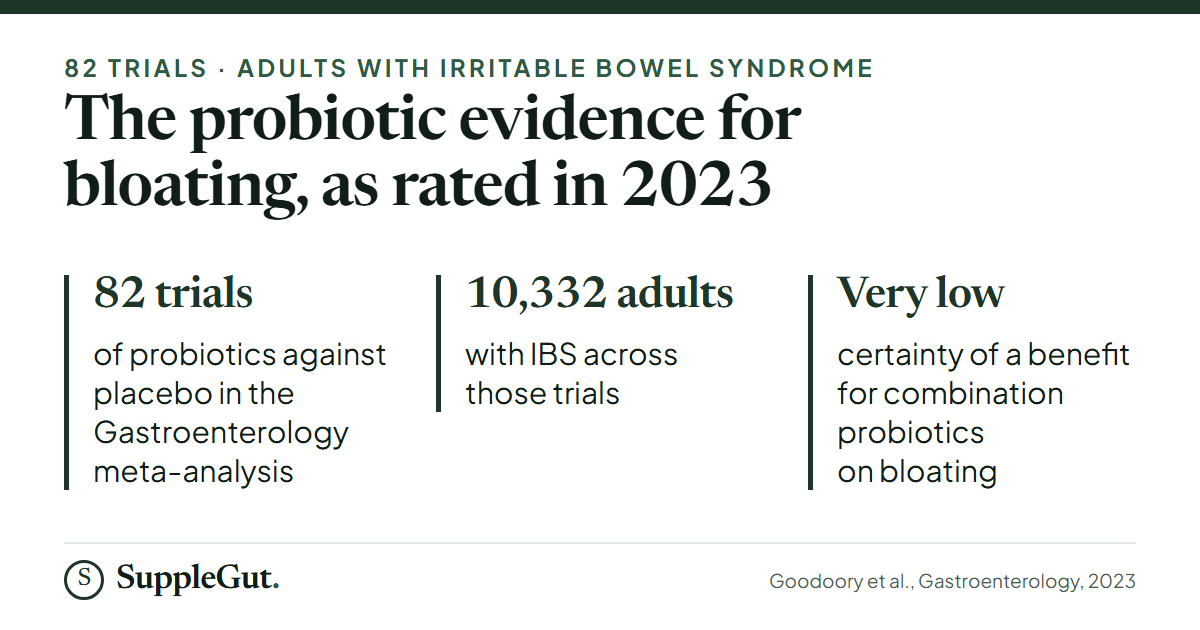
Multi-species probiotics. The 2023 meta-analysis pooled 82 randomized trials in 10,332 adults with IBS. For bloating or distension it found very low certainty of a benefit for combination probiotics, overall certainty was low to very low across almost all analyses, and adverse events were not significantly higher than on placebo (Goodoory et al., Gastroenterology, 2023). A network meta-analysis of 81 trials in 9,253 people found three strains and two mixtures effective for bloating, and the mixtures it names are specific products, not this blend (Xie et al., Nutrients, 2023). All of this is in people with IBS, using named strains or mixtures at their own doses; this label names species only. The U.S. National Center for Complementary and Integrative Health says it was not possible to draw definite conclusions for IBS and that the strains and doses that work are uncertain.
Apple cider vinegar powder. A prebiotic, by the international consensus definition, is a substrate selectively used by gut microbes that confers a documented health benefit (Gibson et al., Nature Reviews Gastroenterology & Hepatology, 2017). We found no human trial of apple cider vinegar powder as a prebiotic or for bloating. The one gut trial we found was 10 people with type 1 diabetes and gastroparesis taking 30 mL of liquid vinegar for two weeks, which slowed stomach emptying (median 27% against 17%), in a different population and form (Hlebowicz et al., BMC Gastroenterology, 2007).
How to take Rae Pre + Probiotic
The label says to take two capsules daily, ideally in the morning on an empty stomach, and recommends using it consistently for 30 days; a 60-capsule jar is a 30-day supply. Cleveland Clinic notes that probiotics can produce gas as a by-product and that early gas and bloating should resolve within a few days, which fits several reviewers who describe a rough first week. A month at the label dose is the brand’s own test period.
Side effects and who should not take it
We found no warning printed on the label image or the product page beyond the standard statement that the claims have not been evaluated by the FDA, and no pregnancy, breastfeeding, medication or age line. Cleveland Clinic notes a small risk of adverse effects for people with weakened immune systems. The label states the product is made in a facility that also processes milk, soy, wheat, egg, peanuts, tree nuts, fish and shellfish, and prints no “contains” statement. The brand describes its products as vegan, non-GMO and free from gluten. Among reviewers, about two of 532 describe clearly worse bloating and about seven mention gas; one blames the mint for acid reflux, and another reports heartburn.
What the reviews say
Retail ratings are hard to find. We could find no Rae listing at Target or Amazon. Rae paused operations in late 2023 and relaunched direct to consumer in December 2025, and the founder says the products have not changed. The brand site shows 4.7 from 479 reviews in its page widget (407 five-star, 43 four, 16 three, 6 two, 7 one); the same review feed holds 532 unique reviews after removing repeats, with 451 five-star and 10 one-star, and 988 of 996 entries marked verified buyer and none marked incentivized. Nearly all date from 2019 to 2023, with only seven from 2026, mainly “glad it’s back” comments. Trustpilot has five reviews at 2.5, none in the last year, on an unclaimed profile. Trade coverage of the relaunch reports the brand’s own figures of 4.5 million customers served before the pause and 82% five-star reviews.
Within the 532 unique reviews, 82 mention regularity, 74 mention bloating (mostly as improved) and 76 mention mint; 34 are one to three stars and most of those say they noticed no change. About 97 mention taste or smell, with the negatives being too much mint or a vinegar smell, and one dislikes that a serving is two capsules.
The subscription and refund terms
A subscription is $16.99 a jar, 15% off, and the 60-day and 90-day packs are listed at $39.98 and $59.97. The refund policy says all sales are final: no returns of opened or unopened supplements, seven days from delivery to report damaged, defective or wrong items, subscriptions to be canceled before the next billing date, and refunds up to 10 business days after approval. A single jar can be bought one time at $19.99. Of 532 reviews, 18 mention subscriptions, mostly positively; one complaint is that subscribers waited when the product sold out, and the Trustpilot reviews mention a pending order and unanswered emails.
Who Rae Pre + Probiotic is for
- Someone who wants a once-a-day probiotic capsule at a lower per-day cost and is comfortable with species named but no strains.
- Someone who can take two capsules in the morning on an empty stomach and keep going for a month.
- Someone buying direct from the brand, since the terms are all sales final.
If you want strains you can match to trials, see Culturelle Digestive Daily, which names its strain, or Seed DS-01; the probiotic guide and probiotic side effects guide cover choosing and tolerating them.
Cost
$19.99 for 60 capsules is $0.67 a day at the two-capsule serving, or $0.57 a day at $16.99 on subscription. Free shipping starts at $30.
The products in this catalog
Common questions
Does Rae Pre + Probiotic work?
About 85% of the brand-hosted reviews are five stars, and reviewers mostly mention more regular bowel movements and less bloating; a minority report no difference. We could find no trial of this formula or of the SL14 blend. The class evidence for multi-species probiotics and bloating is rated very low certainty.
Is Rae Pre + Probiotic safe, and what are the side effects?
Reviewers who had problems mention bloating, gas or heartburn, and one blames the mint for reflux. Probiotics can cause gas that Cleveland Clinic says should settle within a few days. The label prints no pregnancy or medication warning; Cleveland Clinic notes a small risk for people with weakened immune systems.
How much does Rae Pre + Probiotic cost?
$19.99 for a 30-day jar of 60 capsules, which is $0.67 a day at the label serving of two capsules, or $16.99 on a subscription. Sales are final under the brand’s policy, with seven days to report a damaged or wrong item. Free shipping starts at $30.
Rae Pre + Probiotic vs a probiotic with named strains?
Rae prints fourteen species with no strain designations or per-species counts, and about 4 billion CFU per serving by calculation. Products that name strains can be matched to the trials of those strains, as our probiotic guide explains. Rae also adds 300 mg of apple cider vinegar powder in place of a prebiotic fiber.
Where can I buy Rae Pre + Probiotic?
Rae paused operations in late 2023 and relaunched direct-to-consumer in December 2025, selling on its own site. We could find no Rae listing at Target or Amazon, and the founder has said a return to retail will be gradual.
How many CFU are in Rae Pre + Probiotic?
The label prints a 10 mg blend at 400 billion CFU per gram and no total. That works out to about 4 billion CFU per two-capsule serving, our calculation from the printed figures and presumably the count at manufacture rather than at expiry. Our CFU guide covers how much matters.
Sources
- Goodoory VC, Khasawneh M, Black CJ, et al. "Efficacy of Probiotics in Irritable Bowel Syndrome: Systematic Review and Meta-analysis." Gastroenterology, 2023;165(5):1206–1218. doi.org/10.1053/j.gastro.2023.07.018
- Xie P, Luo M, Deng X, et al. "Outcome-Specific Efficacy of Different Probiotic Strains and Mixtures in Irritable Bowel Syndrome: A Systematic Review and Network Meta-Analysis." Nutrients, 2023;15(17). doi.org/10.3390/nu15173856
- Gibson GR, Hutkins R, Sanders ME, et al. "Expert consensus document: The International Scientific Association for Probiotics and Prebiotics (ISAPP) consensus statement on the definition and scope of prebiotics." Nature Reviews Gastroenterology & Hepatology, 2017;14(8):491–502. doi.org/10.1038/nrgastro.2017.75
- Hlebowicz J, Darwiche G, Björgell O, et al. "Effect of apple cider vinegar on delayed gastric emptying in patients with type 1 diabetes mellitus: a pilot study." BMC Gastroenterology, 2007;7:46. doi.org/10.1186/1471-230X-7-46
- National Center for Complementary and Integrative Health. "Probiotics: Usefulness and Safety." nccih.nih.gov
- Cleveland Clinic. "Probiotics": gas as a by-product and risk with weakened immune systems. my.clevelandclinic.org
- Rae Wellness brand page: label, directions and price. raewellness.co/products/pre-probiotic
- Rae Wellness refund policy and founder’s letter on the pause and relaunch. raewellness.co/policies/refund-policy
- Nutraingredients. "Rae Wellness returns after operational overhaul": relaunch, formula unchanged, customer figures. nutraingredients.com
Not sure which product fits your situation?
This guide covers the mechanics. The quiz takes your specific symptoms, routine and preferences and matches you to one product from the catalog.
Take the quiz →