Guide
Does Silver Fern Cleanse work? 2 g of serum immunoglobulin, the 5 to 10 g trials and what “detox” rests on
Quick answer
Does Silver Fern Cleanse work? We found no trial of the capsule, and none of “toxin binding,” the brand’s lead claim. The nearest human data test serum-derived bovine immunoglobulin at 5 to 10 g a day in diarrhea-predominant IBS; four capsules of Cleanse supply 2 g (900 mg IgG). Amazon shows 4.5 from 195 ratings, and the brand page shows 4.4 from 441 reviews.
Silver Fern Brand Cleanse is a four-capsule-a-day supplement whose only active is a serum-derived bovine immunoglobulin concentrate, sold under the name “Daily Gut Cleanse” and described by the brand as a way to “bind toxins for removal.” It has no herbs, no fiber and no probiotic, which sets it apart from most “cleanse” products on the shelf. This page covers the panel, the trials of the ingredient class and their doses, the directions, the reviews, the price and the refund terms.
Six lines on the panel, and what each one is
The Supplement Facts panel (not a Drug Facts panel) gives a serving of four capsules and 30 servings in a 120-capsule bottle. Every line has a weight and there is no proprietary blend: 2,000 mg of serum-derived immunoglobulin concentrate, which the label names ImmunoLin, with 900 mg of IgG, 100 mg of IgM, 20 mg of IgA and 100 mg of bovine serum albumin listed beneath it, plus 2 g of total protein. The four component lines add up to 1,120 mg of the 2,000 mg, and the panel does not say what the remaining 880 mg is. The other ingredients are sunflower lecithin and a vegetable capsule shell.
Immunoglobulins are antibody proteins. The idea behind taking them by mouth is that they stay in the gut and bind to bacteria and their components there. Here they come from cattle blood serum, not from milk, which is why the brand can call the product dairy-free; it adds lactose-free, casein-free and no rBST hormones. The panel itself prints no allergen statement, no free-from line and no facility statement, and no testing laboratory or certificate of analysis is named anywhere we looked.
The capsule has no trial, and the ingredient has small ones
We found no trial of this capsule, and the brand cites none. A PubMed search for ImmunoLin turned up only general immunoglobulin papers, none naming that ingredient in a title or abstract. The trials below tested “serum-derived bovine immunoglobulin” or “protein isolate,” the same class of ingredient. Several have authors from Entera Health, maker of the EnteraGam medical food (Wilson 2013, Valentin 2017, Shaw 2017), and we found no source that ties the Cleanse ingredient to that exact product, so this is class evidence.
| Study | People and length | Daily dose | Result |
|---|---|---|---|
| Cleanse label | No trial found | 2 g concentrate at 4 capsules (900 mg IgG); 4 g at the brand’s 8-capsule loading dose | — |
| Wilson 2013 | Adults with IBS-D, placebo-controlled, 6 weeks; 15 in each dose group | 5 g or 10 g | 10 g group: abdominal pain, loose stools, urgency, bloating and flatulence improved within the group; 5 g group: fewer days with flatulence and incomplete evacuation; analysis was within group; no change in quality-of-life scores |
| Valentin 2017 | 15 adults with IBS-D, open label, 8 weeks | 5 g twice a day | Stools a day fell; stool microbiome, permeability and duodenal gene expression not significantly different |
| Arrouk 2018 | Children 8 to 18 with IBS-D, placebo-controlled pilot, 3 weeks; 15 completed (9 and 6) | 5 g twice a day | Abdominal pain and stool form improved in the treated group |
| Asmuth 2013 | 8 people with HIV enteropathy, open label, 8 weeks | 2.5 g twice a day | Bowel movements a day fell |
Two looser sources point the same way. A case series of 14 people with IBS taking 5 g or 10 g a day found 12 reporting some improvement (Good et al., 2015), and a survey of 595 patients prescribed EnteraGam found mean daily stools falling from 6.5 to 2.6, with authors from the maker (Shaw et al., 2017). Reviews of oral serum immunoglobulins describe the applications as well established in HIV enteropathy and IBS-D and as potential elsewhere (Van Arsdall et al., 2016; Petschow et al., 2014).
Two grams against five to ten
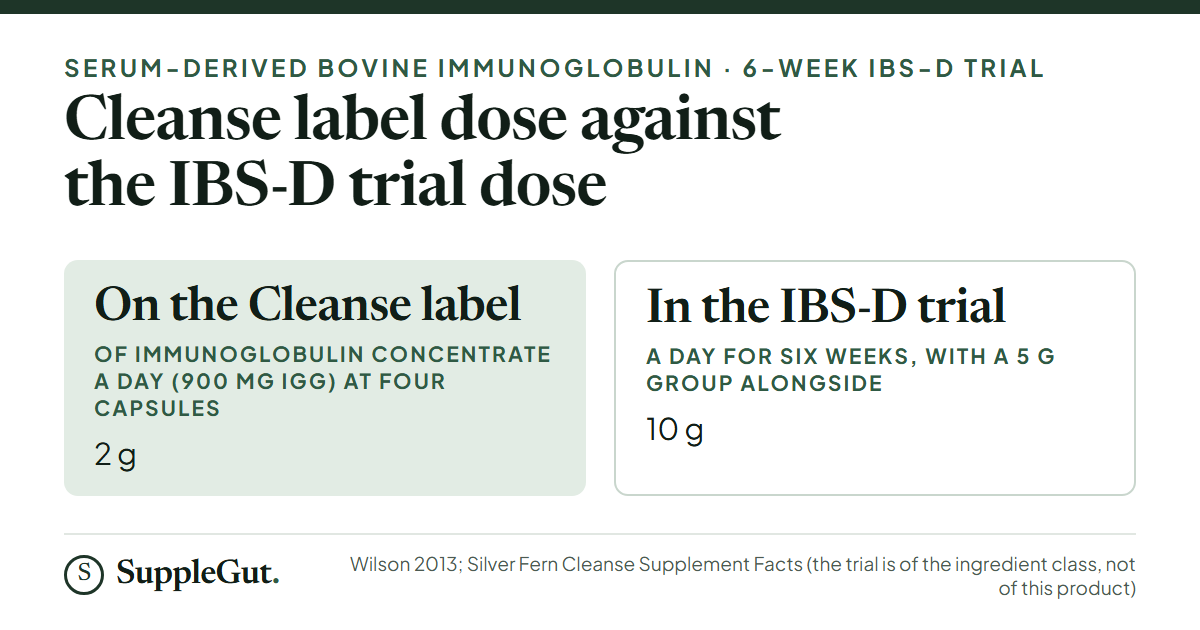
Every trial above used 5 g a day or more of the isolate: 5 g and 10 g in the placebo-controlled adult trial, 10 g in the children and in the open-label study, 5 g in the HIV group. Four capsules of Cleanse supply 2 g, which is 40% of the lowest of those doses and 20% of the highest, and the brand’s eight-capsule loading dose reaches 4 g, still under all of them. The brand page says people have consumed up to 20 g or more a day of the concentrate in clinical studies; that statement is not on the panel and the page names no study. The trials were also in people with diagnosed diarrhea-predominant IBS or HIV enteropathy, and the capsule is sold more broadly for bloating, gas and general gut upset.
Most of the trial results are changes inside each treated group from its own baseline, and the pediatric trial finished only 15 children. They are an indication that this class of protein is worth studying at 5 to 10 g, not a measurement of what 2 g does. The Designs for Health entry in this catalog, IgGI Shield, carries the same caveat about the same trial.
What “detox” and “binds toxins” rest on
The product page says immunoglobulins “bind like a lock-and-key to bad stuff in the gut,” and the kit page says the capsule has been shown to bind problematic bacteria and suggests opening capsules into water for H. pylori concerns. We found no human trial in which serum immunoglobulin was measured removing toxins, and none of the trials above measured it; they measured pain, stool frequency and form, bloating and, in one case, the microbiome. A critical review of commercial detox diets found no randomized trials of their effectiveness in humans (Klein and Kiat, 2015); that review covers detox diets, not this ingredient, and it is the closest check we found on the word itself. The product contains no herb, and the brand’s page states plainly that it is not a laxative.
Four capsules, or eight: the directions
The panel says to take four capsules daily with or without food. The brand’s page adds that the morning on an empty stomach, or right before bed, works best, that the dose can be split two and two, and that people with moderate to severe stomach issues can take eight or more capsules a day for a 30-day loading period. No trial tested either schedule of this product. Reviewers use it inside SIBO, candida and histamine protocols (“Seems to work great on my many year long SIBO,” one writes), and they are describing their own protocols, not tested claims.
Constipation first, diarrhea for some: side effects
The label caution is the standard one: pregnant or nursing mothers, children under 18 and people with known medical conditions should consult a physician, and the seal should be intact. No medication-specific warning is printed. The brand’s page says the binding “may actually cause constipation in the beginning stages,” and the kit page advises anyone who is constipated to establish normal regularity before starting. Reviews run in both directions: one 2-star reviewer reports “diarrhea worse than EVER,” and a 1-star reviewer calls it constipating, while others report relief from loose stools. Because the ingredient is of bovine origin and the panel prints no allergen line, anyone with a beef or dairy allergy can ask the brand before buying.
441 brand-page reviews and 195 Amazon ratings
The brand page runs a review app (Yotpo) showing 4.37 out of 5, displayed as 4.4, from 441 reviews: 319 five-star, 32 four-star, 50 three-star, 16 two-star and 24 one-star. 375 are marked as verified buyers and none is marked incentivized. Amazon, where the seller is Silver Fern Brand, shows 4.5 from 195 ratings: 78% five-star, 7% four, 4% three, 8% two and 3% one. Amazon shows no review summary for the listing, and the review text sits behind its sign-in. The Trustpilot profile for the brand’s website is unclaimed, with two reviews.
The praise clusters in three places: less bloating and gas with more regular bowels (one reviewer noticed less bloating after a week), use inside SIBO, candida and histamine routines, and relief for IBS and loose stools. The 1- and 2-star reviews total 40, or 9%, and fall into three groups: no effect (26 of the 441 reviews contain the word “nothing”), stomach upset in either direction, and refunds or pill count.
Price per day, the pre-selected subscription and the opened-bottle rule
A 120-capsule bottle is $74.06 on the brand site, about $2.47 a day at four capsules, and $81.96 on Amazon, about $2.73. The brand’s prices drop with quantity: $129.35 for two bottles ($2.16 a day) and $239.99 for four ($2.00). The loading dose changes the arithmetic, since a bottle lasts 15 days at eight capsules, so a day costs about $4.94 at the brand price and $5.46 on Amazon.
The product page’s code sets the Subscribe & Save option as the default selection, with one-time purchase as the alternative; subscriptions deliver every 4, 6 or 8 weeks at 15% off ($62.95 a bottle, about $2.10 a day), and the widget’s own text says there is no commitment and that it can be cancelled any time.
The brand’s published return policy accepts unopened products within 30 days of delivery with a 5% restocking fee and non-refundable shipping, and states that opened products are final sale. A separately purchased satisfaction guarantee insurance allows a return within 90 days of the order. Three 1-star reviews say there was no refund on an open bottle. Amazon does not take the capsules back for food-safety reasons unless they arrive damaged or defective. A first bottle is therefore a purchase of at least the price above, and it covers 30 days at four capsules or 15 days at eight.
Who Cleanse suits
- Someone who wants a single-ingredient immunoglobulin capsule with every line weighed on the panel and no herbs, fiber or probiotic alongside it.
- Someone who needs a dairy-free product from a bovine source and is comfortable with the brand’s own dairy-free statements, since the panel prints no free-from line.
- Someone with loose stools or bloating who understands the dose gap: 2 g on the label, 5 to 10 g in the trials, and no trial of the capsule.
- Someone planning a month at four capsules a day, where the brand price is about $2.47 a day, rather than a loading month at eight, which roughly doubles it.
A serum immunoglobulin powder with its own page is Designs for Health IgGI Shield, and the brand’s other gut products have theirs: Ultimate Probiotic (guide) and Gut Repair (guide). Loose stools are covered in the loose stools and IBS-D guide, and the quiz starts from symptoms.
Products this guide draws on
Common questions
Does Silver Fern Cleanse work?
No trial of this capsule was found. Trials of serum-derived bovine immunoglobulin, the same ingredient class, reported less abdominal pain, fewer loose stools and less bloating in adults with diarrhea-predominant IBS at 5 to 10 g a day, while four capsules here supply 2 g. On Amazon it holds 4.5 from 195 ratings, and reviewers who like it mention less bloating.
Is Silver Fern Cleanse a laxative, and does it contain senna?
No. The panel lists one active, an immunoglobulin concentrate, with no senna, cascara, aloe or other laxative herb, and the brand’s page says the product is not and will not have a laxative effect. The brand also says it may cause constipation in the beginning stages, and some reviewers report constipation while others report diarrhea.
Is Silver Fern Cleanse made from colostrum?
No. The panel names a serum-derived bovine immunoglobulin concentrate, which comes from cattle blood serum and not from milk or colostrum, and the brand calls it dairy-free, lactose-free and casein-free. The panel itself prints no allergen or free-from statement. Colostrum products are covered in the bovine colostrum guide.
How many capsules of Silver Fern Cleanse should I take?
The panel serving is four capsules daily, with or without food. The brand’s page suggests the morning or right before bed on an empty stomach, split two and two if you like, and eight or more capsules a day for a 30-day loading period in moderate to severe stomach issues. The eight-capsule figure is not on the panel. The label advises checking with a physician if you are pregnant, nursing, under 18 or have a medical condition.
How much does Silver Fern Cleanse cost per day?
One bottle of 120 capsules is $74.06 on the brand site, about $2.47 a day at four capsules, and $81.96 on Amazon, about $2.73. A bottle lasts 15 days at the eight-capsule loading dose, which is about $4.94 a day at the brand price. The brand page pre-selects a subscription at 15% off, about $2.10 a day.
Can I return an opened bottle of Silver Fern Cleanse?
The brand’s published policy accepts unopened products within 30 days of delivery with a 5% restocking fee, and treats opened products as final sale. A separately bought satisfaction guarantee insurance allows a return within 90 days of the order. Amazon does not take the listing back for food-safety reasons unless it arrives damaged or defective.
Is Silver Fern Cleanse the same as EnteraGam or IgGI Shield?
We found no source tying the label’s ImmunoLin ingredient to the serum immunoglobulin used in the trials, some of which have authors from the maker of EnteraGam. Designs for Health IgGI Shield is the other serum immunoglobulin powder in this catalog, and its pack also names ImmunoLin.
Sources
- Wilson D, et al. Serum-derived bovine immunoglobulin protein isolate in adults with diarrhea-predominant IBS: randomized, double-blind, placebo-controlled, 5 g and 10 g a day for 6 weeks. Clinical Medicine Insights: Gastroenterology, 2013. PMID 24833942. pubmed.ncbi.nlm.nih.gov/24833942
- Valentin N, et al. Serum-derived bovine immunoglobulin protein isolate in IBS-D: open-label study, 5 g twice a day for 8 weeks. Physiological Reports, 2017. PMID 28275113. pubmed.ncbi.nlm.nih.gov/28275113
- Arrouk R, et al. Serum-derived bovine immunoglobulin in children and adolescents with IBS-D: randomized pilot (NCT02609529). Pediatric Health, Medicine and Therapeutics, 2018. PMID 30498390. pubmed.ncbi.nlm.nih.gov/30498390
- Good L, et al. Serum-derived bovine immunoglobulin in IBS: case series of 14 patients at 5 g or 10 g a day. World Journal of Gastroenterology, 2015. PMID 25805945. pubmed.ncbi.nlm.nih.gov/25805945
- Shaw AL, et al. Patient survey of serum-derived bovine immunoglobulin prescribed as EnteraGam. Patient Preference and Adherence, 2017. PMID 28615929. pubmed.ncbi.nlm.nih.gov/28615929
- Asmuth DM, et al. Serum-derived bovine immunoglobulin in HIV enteropathy: open-label, 2.5 g twice a day for 8 weeks. AIDS, 2013. PMID 23660579. pubmed.ncbi.nlm.nih.gov/23660579
- Petschow BW, et al. Bovine immunoglobulin protein isolates and plasma protein concentrates in enteropathy: review. World Journal of Gastroenterology, 2014. PMID 25206275. pubmed.ncbi.nlm.nih.gov/25206275
- Van Arsdall M, et al. Enteral serum-derived immunoglobulins: review. Advances in Nutrition, 2016. PMID 27184280. pubmed.ncbi.nlm.nih.gov/27184280
- Klein AV, Kiat H. Detox diets for toxin elimination and weight management: a critical review. 2015. PMID 25522674. pubmed.ncbi.nlm.nih.gov/25522674
- Silver Fern Brand Cleanse: product page, Supplement Facts panel, subscription plans, price and return policy. silverfernbrand.com; return policy
- Amazon listing for Silver Fern Cleanse (ASIN B08K3RHCDG): price, ratings and star split. amazon.com
One answer for your symptoms
If this page raised more questions than it settled, the quiz asks the ones that matter for you and answers with one product.
Take the quiz →