
Guide
Does Silver Fern Ultimate Probiotic work? Five organisms, three strain codes and no count on the label
Quick answer
Does Silver Fern Ultimate Probiotic work? We could find no trial of the finished capsule. Human trials exist for two strains on its label: B. coagulans SNZ 1969 improved colonic transit time in 80 adults with mild constipation over eight weeks, and B. subtilis HU58, tested with a strain not on the label, improved pain and stool consistency in 61 adults with IBS-D over four weeks. The label prints one 342 mg blend with no CFU for any organism, and it names SNZ 1969 where the brand’s page names SC-208. Reviews are mostly positive (Amazon 4.4 from 906) with a minority reporting no effect or new gas and constipation.
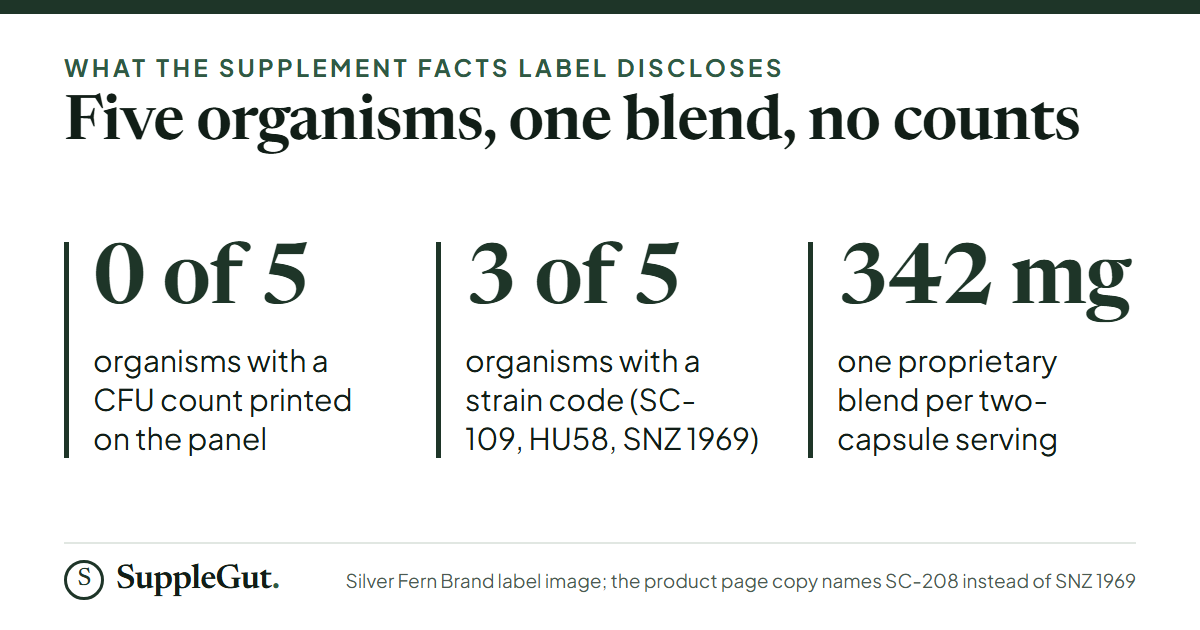
Silver Fern Brand Ultimate Probiotic is a two-capsule-a-day blend of five organisms: a yeast, three Bacillus spore-formers and a lactic-acid bacterium. The brand has sold it since 2016 and pitches it on the idea that spore-formers survive stomach acid without a coating. The thing to know before anything else is that it has no trial of its own and its label prints no count for any organism, and the strain list on the label does not match the strain list on the brand’s product page.
What the label prints
One serving is two capsules, 30 servings to a bottle. The panel has one line for the probiotics, a proprietary probiotic blend of 342 mg, with no CFU for any organism and no CFU for the blend. “8 Billion CFU” appears on the front of the bottle graphic and in the title, and it is not stated whether that is per capsule or per two-capsule serving. The other ingredients are microcrystalline cellulose, a vegetable capsule, magnesium stearate and silica. The label says it does not contain dairy, wheat, soy or artificial colors or flavors, and says nothing about egg, fish, tree nuts or sesame. The brand’s comparison table ticks “prebiotic support” and Amazon’s ingredient line ends with “Cellulose Prebiotic”, but the panel lists no prebiotic.
| Organism as printed on the label | Strain designation | Human trial for that strain |
|---|---|---|
| Saccharomyces boulardii | None | Species-level trials only |
| Bacillus clausii | SC-109 | None found |
| Bacillus subtilis | HU58 | One pilot, paired with a different strain |
| Bacillus coagulans | SNZ 1969 | One 80-adult constipation trial |
| Pediococcus acidilactici | None | None to match |
Which B. coagulans is in it
The label image prints B. coagulans SNZ 1969 and B. clausii SC-109. The product page copy lists B. coagulans SC-208, and Amazon’s ingredient text names only HU58 and gives no strain for the other two Bacillus species. SNZ 1969 and SC208 are different strains with different suppliers and different trials, and we could not tell from the brand’s pages which is in the capsule today. The label is the regulated statement; the page is marketing. One reviewer wrote that the ingredients had changed without notice and that they are allergic to the new one.
The trial of the capsule itself
There is none. We searched PubMed for the product, the brand and the strain combination, and the brand cites no study. Its page shows a “survivability study results” chart image with no reference, claims verification by a third-party lab (Sun Genomics), and a pharma-grade cGMP facility; we found no certificate of analysis, no NSF listing for this product and no CFU-at-expiry data.
The evidence for the strains
- B. coagulans SNZ 1969 (on the label): 80 healthy adults with mild intermittent constipation took it or placebo for eight weeks. Colonic transit time improved (P=0.031), complete spontaneous bowel movements were better at week 2 (P=0.045) and week 9 (P=0.038), and bowel discomfort was lower at weeks 3 and 6 (P=0.019, 0.029). The abstract does not give the dose (Kang et al., 2021).
- B. subtilis HU58 with SC208: 61 adults with diarrhea-predominant IBS, four weeks, against placebo. The responder rate for abdominal pain and stool consistency was higher (P=0.003), and stress scores did not differ. The pair was tested together, SC208 is not on the label, the authors are at Novozymes and Synergia Life Sciences, and the dose is not in the abstract (Sorensen et al., 2026).
- B. clausii SC-109: no trial found. Reviews of B. clausii are of a different four-strain product.
- S. boulardii: a meta-analysis of 21 trials in 4,780 people found antibiotic-associated diarrhea fell from 18.7% to 8.5% (RR 0.47, 0.38 to 0.57), and in adults from 17.4% to 8.2%; C. difficile diarrhea in adults was not significantly different (RR 0.8, 0.47 to 1.34). The products tested are not necessarily this label’s strain (Szajewska and Kolodziej, 2015).
The label prints no amount for any organism, so none of these doses can be compared with a serving. A strain-by-strain meta-analysis of probiotics in IBS (32 articles, ten single strains) found efficacy for other strains and conflicting results for S. boulardii CNCM I-745; none of SNZ 1969, HU58 or SC-109 was analyzed (Maslennikov et al., 2026). The American College of Gastroenterology’s 2021 IBS guideline suggests against probiotics for global IBS symptoms, a conditional recommendation with very low certainty (Lacy et al., 2021).
How to take it
The label directs adults and children above 10 to start with one capsule a day for the first week, then two capsules daily, with a meal. Amazon adds half a capsule then one for children under 10. The label does not say whether the two capsules go together. The constipation trial ran eight weeks and the IBS-D pilot four, and one reviewer reports two months with no change in constipation, so a month at the full dose is the shortest test with any trial behind it.
Side effects and who should not take it
The label caution: do not exceed the recommended dose, and pregnant or nursing mothers, children under 18 and people with known medical conditions should consult a physician. Amazon adds consulting a doctor if taking medications. The blend contains S. boulardii, a yeast, and a few reviewers say they react to it. The brand’s own ad text says starting the product with small intestinal bacterial overgrowth (SIBO) can make symptoms worse by increasing lactic acid. Reviewers also report stomach aches, gas, nausea and constipation after starting, as well as the reverse. Amazon notes that capsules may contain brown specks from the ferment.
What the reviews say
The brand’s own widget shows 4.35 from 1,837 reviews (72% five-star, 9% four, 9% three, 4% two, 7% one), 94% flagged as verified buyers and none as incentivized, dated from 2016. Amazon shows 4.4 from 906 ratings (75%, 10%, 6%, 3%, 6%), with the text behind a sign-in. Trustpilot has two reviews, both five-star, on an unclaimed profile. The widget’s review volume peaked at 495 in 2021 and was 36 in 2025.
The recurring praise is less bloating and gas (193 of the 1,837 reviews mention bloating), regularity, and a shelf-stable capsule that is easy to swallow. The recurring complaints are no effect or worse digestion, the yeast and the ingredient change, a half-full capsule in one review, and price and refusals on opened bottles.
The refund and subscription terms
The brand’s return policy accepts unopened products within 30 days of delivery, with a 5% restocking fee; open products are final sales and shipping is not refunded. A separate “satisfaction guarantee insurance” bought at checkout allows a no-questions return within 90 days of the order. Amazon marks the listing non-returnable. Subscriptions are 15% off on a 4-, 6- or 8-week schedule, and the subscription page says to modify, pause, update or cancel any time through a login; it states no minimum or billing terms. Reviewers cite refund refusals on opened bottles. We found no independent billing complaints, which is an absence of data. A single bottle can be bought once.
Who it is for
- Someone who wants a shelf-stable, multi-organism capsule with a yeast included.
- Someone comfortable buying on strain codes for three of five organisms and no per-strain counts.
- Someone without a yeast sensitivity who is not managing SIBO, which the brand’s own ad cautions about.
MegaSporeBiotic is a spore-based capsule with a placebo-controlled trial on the finished capsule. Florastor is the S. boulardii product, and Thorne Bacillus Coagulans is a single-species spore capsule. The probiotic-choice guide and the CFU guide cover how to compare labels.
Cost
One 60-capsule bottle is $52.88 on the brand site, which is $1.76 a day at the label’s 30 servings; two bottles are $94.06 ($1.57). A subscription is $44.95 for one bottle ($1.50) or $79.95 for two ($1.33). Shipping is free from $49. Amazon lists $57.48 ($1.92) or $51.73 on Subscribe & Save ($1.72).
The products in this catalog
Common questions
Does Silver Fern Ultimate Probiotic work?
No trial of the finished capsule was found. Human trials exist for two strains on the label (SNZ 1969 for mild constipation, and HU58 paired with another strain for IBS-D), but the label prints no per-strain amounts, so a serving cannot be compared with either dose. Reviews are mostly positive (Amazon 4.4 from 906), with a minority reporting no effect or new gas and constipation.
What strains are in Silver Fern Ultimate Probiotic: SNZ 1969 or SC-208?
The label image prints Bacillus coagulans SNZ 1969, Bacillus subtilis HU58 and Bacillus clausii SC-109, while the product page copy lists Bacillus coagulans SC-208. They are different strains with different trials, and we could not tell from the brand’s pages which is in the bottle today.
Is Silver Fern Ultimate Probiotic safe, and what are the side effects?
The label asks pregnant or nursing mothers, anyone under 18 and people with medical conditions to consult a physician. The blend contains S. boulardii yeast, which a few reviewers say they react to, and reviewers also report stomach aches, gas and constipation after starting. The brand’s own ad says starting it with small intestinal bacterial overgrowth can make symptoms worse.
How many capsules of Silver Fern Ultimate Probiotic should I take?
The label says adults and children above 10 start with one capsule a day for the first week, then take two capsules daily, with a meal. It does not say whether the two go together. The label’s 30 servings per bottle assume two capsules a day.
How much does Silver Fern Ultimate Probiotic cost?
One 60-capsule bottle is $52.88 on the brand site ($1.76 a day at two capsules), with free shipping from $49, and two bottles are $94.06. A subscription takes 15% off ($44.95 for one bottle). Amazon lists $57.48 one time and $51.73 on Subscribe & Save.
What is the Silver Fern refund policy, and can I cancel a subscription?
Unopened products can be returned within 30 days of delivery with a 5% restocking fee, and opened products are final sales. A separate paid satisfaction guarantee at checkout allows a no-questions return within 90 days, and Amazon marks the listing non-returnable. The subscription page says you can modify, pause, update or cancel any time, and several reviewers report refusals on opened bottles.
Sources
- Kang S, Park MY, Brooks I, et al. “Spore-forming Bacillus coagulans SNZ 1969 improved intestinal motility and constipation perception mediated by microbial alterations in healthy adults with mild intermittent constipation: A randomized controlled trial.” Food Research International, 2021;146:110428. doi.org/10.1016/j.foodres.2021.110428
- Sorensen K, Khanna S, Porwal A, et al. “Effects of a Bacillus subtilis HU58 and Heyndrickxia faecalis SC208 spore-forming probiotic formula on gastrointestinal health: results of a randomised, double-blind, placebo-controlled pilot study.” Beneficial Microbes, 2026. doi.org/10.1163/18762891-bja00113
- Szajewska H, Kolodziej M. “Systematic review with meta-analysis: Saccharomyces boulardii in the prevention of antibiotic-associated diarrhoea.” Alimentary Pharmacology & Therapeutics, 2015;42(7):793–801. doi.org/10.1111/apt.13344
- Maslennikov R, Gosteeva E, Ananeva V, et al. “Strain-Specific Systematic Review with Meta-Analysis of Probiotics Efficacy in the Treatment of Irritable Bowel Syndrome.” Journal of Clinical Medicine, 2026;15(3). doi.org/10.3390/jcm15031152
- Lacy BE, Pimentel M, Brenner DM, et al. “ACG Clinical Guideline: Management of Irritable Bowel Syndrome.” American Journal of Gastroenterology, 2021;116(1):17–44. PubMed 33315591
- Brand page: label image, directions, caution, price and subscription (silverfernbrand.com); return policy (silverfernbrand.com/pages/return-policy)
- Amazon listing: ingredient text, price and ratings (amazon.com/dp/B01GQSXBMI); Trustpilot, silverfernbrand.com: two reviews (trustpilot.com)
Not sure which product fits your situation?
This guide covers the mechanics. The quiz takes your specific symptoms, routine and preferences and matches you to one product from the catalog.
Take the quiz →