
Guide
Does Silver Fern Sensitive Gut Fiber work? A new Solnul label, an older Sunfiber listing and the trials behind each
Quick answer
Does Silver Fern Sensitive Gut Fiber work? No trial of the powder itself was found. Its Solnul resistant potato starch was tested at the label dose (3.5 g) in a 4-week placebo-controlled trial of 70 healthy adults funded by the starch’s maker, where bifidobacteria rose and both constipation-type and diarrhea-type stools were fewer than on placebo; a follow-up analysis found no change in average bowel-symptom scores. The baobab-acacia blend has no human trial of its own. Amazon shows 4.1 from 102 ratings, and the brand’s page shows 4.26 from 136 reviews.
Silver Fern Brand Sensitive Gut Fiber is an unflavored powder in a 7.94 oz (225 g) tub, sold by Silver Fern Brand, LLC as “a gentle, FODMAP-friendly daily fiber supplement.” One 8.5 g scoop holds two named ingredients, and the brand’s own pages describe two different formulas. This page sorts out which is which, what the trials cover, what reviewers report and what it costs.
What Sensitive Gut Fiber is, and what it is not
The label image on the brand’s site and the second image on Amazon read “Solnul + Inavea Baobab Acacia.” The Supplement Facts panel gives one scoop (8.5 g), 30 servings, 20 calories, 2 g of carbohydrate and 4 g of dietary fiber (14% of the Daily Value), plus 34 mg of calcium and 117 mg of potassium. Two ingredients print their own weights: Inavea baobab fruit and acacia seyal gum 5 g and Solnul resistant potato starch 3.5 g. They add to 8.5 g, the serving size, so this is not a proprietary blend, although the split between baobab and acacia inside the 5 g is not printed. The label does not explain why 8.5 g of ingredients is counted as 4 g of fiber. No sweetener or flavor line appears, and no “other ingredients” line is shown.
It is a Supplement Facts product, not a Drug Facts one. The panel carries no allergen statement, no free-from line and no facility statement, and no third-party testing mark or certificate is linked on the product page, label or Amazon bullets.
The formula change: label first, older text second
The brand’s pages do not agree with each other. The current label reads Solnul and Inavea baobab-acacia. The Amazon title still says “6 Grams of Dietary Fiber Per Serving” with “Galactomannan Guar Fiber, Baobab Fruit Powder,” and its bullets say “Includes: Sunfiber Galactomannan Fiber.” The brand’s own fourth gallery image is an older panel: a “Gentle Fiber Blend” of 7,500 mg (Sunfiber galactomannan fiber, baobab fruit pulp and acacia senegal gum, amounts not printed), a 7.5 g serving and 6 g of fiber. The brand-page text names Solnul and also “fibers from guar beans, baobab fruit, and acacia trees.”
Image file dates on the brand’s site point to the switch to the Solnul panel in 2025. This page treats the current label image as the source of truth for what is in the scoop. The Sunfiber text on Amazon and in the older image is described here as what those pages say, not as the contents. The change matters in two ways. The trial evidence differs by formula (below), and so do the ratings: the Amazon score and most of the brand-page reviews were written before the change.
The brand’s pages do not say which panel is on the tub that ships today. The panel on the tub is the check: a Solnul line and 4 g of fiber match the current label, while a Gentle Fiber Blend and 6 g match the older one.
Is there a trial of Sensitive Gut Fiber itself?
We found none. Searches of PubMed under the brand and product names, and of ClinicalTrials.gov for Solnul and resistant potato starch, turned up no entry naming a Silver Fern product. The brand makes claims well beyond fiber: that it “tackles constipation and diarrhea” in four weeks, “helps bring down histamine levels” and “strengthens your gut barrier,” each marked with the standard FDA disclaimer. The only trial behind the Solnul claims is the one below, in healthy adults, and nothing we found tests the histamine or gut-barrier statements. The brand’s page marks several acacia claims as seen in laboratory or pre-clinical studies.
The Solnul trial at the label dose, and its limits
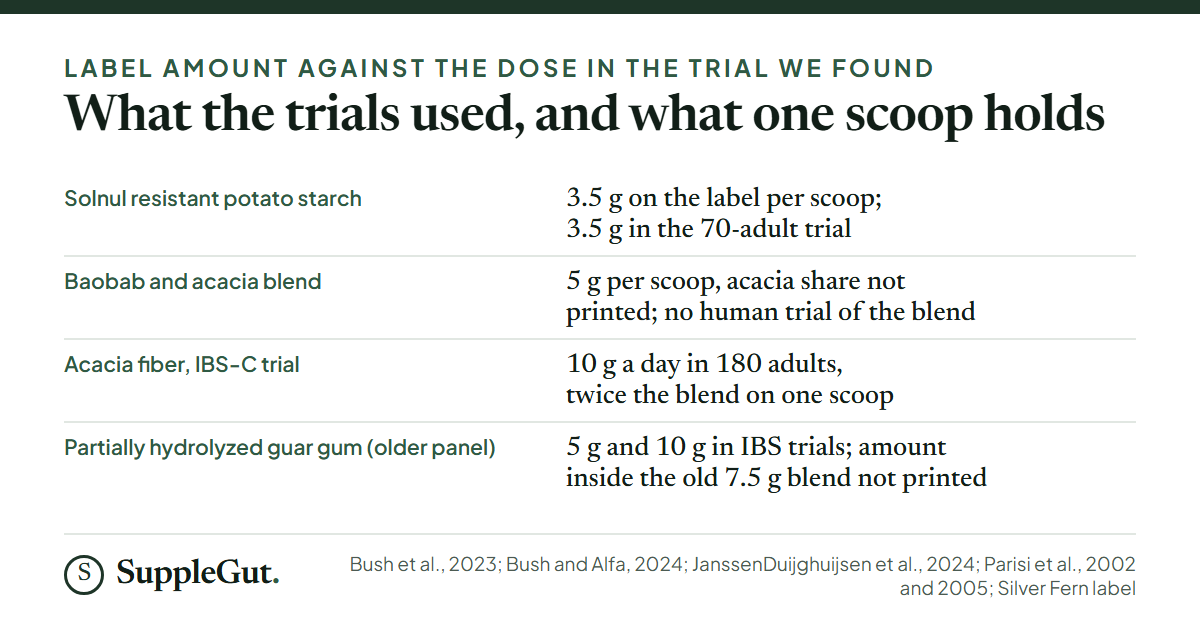
Solnul is the one ingredient here with a trial at the label amount. Bush and colleagues ran a three-arm, randomized, double-blind, placebo-controlled trial: 75 healthy adults aged 18 to 69 (25 per arm, 70 finished), with people diagnosed with IBS excluded. They took 3.5 g, 7 g or a corn-starch placebo daily for four weeks. At 3.5 g, Bifidobacterium and Akkermansia rose significantly more than on placebo, and the numbers of diarrhea-associated and constipation-associated bowel movements on the Bristol stool scale were both significantly lower. The 7 g arm responded similarly, with only the diarrhea-associated improvement significant (Bush et al., Nutrients, 2023).
Three limits apply. The trial was funded by MSP Starch Products Inc., the maker of Solnul, one author is employed by it, and the maker holds the data. It enrolled healthy adults rather than people with symptoms. And it tested the starch alone, not this formula. A secondary analysis of the same 70 people found that neither the starch nor placebo had significant effects on mean abnormal-bowel-symptom scores; it reported correlations between symptom changes and some bacterial groups, whose average abundance did not change with treatment (Bush and Alfa, BMC Nutrition, 2024). So at the label dose the evidence is a change in gut bacteria and stool form in healthy people, with no measured change in average symptoms.
Acacia, baobab and the dose
We found no human trial of the Inavea baobab-acacia blend, and no randomized human trial of baobab fruit fiber on bowel outcomes. The closest trial is for acacia fiber alone: 180 adults with Rome IV constipation-predominant IBS took 10 g of acacia fiber, a probiotic or 10 g of maltodextrin daily for four weeks after a four-week observation period. Stool frequency improved on acacia against placebo (P < 0.001), with no significant change in stool consistency, stool mass or quality of life and a trend toward fewer constipation symptoms (P = 0.10). One author is from Nexira, Inavea’s maker (JanssenDuijghuijsen et al., European Journal of Nutrition, 2024).
The label’s 5 g is half that dose, and it is a baobab-acacia blend with the acacia share unprinted. At two scoops the blend reaches 10 g, but the acacia within it would be less than 10 g.
The guar-fiber trials belong to the older panel only. In 188 adults with IBS, 5 g a day of partially hydrolyzed guar gum was compared with 30 g of wheat bran for 12 weeks in an open trial; both improved pain and bowel habits on per-protocol analysis with no difference, and success was higher on guar gum on intention-to-treat analysis (60% against 40%) (Parisi et al., Digestive Diseases and Sciences, 2002). An open 12-week trial in 86 IBS patients at 10 g (40 people) or 5 g (46 people) a day found improved symptoms and quality of life at both doses, with the gain shrinking after treatment stopped (Parisi et al., Digestive Diseases and Sciences, 2005). In 52 nursing-home residents with chronic constipation, 5 g for four weeks did not change bowel frequency or stool form against placebo but reduced laxative use in weeks three and four (Chan et al., Journal of Nutrition, Health & Aging, 2022). The amount of Sunfiber inside the older 7.5 g blend was not printed, so how closely those doses match it is unknown.
| Ingredient | On the current label | Dose in the trial we found | Trial |
|---|---|---|---|
| Solnul resistant potato starch | 3.5 g per scoop | 3.5 g | 70 healthy adults, 4 weeks, maker-funded |
| Baobab and acacia blend | 5 g per scoop | No trial of the blend | Acacia alone: 10 g, 180 adults with IBS-C |
| Guar fiber (older panel) | Not on the current label | 5 g and 10 g | IBS and constipation trials of 52 to 188 people |
How to take it
The label says: “Add 1-2 scoops to 12 ounces of water or your favorite morning beverage. For best results take first thing in the morning.” Nothing on it requires food. One scoop is 3.5 g of Solnul, the tested dose, and two scoops are 7 g, the trial’s second arm; a tub lasts 30 days at one scoop and 15 at two. One reviewer says two level scoops a day did not last a month from a two-tub order. The label gives no timing against medicines. The Solnul trial ran four weeks.
Side effects, low-FODMAP and tolerance
The brand’s copy says “Low-FODMAP,” “FODMAP-friendly” and that Inavea baobab-acacia is a “certified FODMAP friendly blend.” It does not name the certifier or the serving size tested, and no vegan, gluten-free or non-GMO statement is made. The label’s only caution reads that pregnant or nursing mothers, children under 18 and people with known medical conditions should consult a physician, and it prints no medication warning.
Tolerance is the point the brand’s page makes most, and reviewers split on it. About 30 of the 136 brand-page reviews use tolerance language such as gentle or “doesn’t upset.” About 12 mention pain or cramps, including 1-star reviews of intense bloating, gas and pain after one dose, and of cramps and dizziness at a fraction of a dose. In the Solnul trial, only the diarrhea-associated improvement was significant at 7 g, against both at 3.5 g. The label allows one to two scoops, and one scoop is the lower of the two.
What the reviews say
Amazon shows 4.1 out of 5 from 102 ratings: 65% five-star, 12% four, 7% three, 1% two and 15% one. The one-tub and two-tub listings show the same 102. Amazon’s summary of review text calls the feedback on quality positive, effectiveness and sensitivity mixed (some say it helps, others find it ineffective or report severe reactions), and taste divided. The individual Amazon reviews sit behind a sign-in, so none is quoted here.
The brand’s page runs a Yotpo review app showing 4.26 from 136 reviews: 97 five-star, 7 four, 12 three, 10 two and 10 one. Ninety-seven are flagged as verified buyers and none as incentivized. The brand hosts that feed. It also splits by formula: 119 reviews posted before the Solnul label image appeared average 4.16, describing the older Sunfiber formula, and the 17 since average 4.94, all but one five-star. The Amazon 4.1 mixes both formulas for the same reason, and we could not split it.
- Praise: tolerance for people who could not take other fibers (about 30 reviews), regularity and relief from constipation including with GLP-1 medicines, and little or no bloating (about 15 mention bloating or gas, most as “no bloating”). About 22 mention that it mixes easily or tastes neutral.
- Complaints: pain, cramps or diarrhea from a product sold as gentle (about 12), no effect after weeks (25 of the 136 reviews are 1 to 3 stars), powder that did not dissolve fully in cold water, and, from one reviewer, a price higher than Benefiber’s. Most of the mixing and price comments date from the older formula.
Three of the 136 reviews mention cancelling, subscribing or refunds, which is too few to call a pattern. Trustpilot would not load for us, and the brand is not listed at Walmart, Target or iHerb in our searches.
Price, the pre-selected subscription and the refund terms
| Route | Price | Servings | Per day at 1 scoop | Per day at 2 scoops |
|---|---|---|---|---|
| Brand, 1 tub, one time | $38.76 | 30 | $1.29 | $2.58 |
| Brand, 1 tub, subscription (15% off) | $32.95 | 30 | $1.10 | $2.20 |
| Brand, 2 tubs, one time | $65.82 | 60 | $1.10 | $2.19 |
| Brand, 2 tubs, subscription | $55.95 | 60 | $0.93 | $1.87 |
| Amazon, 1 tub | $41.96 | 30 | $1.40 | $2.80 |
| Amazon, 2-tub listing | $67.48 | 60 | $1.12 | $2.25 |
Brand shipping is free on orders of $49 and over and calculated at checkout below that, so a single $38.76 tub pays shipping. The product page pre-selects the subscription at 15% off, shipping every 4, 6 or 8 weeks, with the line “No commitment. Cancel anytime”; a one-time purchase is one click away.
The brand’s return policy, as worded, accepts unopened products within 30 days of delivery, charges a 5% restocking fee, treats shipping as non-refundable and does not accept returns of opened products. An optional satisfaction-guarantee insurance bought at checkout allows a “no questions asked return within 90 days of order.” The brand’s other fiber, Ultimate Fiber, has the same terms. Amazon’s returns terms for these two listings were not read.
Opened tubs are final sale under the brand’s terms. A first purchase on the pre-selected subscription schedules later tubs, while a one-time purchase does not.
Sensitive Gut Fiber vs Ultimate Fiber
Both are Silver Fern powders with 3.5 g of Solnul per scoop. After that they diverge. Sensitive Gut Fiber is an 8.5 g scoop with a 5 g baobab-acacia blend, 4 g of counted fiber and $1.29 a day on the brand site. Ultimate Fiber is a 19 g scoop with three fibers printed at their own weights (tapioca fiber 10.5 g, acacia 5 g, Solnul 3.5 g), 15 g of counted fiber and $1.45 a day. Ultimate Fiber carries no Sunfiber and no baobab, and has its own page: Ultimate Fiber, with the evidence in the Ultimate Fiber guide. The same Solnul trial applies to both. No study compares them.
Who Sensitive Gut Fiber is for
- Someone who wants a small daily fiber dose with no flavor or sweetener, starting at 4 g a day, and who wants the ingredient with a trial at its label amount.
- Someone who has stopped other fiber powders because of gas or bloating and is trying a fermentable one, knowing a minority of reviewers report cramps on this one too.
- Someone comfortable reading the panel on the tub to see which formula arrived.
For more fiber per scoop, see Ultimate Fiber above. The psyllium guide covers a different fiber type, and the quiz starts from your symptoms.
The products in this catalog
Common questions
Does Silver Fern Sensitive Gut Fiber work?
No trial of the finished powder was found. Its Solnul resistant potato starch, at the label’s 3.5 g, raised bifidobacteria and lowered constipation-type and diarrhea-type stools against placebo in a 4-week trial of 70 healthy adults, funded by the starch’s maker. The baobab-acacia blend has no trial of its own. Reviewers are split, with most describing easier regularity and a minority reporting cramps or no effect.
What is in Sensitive Gut Fiber, and is it still Sunfiber?
The current label image prints one 8.5 g scoop with 5 g of Inavea baobab fruit and acacia seyal gum and 3.5 g of Solnul resistant potato starch, counted as 4 g of dietary fiber. It lists no Sunfiber. The Amazon title and bullets, and an older panel image on the brand’s own page, still describe a Sunfiber guar-fiber version with 6 g of fiber.
Is Sensitive Gut Fiber low FODMAP, and does it cause bloating?
The brand calls it low-FODMAP and says its baobab-acacia blend is a certified FODMAP-friendly blend; the page does not name a certifier. In the brand-page reviews, about 30 of 136 use tolerance language and about 12 report pain or cramps, some after a half dose. Amazon’s summary calls reactions mixed. Starting with one scoop is the label dose.
How many scoops should you take?
The label says to add one to two scoops to 12 ounces of water or a morning drink, ideally first thing in the morning. One scoop holds 3.5 g of Solnul, the dose tested in the trial; two scoops hold 7 g, the trial’s other arm. A 30-scoop tub lasts 15 days at two scoops.
How much does Sensitive Gut Fiber cost per day?
A 30-scoop tub is $38.76 on the brand site, about $1.29 a day at one scoop, and $41.96 on Amazon, about $1.40. The brand’s page pre-selects a 15% subscription at $32.95 a tub ($1.10 a day). Both figures double at two scoops a day.
Can you return it, and is the subscription easy to cancel?
The brand accepts unopened returns within 30 days of delivery with a 5% restocking fee and non-refundable shipping, and treats opened products as final sale unless an optional satisfaction-guarantee insurance was bought at checkout, which allows a return within 90 days of the order. The subscription widget says “No commitment. Cancel anytime.” Amazon’s return terms for these listings were not read.
Sensitive Gut Fiber vs Ultimate Fiber: what is the difference?
Both carry 3.5 g of Solnul. Sensitive Gut Fiber is an 8.5 g scoop with a baobab-acacia blend and 4 g of counted fiber. Ultimate Fiber is a 19 g scoop with three printed fibers and 15 g of counted fiber, at $1.45 a day on the brand site. The Ultimate Fiber guide has its label and trials.
Sources
- Bush JR, Baisley J, Harding SV, Alfa MJ. “Consumption of Solnul Resistant Potato Starch Produces a Prebiotic Effect in a Randomized, Placebo-Controlled Clinical Trial.” Nutrients, 2023;15(7):1582. PubMed 37049425
- Bush JR, Alfa MJ. “Consumption of resistant potato starch produces changes in gut microbiota that correlate with improvements in abnormal bowel symptoms: a secondary analysis of a clinical trial.” BMC Nutrition, 2024;10:152. PubMed 39605008
- JanssenDuijghuijsen L, van den Belt M, Rijnaarts I, et al. “Acacia fiber or probiotic supplements to relieve gastrointestinal complaints in patients with constipation-predominant IBS: a 4-week randomized double-blinded placebo-controlled intervention trial.” European Journal of Nutrition, 2024;63(5):1983–1994. PubMed 38653808
- Parisi GC, Zilli M, Miani MP, et al. “High-fiber diet supplementation in patients with irritable bowel syndrome (IBS): a multicenter, randomized, open trial comparison between wheat bran diet and partially hydrolyzed guar gum (PHGG).” Digestive Diseases and Sciences, 2002;47(8):1697–1704. PubMed 12184518
- Parisi G, Bottona E, Carrara M, et al. “Treatment effects of partially hydrolyzed guar gum on symptoms and quality of life of patients with irritable bowel syndrome. A multicenter randomized open trial.” Digestive Diseases and Sciences, 2005;50(6):1107–1112. PubMed 15986863
- Chan TC, Yu VMW, Luk JKH, et al. “Effectiveness of Partially Hydrolyzed Guar Gum in Reducing Constipation in Long Term Care Facility Residents: A Randomized Single-Blinded Placebo-Controlled Trial.” Journal of Nutrition, Health & Aging, 2022;26(3):247–251. PubMed 35297467
- Silver Fern Brand: product page, label images, older panel image and Yotpo review feed (silverfernbrand.com/products/sensitive-gut-fiber); return policy (silverfernbrand.com/pages/return-policy)
- Amazon listings: title, bullets, price, ratings and review summary (amazon.com/dp/B0BMW4P5X7; amazon.com/dp/B0BMW2Q2LQ)
Not sure which product fits your situation?
This guide covers the mechanics. The quiz takes your specific symptoms, routine and preferences and matches you to one product from the catalog.
Take the quiz →