
Guide
Does Silver Fern Ultimate Fiber work? Three fermentable fibers, the trials behind each and what the label prints
Quick answer
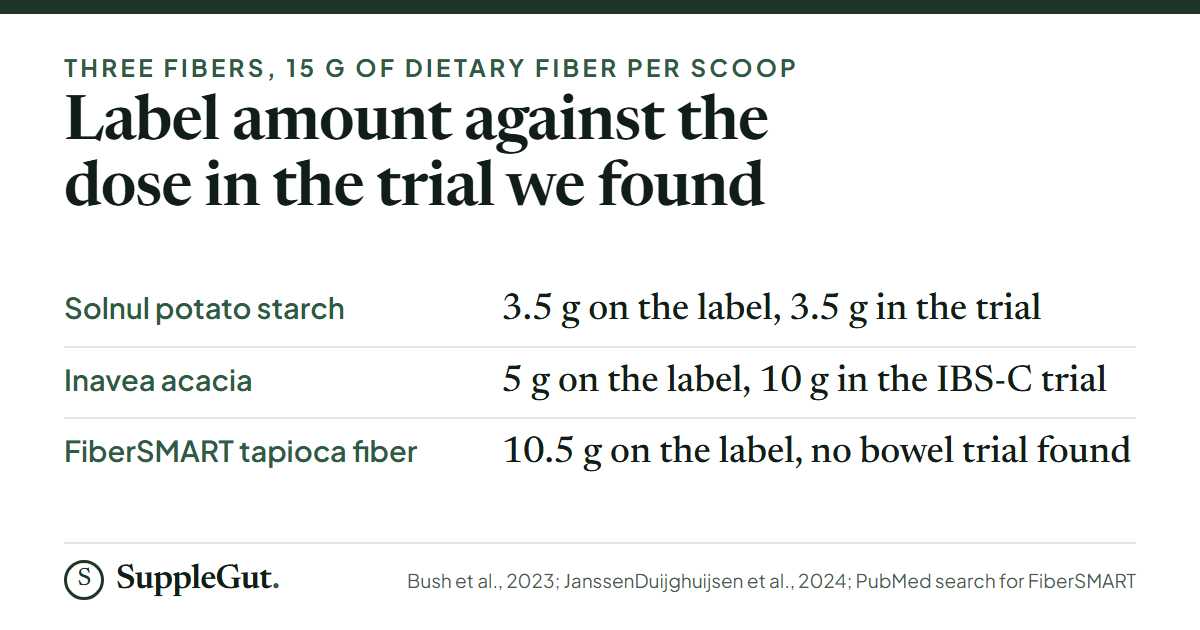
Does Silver Fern Ultimate Fiber work? No trial of the finished powder exists. Its three fibers have separate evidence: Solnul resistant potato starch is at its trial dose (3.5 g, a 75-adult, 4-week trial that raised Bifidobacterium and Akkermansia but showed no symptom benefit in the follow-up analysis), acacia is 5 g against 10 g in the 180-adult IBS-C trial, and no bowel trial of the tapioca fiber was found. A 2022 meta-analysis of 16 constipation trials found benefit above 10 g a day, with only psyllium and pectin significant by type and more flatulence on fiber.
Silver Fern Brand Ultimate Fiber is an unflavored powder in a 20 oz tub, sold by Silver Fern Brand, LLC of Salt Lake City. One 19 g scoop holds three named fibers and prints 15 g of dietary fiber. What sets it apart from the psyllium tub on the next shelf is that all three fibers are fermentable ones, so the evidence has to be read fiber by fiber, and none of it is a trial of the powder itself.
What Ultimate Fiber is, and what it is not
The Supplement Facts panel lists one scoop (19 g), 45 calories, 18 g of carbohydrate and 15 g of dietary fiber. Each fiber has its own printed amount, so this is not a proprietary blend: FiberSMART soluble tapioca fiber (a resistant dextrin) 10.5 g, Inavea Pure Acacia fiber 5 g and Solnul resistant potato starch 3.5 g. The three amounts add to 19 g, the serving size; the label does not explain why the fiber line reads 15 g. Other ingredients: none, so no sweetener, flavor or anti-caking agent.
Two things it does not contain. There is no psyllium, and there is no Sunfiber (partially hydrolyzed guar gum, or PHGG). The brand sells a separate product, Sensitive Gut Fiber, that has guar fiber, so the PHGG trials in IBS are not evidence for this one. A third-party listing and some older brand text still say “Nutriose”; the current label says FiberSMART. The label has no allergen statement; the brand page says gluten-free, dairy-free, soy-free, vegan and “low-FODMAP by design”, with no certification or lab named.
Fermentable fiber and bulking fiber
All three fibers are fermented by gut bacteria. The brand’s case is that this feeds beneficial bacteria, and the trials of the individual fibers below measured bacterial counts and stool records. A separate line of research asks a different question: what makes a fiber a laxative. A review by McRorie and Chey concluded that a fiber must resist fermentation and hold water through the large bowel to loosen stool, and that a readily fermented soluble fiber, gel-forming or not, “has no laxative effect” (McRorie and Chey, 2016). The first author was employed by Procter & Gamble, which markets psyllium. Resistant dextrin and acacia are fermentable, and Solnul’s maker describes it as “insoluble but fully fermentable”.
The trial of the product itself
There is none. We searched PubMed under the brand and product names and ClinicalTrials.gov under the brand, and found nothing. The brand page says the formula is “supported by more than 26 published studies”; we could not trace that figure to a list, and the link to the brand’s acacia research summary returned a not-found error when we tried it. The page also says each ingredient is used “at the same dose shown in human studies”. From the sources we found, that holds for one of the three.
The evidence for each fiber
| Fiber | On the label | Dose in the trial we found | Trial |
|---|---|---|---|
| Solnul resistant potato starch | 3.5 g | 3.5 g | 75 healthy adults, 4 weeks |
| Inavea acacia | 5 g | 10 g | 180 adults with IBS-C, 4 weeks |
| FiberSMART tapioca fiber | 10.5 g | No bowel trial found | Appetite and tolerance work only |
Solnul. Bush and colleagues ran a three-arm, double-blind, placebo-controlled trial in 75 healthy adults (25 per arm): 3.5 g, 7 g or placebo each morning for four weeks. At 3.5 g, Bifidobacterium rose more than on placebo (p = 0.038) and so did Akkermansia (p = 0.014), after statistical outliers were removed, and the 3.5 g group had fewer very hard or very loose stools. Adverse events matched placebo at 3.5 g; at 7 g there were more reports of flatulence (Bush et al., 2023). The registered sponsor and one author are the ingredient’s maker. A later analysis of the same trial found that neither Solnul nor placebo changed mean scores for abdominal symptoms (Bush and Alfa, 2024). So at the label dose, the trial shows a change in bacteria and stool form in healthy people, and no symptom benefit.
Acacia. In 180 adults with constipation-predominant IBS, 10 g a day of acacia fiber for four weeks improved stool frequency against placebo (P < 0.001), with no significant change in stool consistency, stool mass or quality of life, and a trend in constipation symptoms (P = 0.10). Two authors work for Nexira, the supplier (JanssenDuijghuijsen et al., 2024). The label carries half that dose. In healthy volunteers, a gum arabic dose-finding study put the optimum for bifidobacteria and lactobacilli at around 10 g, with 5 g the lowest dose tested (Calame et al., 2008). At 40 g, acacia gum caused more bloating, flatulence and rumbling than the control in 48 healthy adults (Larson et al., 2021).
FiberSMART. PubMed returns no peer-reviewed human trial of it on stool or bowel outcomes. Registered work covers an acute glucose crossover in 15 adults and an appetite study at 20 and 40 g; a supplier-promoted tolerance study at 10, 30 and 50 g appeared only in trade press. The label dose is 10.5 g.
What the constipation meta-analysis found
A 2022 meta-analysis pooled 16 trials in 1,251 adults with chronic constipation. Overall, 66% responded on fiber against 41% on control (risk ratio 1.48, 95% CI 1.17 to 1.88). By type, only psyllium and pectin had significant effects. The benefit on response appeared only above 10 g a day, stool frequency improved with doses of 4 weeks or more, and flatulence was higher on fiber (standardized mean difference 0.80, 95% CI 0.47 to 1.13). The authors caution about considerable heterogeneity (van der Schoot et al., 2022). The label’s 15 g is above the 10 g line; the three fibers here are not the types that were significant in it.
Psyllium is the fiber with the clearest result in that review. The site’s psyllium buying guide and the psyllium husk vs Metamucil comparison cover it, and the SuperGut guide covers another fiber powder.
How to take it
The label says one scoop a day stirred into water, juice, oatmeal or a shake, shaken well, and not for hot drinks. The brand page adds that it works best with or near a meal and says it may be used as one, two or three scoops; three scoops would be 45 g of fiber, and the brand gives no maximum. The label gives no water amount and no timing against medicines. The meta-analysis points to at least four weeks as a fair test.
Side effects and who should not take it
The label says pregnant or nursing mothers, anyone under 18 and people with known medical conditions should consult a physician. Gas is the usual cost of fiber powders: it was higher on fiber in the meta-analysis, and 7 g of Solnul brought more flatulence reports than 3.5 g in its trial. One reviewer says the dose had to be worked up slowly. Several reviewers mention taking it alongside a GLP-1 medicine; the label says nothing about that.
What the reviews say
The brand’s own page shows 4.96 from 24 reviews (23 five-star, one four-star), none flagged as a verified buyer, five posted on the same day. Amazon shows 4.6 from 25 ratings (77% five-star, 10% four, 13% three), with the review text behind a sign-in. Trustpilot has no product page; the brand-wide profile is unclaimed and has two reviews. Reviewers praise easier regularity (about 10 of the 24 mention it), mixing without gel or grit and a neutral taste, and no bloating. The reservations are small: working up slowly, a mix that is not pretty, and best dissolved in room-temperature water.
Cost, subscription and refund terms
One 30-scoop tub is $43.47 on the brand site, which is $1.45 a day, plus $4.95 shipping on orders of $49 or less. Two tubs are $81.12 ($1.35 a day) and a 15% subscription is $36.95 a tub ($1.23 a day) with free shipping. Amazon lists $46.96 for one tub and $85.96 for two. The brand’s return policy takes back unopened products within 30 days of delivery with a 5% restocking fee, does not accept opened products, and treats shipping as non-refundable; a separately purchased guarantee allows a return within 90 days. Subscriptions can be modified, paused or cancelled at any time through login. Amazon marks the listing non-returnable. We found no independent billing complaints about this product.
Who Ultimate Fiber is for
- Someone who wants a fermentable, unflavored prebiotic fiber that dissolves in cold drinks, knowing the trials measured gut bacteria rather than constipation at these doses.
- A person who has read the meta-analysis and wants 15 g a day of fiber from several types in one scoop.
If the goal is constipation specifically, the review favors psyllium; the psyllium guide compares the options.
The products in this catalog
Common questions
Does Silver Fern Ultimate Fiber work?
No trial of the finished product was found. Of its three fibers, the potato starch (3.5 g, the label dose) raised bifidobacteria in a 75-person, 4-week trial run by its maker, and acacia improved stool frequency in 180 adults with constipation-predominant IBS at 10 g a day, twice the label’s 5 g. No peer-reviewed bowel trial of the tapioca fiber was found. Brand-site reviewers mostly describe easier regularity, but none is flagged as a verified buyer.
What fibers are in Ultimate Fiber, and is it the same as Sunfiber?
One 19 g scoop has FiberSMART tapioca fiber (a resistant dextrin) 10.5 g, Inavea acacia fiber 5 g and Solnul resistant potato starch 3.5 g, printed as 15 g of dietary fiber. It has no Sunfiber (partially hydrolyzed guar gum); the brand sells that in a separate product, Sensitive Gut Fiber, so PHGG trials do not apply here.
Is Ultimate Fiber low FODMAP, and will it cause gas?
The brand page says low-FODMAP by design; no certification or lab is named. Gas was higher on fiber supplements as a class in a 2022 meta-analysis, 7 g of Solnul brought more flatulence reports than 3.5 g in its trial, and one reviewer says the dose had to be worked up slowly. Starting with one scoop is the label dose.
Ultimate Fiber vs Metamucil: which has more evidence?
No study compares them. Metamucil is psyllium, one of the two fiber types that were significant in the 2022 constipation meta-analysis; Ultimate Fiber’s three fibers are all fermentable and were not. See the psyllium husk vs Metamucil comparison for the psyllium side.
How many scoops a day can you take?
The label says one scoop a day. The brand page says it may be used as one, two or three scoops depending on goals, which would be 15, 30 or 45 g of fiber, and gives no maximum. Trials of the individual fibers used 3.5 g of Solnul and 10 g of acacia.
How much does Ultimate Fiber cost?
One 30-scoop tub is $43.47 on the brand site, which is $1.45 a day, plus $4.95 shipping on orders of $49 or less. Two tubs are $81.12, and a 15% subscription is $36.95 a tub with free shipping. Amazon lists $46.96 for one tub and $85.96 for two.
What is the Ultimate Fiber refund policy?
The brand takes back unopened products within 30 days of delivery with a 5% restocking fee, does not accept opened products, and does not refund shipping. A separately purchased guarantee allows a return within 90 days of the order. Amazon marks the listing non-returnable, with refund or replacement for damaged or defective items.
Sources
- van der Schoot A, Drysdale C, Whelan K, Dimidi E. "The Effect of Fiber Supplementation on Chronic Constipation in Adults: An Updated Systematic Review and Meta-Analysis of Randomized Controlled Trials." American Journal of Clinical Nutrition, 2022;116(4):953–969. doi.org/10.1093/ajcn/nqac184
- Bush JR, Baisley J, Harding SV, Alfa MJ. "Consumption of Solnul Resistant Potato Starch Produces a Prebiotic Effect in a Randomized, Placebo-Controlled Clinical Trial." Nutrients, 2023;15(7):1582. doi.org/10.3390/nu15071582
- Bush JR, Alfa MJ. "Consumption of resistant potato starch produces changes in gut microbiota that correlate with improvements in abnormal bowel symptoms: a secondary analysis of a clinical trial." BMC Nutrition, 2024;10:152. doi.org/10.1186/s40795-024-00962-7
- JanssenDuijghuijsen L, van den Belt M, Rijnaarts I, et al. "Acacia fiber or probiotic supplements to relieve gastrointestinal complaints in patients with constipation-predominant IBS: a 4-week randomized double-blinded placebo-controlled intervention trial." European Journal of Nutrition, 2024;63(5):1983–1994. doi.org/10.1007/s00394-024-03398-8
- Calame W, Weseler AR, Viebke C, Flynn C, Siemensma AD. "Gum arabic establishes prebiotic functionality in healthy human volunteers in a dose-dependent manner." British Journal of Nutrition, 2008;100(6):1269–1275. doi.org/10.1017/S0007114508981447
- Larson R, Nelson C, Korczak R, et al. "Acacia Gum Is Well Tolerated While Increasing Satiety and Lowering Peak Blood Glucose Response in Healthy Human Subjects." Nutrients, 2021;13(2):618. doi.org/10.3390/nu13020618
- McRorie JW, Chey WD. "Fermented Fiber Supplements Are No Better Than Placebo for a Laxative Effect." Digestive Diseases and Sciences, 2016;61(11):3140–3146. doi.org/10.1007/s10620-016-4304-1
- ClinicalTrials.gov records for FiberSMART: NCT07075822 (clinicaltrials.gov/study/NCT07075822) and NCT04596969 (clinicaltrials.gov/study/NCT04596969)
- Brand page: label, directions, claims and price (silverfernbrand.com/products/ultimate-fiber); brand return policy (silverfernbrand.com/pages/return-policy) and shipping policy (silverfernbrand.com/pages/shipping-policy); Amazon listing: price, ratings and returns (amazon.com/dp/B0GRK99DCT)
Not sure which product fits your situation?
This guide covers the mechanics. The quiz takes your specific symptoms, routine and preferences and matches you to one product from the catalog.
Take the quiz →