
Comparison
Metamucil vs Benefiber: which fiber does the job?
They sit on the same shelf, they both say “fiber supplement,” and they cost roughly the same. But they contain two completely different fibers that behave differently once you swallow them — and only one of them has a real evidence base for regularity.
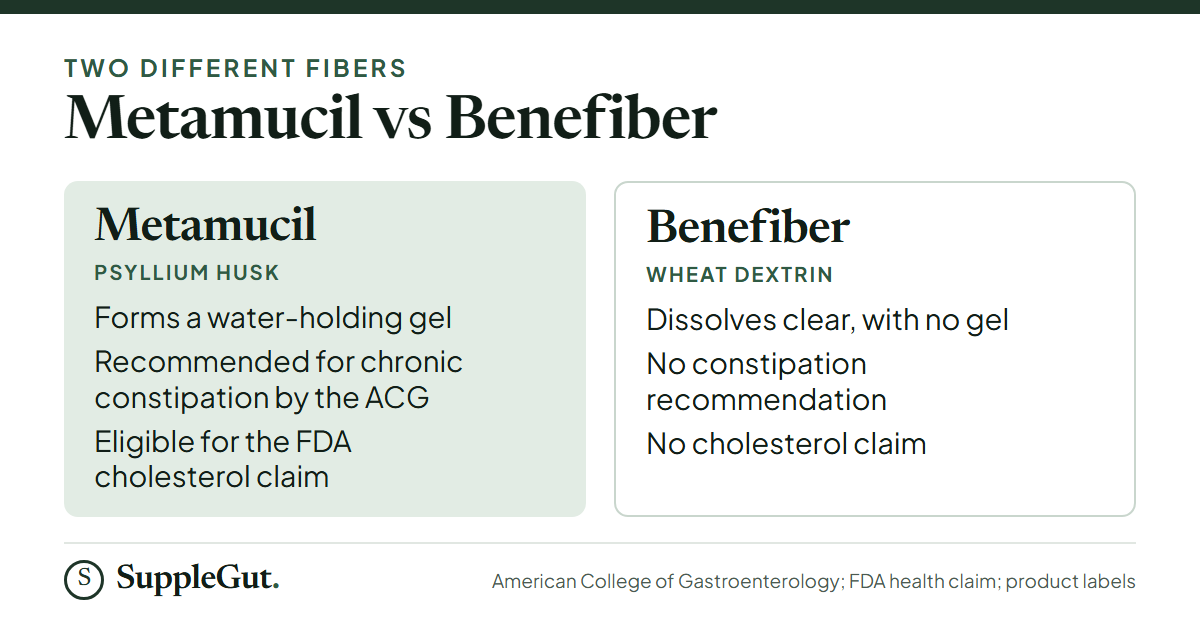
The short answer
Metamucil — psyllium husk
$0.22–0.25 a dose · 4.6★ from 7,984 ratings at Walmart Business
Psyllium forms a gel that resists fermentation and holds water all the way through the colon. It is the only fiber supplement the American College of Gastroenterology found sufficient evidence to recommend for chronic constipation, and psyllium is an eligible source for the FDA-authorized cholesterol health claim. Wheat dextrin is neither.
- Your stools are hard, infrequent or incomplete
- You want the cholesterol benefit as well
- You can live with a thickening orange drink you have to finish quickly
Benefiber — wheat dextrin
$0.37–0.44 a day · 4.6★ from 4,553 ratings at Walmart Business
The unflavored powder is a single ingredient — wheat dextrin, nothing else — it is taste-free, dissolves clear, does not thicken, and is labeled gluten-free despite the wheat origin. What it does not have is trial evidence that it relieves constipation.
- You have tried psyllium and could not keep taking it
- You want to stir fiber into coffee or soup without changing it
- You are after prebiotic fermentation rather than a laxative effect
- You want the shortest possible ingredient list
Not sure which of the two fits you? The quiz asks about your symptoms before it names one.
The caveat. Neither of these is the answer if your main complaint is bloating and gas rather than hard or infrequent stools. Fermentable fiber can make gas worse before it makes anything better, and both of these are commonly bought by people whose actual problem is something else entirely.
Side by side
✓ marks the product with the advantage on that row. Rows with no mark are a genuine tie or a matter of preference.
Where they differ
1. Two different fibers, and the difference is physical
Soluble fiber is not one thing. Psyllium is viscous and gel-forming, and it resists fermentation, so it survives intact through the large bowel holding water with it — which is what softens stool and increases output. Wheat dextrin is classified as a non-viscous soluble fiber that does not gel and is readily fermented.
The consequence, in the words of the review literature: non-viscous soluble fibers like wheat dextrin and inulin “are fermented… and have no water-holding capacity and thus do not provide a laxative benefit at physiologic doses.” The same review goes further and says wheat dextrin “actually has a constipating effect at physiologic doses (eg, 10–15 g/d).” For scale on the other side: psyllium has been measured as 3.4 times more effective than wheat bran for increasing stool output.
Benefiber’s “non-thickening, dissolves clear” marketing and the mechanism above are the same fact told two ways. Not thickening is exactly why it does not do what psyllium does. It is a genuine convenience feature and it is also the reason to expect less.
2. The evidence is not close — but we will be precise about why
A 2022 systematic review and meta-analysis pooled 16 randomized trials in 1,251 people with chronic constipation. Treatment responders were 66% on fiber against 41% on control (relative risk 1.48). Crucially, the effect was significant only for psyllium and pectin, and only at doses above about 10 g a day sustained for four weeks or more. The American College of Gastroenterology reached the same conclusion from the other direction: it found insufficient evidence for calcium polycarbophil, methylcellulose and bran, and identified psyllium as the only fiber supplement with enough clinical evidence to recommend.
For wheat dextrin, the honest position is that the constipation evidence is close to absent. The positive stool-output data comes from healthy volunteers taking 100 g a day — roughly sixteen times a label serving. Its cholesterol data comes from hamsters. Its real, documented effects are prebiotic and glycemic, at 30–45 g a day.
One thing to be clear about: there has never been a randomized head-to-head trial of psyllium against wheat dextrin. Everything above is mechanistic classification plus two separate bodies of trial evidence. It is a strong basis for a recommendation. It is not the same as a trial that beat the other product.
3. What else is in the tub
Metamucil
Psyllium husk, maltodextrin, citric acid, natural and artificial orange flavor, aspartame, Yellow 6. The aspartame brings a phenylketonurics warning — 25 mg of phenylalanine per teaspoon. Gluten-free is not stated on the canister; only some single-serve packet listings claim it, and with a “may contain trace amounts under 20 ppm” qualifier.
Benefiber
Wheat dextrin. That is the complete list. The label footnote explains the wheat “has been processed to allow this food to meet the… requirements for gluten-free foods,” measured under 20 ppm. Buy the unflavored one. The orange variant is a different animal: aspartame, acesulfame potassium, lactose from milk, Yellow 6 and Red 40.
4. Cost, on a like-for-like basis
Per dose Metamucil looks cheaper, at $0.22–0.25. But its regularity dosing is one teaspoon up to three times a day, so a full day runs about $0.66–0.75. Benefiber’s digestive-health dose is four teaspoons once a day, about $0.37–0.44. Benefiber is cheaper and simpler to take. That only matters if the fiber does the job you bought it for.
5. Neither publishes a certificate
No third-party testing claim, no COA, no USP or NSF mark appears on either brand’s site or on any retailer listing we checked. You are trusting two large consumer-health companies on potency, which is a reasonable thing to do and still worth knowing.
What we would buy
If the argument above holds, the sensible move is not Metamucil — it is plain psyllium, without the aspartame, the Yellow 6 or the flavoring you are paying for.
NOW Foods Psyllium Husk Powder
$0.31 a day · 4.7★ from 23,144 ratings at iHerb
One ingredient: psyllium husk powder. 7 g of fiber in a serving against Metamucil’s 3 g per teaspoon, at roughly half the daily cost, with no sweetener, no color and no flavoring. Non-GMO Project Verified and GMP Quality Assured, though no testing certificate is published.
- The honest downside: it is unflavored, and it gels almost immediately — several reviewers say you have to drink it fast or it turns to jelly
California Gold Nutrition Prebiotic Fiber (Sunfiber PHGG)
$0.77 a day · 4.7★ from 7,979 ratings at iHerb
Be clear what this is and is not. Partially hydrolyzed guar gum is also non-viscous, so it is not a laxative fiber either. What it has is a 12-week placebo-controlled trial in 108 IBS patients using this exact ingredient brand at 6 g a day, which found greater improvement in bloating and gas — and no benefit for abdominal pain or stool frequency. One serving here is 6 g, the same dose. It also carries a published iTested certificate, which nothing else here does.
- Tasteless and non-thickening, so it goes into anything
Or buy either of the two compared here
The Benefiber button goes to the Amazon listing for the same unflavored powder, priced at $0.18 a day there. The 4.6 from 4,553 ratings in the table above is read from the Walmart Business listing, which is a different rating pool for the same product.
Read the full research
In one line: Metamucil — psyllium husk — for regularity or cholesterol.
Which fiber for constipation, on one page
Which fibers have the trials, the dose that worked, and how to take it without the gas. Sent by email, then two short follow-ups over ten days. Unsubscribe any time.
Your address is used for these three emails and nothing else. How we handle it.
Speak to a doctor first if you are pregnant, breastfeeding, trying to conceive, immune-suppressed, or taking prescription medication — and before starting anything if you have blood in your stool, unexplained weight loss, persistent vomiting, or pain severe enough to wake you at night. Those are signs to get looked at, not to try a supplement.
Not sure fiber is your problem at all?
Fiber is the right answer for hard, infrequent or incomplete stools. It is often the wrong answer for bloating and gas. Our quiz asks what you are experiencing and tells you which category to look at first.
Find your match →Free · Private · No sign-up · 1–3 minutes
Related guides
Other comparisons
Where these numbers come from
- Metamucil label, ingredients and dosing (official) — www.metamucil.com/en-us/products/fiber-powders/sugar-free-oran
- Metamucil supplement facts, other ingredients and per-dose price — www.heb.com/product-detail/metamucil-4-in-1-psyllium-husk-fibe
- Metamucil OTC drug label, warnings, psyllium per packet — dailymed.nlm.nih.gov/dailymed/drugInfo.cfm?setid=a9824f73-5ea2
- Metamucil rating, 4.6 from 7,984 — business.walmart.com/ip/Metamucil-Fiber-Supplement-Sugar-Free-
- Benefiber single-ingredient panel, gluten footnote, price — www.target.com/p/benefiber-prebiotic-sugar-free-fiber-suppleme
- Benefiber dosing and brand claims — www.benefiber.com/fiber-supplement-products/benefiber-powder
- Benefiber rating, 4.6 from 4,553 — business.walmart.com/ip/Benefiber-Daily-Prebiotic-Fiber-Supple
- Meta-analysis, 16 trials, 1,251 people: only psyllium and pectin significant — pubmed.ncbi.nlm.nih.gov/35816465
- ACG position, psyllium the only recommended fiber supplement; wheat dextrin constipating at 10-15 g/d — pmc.ncbi.nlm.nih.gov/articles/PMC4415970
- Viscous versus non-viscous soluble fiber classification — pubmed.ncbi.nlm.nih.gov/27680987
- Wheat dextrin review: 100 g/day stool output, animal cholesterol data, no constipation trial — journals.sagepub.com/doi/pdf/10.1177/147323000903700101
- FDA authorized health claim, 21 CFR 101.81, eligible soluble fiber sources — www.law.cornell.edu/cfr/text/21/101.81
- Psyllium 3.4x more effective than wheat bran for stool output — europepmc.org/article/med/31764399
- Sunfiber PHGG 12-week trial in 108 IBS patients at 6 g/day — www.iherb.com/pr/california-gold-nutrition-prebiotic-fiber-6-3
Prices and star ratings are point-in-time snapshots and move around. Where a figure could not be confirmed from a manufacturer label or retailer listing, this page says so rather than estimating.