
Guide
Does Stomach Soothe work for heartburn? The alginate evidence, the unprinted amounts and what the reviews say
Quick answer
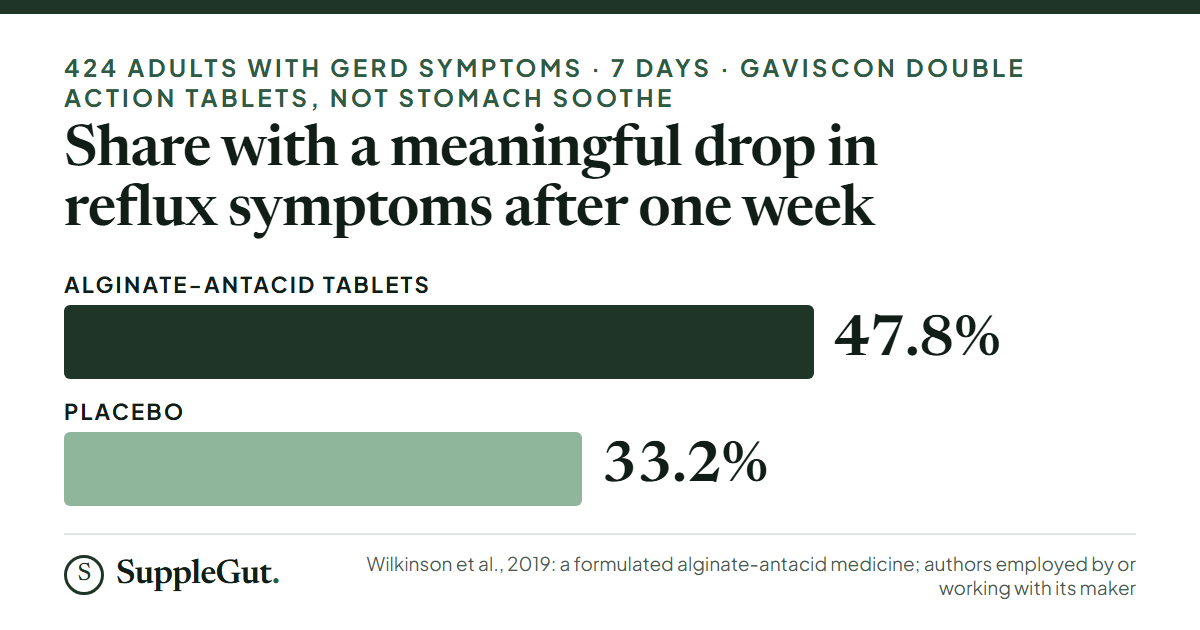
Does Stomach Soothe work? We could find no trial of Stomach Soothe. The reflux trials of alginate used formulated alginate-antacid tablets: in one 424-adult, 7-day trial 47.8% had a meaningful symptom drop against 33.2% on placebo, but a 2020 meta-analysis of 11 trials found no significant pooled difference from placebo or antacids. This label lists sodium alginate with no amount and no carbonate, the L-glutamine (400 mg) has no reflux trial, and we found none for slippery elm or marshmallow root. Reviewers range from relief within weeks to more heartburn.
Stomach Soothe is a 12 oz pouch of powder from Soothe Naturals, a family-owned California company: apple, green banana, arrowroot, papaya, sodium alginate from seaweed, slippery elm bark and marshmallow root, plus L-glutamine, stirred into a few ounces of water. The label is a Supplement Facts panel, but the brand’s ads and Amazon copy use heartburn and acid reflux wording. The one ingredient with reflux trials behind it is alginate, and those trials were of antacid medicines. This page sets out what the label prints, what the alginate trials tested, and what the reviews and terms say.
What Stomach Soothe is, and what it is not
One serving is 1 tablespoon (11.5 g), and the pouch lists about 30. Of that, 11.1 g is a single “Soothe Naturals Blend” of seven ingredients in the order whole apple, green banana, arrowroot, papaya, sodium alginate, slippery elm and marshmallow root, with no amount printed for any of them; the label does not say the order is by weight. Only L-glutamine has its own figure, 400 mg. The tablespoon has 40 calories, 3 g of dietary fiber, 1 g of sugar from the fruit and 25 mg of sodium. The brand’s site adds that kudzu root is currently left out because of sourcing issues.
Two things are absent. There is no carbonate or bicarbonate on the panel, which the formulated alginate antacids used in reflux trials contain, and there is no allergen or facility statement, so we treat allergens as undisclosed. The label is not an antacid’s Drug Facts panel, and the product is not sold as an over-the-counter medicine.
The trial of the product itself
We found none. The brand’s pages cite no study and say only that it has helped thousands of people, without data. Its claims, as printed, include “Prevent and relieve acid reflux & indigestion” in ads and “gut repair” and “leaky gut formula” in Amazon bullets; we found no trial of Stomach Soothe for any of them.
The evidence for the ingredients
Alginate. The reflux trials are of formulated alginate-antacid products, mainly Gaviscon, in which sodium alginate is combined with sodium bicarbonate and calcium carbonate so that a gel “raft” forms over the stomach contents. We found no trial of a food-grade sodium alginate powder without an antacid base, and no trial of this blend. The main results:
| Study | What it compared | Result |
|---|---|---|
| Wilkinson et al., 2019 | Gaviscon Double Action tablets against placebo, 424 adults, 7 days | 47.8% against 33.2% with a meaningful symptom drop (OR 1.85, 1.23 to 2.78); authors employed by or working with the maker |
| Leiman et al., 2017 | 14 trials, 2,095 people | Against placebo or antacids, OR 4.42 (2.45 to 7.97); against PPIs or H2 blockers, OR 0.58 (0.27 to 1.22), not significant |
| Zhao et al., 2020 | 11 randomized trials | No significant pooled difference from placebo or antacids for heartburn, regurgitation or dyspepsia |
| Xu and Zhuang, 2024 | PPI plus alginate against PPI alone, 4 trials, 608 people | No significant difference (heartburn score SMD −0.29, −0.78 to 0.19) |
A 1,107-person Chinese trial of the same tablet (Sun et al., 2015) was retracted in 2018 for protocol deviations at some sites (retraction notice); we did not check whether the meta-analyses included it. The trial doses were two tablets four times a day for a week, and the abstracts do not print the alginate per dose, so a milligram comparison with Soothe’s unprinted amount is not possible.
L-glutamine. We found no human trial for heartburn or reflux. In rats with surgically induced reflux esophagitis, glutamine given into the stomach at 750 to 1,500 mg/kg made the lesions worse in a dose-dependent way (Nagahama et al., 2012). The label’s 400 mg is about 5.7 mg/kg for a 70 kg adult, roughly 130 times lower by body weight, and the model was acute and surgical, so it does not show what happens in people at the label dose.
Slippery elm and marshmallow root. We found no randomized trial of either for heartburn or reflux. Both contain mucilage, a gel-forming fiber that sellers say coats the esophagus. The nearest human data is a 31-person open-label pilot in IBS of two multi-herb formulas that each contained slippery elm, which cannot separate the herb from the other ingredients or from placebo (Hawrelak and Myers, 2010). For apple, green banana, arrowroot and papaya we found no reflux trial; they supply the 3 g of fiber.
How to take Stomach Soothe
The directions are 1 to 2 tablespoons stirred into 2 to 4 oz of water to a thick consistency, drunk right away, daily on an empty stomach, ideally in the morning, with 25 to 30 minutes before eating, and also on the spot during the day. The brand suggests a handheld frother. The 30-serving count assumes one tablespoon; at two a pouch lasts about 15 days. The reviews run from relief within a few weeks to none after a month, so a month at the label dose is a reasonable test.
Side effects and who should not take it
The label prints no warnings beyond the FDA disclaimer. The brand’s FAQ says it is generally safe in pregnancy with a physician’s advice and can be used alongside PPIs. Herbal sellers say mucilage herbs can slow the absorption of other pills and advise spacing them, a point we found only in secondary sources; a pharmacist can say how to space a specific medicine. The NIH LactMed entry for marshmallow root notes no safety data for breastfeeding. Brand-site reviewers report more heartburn, diarrhea, stomach discomfort and, in one case, a racing heart, and some report no change.
What the reviews say
The brand’s site shows 4.53 from 3,667 reviews in a Judge.me widget it hosts: 69% five-star, 20% four, 8% three, 2% two and 2% one. Amazon shows 4.1 from 459 ratings (64%, 12%, 10%, 2% and 12% one-star), sold by a third-party seller with review text behind a sign-in. The brand-site feed includes reviews dated 2021 and 2022, although the product record was created in November 2022. We found no Trustpilot profile.
The recurring praise is heartburn easing over days to weeks (including coffee tolerated again), an easy stir, and a gentle formula with extra fiber. The recurring complaints are more heartburn or other symptoms, no change, and the taste and thickness.
The subscription and refund terms
The page prints beside the buy button: “By subscribing, you’re entering a commitment to receive at least 2 orders before cancellation. All subscription purchases are final and not eligible for refunds or returns,” and suggests a one-time purchase first. The 45-day money-back guarantee carries “restrictions apply”: a return is accepted within 45 days of receiving the order, no return label is provided, and only one refund per product is given per address. We found no separate subscription-terms page. One brand-site reviewer reports no response to a return request, and we found no independent billing or refund complaints, which is an absence of data, not evidence either way. A single pouch can be bought once, on the brand site or on Amazon.
Who Stomach Soothe is for
- Someone who prefers a stir-in powder with fruit fiber and herbs over a tablet or capsule.
- Someone taking it on an empty stomach in the morning and giving it a month.
- Someone who has read the alginate evidence above and wants the seaweed ingredient in a food-style form.
The reflux guide covers the options with their own trial evidence. The catalog pages are Hartspan KHelp, a single-ingredient alginate capsule, and Natural Factors Chewable DGL, and the Liáo Herbal guide sets out another herbal reflux product the same way.
Cost
A pouch is $39.00 one time, which is $1.30 a day at one tablespoon and $2.60 at two. Subscribing is $35.00 ($1.17 a day) with free shipping, three pouches are $99.00 ($1.10), and free shipping applies from $65. The shipping charge on a single pouch is not stated. Amazon lists $46.00 ($1.53) from a third-party seller.
The products in this catalog
Common questions
Does Stomach Soothe work for heartburn?
No trial of Stomach Soothe was found. Reflux trials of alginate used formulated alginate-antacid tablets: a 7-day trial of 424 adults found 47.8% against 33.2% on placebo had a meaningful symptom drop, while a 2020 meta-analysis found no significant pooled difference from placebo or antacids. The label lists sodium alginate with no amount and no carbonate, and we found no reflux trial of its L-glutamine, slippery elm or marshmallow root.
Is Stomach Soothe safe, and what are the side effects?
The label prints no warnings. The brand says it is generally safe in pregnancy with a physician’s advice and can be used alongside PPIs. Brand-site reviewers report heartburn, diarrhea, stomach discomfort and, in one case, a racing heart, and herbal sellers say mucilage herbs can slow absorption of other pills, so a pharmacist can say how to space doses.
Can I take Stomach Soothe with a PPI like omeprazole?
The brand says Stomach Soothe can be used alongside PPIs. In the alginate meta-analyses, adding alginate to a PPI made no significant difference in heartburn (SMD −0.29, 95% CI −0.78 to 0.19, four trials), and those trials used alginate-antacid medicines, not this powder. A pharmacist can advise on timing, and the reflux guide covers options with their own evidence.
Stomach Soothe vs Gaviscon: is it the same thing?
Both contain alginate from seaweed, but Gaviscon is an antacid medicine that combines alginate with bicarbonate and calcium carbonate, and it was the product tested in reflux trials. Stomach Soothe is a Supplement Facts powder of fruit, root, bark and herb ingredients with sodium alginate in an unitemized 11.1 g blend and no carbonate. We found no head-to-head comparison.
How much does Stomach Soothe cost?
A 12 oz pouch is $39.00 one time, which is $1.30 a day at one tablespoon and $2.60 at two. Subscribing is $35.00 ($1.17 a day) with free shipping, and three pouches are $99.00. Amazon lists $46.00 from a third-party seller.
What is the Stomach Soothe refund policy, and can I cancel a subscription?
The brand offers a 45-day money-back guarantee with “restrictions apply”, no return label and one refund per product per address. Subscriptions require at least two orders before cancelling and are final sales with no refunds or returns, and the brand suggests starting with a one-time purchase. We found no Trustpilot profile, so there is no independent record of billing complaints either way.
Sources
- Wilkinson J, Wade A, Thomas SJ, et al. “Randomized clinical trial: a double-blind, placebo-controlled study to assess the clinical efficacy and safety of alginate-antacid (Gaviscon Double Action) chewable tablets in patients with gastro-oesophageal reflux disease.” European Journal of Gastroenterology & Hepatology, 2019;31(1):86–93. doi.org/10.1097/MEG.0000000000001258
- Leiman DA, Riff BP, Morgan S, et al. “Alginate therapy is effective treatment for GERD symptoms: a systematic review and meta-analysis.” Diseases of the Esophagus, 2017;30(5):1–9. doi.org/10.1093/dote/dow020
- Zhao CX, Wang JW, Gong M, et al. “Efficacy and safety of alginate formulations in patients with gastroesophageal reflux disease: a systematic review and meta-analysis of randomized controlled trials.” European Review for Medical and Pharmacological Sciences, 2020;24(22):11845–11857. doi.org/10.26355/eurrev_202011_23841
- Xu X, Zhuang P. “A Meta-analysis of PPIs Plus Alginate Versus PPIs Alone for the Treatment of GERD.” Journal of Voice, 2024;40(4):1146–1153. doi.org/10.1016/j.jvoice.2024.02.011
- Sun J, Yang C, Zhao H, et al. Gaviscon Double Action versus placebo, Alimentary Pharmacology & Therapeutics, 2015;42(7):845–854, retracted: Aliment Pharmacol Ther, 2018;48(9):1039. doi.org/10.1111/apt.15018
- Nagahama K, Nishio H, Yamato M, Takeuchi K. “Orally administered L-arginine and glycine are highly effective against acid reflux esophagitis in rats.” Medical Science Monitor, 2012;18(1):BR9–15. doi.org/10.12659/MSM.882190
- Hawrelak JA, Myers SP. “Effects of two natural medicine formulations on irritable bowel syndrome symptoms: a pilot study.” Journal of Alternative and Complementary Medicine, 2010;16(10):1065–1071. PubMed 20954962
- NIH LactMed, “Marshmallow” (PubMed 30000899)
- Brand pages: label, directions, price, claims, refund policy and subscription terms (soothenaturals.co/products/stomach-soothe, refund policy); Amazon listing: price and ratings (amazon.com/dp/B0G59PYN3W)
Not sure which product fits your situation?
This guide covers the mechanics. The quiz takes your specific symptoms, routine and preferences and matches you to one product from the catalog.
Take the quiz →