Guide
Does Traditional Medicinals Gas Relief Tea work? Five herbs at 300 mg each, and trials of oils and extracts rather than tea bags
Quick answer
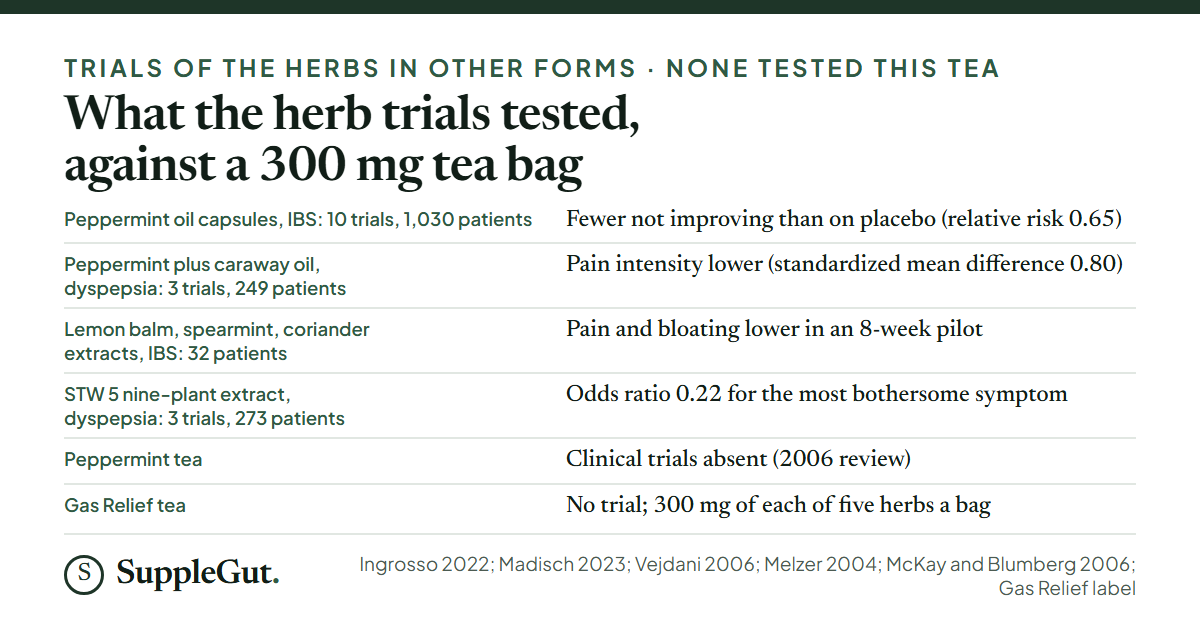
Does Traditional Medicinals Gas Relief Tea work? No trial of the tea was found. Its herbs have trials as oils and extracts: peppermint oil in 10 IBS trials (1,030 patients), a peppermint and caraway oil combination in 3 dyspepsia trials (249 patients), and a lemon balm, spearmint and coriander extract in a 32-person IBS pilot. A bag holds 300 mg of each of five herbs, far from those forms and doses. Amazon shows 4.5 from 1,766 ratings, and the brand directs 1 to 4 cups a day.
Traditional Medicinals Organic Gas Relief Tea is a caffeine-free bag of five dried herbs (caraway, coriander, chamomile, lemon balm and peppermint) sold for gas and bloating. Each herb has a long history as a carminative, a traditional term for an herb used to ease gas, and some of them have trials. Those trials used oils and concentrated extracts, not a tea bag. This page covers the printed amounts, the research on the herbs, the brewing directions, the label cautions, the reviews and what a cup costs.
Five herbs at 300 mg each: reading the panel
The Supplement Facts panel lists five organic herbs in this order: caraway fruit, coriander fruit, chamomile flower, lemon balm leaf and peppermint leaf. Each is printed at 300 mg per tea bag, 1,500 mg in all, which matches the box weight of 24 g across 16 bags (1.5 g a bag). The panel shows no proprietary blend and no sweetener, flavor or other added ingredient, and no laxative herb such as senna or cascara appears. The brand lists the tea as caffeine free and certified organic by CCOF, and Amazon adds Non-GMO and kosher. No testing laboratory or certificate of analysis is published.
The box front reads “Herbal Supplement,” which is why a Supplement Facts panel is printed on a tea. The brand says the formula relieves gas and bloating and has been used to support digestion for thousands of years, with an asterisk pointing to the usual traditional-use statement. Its herb cards file chamomile, lemon balm and peppermint under carminative and antispasmodic, among other traditional labels.
Peppermint and caraway oil: the dyspepsia and IBS trials
The closest research to the pairing of peppermint and caraway is a capsule called Menthacarin, a peppermint oil and caraway oil combination. A 2023 systematic review found 5 randomized trials in 580 patients with functional dyspepsia, the recurring upper-stomach pain and fullness with no structural cause. In the meta-analysis of 3 trials in 249 patients, pain intensity fell more on the oil combination (standardized mean difference 0.80, 95% confidence interval 0.39 to 1.21). Several authors work for or receive honoraria from the manufacturer, Dr. Willmar Schwabe (Madisch et al., Digestive Diseases, 2023).
Peppermint oil alone has the larger record in irritable bowel syndrome (IBS). A 2022 meta-analysis pooled 10 randomized trials in 1,030 patients. The relative risk of not improving was 0.65 for global symptoms (number needed to treat 4) and 0.76 for abdominal pain (number needed to treat 7). Adverse events were more frequent on the oil, and the authors rated the quality of evidence very low (Ingrosso et al., Alimentary Pharmacology & Therapeutics, 2022). The peppermint tea and IBS guide goes through those trials in more detail.
Both bodies of work test an oil, delivered in a capsule, in people with a diagnosed disorder. A tea bag for an occasional gassy evening is a different product and a different population.
Lemon balm, coriander and the multi-herb extracts
Two herbs in this bag, lemon balm and coriander, appear together in a small trial. Carmint is a product holding total extracts of lemon balm, spearmint and coriander. In a pilot of 32 people with IBS, Carmint or placebo was taken for eight weeks alongside loperamide or psyllium, depending on bowel pattern. The severity and frequency of abdominal pain were lower on Carmint (P = 0.016 and P = 0.001), as were the severity and frequency of bloating (P = 0.02 and P = 0.002). The authors describe it as a pilot, and spearmint, which is not in Gas Relief, was part of the formula (Vejdani et al., Digestive Diseases and Sciences, 2006). A PubMed search on coriander with IBS, dyspepsia, bloating or colic returned no human trial of coriander alone.
A larger multi-herb reference point is STW 5 (sold as Iberogast), a liquid extract of nine plants that includes peppermint leaf, chamomile flower, caraway fruit and lemon balm. A pooled analysis of three placebo-controlled trials in functional dyspepsia (138 people on STW 5, 135 on placebo) found an odds ratio of 0.22 (95% confidence interval 0.11 to 0.47) for the most bothersome symptom (Melzer et al., Alimentary Pharmacology & Therapeutics, 2004). It shares four of the five herbs, but it is a nine-plant liquid extract, not a five-herb tea.
Chamomile and lemon balm: what is and is not studied
A PubMed search for chamomile with irritable bowel, dyspepsia, bloating or gas and randomized trials returned no adult gut trial of chamomile. The nearest human work is in infants with colic, and it tested blends. In 93 breastfed colicky infants, a standardized extract of chamomile, fennel and lemon balm given twice a day for one week cut daily crying time from 201 to 77 minutes, against 199 to 170 minutes on placebo (88 infants completed it; Savino et al., Phytotherapy Research, 2005). A 1993 trial of an herbal tea preparation reported that colic was eliminated in 19 of 33 infants (57%) against 9 of 35 (26%) on placebo (Weizman et al., Journal of Pediatrics, 1993).
Those are infants, not adults, and mixtures, not chamomile or lemon balm alone. The brand lists both herbs as nervine, a traditional word for calming herbs, and that reputation is the reason they appear in a formula for symptoms that tend to flare with tension. No adult trial in this search tested that idea with these two herbs.
Has anyone tested the tea, and how does a bag compare with the trial doses?
A PubMed search for the brand name with gas relief, chamomile mint, or the herbs together as a tea found no trial, and the brand’s page cites none. A 2006 review of peppermint tea states that human studies of peppermint leaf are limited and that clinical trials of peppermint tea are absent (McKay and Blumberg, Phytotherapy Research, 2006). A newer search turned up no peppermint-tea trial either.
The doses differ in kind. A bag holds 300 mg of each dried herb, and none of the trials above used a 300 mg herb bag: they used oils, extracts concentrated from the plants, or a nine-plant liquid. Several of these herbs contain volatile oils (carvone, menthol, bisabolol) that relax gut muscle in laboratory studies. A steeped bag releases a small and unmeasured share of those oils. The label lets you check the five herbs and their milligrams, but it cannot show how much oil ends up in the cup.
A missing trial is not a negative result. It means the question has not been measured for this tea, so the trial findings above describe the herbs in other forms and say nothing for or against a cup.
How to brew it
The brand’s directions: pour 8 oz of freshly boiled water over one bag, cover and steep for 10 to 15 minutes, squeeze the bag, and drink 1 to 4 cups a day. Covering the cup keeps more of the volatile oils in the water rather than letting them escape with the steam. Amazon’s listing gives only a short line (“steep the tea bag in hot water”), so the brand’s page holds the full instructions. The label names no time of day and does not say whether to take it with food. Four cups would mean 1,200 mg of each herb, 6,000 mg in all, spread across the day.
Side effects and the cautions printed on the label
The panel asks you to consult a healthcare practitioner if symptoms persist or worsen, and before use if you have gallstones or are experiencing acute abdominal pain, if you have a hiatal hernia or acid reflux, or if you are pregnant or breastfeeding. It also says not to use the tea if you are allergic to plants in the parsley family (Apiaceae, which includes caraway and coriander) or the daisy family (Asteraceae, which includes chamomile). Amazon’s safety line adds “avoid contact with skin and eyes.” No medication line is printed.
The reflux and hiatal hernia lines connect to a known issue with peppermint, covered in the peppermint tea guide. In the reviews read, no side-effect pattern shows. Of 131 taste mentions in Amazon’s review summary, 14 are negative, and those concern flavor.
What reviewers say
The 16-bag Amazon listing shows 4.5 out of 5 from 1,766 ratings: 76% five-star, 12% four, 8% three, 1% two and 3% one. The 3-pack listing shows 4.6 from 294. iHerb shows 4.6 from 4,653 reviews as listed in its search results. The brand’s own review widget shows 4.79 from 28 reviews, 27 of them marked verified buyer, spanning 2014 to 2026. That is a feed the brand hosts, so it is a separate kind of figure from the two retailer scores. Trustpilot has an unclaimed profile for the brand with two reviews, neither about this tea.
Amazon’s summary of review text counts 82 mentions of effectiveness (65 positive, 17 negative), 131 of taste (117 positive, 14 negative), 69 of how soothing it is (62 positive, 7 negative) and 18 of value (14 positive, 4 negative). Praise centers on gas and bloating easing within a cup or so, with a few reviewers describing relief in 5 to 10 minutes, a mild minty flavor that needs no sweetener, and a calming cup after meals. The complaints are a tea that did not work for them, the price of 16 bags, fragile bags or a damaged box, and, in one outside review, a sour aftertaste. One reviewer drinking it during an IBS flare said nothing was easing the pain, so could not judge it.
What a cup costs, and who sells the box
| Where | Price | Bags | Per cup |
|---|---|---|---|
| Brand store, 1 box | $7.49 | 16 | $0.47 |
| Brand store, 3-pack | $20.97 | 48 | $0.44 |
| Brand store, 6-pack | $41.94 | 96 | $0.44 |
| iHerb, 1 box | $6.99 | 16 | $0.44 |
| Amazon 3-pack (third-party seller) | $20.97 | 48 | $0.44 |
The Amazon single-box listing, the one with the 1,766 ratings, shows no featured offer, and Amazon is not the seller of record on either Gas Relief listing. The 3-pack comes from a third-party seller whose page lists it as non-returnable for food-safety reasons. The brand’s store offers a subscription at intervals of 1, 2, 3 or 6 months that can be canceled up to 48 hours before the next shipment; the page text does not state the discount. No billing or refund complaint appears in the reviews read. Since the brand directs 1 to 4 cups a day, a box lasts between 4 and 16 days.
Gas Relief beside the brand’s peppermint tea and fennel
The brand’s own Organic Peppermint Tea is one herb at 1,500 mg of peppermint leaf a bag, which is five times the 300 mg of peppermint in Gas Relief. Gas Relief spreads the same bag weight over five herbs. Neither has a trial as a tea. Amazon shows 4.7 from 3,922 ratings for the peppermint tea, and one reviewer on the brand’s site rated Gas Relief three stars after switching back to peppermint, saying the flavor was good but the tea did not work for them.
Fennel is not in this bag. The brand sells a separate single-ingredient fennel seed tea at 2,000 mg a bag, and the Nature’s Way Fennel Seed Capsules hold ground fennel seed, whose only adult trial used the essential oil paired with curcumin. Traditional Medicinals Organic Chamomile Tea covers chamomile on its own.
Who Gas Relief Tea is for
- Someone who wants a caffeine-free, multi-herb cup with every amount printed, in a bag with no sweetener or added flavor.
- Someone comfortable with the research base: trials of the herbs as oils and extracts, and none of this tea.
- Someone who does not have the conditions or allergies the label lists, or who has checked with a practitioner first.
- Someone who wants a flexible, as-needed dose, since the directions run from 1 to 4 cups a day.
If nausea is the main complaint rather than gas, the ginger tea guide covers that herb. For a starting point based on your own symptoms, the quiz begins from your answers.
The catalog entries behind this guide
Common questions
Will a cup of Gas Relief tea ease bloating?
No trial of the tea was found. Reviewers on Amazon and the brand’s site mostly say it eases gas and bloating within a cup or so (4.5 from 1,766 Amazon ratings), and 17 of 82 effectiveness mentions in Amazon’s review summary are negative. The research on its herbs is in oils and extracts, not tea bags.
Which herbs are in a bag, and how much of each?
Five organic herbs at 300 mg each per bag: caraway fruit, coriander fruit, chamomile flower, lemon balm leaf and peppermint leaf, 1,500 mg in all. There is no caffeine, sweetener or added flavor, and no laxative herb.
How long should the bag steep, and how many cups a day?
The brand directs one bag in 8 oz of freshly boiled water, covered, for 10 to 15 minutes, squeezing the bag at the end, and 1 to 4 cups a day. At four cups, the total is 1,200 mg of each herb.
Who is asked to check with a practitioner before drinking it?
The label asks for a practitioner’s advice before use if you have gallstones or acute abdominal pain, a hiatal hernia or acid reflux, or are pregnant or breastfeeding, and if symptoms persist or worsen. It says not to use it with an allergy to parsley-family or daisy-family plants.
What does one cup cost?
A 16-bag box is $7.49 on the brand’s store, about $0.47 a cup, and $6.99 on iHerb, about $0.44. The brand’s 3-pack and 6-pack, and a third-party Amazon 3-pack, all work out to about $0.44 a cup.
How is it different from plain peppermint tea?
Gas Relief splits its bag across five herbs at 300 mg each, so it has 300 mg of peppermint, against 1,500 mg in the brand’s single-herb peppermint tea. Neither has a trial as a tea. The peppermint tea page has that label.
Is the box a tea or a supplement?
The box front reads “Herbal Supplement” and carries a Supplement Facts panel with the milligrams of each herb, even though it is sold and brewed as a tea. It has no caffeine and is certified organic by CCOF.
Sources
- Madisch A, Frieling T, Zimmermann A, et al. “Menthacarin, a Proprietary Peppermint Oil and Caraway Oil Combination, Improves Multiple Complaints in Patients with Functional Gastrointestinal Disorders: A Systematic Review and Meta-Analysis.” Digestive Diseases, 2023;41(3):522–532. PubMed 36502789
- Ingrosso MR, Ianiro G, Nee J, et al. “Systematic review and meta-analysis: efficacy of peppermint oil in irritable bowel syndrome.” Alimentary Pharmacology & Therapeutics, 2022;56(6):932–941. PubMed 35942669
- McKay DL, Blumberg JB. “A review of the bioactivity and potential health benefits of peppermint tea (Mentha piperita L.).” Phytotherapy Research, 2006;20(8):619–633. PubMed 16767798
- Vejdani R, Shalmani HRM, Mir-Fattahi M, et al. “The efficacy of an herbal medicine, Carmint, on the relief of abdominal pain and bloating in patients with irritable bowel syndrome: a pilot study.” Digestive Diseases and Sciences, 2006;51(8):1501–1507. PubMed 16868824
- Melzer J, Rösch W, Reichling J, et al. “Meta-analysis: phytotherapy of functional dyspepsia with the herbal drug preparation STW 5 (Iberogast).” Alimentary Pharmacology & Therapeutics, 2004;20(11–12):1279–1287. PubMed 15606389
- Savino F, Cresi F, Castagno E, et al. “A randomized double-blind placebo-controlled trial of a standardized extract of Matricariae recutita, Foeniculum vulgare and Melissa officinalis (ColiMil) in the treatment of breastfed colicky infants.” Phytotherapy Research, 2005;19(4):335–340. PubMed 16041731
- Weizman Z, Alkrinawi S, Goldfarb D, Bitran C. “Efficacy of herbal tea preparation in infantile colic.” Journal of Pediatrics, 1993;122(4):650–652. PubMed 8463920
- Traditional Medicinals Gas Relief Tea: product page, directions, and prices. traditionalmedicinals.com
- Gas Relief Tea Supplement Facts panel and warnings, from the brand’s panel provider. itsgot.com
- Amazon listings for Gas Relief Tea (ASIN B01LTI9DLS and 3-pack B07FPL5DK3): ratings, review summary, seller and price. amazon.com
- iHerb listing for Organic Gas Relief Tea, 16 bags: price and rating. iherb.com
Still deciding between products?
The guide gives the background. For a single answer, the quiz asks about your symptoms, your routine and what you have tried, then names one product.
Take the quiz →