
Guide
Does Yerba Prima psyllium work? One ingredient, a 5 g teaspoon, and the dose the trials used
Quick answer
Does Yerba Prima psyllium work? It is psyllium husk, the fiber with the clearest effect in constipation and IBS trials, with one ingredient and nothing added. No trial of this product exists, and the trials of psyllium used about 10 g a day, while one label teaspoon is 5 g (4.5 g of fiber). Two teaspoons reach the trial dose at about $0.59 a day, and iHerb rates the jar 4.7 from 775 ratings.
Yerba Prima Psyllium Husks Powder is one ingredient in a jar: psyllium husk, with nothing added. A level teaspoon is 5 g and carries 4.5 g of dietary fiber, 3.5 g of it soluble. That is the thing to know before anything else, because the psyllium trials that found an effect used about 10 g a day, so one label serving is about half of what they tested. This page sets out the label, the trials, what a day costs next to NOW and Metamucil, what the reviews say and what the brand’s missing website means.
What Yerba Prima psyllium is, and what it is not
The 12 oz jar (340 g) is labeled “Premium Dietary Fiber Supplement” and carries a Supplement Facts panel, not the Drug Facts panel on Metamucil’s regularity products. The serving is 1 teaspoon (5 g) and there are 68 servings in the jar. Per serving the panel lists 15 calories, 4.5 g of carbohydrate, 4.5 g of dietary fiber (3.5 g soluble, 1.0 g insoluble), and trace calcium, sodium and potassium. The ingredient line reads “Psyllium,” and the back adds no preservatives, no artificial flavor or color, and no added sugar, binders or fillers. The front carries a Gluten Free badge and a Non-GMO Project Verified seal.
The panel does not print a gram amount for the psyllium itself. With one ingredient and a 5 g serving, the husk is about 5 g, of which 4.5 g counts as fiber. It is not a probiotic, there is no sweetener or flavor, and the label makes no statement about milk, wheat, soy, nuts or other allergens beyond gluten, so cross-contact is simply not addressed. The jar also prints front-of-pack claims, including “Great for weight loss & maintenance” and “Doctor recommended,” each marked with an asterisk. We found no documentation for either claim in the sources we read, and the evidence below is about stool, IBS symptoms and cholesterol, not weight.
Is there a trial of the product?
No. A PubMed search for “Yerba Prima” returns no records and ClinicalTrials.gov lists no study. The ingredient is generic psyllium husk with no brand name or standardization stated, so every result below comes from trials of psyllium as a class, not of this jar. The same is true of NOW, Metamucil and most husk powders; the practical question is whether a serving of this product reaches the doses those trials used.
The evidence for psyllium, and the dose problem
The largest recent review pooled 16 randomized trials in 1,251 adults with chronic constipation. Of 473 people given fiber, 311 (66%) responded, against 134 of 329 (41%) on control, a risk ratio of 1.48. Psyllium and pectin were the fibers with significant effects, stool frequency and consistency both improved, and the authors concluded that psyllium, doses above 10 g a day and treatment of at least four weeks appeared optimal. Flatulence was higher on fiber (van der Schoot et al., American Journal of Clinical Nutrition, 2022).
For IBS, a 12-week primary-care trial of 275 adults compared 10 g a day of psyllium with 10 g of bran and a rice-flour placebo. Adequate relief was reported by 57% on psyllium against 35% on placebo in the first month, and 59% against 41% in the second; symptom severity fell by 90 points against 49 after three months (Bijkerk et al., BMJ, 2009). For cholesterol, a meta-analysis of 28 trials with a median dose of about 10.2 g a day found LDL cholesterol lower by 0.33 mmol/L (Jovanovski et al., American Journal of Clinical Nutrition, 2018). A smaller four-week trial in 79 adults with constipation used 12 g a day of psyllium and reported more complete spontaneous bowel movements and less straining, with adverse events most common on psyllium.
Against those figures, one teaspoon of this product is 5 g of husk. Two teaspoons a day is 10 g, the dose of the IBS trial and the threshold in the constipation review; three teaspoons is 15 g. The jar’s own heart-health direction is one serving a day with meals, half the median dose in the cholesterol meta-analysis.
How to take it
The label says to start with one serving a day, stir the teaspoon into at least 8 ounces (a full glass) of liquid, drink it right away, and increase gradually to the intake wanted. It adds “Use every day for best results.” The Amazon listing prints a fuller range: one rounded teaspoon, one to three times a day, building to three servings a day if needed. If minor gas or bloating occurs, the label says to reduce the amount until the body adjusts.
Reaching the trial dose therefore means two or three servings, built up over a week or two. The constipation review put the clearest effect on stool frequency at four weeks or more, which is the length of a fair test. The timing questions (how many hours before the first bowel movement, what to expect at four weeks) are covered in how long psyllium takes to work, and Metamucil’s own dosing is in Metamucil dosage.
Side effects and who should not take it
The warning block is the standard psyllium one. The label says not to take the product with difficulty swallowing, and not if allergic to any ingredient; to seek immediate medical attention for difficulty swallowing or breathing afterward; and that consuming it without enough liquid may cause choking. It also says not to take it within 1 to 2 hours of prescription medications, and to consult a health professional first if taking medication or under a doctor’s care. No pregnancy or nursing statement is printed. Amazon’s listing adds that a small percentage of people exposed to psyllium dust at work may develop a sensitivity.
Gas and bloating are the common early effects, and the constipation review measured more flatulence on fiber (standardized difference 0.80). The retailer text also carries a California Proposition 65 notice, and the jar notes that psyllium products, like most agricultural products, contain some chemicals the plants absorb from the soil. It does not name the chemical. The jar has no laboratory-testing or heavy-metal statement and no certificate of analysis; one reviewer claims low lead in testing, with no source given.
Price against NOW and Metamucil
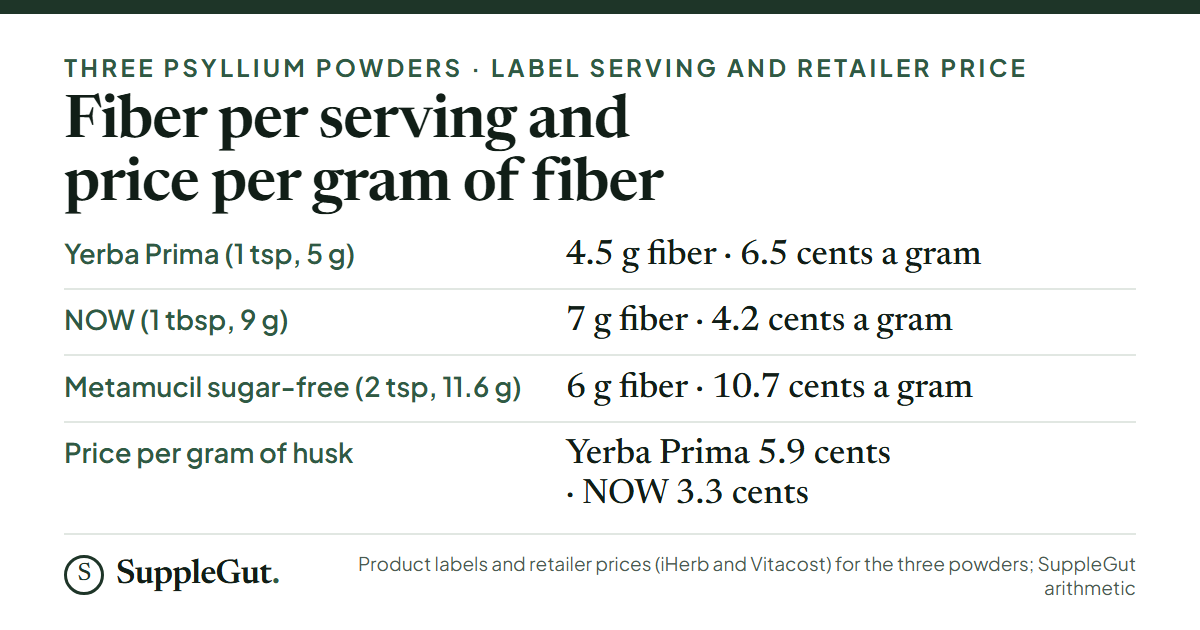
At $19.99 for 68 servings the jar costs about $0.29 a day at one teaspoon and about $0.59 a day at the two-teaspoon trial dose; three teaspoons is about $0.88. Per gram, the figures below use each retailer price and each label’s printed serving.
| Product | Serving | Fiber per serving | Price | A day at one serving | Per gram of husk | Per gram of fiber |
|---|---|---|---|---|---|---|
| Yerba Prima Psyllium Husks Powder | 1 tsp (5 g) | 4.5 g | $19.99 / 340 g | $0.29 | 5.9 cents | 6.5 cents |
| NOW Psyllium Husk Powder | 1 tbsp (9 g) | 7 g | $11.30 / 340 g | $0.30 | 3.3 cents | 4.2 cents |
| Metamucil 4-in-1 Sugar-Free Orange | 2 tsp (11.6 g) | 6 g | $23.10 / 15 oz | $0.64 | Not printed | 10.7 cents |
Yerba Prima and NOW are both single-ingredient husk powders. Per gram of husk, Yerba Prima is about 1.8 times NOW’s price. The similar daily figures at one serving ($0.29 and $0.30) hide that the amounts differ: 4.5 g of fiber in one case and 7 g in the other. Metamucil’s powder is flavored and sweetened and does not print psyllium grams, so only the fiber-gram comparison is like for like. The side-by-side with the plainer powder is at psyllium husk vs Metamucil, and the general buying questions are in which psyllium husk to buy. For a flavored psyllium from a direct-to-consumer brand, see the ColonBroom page.
The same product also comes as 625 mg capsules, four to a serving. That serving holds 2.5 g of husk and 2.2 g of fiber, and at $18.99 for 180 capsules it works out at about $1.69 a day for 10 g of husk (16 capsules).
What the reviews say
The largest independent pool is iHerb: 4.7 from 775 ratings, 641 of them five-star and six one-star. Vitacost shows 175 ratings averaging about 4.7, but those are syndicated from iHerb and add no new evidence. Amazon lists the powder on two pages, 4.4 from 709 ratings and 4.5 from 563, both sold by a third-party seller rather than the brand, and Walmart shows 4.6 from 29 reviews. The brand has no review pool of its own, and Trustpilot has no profile for it.
The recurring praise is regularity and easier bowel movements, a fine powder that mixes with little clumping and a mild taste, and a single ingredient with no sugar or additives at a modest price. Reviewers who bake with it, mostly low-carb and gluten-free cooks, praise the grind. The recurring complaints are texture and swallowing (powder that does not mix well, or that is hard to get down, with some reviewers suggesting capsules instead), a small number of reports of constipation or a blocked feeling instead of relief, and a color change in baked goods. One-star ratings are about 0.8% on iHerb and 5% on Amazon.
The brand and its website
The label gives the company as Yerba Prima, Inc. of Ashland, Oregon, made in the U.S.A. The Better Business Bureau profile says the business started in 1980, rates it A+, shows it as not accredited, and lists no customer reviews and no complaints. The website printed on the jar, yerbaprima.com, currently redirects to an eBay store page that says the store was not found, so the label photographs on retailer pages are the source for everything on this page, and the brand’s own price, refund terms and subscription terms could not be read. iHerb offers an optional 5% Subscribe & Save price of $18.99; no billing or refund complaints turned up in the review sources we could read.
Who this product is for
- Someone who wants unflavored psyllium with a one-word ingredient list and is prepared to take two or three teaspoons to reach the trial dose.
- Someone starting psyllium for the first time, since the 5 g serving is a smaller first step than a 9 g tablespoon.
- Someone who bakes with psyllium and wants a fine grind.
- Someone who can drink a full glass with each dose and keep it two hours from prescription medicines.
Where price per gram of fiber decides, the NOW powder in the table is lower; where a flavored, single-serve format is what keeps the habit going, Metamucil is the familiar option. If the first question is which kind of supplement fits the symptom, the quiz starts from that.
The products in this catalog
Common questions
Does Yerba Prima psyllium husks powder work?
No trial of this product was found, but psyllium husk has trial evidence as an ingredient. A review of 16 trials in 1,251 adults with chronic constipation found psyllium effective, with the clearest effect above 10 g a day and at four weeks or more, and a trial of 275 adults with IBS found 10 g a day gave more relief than placebo (57% against 35% in the first month). One label serving is 5 g, so those doses are two or three servings.
How many teaspoons of Yerba Prima psyllium should you take a day?
The label says to start with one teaspoon (5 g) a day and increase gradually, and the Amazon listing gives one to three teaspoons a day. The IBS trial used 10 g, which is two teaspoons, and the constipation review put the clearest effect above 10 g a day. Each teaspoon needs a full glass (at least 8 ounces) of liquid. Our psyllium timing guide covers the first weeks.
How much fiber is in a teaspoon of Yerba Prima psyllium, and what else is in it?
A 5 g teaspoon has 4.5 g of dietary fiber, 3.5 g soluble and 1.0 g insoluble, with 15 calories. The only ingredient is psyllium; the label states no preservatives, artificial flavor or color, added sugar, binders or fillers, and shows a Gluten Free badge and a Non-GMO Project Verified seal. The panel is Supplement Facts, not Drug Facts.
What are the side effects, and who should not take Yerba Prima psyllium?
The label warns that taking it without a full glass of liquid may cause choking, says not to use it with difficulty swallowing, and says to keep it 1 to 2 hours apart from prescription medications. Minor gas or bloating can occur, and the constipation review found more flatulence on fiber. A small number of iHerb reviewers report constipation or a blocked feeling instead of relief.
How much does Yerba Prima psyllium cost, and where is it sold?
A 12 oz jar is $19.99 at iHerb, Vitacost and Amazon and $19.95 at Walmart, which is about $0.29 a day at one teaspoon (68 servings) and $0.59 at the two teaspoons used in the IBS trial. iHerb’s Subscribe & Save price is $18.99. The Amazon listings are sold by a third-party seller, Peak10 Health LLC.
Yerba Prima vs NOW psyllium and Metamucil: what is different?
Yerba Prima and NOW are both single-ingredient husk powders: 5 g with 4.5 g of fiber at about 5.9 cents a gram of husk, against 9 g with 7 g of fiber at about 3.3 cents. Metamucil’s sugar-free powder gives 6 g of fiber per serving at about 10.7 cents a gram of fiber, against 6.5 for Yerba Prima. The plain-powder comparison is at psyllium husk vs Metamucil.
Is the Yerba Prima website down?
The address printed on the jar, yerbaprima.com, currently redirects to an eBay store page that says the store was not found. The powder is sold through iHerb, Vitacost, Amazon and Walmart. The company lists an Ashland, Oregon address, and the Better Business Bureau profile shows an A+ rating, a 1980 start and no customer reviews or complaints.
Sources
- van der Schoot A, Drysdale C, Whelan K, Dimidi E. "The Effect of Fiber Supplementation on Chronic Constipation in Adults: An Updated Systematic Review and Meta-Analysis of Randomized Controlled Trials." American Journal of Clinical Nutrition, 2022;116(4):953–969. PMID 35816465. pubmed.ncbi.nlm.nih.gov/35816465
- Bijkerk CJ, de Wit NJ, Muris JW, et al. "Soluble or insoluble fibre in irritable bowel syndrome in primary care? Randomised placebo controlled trial." BMJ, 2009;339:b3154. PMID 19713235. pubmed.ncbi.nlm.nih.gov/19713235
- Jovanovski E, Yashpal S, Komishon A, et al. "Effect of psyllium (Plantago ovata) fiber on LDL cholesterol and alternative lipid targets, non-HDL cholesterol and apolipoprotein B: a systematic review and meta-analysis of randomized controlled trials." American Journal of Clinical Nutrition, 2018. PMID 30239559. pubmed.ncbi.nlm.nih.gov/30239559
- “Kiwifruit, psyllium or prunes in chronic constipation” (79 US adults, four weeks). American Journal of Gastroenterology, 2021. PMID 34074830. pubmed.ncbi.nlm.nih.gov/34074830
- Yerba Prima Psyllium Husks Powder: Supplement Facts, directions, warnings and price as printed on the jar and the iHerb listing. iherb.com
- Vitacost listing: label text, Proposition 65 notice, price and syndicated reviews. vitacost.com; capsule label and price: vitacost.com
- Amazon listings: directions, price and ratings. amazon.com/dp/B000EQ0W30, amazon.com/dp/B00012NG1W
- Walmart listing: price and ratings. walmart.com
- Better Business Bureau profile: Yerba Prima, Ashland, Oregon. bbb.org
- NOW Psyllium Husk Powder and Metamucil 4-in-1 Sugar-Free Orange: label and price for the comparison. NOW, Metamucil
Not sure which product fits your situation?
This guide covers the mechanics. The quiz takes your specific symptoms, routine and preferences and matches you to one product from the catalog.
Take the quiz →