Daily gut routine
BioSchwartz Probiotic 40 Billion CFU with Organic Prebiotics
A four-strain Lactobacillus and Bifidobacterium capsule with a small amount of agave prebiotic, taken as two capsules a day.
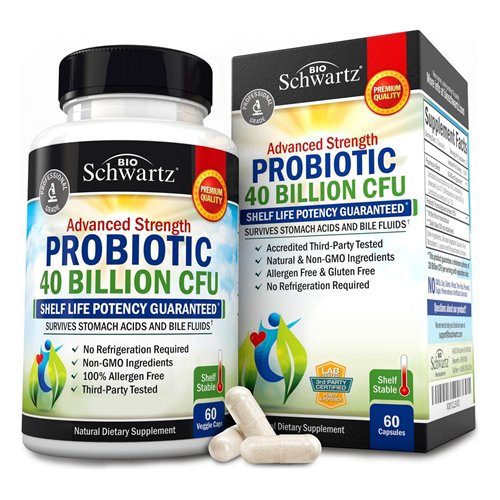
- Format
- Capsule, once a day
- Type
- Probiotic and prebiotic
- Cost
- See the price on Amazon
- Customer rating
- See the reviews on Amazon
Not sure it suits your symptoms? The quiz matches one product to you in one to three minutes.
The mechanism, as the brand describes it
The four strains are lactic-acid-producing bacteria that are thought to add to the gut’s own populations while taken and to influence digestion and the gut lining. The capsule is described as delayed release, meant to carry the bacteria past stomach acid, and the brand adds that the blend survives stomach acids and bile fluids. FOS is a fiber that Bifidobacterium and Lactobacillus can ferment, which the brand includes as food for the strains; at 50 mg the amount is small. Trials of other strain blends suggest any effect on bloating is modest and varies by person. What the label does not let you check is how many of each strain are in the capsule, how many remain alive at expiry on the current formula, and whether the delayed-release claim has been tested on this capsule.
What has actually been tested
No trial of this product or of this exact four-strain blend was found. Two of its four strain codes, Lpc-37 and Bl-04, were in a five-strain blend tested in 156 adults with bloating and functional constipation; that placebo-controlled trial did not meet its bloating endpoint and the placebo performed similarly, though flatulence was lower on the probiotic in a post-hoc analysis. The other two codes, La-14 and Lp-115, have no human gut trial. Class-level IBS reviews of multi-strain probiotics show small improvements in bloating and flatulence in people with IBS.
What the panel prints, and what it leaves out
All four organisms carry strain codes, which lets a reader look up each strain, but the panel gives one 184 mg blend weight and one 40 billion CFU figure measured at the time of manufacture, with no per-strain counts. Earlier versions of the label printed a 20 billion CFU minimum until expiry; the current panel image does not. The brand states third-party testing but names no laboratory and posts no certificate of analysis, and the 50 mg of FOS is a small prebiotic amount.
When it makes sense
In the quiz it comes up for people who describe bloating and general abdominal discomfort. It fits someone whose priority is day-to-day comfort or a steady daily routine. Which product the quiz lands on also turns on what you have already tried, the format you prefer, and any exclusions that apply to you.
Where it falls short of the brief
The dietary claims the label makes are gluten-free. One group does not see Probiotic 40 Billion CFU with Organic Prebiotics in their results: people pregnant or breastfeeding or taking prescription medication. The product is not the problem; the person who should decide is. It is a capsule taken once a day, every day, and the quiz asks whether that is a routine you will keep.
Side effects and what to be aware of
The label advises asking a healthcare provider before use if pregnant, nursing, with a medical condition or on any medication, and says it is for adults only.
Questions people ask
Does BioSchwartz Probiotic 40 Billion CFU work?
Nothing in the trial registries tests BioSchwartz Probiotic 40 Billion CFU with Organic Prebiotics itself. Two of its strain codes, Lpc-37 and Bl-04, were in a five-strain blend tested in 156 adults with bloating and functional constipation; the trial did not meet its bloating endpoint, and flatulence was lower on the probiotic only in a post-hoc analysis.
Is BioSchwartz probiotic safe, and what are the side effects?
The bottle advises consulting a healthcare provider before use if you are contemplating pregnancy, pregnant, nursing, have a medical condition or use any medication, and says it is for adult use only. The brand’s Amazon text lists temporary bloating, gas, stomach pain, nausea, diarrhea, constipation, rashes and headache as possible effects.
How much does BioSchwartz Probiotic 40 Billion CFU cost?
A 60-capsule bottle is 30 servings of two capsules. The brand site charges $27.59 ($0.92 a day), or $24.83 ($0.83 a day) on a recurring order; its 120-capsule bottle is $41.99, or $0.70 a day.
BioSchwartz vs Physician’s Choice probiotic: what is different?
Neither has a trial of its own formula in the sources read. BioSchwartz prints a strain code for all four organisms, so each can be looked up, with 40 billion CFU at manufacture on a proprietary blend and no per-strain counts. The class-level evidence for multi-strain probiotics in IBS is small improvements in bloating and flatulence.
Does BioSchwartz have a refund policy, and how many CFU are left at expiry?
The brand states a satisfaction guarantee with a refund through its support email or phone line, limited to one refund per formula per account, with unopened bottles required for returns of additional bottles and the customer paying return shipping; no number of days is stated. The current label gives 40 billion CFU at time of manufacture only; earlier labels printed a 20 billion minimum until expiration.
Before you take this. Speak to a doctor or pharmacist first if you are pregnant or breastfeeding, or taking prescription medication. Probiotic 40 Billion CFU with Organic Prebiotics is a supplement, not a medicine, and this page is information rather than advice.
Would the quiz pick this for you?
Tell the quiz your symptoms, what you have tried and any medicines you take; it ranks Probiotic 40 Billion CFU with Organic Prebiotics against the rest and shows its reasons.
Take the quiz →Free. Private. Nothing to sign up for.
Its peers in the catalog
Daily gut routine: that is the job BioSchwartz Probiotic 40 Billion CFU with Organic Prebiotics does, and these are the other entries doing it.
See all the products we have researched →
Further reading
The guides behind the category, written from the trials rather than the labels.