
Guide
Does BioSchwartz Probiotic 40 Billion work? Four coded strains, and the one trial that tested two of them
Quick answer
Does BioSchwartz Probiotic 40 Billion CFU work? We could find no trial of this product. All four strains carry codes (La-14, Lpc-37, Bl-04, Lp-115), but the label gives one 184 mg blend with 40 billion CFU at manufacture and no per-strain counts, and no human gut trial of La-14 or Lp-115 exists. Two of the codes were in a five-strain blend tested in 156 adults that did not meet its bloating endpoint. Amazon shows 4.6 from 24,904 ratings, and 148 of 465 side-effect mentions are negative.
BioSchwartz Probiotic 40 Billion CFU with Organic Prebiotics is a two-capsule-a-day product sold mainly on Amazon, with a label that prints four named organisms, each with a strain code, a single 40 billion CFU figure for the whole blend and 50 mg of a prebiotic fiber. The strain codes are what set it apart from many probiotics on the same shelf, because they let a reader look up what each strain has been tested for. This page sets out what the label prints and leaves out, what the trials of those strains found, how the review pools read, and what each route to buying it costs.
What BioSchwartz Probiotic 40 Billion is, and what it is not
The Supplement Facts panel on the current bottle, per serving of two delayed-release capsules, lists a probiotic blend of 184 mg providing 40 billion CFU and 50 mg of fructooligosaccharides (FOS) from organic blue agave. A 60-capsule bottle is 30 servings. The four organisms are Lactobacillus acidophilus (La-14), L. paracasei (Lpc-37), Bifidobacterium lactis (Bl-04) and L. plantarum (Lp-115). The other ingredients are hypromellose (the capsule), maltodextrin, ascorbyl palmitate, silicon dioxide, L-leucine and an astragalus root extract whose amount is not stated.
It is a proprietary blend: one total weight and one total CFU, with no count for any single strain. Dividing the 184 mg by the 40 billion gives about 4.6 mg of material per billion CFU, which is all the arithmetic the panel allows, and it cannot say whether the four strains are present in equal parts. The label also does not name the company that supplies the strains. The front of the bottle says the capsule “survives stomach acids and bile fluids”, which is a brand claim; we found no survival or release testing published for this capsule.
It is not a product with a trial behind it, and it is not a single-strain capsule. It is a four-strain Lactobacillus and Bifidobacterium blend sold for gut and immune support, with a small prebiotic added as food for the bacteria.
What 40 billion CFU means on this label
The 40 billion figure carries a footnote on the panel: “at time of manufacture”. It is a count when the capsules were made, not a count when they are opened. Earlier versions of the same product, on file with the NIH Dietary Supplement Label Database, printed a different promise: a minimum of 20 billion CFU per serving until the expiration date. That line is not on the current panel image, although the bottle front still reads “shelf life potency guaranteed” with the same footnote pointing back to the manufacture count. So the only current printed number is the one at manufacture, and no figure at expiry is given. For how to read a CFU figure, see how many CFU you need.
Amazon’s ingredient text for the listing reads differently from the current bottle image: it lists a cellulose “vegetable capsule”, rice maltodextrin and a “polysaccharides complex”, wording that matches older labels on file. The product has been relabeled at least once, so the panel on the bottle in hand is the one to read.
The trial of the product itself
There is none. We searched PubMed and ClinicalTrials.gov under the brand name and under the four strain codes together and found no registered or published study of this product or of this four-strain combination. The evidence below belongs to individual strains, to different blends that contain some of them, and to the class of multi-strain probiotics.
The evidence for the strains
Two of the four codes appear in a placebo-controlled trial. In 156 adults with self-reported bloating and functional constipation, a five-strain blend containing L. paracasei Lpc-37 and B. lactis Bl-04, plus L. acidophilus NCFM, B. lactis Bi-07 and B. lactis HN019, was taken for two weeks. The blend supplied 27.5 billion CFU a day in total, by our arithmetic from the doses reported. The authors’ conclusion was that product efficacy was not shown in the primary analysis for bloating, nor in the secondary analyses, and that the placebo functioned similarly to the probiotic. In a post-hoc analysis, flatulence was lower on the probiotic at day 7 and day 14 (Airaksinen et al., Beneficial Microbes, 2019). A post-hoc finding is a result looked for after the main one was not met, so it is a lead for further study and not a result the trial was designed to show.
The same five-strain blend was later given to 188 patients with functional gut symptoms in an open-label study with no placebo group. After 30 days, 85.1% reported improved overall gut well-being, and most reported improvement in bloating and distension (Harris et al., Journal of Clinical Gastroenterology, 2022). With no comparison group, that figure cannot separate the blend from other causes of improvement, and in the placebo-controlled trial the placebo group improved similarly.
These are not this product. They used L. acidophilus NCFM rather than La-14, added two more Bifidobacterium strains, and did not include Lp-115. We found no human gut trial of La-14 or of Lp-115; what exists for them is laboratory and animal work, which is not evidence of an effect in people. Single-strain trials of Bl-04 and Lpc-37 outside the gut, on colds and on exam stress, are about outcomes the product’s gut marketing does not name. The label dose of 40 billion CFU at manufacture is higher than the 27.5 billion in the one placebo-controlled trial, and that trial did not meet its bloating endpoint at the lower dose.
The evidence for multi-strain probiotics in general
At the level of the class, the picture is modest and limited to a defined group of patients. A meta-analysis of 35 randomized trials in 3,452 people with IBS found fewer people with persisting symptoms on probiotics (relative risk 0.79) and small improvements in bloating and flatulence scores, with more adverse events on probiotics than on placebo (Niu et al., International Journal of Surgery, 2020). An earlier review of 43 trials reached the same relative risk and noted that which individual species and strains are the most beneficial remains unclear (Ford et al., American Journal of Gastroenterology, 2014). Both studied people with IBS, not people with occasional bloating.
For the species of Bl-04, B. animalis subsp. lactis, a meta-analysis of 13 trials in healthy adults found more frequent bowel movements and no improvement in abdominal pain or bloating (Araujo et al., Nutrition Reviews, 2022). Taken together, the research shows that results belong to particular strains, doses and patient groups, and that this label matches none of them exactly.
The prebiotic
The 50 mg of FOS is the entire prebiotic content. That is one hundredth of a 5 g dose, and we found no trial of a 50 mg dose of FOS for gut symptoms. It is a small amount, and the label does not present it as anything more than food for the strains.
How to take it
The bottle says “Take 2 capsules”. The Amazon directions say to take two capsules once daily, or one capsule during the day and one in the evening, and not to exceed two a day. Neither source gives an instruction about food or an empty stomach. The product is described as shelf stable, so no refrigeration is needed. The trials above ran two to four weeks, so a month at the label serving is a reasonable first test. Reviewers who describe a benefit mostly place it within the first couple of weeks.
Side effects and who should not take it
The bottle advises consulting a healthcare provider before use if you are contemplating pregnancy, are pregnant or nursing, have any medical condition or use any medication. It says the product is for adult use only and should not be used if the safety seal is damaged. The Amazon text, in older wording, adds that probiotics may temporarily cause bloating, gas, stomach pain, nausea, diarrhea, constipation, heartburn, rashes, headache and fatigue, and says it may adversely affect existing conditions including IBS, gastritis and reflux, while calling these effects rare.
The reviews put a number on it. In Amazon’s own summary of the review text, side effects are a topic in 465 mentions, of which 317 are positive and 148 negative, which is about 32% negative against under 9% on each of the other topics summarized. The negative reports are mostly more bloating or gas in the first days or weeks, stomach pain and diarrhea, and in a smaller number a rash or itching. For the general picture on starting a probiotic, see probiotic side effects.
On allergens, the panel strip says it contains no soy, gluten, wheat, tree nuts or peanuts. The Amazon text adds that the Lactobacillus is grown on a dairy medium from which the dairy is removed in processing, and tells people with severe dairy allergy or lactose intolerance to consult a medical professional. The panel does not mention egg, fish or sesame.
What the reviews say
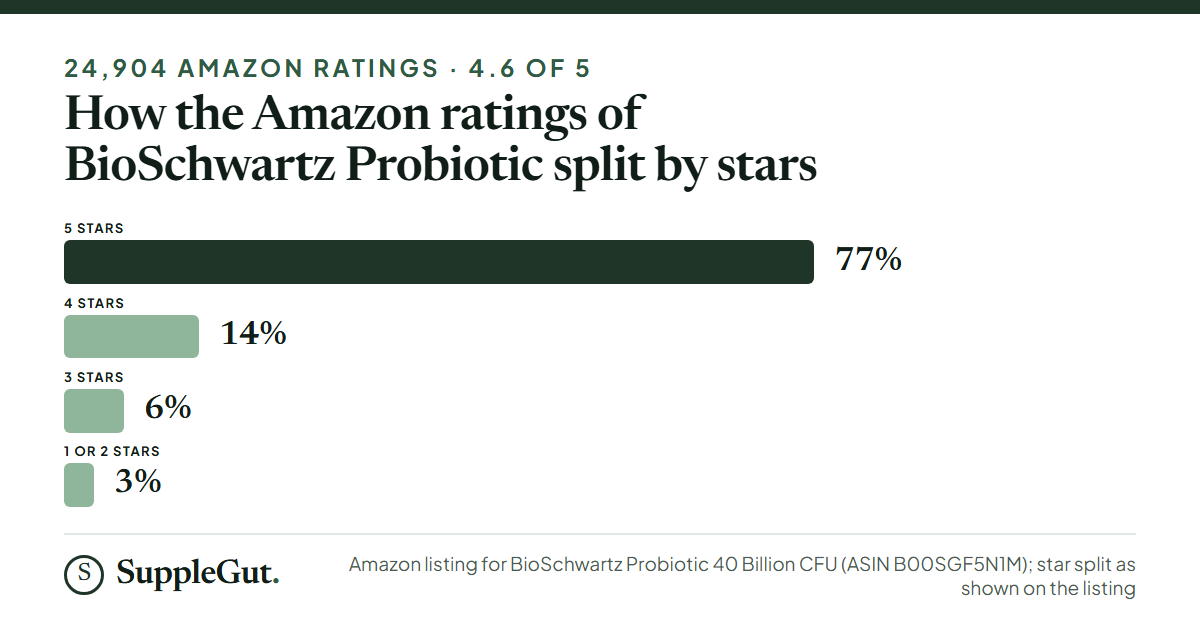
There are two pools of reviews, and they are not the same kind. Amazon shows 4.6 from 24,904 ratings: 77% five-star, 14% four, 6% three, 1% two and 2% one. All pack sizes share the one listing. The recurring praise is less bloating and more regular bowel movements within a few weeks, a capsule that is easy to swallow with no aftertaste, no need for refrigeration, and long-term repeat purchase over several years. The recurring complaints are the side effects above and a smaller number of reports of no effect, including one that it was no stronger than other probiotics; Amazon’s summary counts 127 negative mentions out of 1,498 on effectiveness. One reviewer notes that proprietary blends make products hard to compare, which matches the label.
The brand’s own site shows 4.69 from 1,534 reviews, through a widget that also carries an AI-generated summary. Because the brand hosts it, that pool is not independent, and the dozen reviews visible on the page were all five-star, a sample and not the whole. Trustpilot has a profile for the brand that is unclaimed and shows no reviews. A Better Business Bureau search returns two BioSchwartz entries, but their ratings could not be read. The absence of independent reviews outside Amazon is a gap in the data, not evidence either way.
Refund and subscription terms
On the brand site, a recurring order takes 10% off, and the page says a subscription can be skipped, changed or canceled at any time. The brand’s FAQ describes a satisfaction guarantee under which the purchase price is refunded “no questions asked” on contact by phone or email. The limit is printed in capitals: refund requests are limited to one per formula, per customer account. If a return is required for additional bottles, the product must be unopened and the customer pays all shipping. No number of days is stated. Amazon shows its standard returns, with a free return option, and Subscribe & Save at 10% off. In the reviews we read, we found no complaint about unexpected charges or refused refunds; that was a small sample.
Who makes it
The bottle reads “Manufactured for” BioSchwartz LLC, with an address on 2nd Avenue South in St. Petersburg, Florida, and Amazon’s seller profile gives the same company and city. Older labels on file with the NIH database name other addresses, in Oregon and in Wyoming. The brand’s About page names no founder or owner. One online profile says the brand has been sold to a larger company, but the press releases it cites could not be found, so we could not verify the ownership claim and do not rely on it. The plant that fills the capsules is not named. The brand states the product is third-party tested for purity and potency; no laboratory is named, and we found no certificate of analysis or independent seal such as NSF or USP.
Who this product suits
- Someone who wants a multi-strain Lactobacillus and Bifidobacterium capsule and values being able to look up each strain by its code.
- Someone who will judge it by how they feel over a month, since no trial of this blend exists.
- Someone who prefers a shelf-stable capsule they do not need to refrigerate.
- Someone comparing alternatives with a different evidence base: Align prints one strain with two decades of IBS trials, Culturelle Digestive Daily prints one named strain at 10 billion CFU, and Seed DS-01 prints 24 named strains and has a trial of the finished formula. The Align vs Culturelle comparison sets two of them side by side.
For choosing between product types, see which probiotic to take, or start from symptoms with the quiz.
Cost
A 60-capsule bottle is $22.97 on Amazon, which is $0.77 a day at the two-capsule serving, or $20.67 ($0.69 a day) with Subscribe & Save. Amazon’s listed per-capsule price is $0.38, which is half the daily figure. On the brand site the same bottle is $27.59 ($0.92 a day), or $24.83 ($0.83 a day) on a recurring order, and the 120-capsule bottle is $41.99, which is $0.70 a day. Shipping on the brand site within the United States is free.
The products in this catalog
Common questions
Does BioSchwartz Probiotic 40 Billion CFU work?
No trial of this product was found. Two of its strain codes, Lpc-37 and Bl-04, were in a five-strain blend tested in 156 adults with bloating and functional constipation; the trial did not meet its bloating endpoint, and flatulence was lower on the probiotic only in a post-hoc analysis. On Amazon, 77% of 24,904 ratings are five-star, and reviewers most often mention less bloating and more regular bowel movements.
What strains are in BioSchwartz Probiotic 40 Billion CFU?
Four, each with a strain code: Lactobacillus acidophilus La-14, L. paracasei Lpc-37, Bifidobacterium lactis Bl-04 and L. plantarum Lp-115. The panel gives one 184 mg blend weight and one 40 billion CFU figure measured at the time of manufacture, with no count for any single strain. Two of the four codes appear in a published trial, and we found no human gut trial of La-14 or Lp-115.
Is BioSchwartz probiotic safe, and what are the side effects?
The bottle advises consulting a healthcare provider before use if you are contemplating pregnancy, pregnant, nursing, have a medical condition or use any medication, and says it is for adult use only. The Amazon text lists temporary bloating, gas, stomach pain, nausea, diarrhea, constipation and rashes as possible effects. In Amazon’s review summary, 148 of 465 side-effect mentions are negative, including bloating, stomach pain, diarrhea and rash.
How many CFU are left at expiry, and what changed on the label?
The current panel prints 40 billion CFU “at time of manufacture” and gives no figure for expiry. Earlier labels of the same product printed a minimum of 20 billion CFU per serving until the expiration date, and that line is not on the current panel image. The Amazon ingredient text also differs from the current bottle image, so the panel on the bottle in hand is the one to read.
How much does BioSchwartz Probiotic 40 Billion CFU cost, and what is the refund policy?
A 60-capsule bottle is 30 servings of two capsules. It is $22.97 on Amazon, which is $0.77 a day, or $0.69 a day with Subscribe & Save. The brand site charges $27.59 ($0.92 a day), and its 120-capsule bottle is $41.99 ($0.70 a day). The brand’s guarantee refunds the purchase price on request but is limited to one refund per formula per account, and it states no number of days.
How does BioSchwartz compare with Align, Culturelle and Seed?
BioSchwartz prints four strains with codes at 40 billion CFU at manufacture, two capsules a day at $0.77, and has no trial of its own formula. Culturelle prints one named strain at 10 billion CFU, and Seed DS-01 prints 24 named strains and has a trial of the finished formula. Align vs Culturelle compares two single-strain products directly.
Who makes BioSchwartz, and who owns it?
The bottle says it is manufactured for BioSchwartz LLC of St. Petersburg, Florida, and Amazon’s seller profile gives the same company. The brand’s About page names no founder or owner and does not name the plant, and one ownership claim found online could not be verified. The brand states third-party testing but names no laboratory and posts no certificate that we could find.
Sources
- Airaksinen K, et al. Multispecies probiotic blend (L. acidophilus NCFM, L. paracasei Lpc-37, B. lactis Bl-04, Bi-07 and HN019) in 156 adults with bloating and functional constipation: a randomized, double-blind, placebo-controlled trial. Beneficial Microbes, 2019. PMID 31131616
- Harris LA, et al. Open-label five-strain probiotic blend in 188 patients with functional gastrointestinal symptoms. Journal of Clinical Gastroenterology, 2022. PMID 34028393
- Niu HL, et al. Probiotics in patients with irritable bowel syndrome: systematic review and meta-analysis of 35 randomized controlled trials (3,452 patients). International Journal of Surgery, 2020. PMID 32014597
- Ford AC, et al. Efficacy of prebiotics, probiotics, and synbiotics in irritable bowel syndrome and chronic idiopathic constipation: systematic review and meta-analysis. American Journal of Gastroenterology, 2014. PMID 25070051
- Araujo MM, et al. Bifidobacterium animalis subsp. lactis and gastrointestinal symptoms in healthy adults: systematic review and meta-analysis of 13 randomized trials. Nutrition Reviews, 2022. PMID 34918142
- NIH Dietary Supplement Label Database: earlier label versions of BioSchwartz Probiotic 40 Billion CFU (minimum potency until expiration; address history). dsld.od.nih.gov/label/249935 and dsld.od.nih.gov/label/270392
- BioSchwartz on Amazon: Supplement Facts image, bottle label, listing text, ratings, review summary and price. amazon.com/dp/B00SGF5N1M
- BioSchwartz brand pages: product page and FAQ (refund terms and shipping). bioschwartz.com; bioschwartz.com/pages/faq
Not sure which product fits your situation?
This guide covers the mechanics. The quiz takes your specific symptoms, routine and preferences and matches you to one product from the catalog.
Take the quiz →