
Guide
Does BodyHealth Probiotic work? Eleven organisms with counts, one strain code, and a review widget a third of which is incentivized
Quick answer
Does BodyHealth Probiotic work? We could find no trial of this capsule. It prints 11 organisms with a CFU each, 40 billion per two capsules, and a strain code for only one, B. subtilis DE111 at 4 billion, which was tested at 1 billion CFU a day in a 46-person pilot that shifted immune cell responses but left perceived gut health largely unchanged. A 35-trial meta-analysis found multi-strain probiotics eased IBS symptoms, with named strains. The brand’s widget shows 4.94 from 943 reviews, 342 flagged incentivized, and Amazon 4.5 from 238.
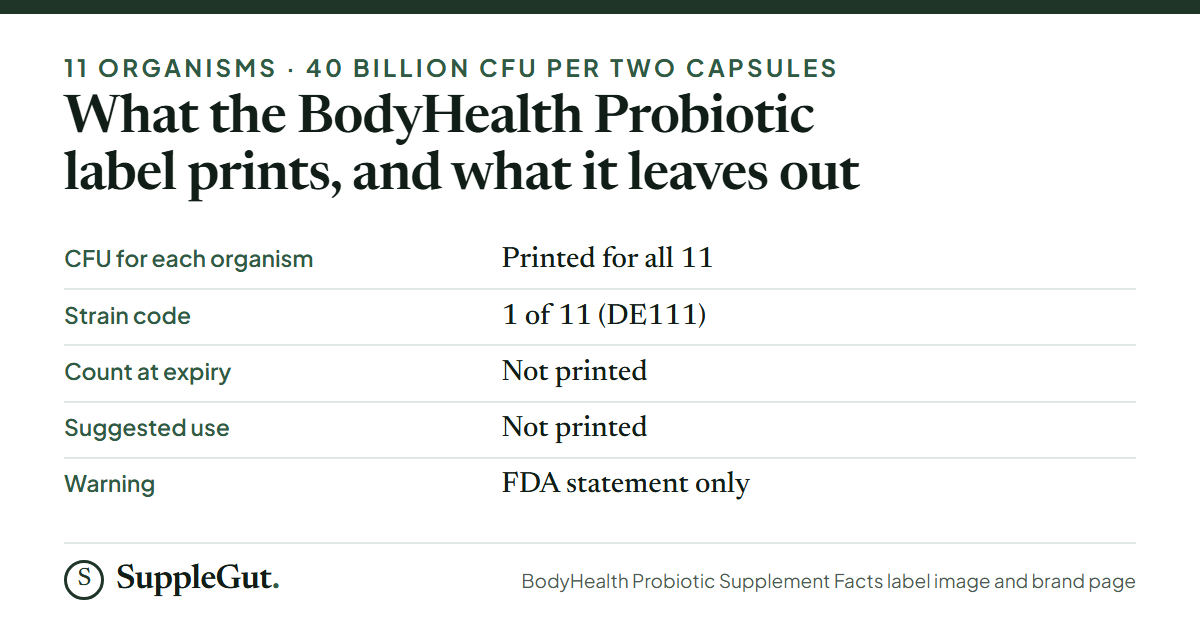
BodyHealth Probiotic is a delayed-release capsule that prints eleven organisms with a CFU count each, 40 billion in all per two-capsule serving, plus a small amino acid and nucleotide blend the brand calls PerfectAmino. Nine of the organisms are Lactobacillus and Bifidobacterium species; two are Bacillus spore formers. Only one of the eleven carries a strain code.
What BodyHealth Probiotic is, and what it is not
The serving is two capsules, and a bottle holds 60, so one bottle is 30 servings. The Supplement Facts panel prints, per serving: Bacillus subtilis DE111 at 4 billion CFU (40 mg); Bifidobacterium longum, Lactobacillus gasseri, L. acidophilus, L. salivarius, L. rhamnosus, L. casei, B. lactis and L. plantarum at 4 billion each; and B. bifidum and Bacillus coagulans at 2 billion each. The counts add up to 40 billion CFU, matching the brand’s figure. The other ingredients are rice flour and a vegetable capsule.
It is not a product with a prebiotic: the panel lists no inulin, FOS, GOS or other fiber. The PerfectAmino blend is 25 mg in total and names 16 components, from leucine and valine to uridine, adenosine triphosphate and thymidine, with no individual weights. We found no gut trial of PerfectAmino.
The brand describes the capsule as delayed release and “resistant to both acid and bile”. It shows no release data for that claim. The label says it is made in a cGMP certified facility, which it does not name, and the brand names no testing laboratory.
Strain codes and what the label leaves out
Only B. subtilis DE111 has a strain designation. The other ten organisms are species names, so a buyer cannot look up which strain of L. rhamnosus or B. lactis is inside, and no strain-specific trial can be matched to them. The panel prints a CFU for each organism, but it states no count at expiry, and we did not see a suggested use or any warning beyond the standard FDA statement. The brand page says both “two that are spore-based” and “three soil-based”; the panel lists two spore formers.
The trial of the product itself
There is none. PubMed searches for BodyHealth with probiotic, and for PerfectAmino with probiotic, returned no trial of this formula, and ClinicalTrials.gov returned no study.
The evidence for DE111
DE111 is a branded strain of B. subtilis from Deerland Probiotics & Enzymes. The main human trial is a pilot: 46 healthy adults took 1 billion CFU a day or placebo for four weeks. Blood cells taken from the DE111 group showed more anti-inflammatory immune cell types after stimulation, while overall perceived gut health, the microbiota and the blood and stool markers of inflammation were “largely unaffected”. The authors said the study may have been underpowered, and Deerland funded it and supplied the capsules (Freedman et al., International Journal of Molecular Sciences, 2021).
A crossover study in 11 people with ileostomies, whose small intestine output can be sampled, found DE111 spores in the output within three hours and germinating in the small intestine within three hours. The authors are Deerland employees, and the study measured survival and germination, not symptoms (Colom et al., Frontiers in Microbiology, 2021). A trial in children aged 2 to 6 found no significant difference in overall microbiome balance between groups (Paytuví-Gallart et al., Beneficial Microbes, 2020).
The label dose is 4 billion CFU per serving, four times the 1 billion used in the pilot. In the PubMed search for DE111 we found human studies in healthy adults, athletes, children and ileostomy patients, and none in people with gut symptoms.
The evidence for multi-strain probiotics
The nearest evidence for the formula as a type is a meta-analysis of 35 randomized trials in 3,452 adults with irritable bowel syndrome (IBS). Multi-strain products left fewer people with persistent symptoms (risk ratio 0.79, 95% confidence interval 0.70 to 0.89) and lowered bloating and flatulence scores slightly, with more adverse events than control (risk ratio 1.21) (Niu et al., International Journal of Surgery, 2020). An earlier review of 43 trials concluded that which individual species and strains are the most beneficial “remains unclear” (Ford et al., American Journal of Gastroenterology, 2014).
Those trials were in people with IBS and mostly used named strains at stated doses. This label names species for ten of its eleven organisms, and the brand markets it for general gut and immune support, so the results may not carry over. The CFU guide explains how to read the counts.
How to take BodyHealth Probiotic
The label serving is two capsules. We found no suggested use on the label image or the brand page beyond a line to take them every day, so whether to take both together, split them, or take them with food is not stated. A bottle lasts 30 days at the label serving. Some reviewers describe starting at one capsule and working up to two. No trial sets a dose or duration for this formula.
Side effects and who should not take it
The label image prints only the FDA statement that the product is not intended to diagnose, treat, cure or prevent any disease. No pregnancy, medication, age or immune-condition warning appears on the image or the brand page text, and we did not see a back label. The vegan, gluten-free and dairy-free claims appear only in the Amazon seller’s bullets. For the general picture on starting a probiotic, see probiotic side effects.
Many reviewers report no side effects. A few on Amazon report feeling bloated or sick soon after a dose.
What the reviews say
The brand’s own page runs a review widget (Okendo) that shows 4.94 from 943 reviews: 895 five-star, 45 four-star and three one-star. Okendo flags 342 of the 943 as incentivized, all dated in 2025 or 2026; those average 4.90 against 4.96 for the 601 not flagged. The reviews run back to 2019, so many describe an earlier version of the formula, and 56 mention another BodyHealth product.
Amazon shows 4.5 from 238 ratings: 77% five-star, 9% four, 8% three, 1% two and 5% one. The listing is run by a third-party seller, not by BodyHealth. Its review summary mentions protein intake, hair and nails and taking five capsules, so the text appears pooled with other BodyHealth products. Trustpilot could not be read.
The recurring praise is less bloating, often within the first week or two, more regular bowel movements, and an easy-to-swallow capsule with no taste or after-taste. The recurring complaints are that no change is noticeable yet, and, in the one-star reviews, billing.
The subscription and refund terms
Two of the three one-star reviews on the brand’s widget are about the account rather than the capsule. One describes being charged and shipped after trying to cancel three times; the other describes a bulk subscription that kept shipping three bottles a month. Both are flagged incentivized. The subscription runs every 4 to 12 weeks, we did not read its terms, and a single bottle can be bought without subscribing.
The brand offers a 90-day money-back guarantee for an exchange or full refund, requested by phone or contact form. One opened bottle of each product is eligible and other returns must be sealed; there is no free return label, and the guarantee does not apply to Amazon purchases.
Who BodyHealth Probiotic is for
- Someone who wants many organisms with a printed CFU each, in a capsule with no prebiotic, and accepts that ten of the eleven have no strain code.
- Someone who wants a coded spore former alongside Lactobacillus and Bifidobacterium species.
- Someone who will buy through the brand site, where the 90-day guarantee applies.
For DE111 alone, Advanced Probiotic DE111 is a single-strain capsule. For another multi-strain capsule with 40 billion CFU and a prebiotic, see BioSchwartz Probiotic 40 Billion CFU. BodyHealth’s butyrate capsule is covered in the Tributyrin guide. To match a product to a symptom, which probiotic to take and the quiz start from the symptom.
Cost
| Where | Price | Servings | Per day at 2 capsules |
|---|---|---|---|
| Brand site, 1 bottle | $37.50 | 30 | $1.25 |
| Brand site, 2 pack | $72.75 | 60 | $1.21 |
| Brand site, 3 pack | $105.75 | 90 | $1.18 |
| Brand site, 6 pack | $202.50 | 180 | $1.13 |
| Brand site, subscription (15% off) | about $31.88 | 30 | about $1.06 |
| Amazon, third-party seller | $38.68 | 30 | $1.29 |
Brand-site orders ship free from $35. At one capsule a day, as some reviewers take it, the bottle price works out to $0.63 a day. The catalog lists DE111 alone at about $0.25 a day.
The products in this catalog
Common questions
Does BodyHealth Probiotic work?
No trial of this product was found. Of its 11 organisms only Bacillus subtilis DE111 has a strain code, and a 46-person pilot of 1 billion CFU a day left perceived gut health largely unchanged in healthy adults. Reviewers on the brand’s widget (4.94 from 943) and on Amazon (4.5 from 238) most often mention less bloating and more regular digestion.
What strains are in BodyHealth Probiotic?
Two capsules give 40 billion CFU from 11 organisms: B. subtilis DE111, Bifidobacterium longum, B. bifidum, B. lactis, Lactobacillus gasseri, L. acidophilus, L. salivarius, L. rhamnosus, L. casei, L. plantarum and Bacillus coagulans. Only DE111 has a strain code, and the label lists no prebiotic.
How many BodyHealth Probiotic capsules should you take?
The label serving is two capsules, and a 60-capsule bottle is 30 servings. We found no suggested use on the label or brand page, so timing, splitting the dose and taking it with food are not stated. Some reviewers started at one capsule and worked up to two.
Does BodyHealth Probiotic have side effects?
The label prints no warning beyond the FDA statement, and we did not see a back label. Many reviewers report no side effects, while a few on Amazon describe bloating or feeling sick soon after a dose. The label does not say whether it suits people who are pregnant, immunocompromised or taking medication, so a clinician is the person to ask.
How much does BodyHealth Probiotic cost per day?
A 60-capsule bottle is $37.50 on the brand site, which is 30 servings or $1.25 a day. A 6 pack brings it to $1.13 a day and the 15% subscription to about $1.06. A third-party seller lists it on Amazon at $38.68, or about $1.29 a day.
How do you cancel a BodyHealth subscription, and is there a refund?
The brand offers a 90-day money-back guarantee by phone or contact form; one opened bottle per product is eligible, other returns must be sealed, and the guarantee does not cover Amazon purchases. Two of the three one-star reviews on the brand’s widget describe being charged after trying to cancel or stacked bulk shipments. Single bottles can be bought without subscribing.
Can you trust the BodyHealth Probiotic reviews?
The brand’s widget shows 943 reviews, and Okendo flags 342 of them as incentivized, all from 2025 and 2026. The Amazon listing is run by a third-party seller, and its review text mentions protein and hair products, so it appears pooled with other BodyHealth products. Trustpilot could not be read.
Sources
- Freedman KE, Hill JL, Wei Y, et al. "Examining the Gastrointestinal and Immunomodulatory Effects of the Novel Probiotic Bacillus subtilis DE111." International Journal of Molecular Sciences, 2021;22(5). PMID 33671071. pubmed.ncbi.nlm.nih.gov/33671071
- Colom J, Freitas D, Simon A, et al. "Presence and Germination of the Probiotic Bacillus subtilis DE111 in the Human Small Intestinal Tract: A Randomized, Crossover, Double-Blind, and Placebo-Controlled Study." Frontiers in Microbiology, 2021;12:715863. PMID 34408741. pubmed.ncbi.nlm.nih.gov/34408741
- Paytuví-Gallart A, Sanmartín-Sierra G, Hernández-Martínez J, et al. "Daily intake of probiotic strain Bacillus subtilis DE111 supports a healthy microbiome in children attending day-care." Beneficial Microbes, 2020;11(7):611–620. PMID 33161736. pubmed.ncbi.nlm.nih.gov/33161736
- Niu HL, Xiao JY. "The efficacy and safety of probiotics in patients with irritable bowel syndrome: Evidence based on 35 randomized controlled trials." International Journal of Surgery, 2020;75:116–127. PMID 32014597. pubmed.ncbi.nlm.nih.gov/32014597
- Ford AC, Quigley EMM, Lacy BE, et al. "Efficacy of prebiotics, probiotics, and synbiotics in irritable bowel syndrome and chronic idiopathic constipation: systematic review and meta-analysis." American Journal of Gastroenterology, 2014;109(10):1547–1561. PMID 25070051. pubmed.ncbi.nlm.nih.gov/25070051
- BodyHealth Probiotic: Supplement Facts label image, brand page, price and refund policy. bodyhealth.com/products/probiotic; bodyhealth.com/policies/refund-policy
- BodyHealth Probiotic on Amazon: price, rating and star split. amazon.com/dp/B07RM53YXQ
- Okendo review aggregate for the brand’s product page: api.okendo.io
Not sure which product fits your situation?
This guide covers the mechanics. The quiz takes your specific symptoms, routine and preferences and matches you to one product from the catalog.
Take the quiz →