
Guide
Does BioSchwartz Advanced Prebiotics and Probiotics work? Ten species, three enzymes and a quarter gram of fiber
Quick answer
Does BioSchwartz Advanced Prebiotics and Probiotics work? We could find no trial of this capsule. It lists ten species with no strain codes in a 101 mg blend stated as 20 billion CFU at manufacture, a 250 mg prebiotic blend against the 12 g of inulin used in the constipation trial, and 150 mg of papain, actinidin and bromelain with no bloating trial. A review of 82 trials rated the certainty of benefit from combination probiotics on bloating as very low. Amazon shows 4.5 from 6,820 ratings, and 23 of 87 side-effect mentions are negative.
BioSchwartz Advanced Prebiotics and Probiotics is a one-capsule-a-day product sold mainly on Amazon that puts three things in one delayed-release capsule: ten probiotic species, a small blend of inulin and fruit fibers, and three plant digestive enzymes. The label gives a single CFU figure and no strain codes, which sets it apart from the same brand’s four-strain probiotic. This page sets out what the label prints and leaves out, what the research on each of the three parts shows, what the reviews report, and what each route to buying it costs.
What BioSchwartz Advanced Prebiotics and Probiotics is, and what it is not
The Supplement Facts panel on the current bottle, per one capsule, lists three proprietary blends. The probiotic blend is 101 mg and is stated as 20 billion CFU, with a footnote reading “formulated with 20 Billion CFU at time of manufacture”. The ten organisms, in the printed order, are Lactobacillus acidophilus, Bifidobacterium longum, L. reuteri, L. casei, L. rhamnosus, L. plantarum, B. lactis, L. bulgaricus, B. bifidum and L. paracasei. None carries a strain designation, and no count is given for any single species. The prebiotic blend is 250 mg of inulin from Jerusalem artichoke root, inulin from blue agave, chicory root (90% inulin), banana fruit and apple fruit (50% fiber), with no per-ingredient amounts. The enzyme blend is 150 mg of papain, actinidin and bromelain. The other ingredients are the hypromellose capsule and organic rice hulls. A 30-capsule bottle is 30 servings.
It is not a product with a trial behind it, and it is not a strain-coded probiotic. It is a species-level multi-organism blend with fiber and enzymes added, taken once a day with water. The brand describes the capsule as delayed release and says each batch is third-party tested, but names no laboratory, and we found no certificate of analysis or independent seal such as NSF or USP.
What 20 billion CFU means on this label
The 20 billion figure is a count at manufacture. Nothing on the current panel states a number at expiry, and the panel prints one total for ten species, so it cannot show whether the species are present in equal parts or whether one dominates. Dividing 101 mg by 20 billion gives about 5 mg of material per billion CFU, which is all the arithmetic the panel allows. For how to read a CFU figure, see how many CFU you need.
Amazon’s text version of the ingredients differs from the bottle image. It lists organic banana powder, three inulin sources, apple fiber and rice fiber, names the enzymes in a different order with actinidin “from Kiwi Fiber Powder”, and gives no weights or CFU. An older box image on the brand site shows an earlier layout. The panel on the bottle in hand is the one to read.
The trial of the product itself
There is none. We searched PubMed and ClinicalTrials.gov under the brand name and found no registered or published study of this capsule or of a ten-species, fiber and enzyme combination like it. No organism on the panel carries a strain code and none of the fibers or enzymes is a branded ingredient, so there is no trial of a trademarked component to borrow either. The research below belongs to classes of ingredient.
The evidence for the ten species
The largest review of probiotics in irritable bowel syndrome pooled 82 randomized trials in 10,332 adults. For abdominal bloating or distension it found “very low certainty” in the evidence for a benefit of combination probiotics, and it rated certainty low to very low across almost all of its analyses. Adverse events were not significantly higher on probiotics than on placebo (Goodoory et al., Gastroenterology, 2023). An earlier meta-analysis of 35 trials in 3,452 people with IBS found fewer people with persisting symptoms on probiotics (relative risk 0.79) and a small improvement in bloating scores (Niu et al., International Journal of Surgery, 2020), and a 2014 review noted that which individual species and strains are the most beneficial “remains unclear” (Ford et al., American Journal of Gastroenterology, 2014).
These reviews studied people with IBS, not people with occasional bloating, and none of them tested this blend. Pooling many different mixtures also hides which mixtures did the work, and a species name alone does not identify one. One of the ten species, L. reuteri, is named in the product’s title, but the meta-analyses above do not isolate it, and we found no species-level result for it in adults with bloating.
The prebiotic blend against the inulin trial
The closest inulin trial we found was a 4-week, double-blind, placebo-controlled crossover study in 44 adults with constipation. They took 12 g a day of chicory inulin (3 doses of 4 g) or maltodextrin, and stool frequency was a median of 4.0 a week on inulin against 3.0 on placebo (p = 0.038) (Micka et al., International Journal of Food Sciences and Nutrition, 2017).
This capsule’s entire prebiotic blend is 250 mg, about 2% of the trial’s daily inulin dose, and the blend includes banana and apple fiber, so the inulin is a part of the 250 mg and not all of it. The panel does not say how much. A trial result at 12 g does not carry over to a dose of that size, and the label presents the fiber as food for the bacteria rather than as a treatment for constipation. Fermentable fibers like inulin can also cause gas in some people, which is relevant if gas is the reason for buying.
The three enzymes
The enzyme blend is 150 mg and the label prints activity units per capsule: papain 30,000 PU, actinidin 1,250 AU and bromelain 3.5 GDU. Papain comes from papaya, bromelain from pineapple and actinidin from kiwifruit; all three break down protein. Printing activity units is more informative than a bare weight, since it says what the enzymes can do and not only how much powder there is.
What is missing is evidence that this matters for bloating. Our PubMed searches for placebo-controlled trials of papain or bromelain supplements for bloating, gas or dyspepsia returned no relevant trials, and the searches were not exhaustive. The nearest kiwifruit research used a different product: in 186 adults with constipation-predominant IBS, a green kiwifruit extract at 575 mg twice a day for four weeks, then daily, raised the share with more spontaneous bowel movements (54% against 36%) but missed the trial’s combined primary endpoint (24% against 26%) (Holtmann et al., JGH Open, 2025). Two green kiwifruit a day, eaten whole, also improved constipation in a multicenter trial (Gearry et al., American Journal of Gastroenterology, 2023). Neither used an isolated enzyme at this capsule’s dose. For the wider picture on enzyme products, see do digestive enzymes work and digestive enzymes vs probiotics for bloating.
How to take it
The bottle says to take one capsule with water, once daily, or as recommended by a healthcare professional. There is no instruction about food or an empty stomach. The panel says refrigeration is not required, and the bottle says to store it in a cool, dry place. The trials of probiotics ran for weeks, so a month at the label serving is a reasonable first test. Reviewers who describe a benefit place it between a couple of days and a few weeks.
Side effects and who should not take it
The bottle advises pregnant or nursing mothers, anyone under 18, and anyone with a medical condition or taking a medication to consult a physician first. The Amazon safety text says prebiotics and probiotics may temporarily cause heartburn, gas, upset stomach, constipation and bloating, and to stop and see a medical professional if adverse effects occur. The label carries no warning about papain, bromelain or kiwi allergy, although all three are plant proteins from foods some people react to.
The reviews put a number on it. In Amazon’s summary of the review text, side effects are a topic in 87 mentions, of which 64 are positive and 23 negative. The negative reports include extreme bloating and painful gas after starting. Fiber, enzymes and ten species are all introduced at once, so a reaction cannot be traced to one part. For the general picture on starting a probiotic, see probiotic side effects.
On allergens, the bottle strip says no GMOs, soy, gluten, wheat, tree nuts, peanuts, sugar, preservatives or artificial colorants, and the Amazon title says dairy-free. The strip does not mention milk, egg, fish or sesame. L. bulgaricus, L. casei and L. rhamnosus are commonly grown on dairy media, and the label does not say whether these were, so anyone with a milk allergy should ask the brand.
What the reviews say
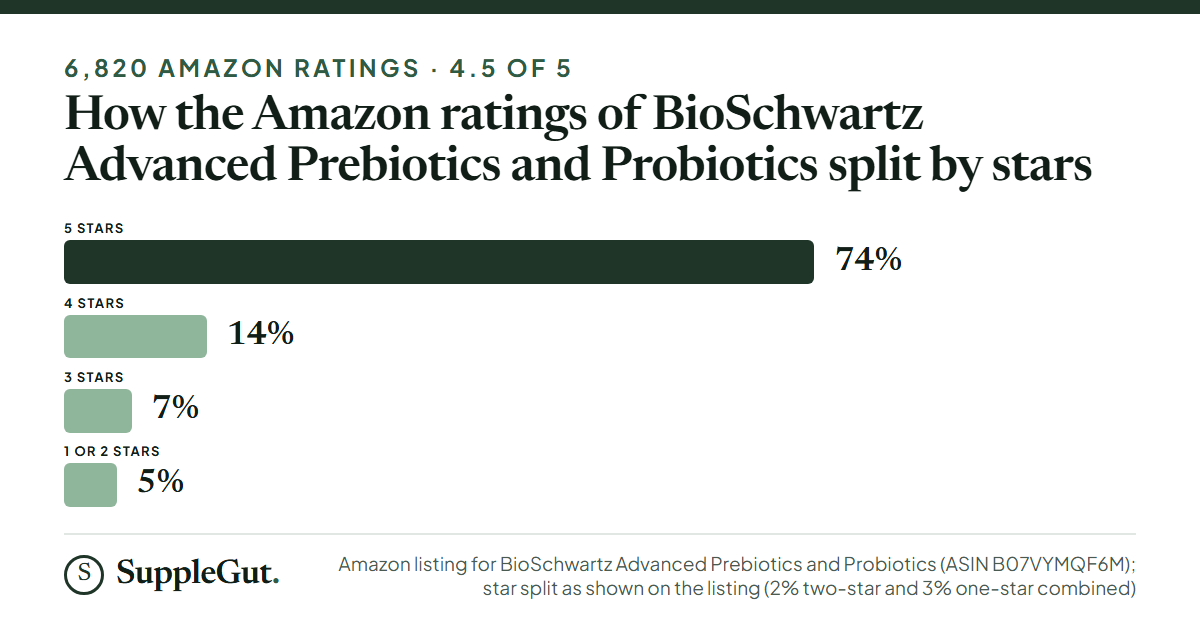
There are two pools of reviews, and they are not the same kind. Amazon shows 4.5 from 6,820 ratings: 74% five-star, 14% four, 7% three, 2% two and 3% one. The 30-count and 60-count bottles share one listing. The recurring praise is less bloating and more regular bowel movements, a capsule that is easy to swallow with no taste, one capsule a day, and a price reviewers call good. In Amazon’s summary all 83 mentions of probiotic content are positive, and 314 of 382 effectiveness mentions are positive, which leaves 68 negative, mostly reports of no change.
A second complaint is about quantity. In the quantity topic, 13 of 32 mentions are negative, and Amazon’s summary says several reviewers found bottles holding only 8 capsules instead of 30. We could not verify from the reviews we could read whether that reflects a fill problem or a few unusual shipments.
The brand’s own site shows 4.80 from 206 reviews, through a widget that also carries an AI-generated summary. Because the brand hosts it, that pool is not independent, and the excerpts visible on the page were all five-star. Trustpilot has a profile for the brand that is unclaimed and shows no reviews, and the Better Business Bureau lists the brand as not rated, with no complaints in three years on the listing we read and no customer reviews. The absence of independent reviews outside Amazon is a gap in the data, not evidence either way.
Price, subscription and refund terms
A 30-capsule bottle is a 30-day supply at one capsule a day. On Amazon it is $19.97, which is $0.67 a day, or $17.97 ($0.60 a day) with Subscribe & Save at 10% off, which Amazon says has no fees and can be skipped or canceled at any time. On the brand site it is $23.99 ($0.80 a day), $21.59 ($0.72 a day) at the sale or recurring-order price shown, and $42.99 for 60 capsules, also $0.72 a day. The brand site describes its recurring order as skippable, changeable or cancelable at any time, and says shipping within the United States is free.
The brand’s FAQ describes a satisfaction guarantee with a refund “no questions asked”, limited to one per formula per customer. A return of additional bottles requires them to be unopened, the customer pays return shipping, and no number of days is stated. On Amazon the listing reads non-returnable for food-safety reasons, with a refund or replacement only if the item arrives damaged or defective. In the reviews we read, we found no complaint about unexpected charges or refused refunds, which is a small sample. Who owns and makes the brand is covered in the BioSchwartz Probiotic 40 Billion guide, since the company is the same.
How it compares with the brand’s 40 billion product
The two BioSchwartz probiotics are built differently. This capsule prints ten species with no strain codes, 20 billion CFU at manufacture, a 250 mg prebiotic blend and a 150 mg enzyme blend, at one capsule and $0.67 a day on Amazon. The 40 billion product prints four strain codes (La-14, Lpc-37, Bl-04 and Lp-115), 40 billion CFU at manufacture and 50 mg of fructooligosaccharides, taken as two capsules at $0.77 a day on Amazon, and has no enzymes. Neither has a trial of its own formula. The practical difference is that coded strains can be looked up and species names cannot.
Who this product suits
- Someone who wants probiotic, fiber and enzymes in one capsule a day and will judge the result by how they feel over a month, since no trial of this capsule exists.
- Someone who prefers a small, tasteless capsule that needs no refrigeration.
- Someone buying through Amazon, where the price per day is lowest and the review pool is independent of the brand.
- Someone who wants strain codes to look up, or a product built around enzymes or a single named strain, should compare the alternatives: Zenwise Digestive Enzymes pairs enzymes with probiotics, and Culturelle Digestive Daily prints one named strain.
For choosing between product types, see which probiotic to take, or start from symptoms with the quiz.
The products in this catalog
Common questions
Does BioSchwartz Advanced Prebiotics and Probiotics work?
No trial of this capsule was found. A 2023 review of 82 trials in 10,332 adults with IBS rated the certainty of benefit from combination probiotics on bloating as very low, and we found no bloating trial of papain or bromelain. On Amazon, 74% of 6,820 ratings are five-star, and reviewers most often mention less bloating and more regular bowel movements.
What strains are in BioSchwartz Advanced Prebiotics and Probiotics?
Ten species, none with a strain code: Lactobacillus acidophilus, Bifidobacterium longum, L. reuteri, L. casei, L. rhamnosus, L. plantarum, B. lactis, L. bulgaricus, B. bifidum and L. paracasei. The panel gives one 101 mg blend weight and one 20 billion CFU figure stated at the time of manufacture, with no count for any species and nothing for expiry.
What do the prebiotic and enzyme blends contain?
The 250 mg prebiotic blend lists two inulins, chicory root, banana and apple fiber with no amounts, against 12 g a day of inulin in the constipation trial. The 150 mg enzyme blend prints papain 30,000 PU, actinidin 1,250 AU and bromelain 3.5 GDU per capsule. We found no placebo-controlled trial of papain or bromelain supplements for bloating.
Is BioSchwartz Advanced Prebiotics and Probiotics safe, and what are the side effects?
The bottle advises pregnant or nursing mothers, anyone under 18, people with a medical condition and people taking medication to consult a physician first. The Amazon text lists temporary heartburn, gas, upset stomach, constipation and bloating. In Amazon’s review summary, 23 of 87 side-effect mentions are negative, including extreme bloating and painful gas, and the label has no warning about papaya, pineapple or kiwi proteins.
Why do some reviews say the bottle held only 8 capsules?
In Amazon’s review summary, 13 of 32 mentions of quantity are negative, and several reviewers say a bottle held 8 capsules instead of the 30 advertised. We could not tell from the reviews we could read whether this reflects a fill problem or a few unusual shipments. On Amazon the item is non-returnable for food-safety reasons unless it arrives damaged or defective.
How much does BioSchwartz Advanced Prebiotics and Probiotics cost, and what is the refund policy?
A 30-capsule bottle is $19.97 on Amazon, which is $0.67 a day, or $0.60 a day with Subscribe & Save. The brand site charges $23.99 ($0.80 a day) for 30 capsules and $42.99 for 60. The brand’s guarantee refunds the purchase price on request but is limited to one refund per formula per customer, with the customer paying return shipping and no number of days stated.
How does it differ from BioSchwartz Probiotic 40 Billion?
This capsule prints ten species with no strain codes, 20 billion CFU at manufacture, a 250 mg prebiotic blend and a 150 mg enzyme blend, taken once a day. The 40 billion product prints four strain codes, 40 billion CFU at manufacture and 50 mg of fructooligosaccharides, taken as two capsules. Neither has a trial of its own formula.
Sources
- Goodoory VC, et al. Efficacy of probiotics in irritable bowel syndrome: systematic review and meta-analysis of 82 randomized trials (10,332 adults). Gastroenterology, 2023. PMID 37541528
- Niu HL, et al. Probiotics in patients with irritable bowel syndrome: systematic review and meta-analysis of 35 randomized controlled trials (3,452 patients). International Journal of Surgery, 2020. PMID 32014597
- Ford AC, et al. Efficacy of prebiotics, probiotics, and synbiotics in irritable bowel syndrome and chronic idiopathic constipation: systematic review and meta-analysis. American Journal of Gastroenterology, 2014. PMID 25070051
- Micka A, et al. Chicory inulin and bowel function in adults with constipation: a randomized, double-blind, placebo-controlled crossover trial (44 adults, 12 g a day for 4 weeks). International Journal of Food Sciences and Nutrition, 2017. PMID 27492975
- Holtmann G, et al. Green kiwifruit extract in irritable bowel syndrome with constipation: a randomized, double-blind, placebo-controlled trial (186 adults). JGH Open, 2025. PMID 40786128
- Gearry R, et al. Two green kiwifruit a day and constipation: an international multicenter randomized trial. American Journal of Gastroenterology, 2023. PMID 36537785
- BioSchwartz on Amazon: Supplement Facts image, bottle label, listing text, ratings, review summary and price. amazon.com/dp/B07VYMQF6M
- BioSchwartz brand pages: product page (price, subscription and shipping) and FAQ (refund terms). bioschwartz.com; bioschwartz.com/pages/faq
Not sure which product fits your situation?
This guide covers the mechanics. The quiz takes your specific symptoms, routine and preferences and matches you to one product from the catalog.
Take the quiz →