
Taken with meals
LactoJoy Lactase Pills, 14,500 FCC
A scored lactase tablet with 14,500 FCC units, taken one at a time just before dairy, in a slim carry tin.
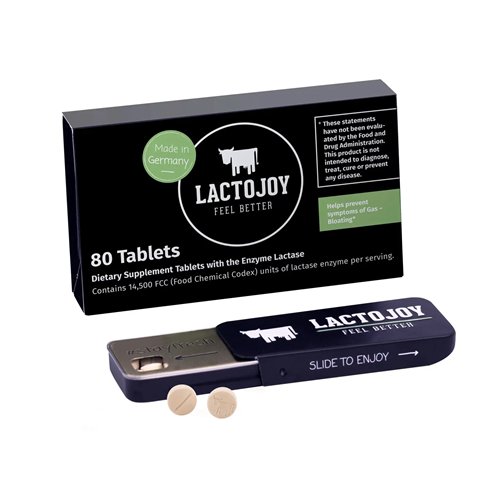
- Format
- Tablet
- Type
- Digestive enzyme
- Cost
- $0.37 per tablet; one tablet just before each dairy meal
- Customer rating
- 4.6 out of 5 from 4,900 ratings from Amazon
What customers consistently report
- One small tablet being enough for a dairy meal
- A slim tin that fits a pocket or purse
- Working better than Lactaid for some people
Those are the themes that recur across the reviews. Moderate review confidence — Amazon shows 4.6 from 4,900 independent ratings on the 80-count, the brand’s own widget shows 4.8 from 299 reviews on that page, but its Trustpilot profile has only 3 reviews (3.1) and no BBB profile was found.
Why it might work
Lactase splits lactose into glucose and galactose, which the small intestine absorbs, so less reaches the colon where bacteria ferment it into gas. That matches dairy being the specific trigger, and it works only on lactose, not on other food sugars or on dairy protein. The enzyme has to be present with the food, so the label says to take it just before eating, and the brand text says with the first bite or sip of dairy. One tablet is 14,500 FCC, about 1.6 times the 9,000 FCC of a Lactaid Fast Act caplet, and the label allows more tablets for a heavier dairy meal, up to 10 a day. The label does not let you check how much activity the tablet has at expiry.
What the research supports
No trial of this product was found. The ingredient is lactase at a dose slightly above the one in the closest placebo-controlled trial: three 4,500 FCC tablets (13,500 FCC in total) taken 5 minutes before 25 g of lactose cut breath hydrogen by 55% in 47 adults, and one tablet here is 14,500 FCC. The tablet can be halved to about 7,250 FCC, which is below that trial dose, and in an uncontrolled test of 15,000 lactase units 60% of 96 patients had no change in breath hydrogen.
What the label discloses
One active is disclosed, lactase at 139.3 mg per tablet on the Supplement Facts panel, with the 14,500 FCC activity printed on the carton front and in the brand text rather than on the panel. The ingredients are lactase, maltodextrin, potato starch and magnesium salts of fatty acids. The brand posts a laboratory certificate from AGROLAB LUFA for microbial and contaminant limits on one sample, which does not measure lactase activity, and no U.S. certification mark was found.
Who this tends to suit
We match this product to people reporting symptoms that follow particular foods, bloating, gas, cramping, loose stools and general abdominal discomfort. It fits someone whose priority is handling meals or day-to-day comfort. Whether it is the best fit for you depends on the rest of your answers — what you have already tried, what format you will take, and anything that has to be ruled out.
Where it may not fit
The label supports gluten-free, dairy-free, vegan and no added sweeteners. A tablet only works if you will take it as often as the label directs.
Side effects and what to be aware of
About 8% of Amazon ratings on the 80-count are one or two stars, and Amazon’s summary shows 54 negative mentions out of 230 on effectiveness and 23 negative out of 47 on value. Some reviewers need several tablets or say it did not work, the tin can slide open, and 20 of 73 side-effect mentions on the 45-count are negative. The carton says to consult a doctor if discomfort continues or is unusual.
Common questions
Does LactoJoy work?
No trial of LactoJoy was found. One tablet has 14,500 FCC of lactase, slightly more than the 13,500 FCC (three 4,500 FCC tablets) that cut breath hydrogen by 55% in a placebo-controlled trial of 47 adults given 25 g of lactose. On Amazon 81% of 4,900 ratings on the 80-count are five-star, and 54 of 230 effectiveness mentions are negative.
Is LactoJoy safe, and what are the side effects?
The only active is lactase enzyme, and the carton says it is a dietary supplement, not a drug, and to consult a doctor if discomfort continues or is unusual. The brand says not to take more than 10 tablets a day. On Amazon, 20 of 73 side-effect mentions on the 45-count are negative and 3 of 27 on the 240-count, with specifics not readable.
How much does LactoJoy cost?
One tablet is taken before each dairy meal. On Amazon, 45 tablets are $19.99 ($0.44 a tablet), 80 are $29.99 ($0.37) and a 240-tablet refill is $79.99 ($0.33). The brand site charges the same prices, with $4.95 shipping under $29.99, and 5% off on subscription or when buying two or more.
LactoJoy vs Lactaid: which is stronger?
LactoJoy prints 14,500 FCC per tablet and Lactaid Fast Act prints 9,000 FCC per caplet, so one LactoJoy tablet is about 1.6 caplets. Neither has a trial of its own product in the sources read. Per 1,000 FCC LactoJoy’s Amazon 80-count is $0.026 against $0.022 for Lactaid at $0.20 a caplet.
Who makes LactoJoy, and what is its refund policy?
LactoJoy is made by better foods GmbH of Göttingen, Germany, and sold on Amazon by that company; Amazon shows 100% positive seller feedback over 12 months. The store banner promises a 30-day money-back guarantee, but its refund page states only the 14-day withdrawal right, and its Trustpilot profile has three reviews, one praising the product and two about returns and service.
Is this the right one for you?
The quiz works out which of the products we have researched fits your symptoms, your routine and what you have already tried — and tells you plainly if none of them do.
Take the quiz →Free. Private. Nothing to sign up for.
Others we researched for the same job
These sit in the same role as LactoJoy Lactase Pills, 14,500 FCC — taken with meals — so they are the sensible things to weigh it against.
See all the products we have researched →
Related reading
Background on how this type of product works, read from the trial evidence.