
Guide
Does Vitamatic lactase work? 9,000 ALU on the panel, 9,000 FCC on the bottle, and one tablet a day
Quick answer
Does Vitamatic lactase work? No trial of this tablet was found. Lactase at 9,000 FCC lowered peak breath hydrogen 33% against placebo in 24 people, and 13,500 FCC lowered cumulative hydrogen 55% in 47, but this panel prints 9000 ALU while the bottle front prints 9000 FCC, with no conversion given. The directions say one tablet a day with water, not timed to dairy. Amazon shows 4.6 from 1,724 ratings, and reviewers describe both relief and needing three or more tablets.
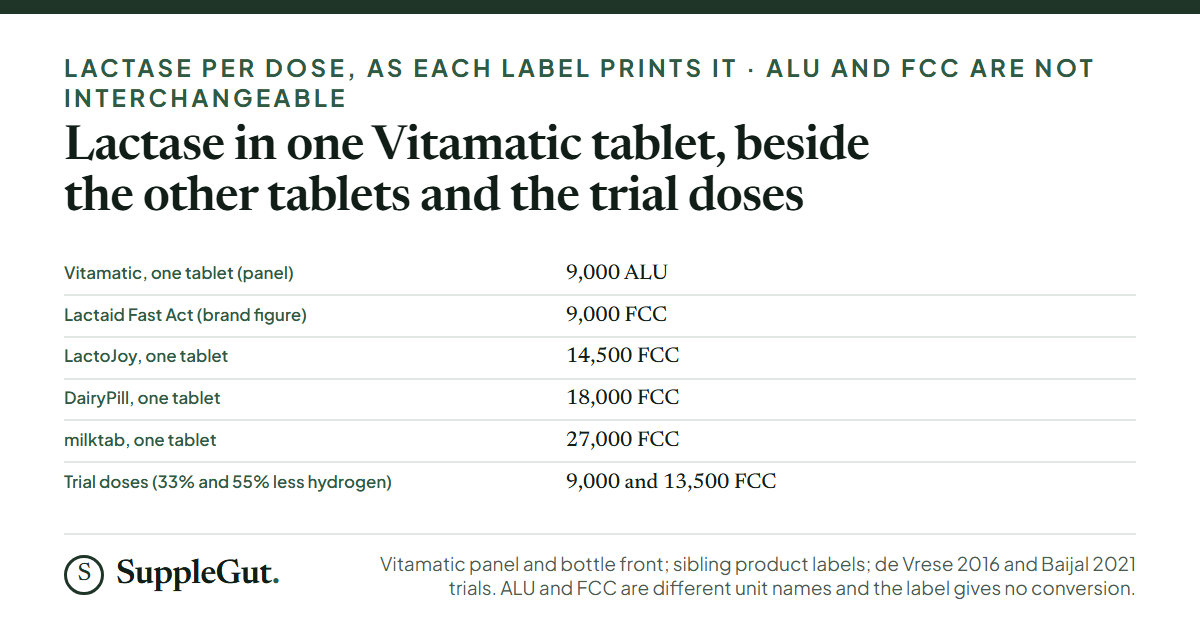
Vitamatic Lactase Enzyme is a single-ingredient lactase tablet sold in a bottle of 240. What sets it apart from the lactase on the next shelf is a number that is printed two ways: the front of the bottle and every product title say 9000 FCC, while the Supplement Facts panel says 9000 ALU. The directions are different too, one tablet a day with water, where the lactase trials gave the enzyme just before the dairy. This page sets out the label, the trial doses, what the certificate of analysis covers, what reviewers report and the cost.
What Vitamatic Lactase is, and what it is not
The panel lists one active, lactase enzyme at 9000 ALU per tablet, with 240 tablets to a bottle and no blend. The other ingredients are microcrystalline cellulose, dicalcium phosphate, croscarmellose sodium, stearic acid, silicon dioxide and vegetable magnesium stearate. The brand’s certificate of analysis gives the tablet weight as 90 mg. The label does not name the organism the enzyme comes from or who makes the tablet, and the bottle front’s line “Formulated by Healthcare Professional” gives no name.
The brand states that the product is free of sugar, starch, yeast, soy, wheat, egg, artificial colors, flavors and preservatives, and adds non-GMO and gluten free. We found no statement about tree nuts, fish or sesame and no shared-facility statement. The panel is headed Supplement Facts and the front reads Dietary Supplement.
The unit problem: ALU on the panel, FCC on the bottle
Lactase strength is counted in units of enzyme activity, and the units have different names. FCC is the Food Chemicals Codex unit that Lactaid, LactoJoy, DairyPill and milktab print. ALU stands for acid lactase units. On this product the bottle front, the product title and the Vitacost listing say 9000 FCC; the Supplement Facts panel, the brand’s certificate of analysis and its marketing graphic (“9000 ALU Per Tablet”) say 9000 ALU. The label gives no conversion between the two, and we have not made one.
So the label alone does not say whether one tablet matches the 9,000 FCC that Lactaid Fast Act prints; only the brand can. We found no trial that used ALU, and a 1994 comparison of three commercial products concluded that “all lactase preparations are not the same” (Ramirez et al.).
What the lactase trials used
We found no trial of this tablet: PubMed searches for the product name returned only general lactase papers, and the NIH label database has no record of it. The evidence is for lactase from other products, measured mostly by breath hydrogen, which rises when colon bacteria ferment lactose that was not digested. The milktab guide, the DairyPill guide and the LactoJoy guide cover the same trials against higher-dose tablets, so only the trials closest to this label are set out here.
| Trial | Lactase dose | Lactose load | Result |
|---|---|---|---|
| de Vrese 2016, 24 lactose malabsorbers, placebo-controlled crossover | 3,300 and 9,000 FCC | 12.5 g | Peak hydrogen lower than placebo by 29% and 33%; the higher dose also reduced flatulence |
| Baijal 2021, 47 adults, placebo-controlled crossover | 13,500 FCC (three 4,500 FCC tablets), 5 minutes before | 25 g | Cumulative hydrogen over 180 minutes 55% lower; sponsor supplied the tablets |
| Ibba 2014, 96 patients, uncontrolled before-and-after | 15,000 units (two 7,500) | 25 g | Breath test negative in 21.9%, lower peak in 17.7%, unchanged in 60.4% |
Read as FCC, one Vitamatic tablet equals the 9,000 FCC arm in the de Vrese trial and is 67% of the 13,500 FCC in the Baijal trial. Read as ALU, none of these trials used the unit. A 2010 systematic review of 36 randomized trials found that lactase dosing varied too much between them to pool.
Lactase acts only on lactose. It does not change how the body handles other food sugars, milk protein or fat, so it fits a pattern where dairy is the specific trigger.
How to take Vitamatic Lactase
The directions read: “take 1 tablet daily with 8 to 12 oz of water or as directed by your healthcare provider.” They do not say to time the tablet to a dairy meal, and they do not say whether it can be chewed. The trials gave lactase 5 to 15 minutes before the lactose, and the other lactase tablets in this group of guides are dosed per dairy meal. The label also says “Do not exceed the recommended dose,” which sits beside reviewers who describe taking more than one tablet.
What the testing covers
The brand posts a certificate of analysis headed “Third-party Independent Laboratory.” It shows lactase activity at the label claim of 9000 ALU as passed, and aerobic plate count, yeast and molds, Salmonella, E. coli, coliforms, arsenic, cadmium, lead and mercury as passed. It names no laboratory, lot number or measured value. Its footnote says third-party results are available on request, that “a reduced frequency testing scheme is used,” and that results may not be available for all lots. We found no NSF, USP or Informed Choice mark.
Side effects and who should not take it
The label says to consult a healthcare provider if you are pregnant, nursing, taking any medications or planning any medical procedures, not to use it if the safety seal is broken, and to keep it out of the reach of children. No side-effect report stood out in the 29 review texts we could read.
What the reviews say
| Platform | Score | Count | Notes |
|---|---|---|---|
| Amazon | 4.6 of 5 | 1,724 ratings | Independent; star split and text not read |
| Vitacost | about 4.5 | 62 ratings | 71% five-star, 5% one-star; texts imported from iHerb |
| Brand site | No reviews | 0 | Self-hosted |
| Trustpilot, whole store | 4.3 | 57 reviews | About the store, not this tablet |
The praise in the 29 Vitacost texts is that it lets people eat ice cream or restaurant dairy, that a strong dose fits in a small tablet, and that it has no aftertaste. The recurring complaint is dose: two reviewers say they need “at least 3 tablets” to avoid symptoms, one titling the review “Low potency.” Three more say it did not work, and one expected capsules and received tablets. That fits the spread in the 96-patient test: lactase response varies, and one tablet a day is a lower dose than reviewers say they take.
Who makes it, and the refund terms
A Walmart seller page names Proempire LLC of Elmwood Park, New Jersey; the tablet’s manufacturer is not stated. The brand site accepts returns of new, unopened items within 30 days for a full refund, with return shipping paid by the customer, and the terms apply to brand-site purchases only. When read, the brand’s product page showed a “Sold out” label beside an “Add to cart” button. There is no subscription on the page, and we found no billing complaints specific to this tablet.
Who Vitamatic Lactase is for
- Someone whose gas, bloating or loose stools follow dairy and who wants a low price per tablet in a large bottle.
- A person willing to take it with the first bite of dairy and to add tablets if one is not enough, which is the pattern reviewers describe.
Lactaid Fast Act is the established comparison, printed in FCC. The brand’s other product here is covered in the Vitamatic fiber gummies guide. If dairy is not the only trigger, Do digestive enzymes work? covers the enzyme evidence, and the quiz matches symptoms to products.
Cost
| Product | Price | Per tablet | Lactase per tablet, as printed |
|---|---|---|---|
| Vitamatic, 240 tablets | $19.99 | $0.083 | 9,000 ALU (panel) / 9,000 FCC (bottle front) |
| Lactaid Fast Act | about $0.20 a caplet | $0.20 | 9,000 FCC |
| LactoJoy, 80 count | $29.99 | $0.37 | 14,500 FCC |
| DairyPill, 90 count | $59.99 | $0.67 | 18,000 FCC |
| milktab, 45 count | $29.99 | $0.67 | 27,000 FCC |
The $19.99 price is the same on the brand site (compare-at $25.99), Amazon and Vitacost, and shipping on the brand site is free over $49. One tablet per dairy meal costs $0.083; the two or three tablets some reviewers take cost two or three times that. A price per 1,000 units is not given for this tablet because the units differ.
The products in this catalog
Common questions
Does Vitamatic lactase work?
No trial of this tablet was found. Lactase as a class lowered breath hydrogen in placebo-controlled trials, by 33% at 9,000 FCC in 24 people and by 55% at 13,500 FCC in 47, but this panel prints 9000 ALU, not FCC, and no trial found used ALU. On Vitacost 3 of 62 ratings are one star, and reviewers describe both “works great” and needing at least three tablets.
Is Vitamatic lactase 9000 FCC or 9000 ALU?
Both appear. The bottle front and the product titles say 9000 FCC, while the Supplement Facts panel, the certificate of analysis and the brand’s marketing graphic say 9000 ALU. These are different unit names for lactase activity, the label gives no conversion, and we have not made one, so the label alone does not show whether it matches Lactaid Fast Act’s 9,000 FCC.
How do you take Vitamatic lactase, and should it be taken with dairy?
The directions say one tablet daily with 8 to 12 oz of water or as directed by a healthcare provider. They do not say to take it before or with dairy, whereas the trials gave lactase 5 to 15 minutes before the lactose. Some reviewers say they need three or more tablets, and the label also says not to exceed the recommended dose.
Is Vitamatic lactase safe, and are there side effects?
The only active is lactase enzyme. The label says to consult a healthcare provider if pregnant, nursing, taking medications or planning a medical procedure. No side-effect report stood out in the 29 review texts we could read, and Amazon review text was not readable to us.
Vitamatic vs Lactaid: what is different?
Vitamatic is $0.083 a tablet against about $0.20 for a Lactaid Fast Act caplet, with 9000 ALU on its panel against Lactaid’s 9,000 FCC. Vitamatic’s directions say one tablet a day with water, and Lactaid is taken with dairy. Neither has a trial of its own product in the sources we read; see the Lactaid page.
How much does Vitamatic lactase cost?
A 240 tablet bottle is $19.99 on Amazon, Vitacost and the brand site, which is $0.083 a tablet. The brand site shows a compare-at price of $25.99 and ships free over $49. One tablet per dairy meal costs that figure; two or three tablets a meal, as some reviewers take, multiplies it.
Is Vitamatic lactase third-party tested?
The brand posts a certificate headed Third-party Independent Laboratory that shows lactase activity, microbes and four heavy metals as passed. It names no laboratory, lot or measured value and states that a reduced frequency testing scheme is used, so results may not exist for every lot. We found no NSF, USP or Informed Choice mark.
Sources
- de Vrese M, et al. Acid lactase (3,300 and 9,000 FCC) in lactose malabsorbers given 12.5 g lactose: randomized, double-blind, placebo-controlled crossover, 24 subjects. Clinical Nutrition, 2016. PMID 25042846. pubmed.ncbi.nlm.nih.gov/25042846
- Baijal R, et al. Lactase tablets (3 x 4,500 FCC) in adults with lactose intolerance: randomized, double-blind, placebo-controlled crossover, 47 adults. JGH Open, 2021. PMID 33490624. pubmed.ncbi.nlm.nih.gov/33490624
- Ibba I, et al. Lactase (A. oryzae), 15,000 units with 25 g lactose in 96 patients: uncontrolled before-and-after test. BioMed Research International, 2014. PMID 24967391. pubmed.ncbi.nlm.nih.gov/24967391
- Ramirez FC, et al. Efficacy of lactase replacement therapy: all lactase preparations are not the same. American Journal of Gastroenterology, 1994. PMID 8147360. pubmed.ncbi.nlm.nih.gov/8147360
- Shaukat A, et al. Systematic review: effective management strategies for lactose intolerance, 36 randomized trials. Annals of Internal Medicine, 2010. PMID 20404262. pubmed.ncbi.nlm.nih.gov/20404262
- Vitamatic brand page: Lactase Enzyme 240 tablets, with the Supplement Facts panel image and the certificate of analysis image: label, directions, warnings and price. Return terms: vitamaticusa.com/pages/return-policy.
- Vitacost listing: Vitamatic Lactase Enzyme, 240 tablets: panel text, price, rating distribution and review texts.
- Amazon listing: B0CZLP9QXQ: price, rating and rating count.
- Independent profile: Trustpilot. Lactaid, LactoJoy, DairyPill and milktab figures are from the pages linked in the sibling guides above.


Not sure which product fits your situation?
This guide covers the mechanics. The quiz takes your specific symptoms, routine and preferences and matches you to one product from the catalog.
Take the quiz →