Taken with meals
Let Loose Koji Digestive Enzymes
A 16-enzyme capsule made by koji fermentation, taken before the two largest meals of the day.
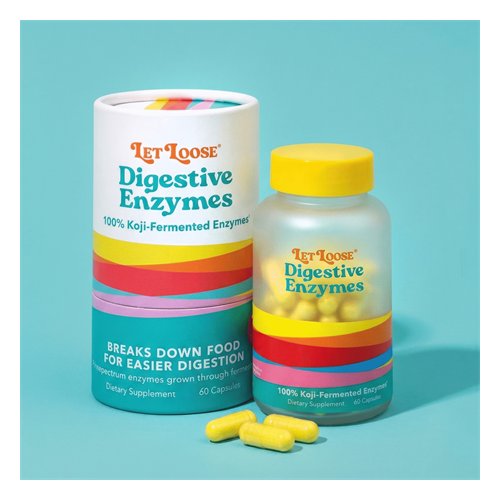
- Format
- Capsule
- Type
- Digestive enzyme
- Cost
- See the price on Amazon
- Customer rating
- See the reviews on Amazon
Not sure it suits your symptoms? The quiz matches one product to you in one to three minutes.
What the ingredients do, in theory
Digestive enzymes are proteins that cut food molecules into smaller pieces before absorption. Koji is grain fermented with the mold Aspergillus oryzae, which secretes many of them at once: proteases and peptidases for protein, amylase and invertase for starch and sugar, lipases for fat, lactase for milk sugar, and cellulase, hemicellulase, xylanase, beta-glucanase and pectinase for plant fiber. This label adds alpha-galactosidase, an enzyme that cuts the sugars in beans and cabbage, and a DPP-IV peptidase the brand says helps with gluten and dairy peptides. The idea is that less undigested food reaches the gut bacteria that ferment it into gas. Enzyme activity on a label is measured in a laboratory, not in a stomach; the capsule is not stated to be delayed release, and the label does not show how much of the 355 mg is enzyme protein.
Reading the label
Every enzyme carries a printed activity unit, which lets a reader compare it with other products, but the 16 enzymes sit under one 355 mg weight, so the amount of each enzyme protein is not listed. The label states a GMP mark and U.S. manufacture but names no laboratory, factory or testing, and the brand’s Science page lists six references whose author names, DOIs or PubMed links do not match the papers it names. There is no strain, substrate or purification statement for the koji.
What the research supports
No trial of this capsule was found, and the label names no strain or trademarked enzyme, so there is no branded-ingredient study to cite. A 120-person trial of a different multi-enzyme blend made by fungal fermentation improved functional dyspepsia scores over two months at 400 mg a day, and a 25-person single-meal trial of an 18-enzyme and herb capsule reduced the rise in waist measurement after a pizza meal but not self-reported bloating. Alpha-galactosidase reduced gas at 1,200 units a meal in one small trial and did not beat placebo in two irritable bowel trials, and this label supplies 300 units per capsule.
The people it is built for
We match this product to people reporting bloating, symptoms that follow particular foods and general abdominal discomfort. Someone whose aim is handling meals or day-to-day comfort is who it is matched to. A symptom match is the first filter, not the last: Koji Digestive Enzymes has to survive your previous products, your format and your exclusions too.
When to look elsewhere
Its packaging states gluten-free, dairy-free, vegan and no added sweeteners. We flag this product for anyone pregnant or breastfeeding or taking prescription medication, and the quiz removes it rather than recommending it in those cases. That is a caution about who should be deciding, not a claim about the product. Form counts: Koji Digestive Enzymes is a capsule, and the trials behind it assume it is taken as often as the label directs.
What to watch for
The brand’s widget has no rating below four stars, and the few cautions in its reviews are no effect yet, the price and waiting to judge. The pack says to consult a healthcare provider if pregnant, nursing, taking medication or having a medical condition, the site adds a kidney-disease and a laxative-effect warning, and Amazon lists the item as non-returnable.
What people want to know
Does Let Loose Koji Digestive Enzymes work?
Let Loose Koji Digestive Enzymes has not been tested in a trial of its own. The ingredients are koji (Aspergillus oryzae) enzymes with printed activity units, and a 120-person trial of a different fungal-fermentation enzyme blend improved functional dyspepsia scores over two months. The brand’s own review widget shows 4.86 from 76.
What is koji, and are koji enzymes different from other digestive enzymes?
Koji is grain fermented with the mold Aspergillus oryzae, used for miso, soy sauce and sake; the mold secretes protein-, starch- and fat-cutting enzymes. Enzyme mixtures in trials draw on several sources, and no trial compares koji enzymes with the others. The label does not name a strain or say whether the enzymes are purified from the culture.
How much does Let Loose Koji Digestive Enzymes cost per day?
A 60-capsule bottle is $56.00 one-time on the brand site, or $0.93 a capsule. The directions are one capsule before each of the two largest meals, which is $1.87 a day, and two capsules before a heavier meal, which is up to $3.73 a day. Subscribing on the brand site is $44.80 to $50.40 a bottle.
Let Loose vs HoloZyme or Digest Gold: how do the enzymes compare?
Let Loose lists 16 enzymes in a 355 mg blend, HoloZyme 15 and Digest Gold 13. Per capsule Let Loose has more hemicellulase (2,000 HCU vs 30), beta-glucanase and invertase than Digest Gold, and less lactase (400 ALU vs 900 and 3,000), alpha-galactosidase, xylanase and lipase. None of the three has a trial of its own formula.
Are there side effects, and who should not take it?
The pack says to consult a healthcare provider before use if pregnant, nursing, taking medication or having a medical condition, and to stop if adverse reactions occur. The site adds an ask-a-doctor line for kidney disease and says it may have a laxative effect. No side-effect pattern was readable in the brand’s reviews; Amazon’s review text was not readable.
If you are pregnant or breastfeeding, or taking prescription medication. Ask a doctor or pharmacist before Koji Digestive Enzymes; this page describes the product and the evidence, it does not prescribe.
Not sure this is your match?
Eight questions, one answer: where Koji Digestive Enzymes lands for you, and why.
Take the quiz →No sign-up, no email, about three minutes.
What else does this job
These sit in the same role as Let Loose Koji Digestive Enzymes — taken with meals — so they are the sensible things to weigh it against.
See all the products we have researched →
Guides that explain the category
Background on how this type of product works, read from the trial evidence.